Road Safety at Level Rail Crosssings
When I was seconded to URC from the Ministry of Works and Transport between March 2022 and March 2023, I saw firsthand how level‑crossing safety is handled. Safety Management was hapzard or non existent in some areas. Unfortunately when I raise these and other welfare concerns of the real technical people that keep the company limping on, a Minister accused me of trying to be "popular" with the workers and he did not send me back. It is still something I do not understand to date. Be popular for what?
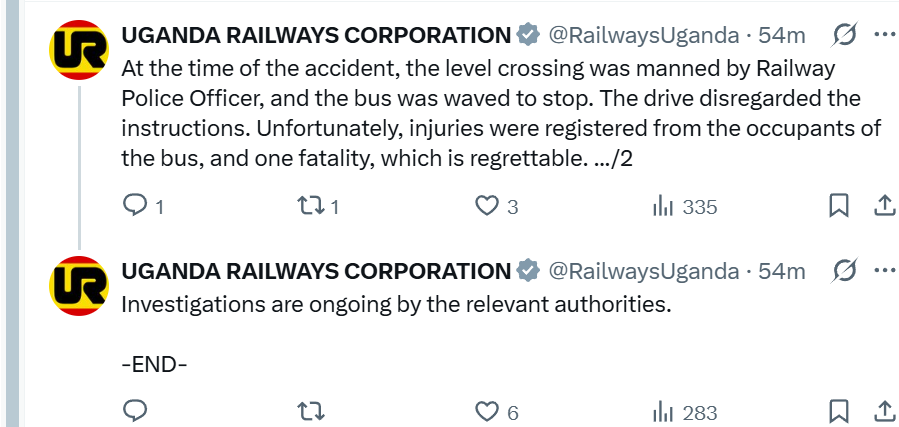
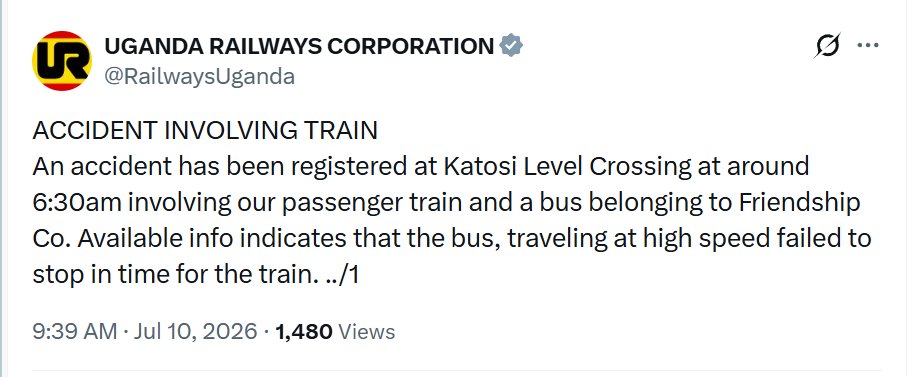
The statement on X statement does not answer the most basic safety questions. Despite the fact that the URC Act (Cap 331) clearly grants trains right of way under Section 41(5) but it still places a duty on URC to ensure safety at level crossings under Section 41(2). That responsibility is not taken serious.
The statement issued today falls short of demonstrating that even the minimum safety measures were in place before the crash. These are not complicated requirements:
1. Boom Barriers:
Were automated boom barriers, high‑intensity LED lights, or audible alarms installed? We discussed these interventions extensively, yet they remain absent at most crossings.
2. Visibility and signage:
Were there clearly visible, reflective signs placed 200m, 100m, and 50m before the crossing? Were stop lines and “RAILWAY CROSSING” markings present? Were retroreflective posts installed to guide motorists in darkness?
3. Train Warning Signals:
Was the whistle, horn, or hooter sounded? These signals are extremely loud and impossible for any attentive motorist to ignore, unless they were non‑functional or not used.
4. Flagging by URC Police:
Flagging down vehicles at 6:30 a.m. is not a credible safety measure. The flags are not reflective, visibility is poor, and one officer cannot manage that entire section of the crossing (as the video shows). Motorists respond to Traffic Police because they understand their authority; most do not even recognise URC Police.
5. It is perplexing how such a road has no traffic.
measures while approaching a clear hazardous area. Did UNRA not envision this?
As a country, we have normalised road crashes as an unavoidable risk instead of treating them as preventable events. We cannot defend that a URC Police officer with a non‑reflective flag is an adequate substitute for engineered protections. We cannot continue ignoring global best practice while citizens die at predictable, preventable points of failure. The potential impact of this crash is scary.
@LadyG824@Sudhirntv Now this is it. Basic road safety standards! We cannot be blaming the driver when the responsible government agency should have done its work.
@bo3yz2gal@harderHB@MoWT_Uganda I think basic road safety standards require that there are barriers at every railway crossing. I think ministry of works needs to do better on this. There might have been a human error on the part of the driver but really this one rests on government.
I Timothy 6:12 NKJV
[12] Fight the good fight of faith, lay hold on eternal life, to which you were also called and have confessed the good confession in the presence of many witnesses.
Matthew 19:26 NKJV
[26] But Jesus looked at them and said to them, “With men this is impossible, but with God all things are possible.”
https://t.co/kJNyP8CMaE
“But he said to me, ‘My grace is sufficient for you, for my power is made perfect in weakness.’ Therefore I will boast all the more gladly about my weaknesses, so that Christ’s power may rest on me.” 2 Corinthians 12:9
Closed doors are not punishment. They are protection. God will withhold things from you not because He does not care, but because He does. What looks like rejection from God is often redirection toward something better than what you asked for.
God's word will light up the very next step in front of you. You don't need to see the whole path, you just need enough light for where you are right now. (Psalm 119:105)
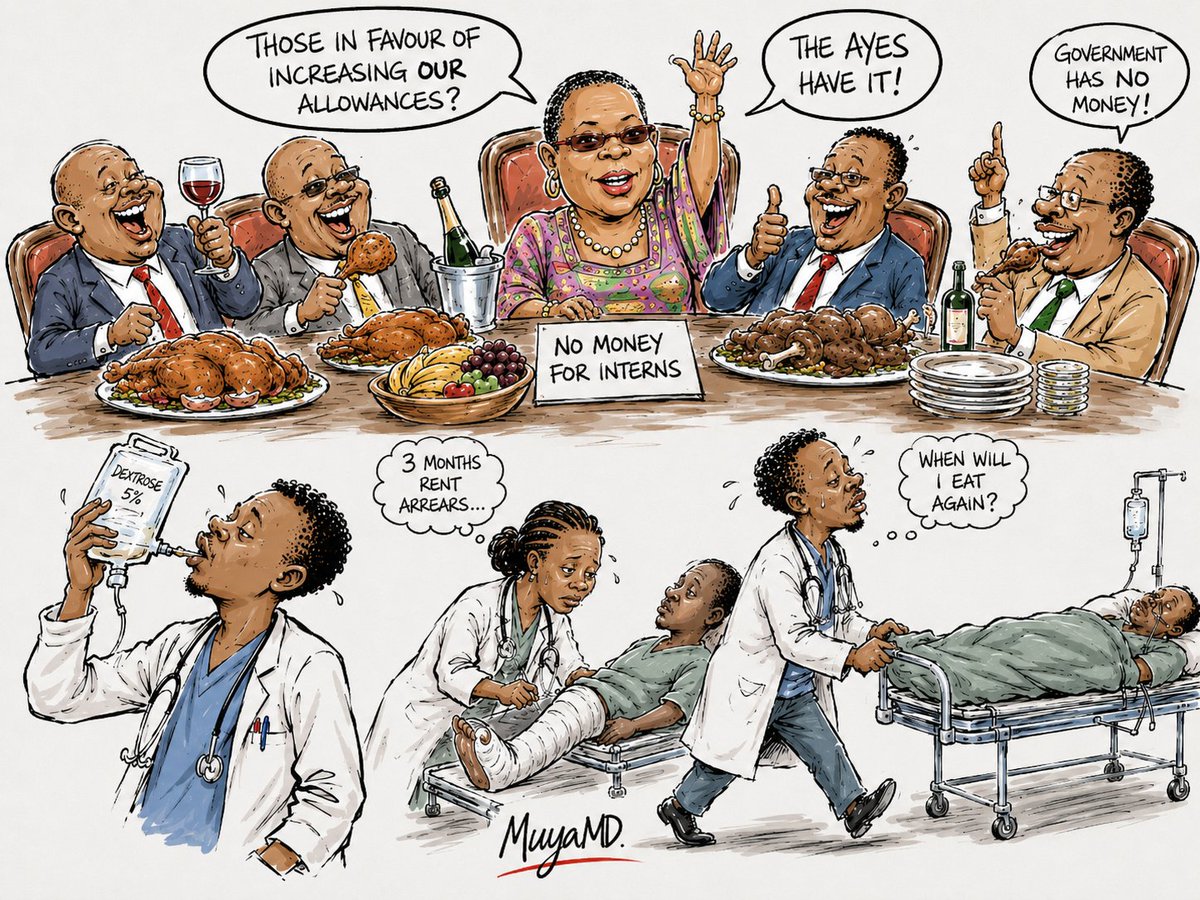
Let us be honest: the issue is not that medical interns are too many.
It is not that Uganda has no money.
It is that medical interns are not being treated as a priority.
Consider the choices being made:
• Parliament keeps growing.
Parliament’s budget reportedly doubled to about 𝗦𝗵𝘀 𝟭. 𝟮 𝘁𝗿𝗶𝗹𝗹𝗶𝗼𝗻. The money going to 529 MPs rose from about 𝗦𝗵𝘀 𝟰𝟬𝟬𝗯 in 2020/21 to 𝗦𝗵𝘀 𝟳𝟰𝟰.𝟰𝗯 in 2026/27, an increase of about 𝗦𝗵𝘀 𝟯𝟰𝟰.𝟰𝗯.
What direct return does this give the common Ugandan in a crowded hospital?
• Two offices alone tell the story.
The Speaker and Deputy Speaker offices had about 𝗦𝗵𝘀 𝟳.𝟭𝗯 combined in 2020/21. In 2026/27, they stand at about 𝗦𝗵𝘀 𝟱𝟬.𝟮𝗯 , an increase of about 𝗦𝗵𝘀 𝟰𝟯.𝟭𝗯 for only two offices.
That increase alone can pay 𝟯𝟬𝟬𝟬 interns 𝗦𝗵𝘀 𝟭𝗺 𝗽𝗲𝗿 𝗺𝗼𝗻𝘁𝗵 𝗳𝗼𝗿 𝗮 𝗳𝘂𝗹𝗹 𝘆𝗲𝗮𝗿, with money left.
• Questionable spending continues.
In 2025/26, selected Speaker’s office lines reportedly included 𝗦𝗵𝘀 𝟮.𝟰𝗯 for foreign travel, 𝗦𝗵𝘀 𝟵𝟲𝟲𝗺 for fuel, 𝗦𝗵𝘀 𝟰.𝟴𝗯 for incapacity, death benefits and funeral expenses, and 𝗦𝗵𝘀 𝟱.𝟮𝗯 for donations. Total: about 𝗦𝗵𝘀 𝟭𝟰.𝟮𝗯. What lasting public health return does this produce compared with doctors on wards?
• RDC structures are being funded.
Uganda reportedly has 146 RDCs, 170 Deputy RDCs and 432 Assistant RDCs, total 748 officials. Their proposed salary enhancement requires an extra 𝗦𝗵𝘀 𝟮𝟵.𝟬𝟳𝟵𝗯 every year.
Add the reported 𝗦𝗵𝘀 𝟯𝟬𝗯 for LC I to LC V political leader facilitation, and that is about 𝗦𝗵𝘀 𝟱𝟵𝗯. In what way does this benefit the common Ugandan?
• Donations are funded.
State House donations reportedly consumed 𝗦𝗵𝘀 𝟳𝟱𝟭𝗯 over seven financial years. In 2023/24 alone, donations were budgeted at 𝗦𝗵𝘀 𝟭𝟴.𝟭���, but actual spending reached 𝗦𝗵𝘀 𝟴𝟬.𝟭𝟴𝗯. If tens and hundreds of billions can be found for donations, how does 𝗦𝗵𝘀 𝟮𝟰𝗯 to 𝗦𝗵𝘀 𝟯𝟲𝗯 for over 2,000 medical interns become impossible?
• Health was not protected with the same urgency.
The Ministry of Health vote fell from about 𝗦𝗵𝘀 𝟭. 𝟲𝟵𝟯 𝘁𝗿𝗶𝗹𝗹𝗶𝗼𝗻 in FY2023/24 to about 𝗦𝗵𝘀 𝟭. 𝟯𝟰𝟰 𝘁𝗿𝗶𝗹𝗹𝗶𝗼𝗻 in FY2024/25, a reduction of about 𝗦𝗵𝘀 𝟯𝟰𝟵𝗯. Even the 2025/26 estimate of 𝗦𝗵𝘀 𝟭.𝟱𝟲𝟰 𝘁𝗿𝗶𝗹𝗹𝗶𝗼𝗻 remains below the 2023/24 level. Yet health is the sector that directly touches mothers in labour, accident victims, children with malaria, emergency patients and families in public hospitals.
Now compare:
• 2,000 interns × Shs1m × 12 months = 𝗦𝗵𝘀 𝟮𝟰𝗯 per year
• 2,500 interns × Shs1m × 12 months = 𝗦𝗵𝘀 𝟯𝟬𝗯 per year
• 3,000 interns × Shs1m × 12 months = 𝗦𝗵𝘀 𝟯𝟲𝗯 per year
Even using the Ministry of Health’s own gross figure of Shs15.6m per intern per year, the reported 2,706 eligible interns would require about Shs42.2b. That is still small compared with what is being found for political comfort and administrative expansion.
That money is not a handout.
✨ It avails doctors on wards.
✨ It keeps emergency units covered.
✨ It supports maternity care.
✨ It fills staffing gaps in regional referrals.
✨ It protects patients.
So let us stop pretending.
This is not a numbers problem.
This is not a money problem.
It is a priority problem.
Medical interns are doctors under apprenticeship, not free labour!
#InternsNotSlaves
@OGWALTK@NewtonAllan6 We cannot have hungry, angry and disengaged doctors; but these are some of the outcomes of unpaid labour. It is going to be disastrous!
Pentecost was not just a moment of emotion or excitement. It was the moment the Church was empowered by the Holy Spirit to boldly carry the gospel to the world.
Jesus told His followers to wait before stepping into their assignment because He never intended kingdom work to be done in human strength alone.
When the Holy Spirit came, everything changed. Ordinary believers were filled with supernatural power, boldness, and conviction. Fear gave way to courage. Hiddenness gave way to witness.
And the promise did not end in the Upper Room. Peter declared, “The promise is to you and to your children, and to all who are afar off.”
The Holy Spirit still empowers believers today.
This Pentecost Sunday, don’t try to live the Christian life in your own strength. Ask the Holy Spirit to fill you afresh and empower you to boldly live for Jesus.