Telecom sites did not just evolve from 2G to 5G. They became more distributed, software-driven and transport-dependent.
In 2G, the BTS, or Base Transceiver Station, worked mostly as an all-in-one site. Radio and baseband functions were centralized in one setup. With 3G, the NodeB introduced the beginning of separation. The BBU, or Baseband Unit, handled processing and control, while the RRU, or Remote Radio Unit, moved radio functions closer to the antenna. In 4G, the eNodeB, or evolved NodeB, made this split more standardized. The BBU handled baseband processing and control, while the RRU managed radio transmission near the antenna. This helped reduce feeder loss and supported LTE features such as OFDMA, MIMO and carrier aggregation. 5G pushed the architecture further. The gNodeB, or next-generation NodeB, can split functions across RU, DU and CU. RU means Radio Unit. It handles radio transmission and reception near the antenna. DU means Distributed Unit. It manages real-time lower-layer processing.
CU means Centralized Unit. It handles higher-layer control and user-plane functions. This split enables flexible RAN design. RAN means Radio Access Network. vRAN means Virtualized Radio Access Network, where RAN functions run on virtualized infrastructure. O-RAN means Open Radio Access Network, which promotes open interfaces, interoperability and vendor flexibility. Transport also becomes critical. Fronthaul connects RU to DU. Midhaul connects DU to CU. Backhaul connects the RAN side to the core network. Timing through GPS, SyncE or IEEE 1588 PTP is also essential.
Note: Telecom site architecture can vary by vendor, deployment model, spectrum, transport network and operator design.
Discussion question: In 5G deployment, what is harder to manage: RU/DU/CU split, synchronization, fronthaul capacity, power planning or site densification?
#Telecom #5G #4G #RAN #vRAN #ORAN #gNodeB #eNodeB #BTS #BBU #RRU #RU #DU #CU #Fronthaul #Backhaul #CyberneticsIT
📶 From 2 Mbps to 46 Gbps!
The evolution of Wi-Fi has been remarkable:
🔹 Wi-Fi 1 (802.11b) → 11 Mbps
🔹 Wi-Fi 4 (802.11n) → 600 Mbps
🔹 Wi-Fi 5 (802.11ac) → 6.9 Gbps
🔹 Wi-Fi 6/6E (802.11ax) → 9.6 Gbps
🔹 Wi-Fi 7 (802.11be) → Up to 46 Gbps
Key innovations:
✅ OFDMA
✅ MU-MIMO
✅ 6 GHz Spectrum
✅ Multi-Link Operation (MLO)The future of connectivity is faster, smarter, and built for AI, IoT, AR/VR, and ultra-high-density networks.
Which Wi-Fi generation are you currently using?
Dad: "Son ,I wish you to marry a Girl I choose for you."
Son: "Dad, I already told you....I have a plan to choose my Own wife."
Dad: "But that girl is Bill Gates daughter."
Son: "Oh. Well, that changes things. Okay "
Dad went to meet Bill Gates.
Dad: " Sir, I'd like your daughter to marry my son."
Bill Gates: its quite impossible what you think of..
Dad: "Because my son is the CEO of the renowned World Bank."
Bill Gates: " CEO of the world Bank? That's great and impressive too.
Alright then."
Dad goes to the president of the World Bank.
Dad: " Appoint my son as the CEO of your Bank.
President:-That's impossible .Why should I ?"
Dad: "Because he is the Bill Gates future son in Law."
President : "When can he start ?"
Most people jump into AI tools without a roadmap.
That’s why they stay stuck watching tutorials instead of building real projects.
Here’s a practical AI learning roadmap from beginner to advanced:
1️⃣ Build strong foundations
• Math & logic
• Python programming
• Computer science basics
2️⃣ Learn core AI concepts
• Machine Learning
• Neural Networks
• PyTorch / TensorFlow
3️⃣ Go deeper into Deep Learning
• CNNs, RNNs, Transformers
• Model training & optimization
• Real-world AI projects
4️⃣ Pick a specialization
• NLP
• Computer Vision
• Reinforcement Learning
• Generative AI
5️⃣ Develop research-level skills
• Read AI papers
• Build open-source projects
• Learn system scaling
6️⃣ Master real-world AI deployment
• APIs & productization
• AI ethics & safety
• Leadership & innovation
AI mastery is not about learning everything at once.
It’s about consistent progress, real projects, and staying curious.
The best time to start was yesterday.
The second best time is today.
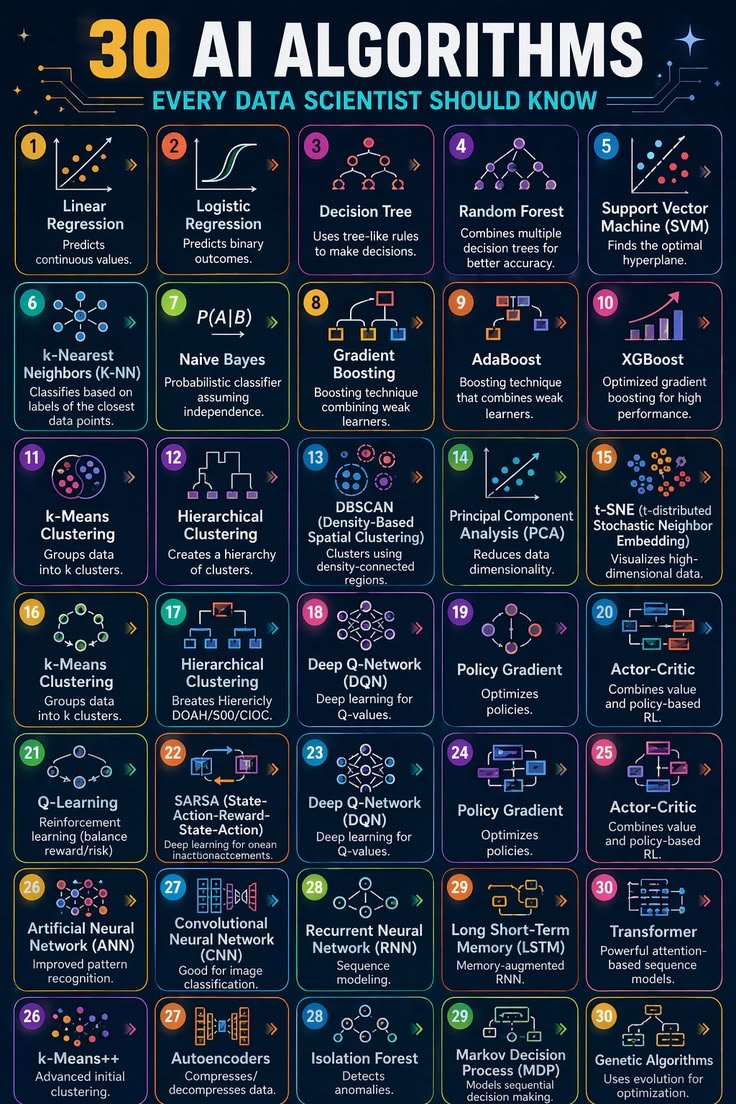
Mastering the "Top 30" is basically the data science equivalent of learning your scales.
Whether you're building a simple predictor or the next LLM, these are the fundamental building blocks of AI.
The 30 algorithms every Data Scientist should have in their toolkit:
1️⃣ The Classics (Supervised Learning)
These are your bread and butter. From Linear Regression for predicting prices to XGBoost for winning Kaggle competitions, these handle labeled data like pros.
Decision Trees & Random Forests
SVMs & k-NN
The "Boosting" Family (AdaBoost, Gradient Boosting)
2️⃣ Finding Patterns (Unsupervised Learning)
When you don't have labels, you hunt for structure.
Clustering: k-Means, Hierarchical, and DBSCAN.
Dimensionality Reduction: PCA and t-SNE (essential for making sense of high-dimensional "data soup").
3️⃣ The Modern Era (Deep Learning)
The heavy hitters behind computer vision and NLP.
CNNs: For everything image-related.
RNNs & LSTMs: For sequence and time-series.
Transformers: The "T" in ChatGPT. The GOAT of modern AI. 🐐
4️⃣ Strategy & Optimization (Reinforcement Learning)
Teaching agents to make decisions in complex environments.
Q-Learning & Deep Q-Networks (DQN)
Actor-Critic models
Genetic Algorithms (Evolutionary optimization)
Pro-tip: Don't just memorize the names. Understand the trade-offs. When do you use a simple Logistic Regression over a complex Neural Network?
(Hint: Usually when you need interpretability over raw power).
Which one is your "go-to" for a new project?
AI is no longer just a trend in marketing. It’s becoming the engine behind smarter campaigns, deeper customer insights, and higher ROI.
From audience analysis to automation and personalized experiences, AI helps brands make faster decisions and deliver better results at scale.
🔹 Smarter Insights
🔹 Automated Workflows
🔹 Better Campaign Performance
🔹 Personalized Customer Experiences
🔹 Reduced Costs & Increased ROI
The winning formula?
AI + Human Creativity
Technology handles the data. Humans bring the strategy, emotion, and vision.
To get more updates follow us. Like, Comment and repost this.
Small businesses no longer need massive teams or complex software stacks to scale. With AI Agents + n8n, you can automate:
• Lead generation
• Email follow-ups
• Customer support
• Repetitive workflows
• Reporting & task management
No-code automation is becoming the new competitive advantage in 2026.
Imagine an AI agent that can:
✅ Capture leads from forms
✅ Qualify prospects automatically
✅ Reply to customer queries
✅ Draft emails & reports
✅ Connect Gmail, Sheets, Slack, HubSpot & more
✅ Keep humans in the loop when needed
The future of business isn’t about working harder.
It’s about building smarter systems that work 24/7.
AI + Automation = More growth with less manual work.
Ready to level up your income in 2026?
AI isn't just a buzzword—it's a tool to build extra income on your terms. Whether you're interested in building Micro SaaS tools, offering Prompt Engineering as a service, or launching an AI Video Creation Agency, the opportunities are bigger than ever.
Check out these high-potential AI side hustles:
AI Digital Products: Create once, sell forever with profit margins that can reach $20,000+ per month.
AI Automation for Businesses: Help companies save time with chatbots and CRM workflows.
AI Content + Distribution: Monetize niche YouTube Shorts, newsletters, and more.
The Reality Check: Don't try to master 10 at once. Pick one niche, solve one real problem, and use AI as your leverage.
AI won't replace side hustlers, but side hustlers who use AI will replace those who don't.
See the full roadmap in the AI Side Hustles below!
Ready to build the ultimate tech stack?
AI isn’t just a chatbot anymore—it’s an entire ecosystem. From deep research and automated coding to high-fidelity video and voice agents, your "team" is now more capable than ever.
Here is the breakdown of the heavy hitters in 2026:
📊 Presentations: Gamma
🔍 Research: Perplexity
🎨 Images: Nano Banana
🤖 Search/Chat: ChatGPT
⚙️ Automation: n8n
🎬 Videos: Kling
💻 Coding: Claude Code
🌐 Websites: Lovable
🎙️ Voice: Retell AI
Stop working harder. Start orchestrating better. Which of these is the MVP of your workflow?
Revolutionize your facility with the Digital Transformation Framework—a high-end blueprint for modern industrial manufacturing. This structured approach drives operational excellence by integrating every function of your facility into a single, cohesive strategy.
The Core Equation
True business value is unlocked through the synergy of four key pillars:
People: Empathetic leadership and workforce training.
Process: Lean manufacturing and optimized workflows.
Technology: Digital twins, AI insights, and predictive analytics.
Strategy: Targeted planning for capacity and sustainability.
Holistic Impact
From Production and Maintenance to Safety and Supply Chain, this framework ensures that every aspect of the facility contributes to compounding value. Whether it's implementing SOPs or achieving through-put optimization, the goal is clear: Sustainable Operational Excellence.
The 2026 Google AI landscape is looking absolutely massive.
From deep research and creative coding to real-time voice collaboration with Gemini Live, the ecosystem has evolved into a full-stack productivity powerhouse.
Here are the highlights from "The Ultimate 2026 Google AI Stack":
🔹 Creativity & Media: Veo 3.1 for high-fidelity video, Imagen for next-gen visuals, and Google Vids for turning scripts into instant explainers.
🔹 Productivity: Gemini deeply integrated across Workspace (Docs, Sheets, Gmail, Meet) to automate the heavy lifting.
🔹 Search & Discovery: Circle to Search, AI-powered Shopping, and Deep Research for structured, long-form insights.
🔹 Developer Tools: Firebase Studio and App Builder making browser-based AI development more seamless than ever.
Google isn't just a search engine anymore; it’s a personal intelligence layer for basically everything you do online.
To get more updates about AI topic follow us. Like, Comment and Repost this post.
6. Drafting the Results Section
Finally, draft your report in a professional academic tone.
Prompt: Draft a well-structured quantitative 'Results' section using these outputs. Maintain a formal academic tone suitable for a journal article. Report the findings objectively and strictly based on the presented data.
Research is a journey of dedication. Use AI to make your work faster and more accurate, but the final decision should always be your own.
Save + Share
Feeling overwhelmed with thesis or research data? Thinking of NotebookLM as just a "notebook" would be a mistake. It is now your research partner! From data analysis to hypothesis generation, today I’m sharing 6 magical prompts.
For those of us conducting research or writing a thesis, the biggest pain points are organizing data and accurately interpreting statistics. Many believe NotebookLM is only for summarization. However, if you know the right prompts, it can accelerate your research speed tenfold.
Remember, AI won't think for you, but it will help make your thoughts precise. Here are 6 powerful prompts for your research:
5. Table and Visualization Ideas
Find out exactly what kind of tables or graphs your paper needs beforehand.
Prompt: Generate publication-style summary tables for the major findings. Also, recommend the most suitable charts or visualizations (e.g., bar charts, scatter plots) for presenting these variable relationships.