Crows don't just hold grudges; they teach their kids which human faces to attack. 🦅
Researchers wearing caveman masks found that unmasked people got attacked years later.
The original crows passed the memory down, training the next generation to spot dangerous humans.
𝐍𝐈𝐆𝐄𝐑𝐈𝐀 𝐇𝐀𝐒 𝐀 𝐃𝐑𝐔𝐌 𝐓𝐇𝐀𝐓 𝐂𝐀𝐍 𝐓𝐀𝐋��! 🇳🇬
Imagine hearing a drum and understanding actual words.
The Yoruba dùndún, known as the talking drum, can imitate the tones and rhythms of spoken Yoruba.
By squeezing its cords, a skilled drummer changes its pitch to send messages.
It's not just an instrument. It's a language played through music.
𝐈𝐧 𝟐𝟎𝟎𝟎, 𝐉𝐚𝐩𝐚𝐧 𝐡𝐚𝐝 𝐚 𝐬𝐥𝐢𝐠𝐡𝐭𝐥𝐲 𝐛𝐢𝐠𝐠𝐞𝐫 𝐩𝐨𝐩𝐮𝐥𝐚𝐭𝐢𝐨𝐧 𝐭𝐡𝐚𝐧 𝐍𝐢𝐠𝐞𝐫𝐢𝐚.
But look at the difference today.
Nigeria has grown from 122 million to about 242 million people, while Japan has dropped from 126 million to 122.4 million.
𝗪𝗵𝗮𝘁 𝗮 𝗵𝘂𝗴𝗲 𝘀𝗵𝗶𝗳𝘁 𝗶𝗻 𝗷𝘂𝘀𝘁 𝟮𝟲 𝘆𝗲𝗮𝗿𝘀!
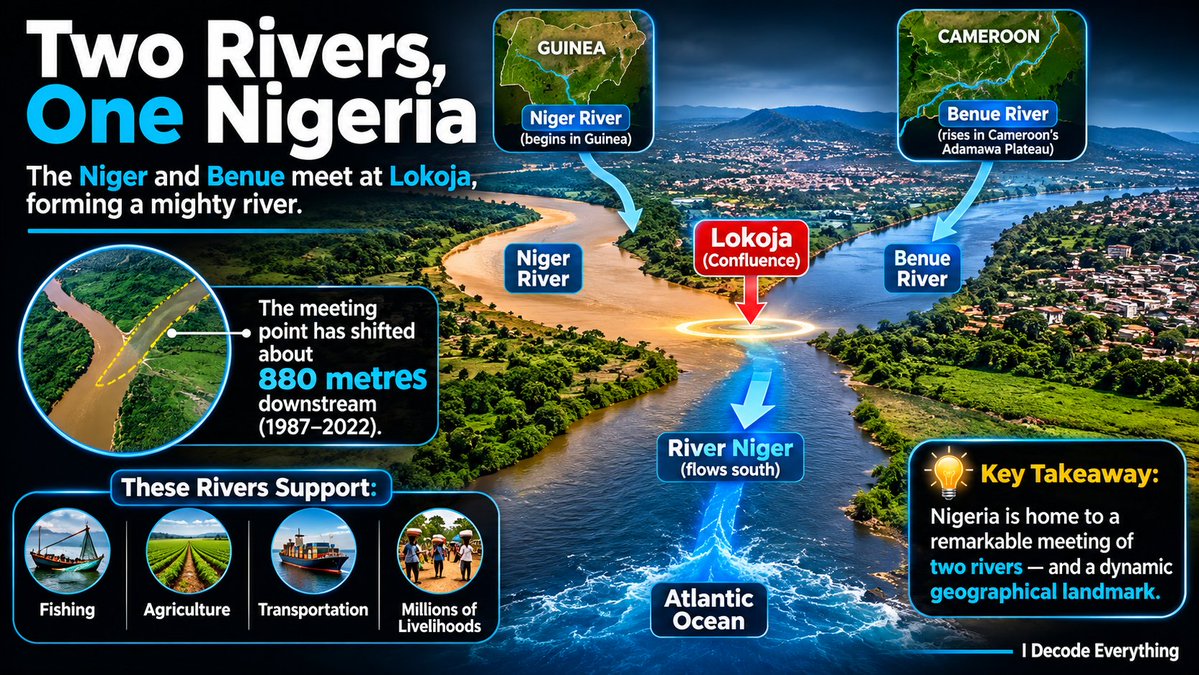
𝐓𝐖𝐎 𝐆𝐑𝐄𝐀𝐓 𝐑𝐈𝐕𝐄𝐑𝐒 𝐌��𝐄𝐓 𝐈𝐍 𝐍𝐈𝐆𝐄𝐑𝐈𝐀. 𝐇𝐄𝐑𝐄'𝐒 𝐖𝐇𝐀𝐓 𝐇𝐀𝐏𝐏𝐄𝐍𝐒 𝐍𝐄𝐗𝐓. 🇳🇬
Imagine two rivers beginning their journeys in different countries, travelling hundreds of kilometres, and finally meeting in one Nigerian city.
That city is Lokoja, the capital of Kogi State.
One river is the Niger, which begins in Guinea.
The other is the Benue, which rises in Cameroon's Adamawa Plateau.
They meet at a remarkable geographical landmark known as the Confluence of the Niger and Benue.
But here's where it gets interesting.
After joining, their waters continue southwards as the River Niger, eventually flowing through the Niger Delta and into the Atlantic Ocean.
These rivers do much more than shape Nigeria's landscape.
They support fishing, agriculture, transportation and millions of livelihoods.
And there's another fascinating detail: scientific research found that the confluence shifted approximately 880 metres downstream between 1987 and 2022.
𝙏𝙖𝙠𝙚𝙖𝙬𝙖𝙮: 𝙉𝙞𝙜𝙚𝙧𝙞𝙖 𝙞𝙨𝙣'𝙩 𝙟𝙪𝙨𝙩 𝙝𝙤𝙢𝙚 𝙩𝙤 𝙩𝙝𝙞𝙨 𝙧𝙚𝙢𝙖𝙧𝙠𝙖𝙗𝙡𝙚 𝙢𝙚𝙚𝙩𝙞𝙣𝙜 𝙤𝙛 𝙩𝙬𝙤 𝙧𝙞𝙫𝙚𝙧𝙨. 𝙄𝙩'𝙨 𝙖𝙡𝙨𝙤 𝙝𝙤𝙢𝙚 𝙩𝙤 𝙖 𝙜𝙚𝙤𝙜𝙧𝙖𝙥𝙝𝙞𝙘𝙖𝙡 𝙡𝙖𝙣𝙙𝙢𝙖𝙧𝙠 𝙩𝙝𝙖𝙩 𝙘𝙤𝙣𝙩𝙞𝙣𝙪𝙚𝙨 𝙩𝙤 𝙘𝙝𝙖𝙣𝙜𝙚 𝙤𝙫𝙚𝙧 𝙩𝙞𝙢𝙚.
𝐍𝐈𝐆𝐄𝐑𝐈𝐀 𝐈𝐒 𝐌𝐎𝐑𝐄 𝐓𝐇𝐀𝐍 𝐎𝐍𝐄 𝐂𝐔𝐋𝐓𝐔𝐑𝐄 🇳🇬
Imagine living in a country where hundreds of different cultural identities exist within one national border.
That's Nigeria.
Nigeria is home to more than 250 ethnic groups, making it one of Africa's most culturally diverse countries.
And each community has its own history, traditions, languages and identity.
The three largest ethnic groups are the Hausa, Yoruba and Igbo.
But they represent only part of Nigeria's cultural story.
There are also the Tiv, Kanuri, Ijaw, Edo, Ibibio, Efik, Nupe and hundreds of other communities.
Each contributes something unique to the country's identity.
And here's something worth remembering:
Nigeria's diversity goes beyond traditional clothing, food and festivals.
It influences languages, music, architecture, marriage traditions, storytelling and everyday life.
Even within the same ethnic group, different communities can have distinct customs and dialects.
The bigger picture?
Nigeria is not culturally defined by just three major ethnic groups.
Its richness comes from the hundreds of communities that make up the country.
We share one national identity, but our cultural stories are beautifully diverse.
𝑯𝒐𝒘 𝒎𝒂𝒏𝒚 𝑵𝒊𝒈𝒆𝒓𝒊𝒂𝒏 𝒆𝒕𝒉𝒏𝒊𝒄 𝒈𝒓𝒐𝒖𝒑𝒔 𝒄𝒂𝒏 𝒚𝒐𝒖 𝒏𝒂𝒎𝒆 𝒃𝒆𝒚𝒐𝒏𝒅 𝑯𝒂𝒖𝒔𝒂, 𝒀𝒐𝒓𝒖𝒃𝒂 𝒂𝒏𝒅 𝑰𝒈𝒃𝒐?
𝐖𝐇𝐘 𝐃𝐎𝐄𝐒 𝐌𝐄𝐓𝐀𝐋 𝐅𝐄𝐄�� 𝐂𝐎𝐋𝐃𝐄𝐑 𝐓𝐇𝐀𝐍 𝐖𝐎𝐎𝐃?
Here's something strange: A metal spoon and a wooden spoon can sit in the same room for hours, reach exactly the same temperature, yet feel completely different when you touch them.
The metal feels colder. But it's not necessarily colder than the wood.
The secret is heat transfer. Your hand is warmer than both objects.
When you touch them, heat naturally flows from your skin into the materials.
But metal is an excellent conductor of heat.
It pulls heat away from your hand much faster than wood does.
Wood, on the other hand, is a poor heat conductor.
It slows down the movement of heat, making your hand lose warmth more gradually.
Your brain interprets this difference in heat loss as a difference in temperature.
And here's the fascinating part: The same thing happens in reverse.
If both objects are hot, the metal can feel much hotter than the wood because it transfers heat into your skin faster.
𝐒𝐨 𝐭��𝐞 𝐧𝐞𝐱𝐭 𝐭𝐢𝐦𝐞 𝐦𝐞𝐭𝐚𝐥 𝐟𝐞𝐞𝐥𝐬 𝐜𝐨𝐥𝐝𝐞𝐫 𝐭𝐡𝐚𝐧 𝐰𝐨𝐨𝐝, 𝐫𝐞𝐦𝐞𝐦𝐛𝐞𝐫: 𝐲𝐨��'𝐫𝐞 𝐧𝐨𝐭 𝐣𝐮𝐬𝐭 𝐟𝐞𝐞𝐥𝐢𝐧𝐠 𝐭𝐞𝐦𝐩𝐞𝐫𝐚𝐭𝐮𝐫𝐞. 𝐘𝐨𝐮'𝐫𝐞 𝐟𝐞𝐞𝐥𝐢𝐧𝐠 𝐡𝐨𝐰 𝐪𝐮𝐢𝐜𝐤𝐥𝐲 𝐡𝐞𝐚𝐭 𝐦𝐨𝐯𝐞𝐬.
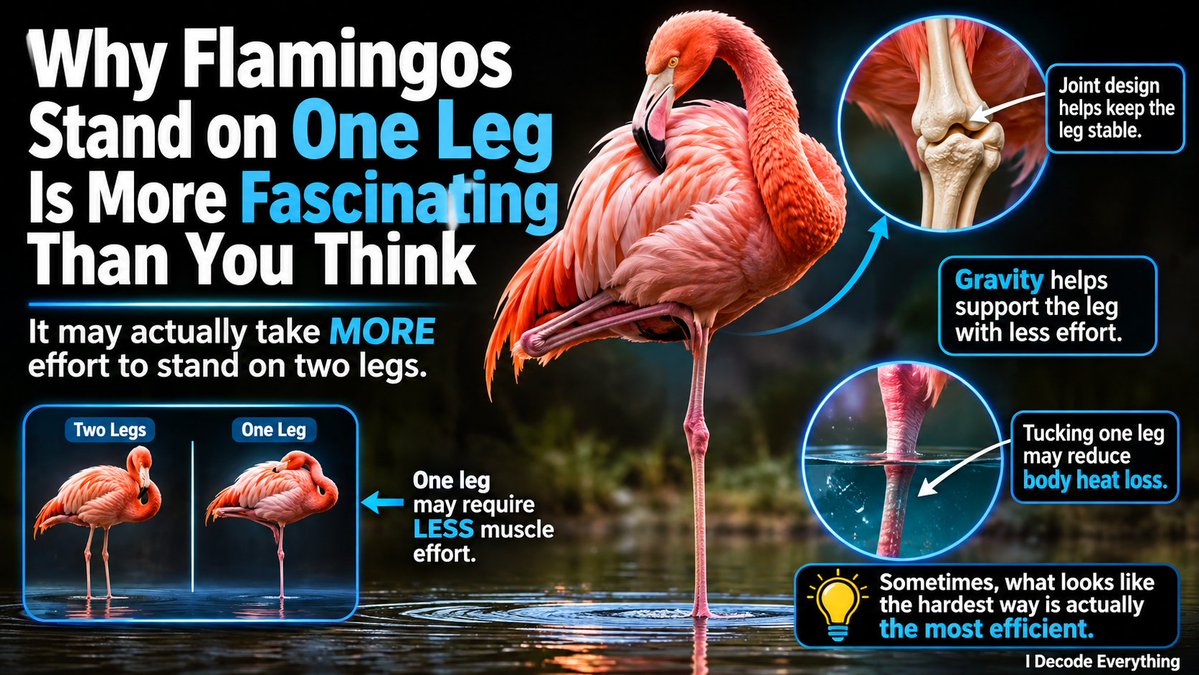
𝐖𝐡𝐲 𝐅𝐥𝐚𝐦𝐢𝐧𝐠𝐨𝐬 𝐒𝐭𝐚𝐧𝐝 𝐨𝐧 𝐎𝐧𝐞 𝐋𝐞𝐠 𝐈𝐬 𝐌𝐨𝐫𝐞 𝐅𝐚𝐬𝐜𝐢𝐧𝐚𝐭𝐢𝐧𝐠 𝐓𝐡𝐚𝐧 𝐘𝐨𝐮 𝐓𝐡𝐢𝐧𝐤
A flamingo can stand on one leg for hours.
Here's the surprising part: It may actually take MORE effort for the bird to stand on two legs.
That sounds impossible, right?
But scientists discovered something remarkable about flamingo anatomy.
In a 2017 study, researchers found that a dead flamingo could maintain a stable one-legged position without active muscle effort.
The secret lies in how its joints and body are positioned.
Gravity helps keep the leg stable, allowing the bird to support its weight without constantly working its muscles.
But that's not the only possible benefit.
Flamingos often stand in water, where their long, exposed legs can lose body heat.
Tucking one leg beneath their body may help reduce that heat loss.
So, their unusual posture may serve two purposes: Saving muscular effort and conserving body heat.
𝐓𝐇𝐄 𝐓𝐀𝐊𝐄𝐀𝐖𝐀𝐘:
Sometimes, what looks like the hardest way to do something is actually the most efficient.
Nature doesn't always solve problems the way we expect.
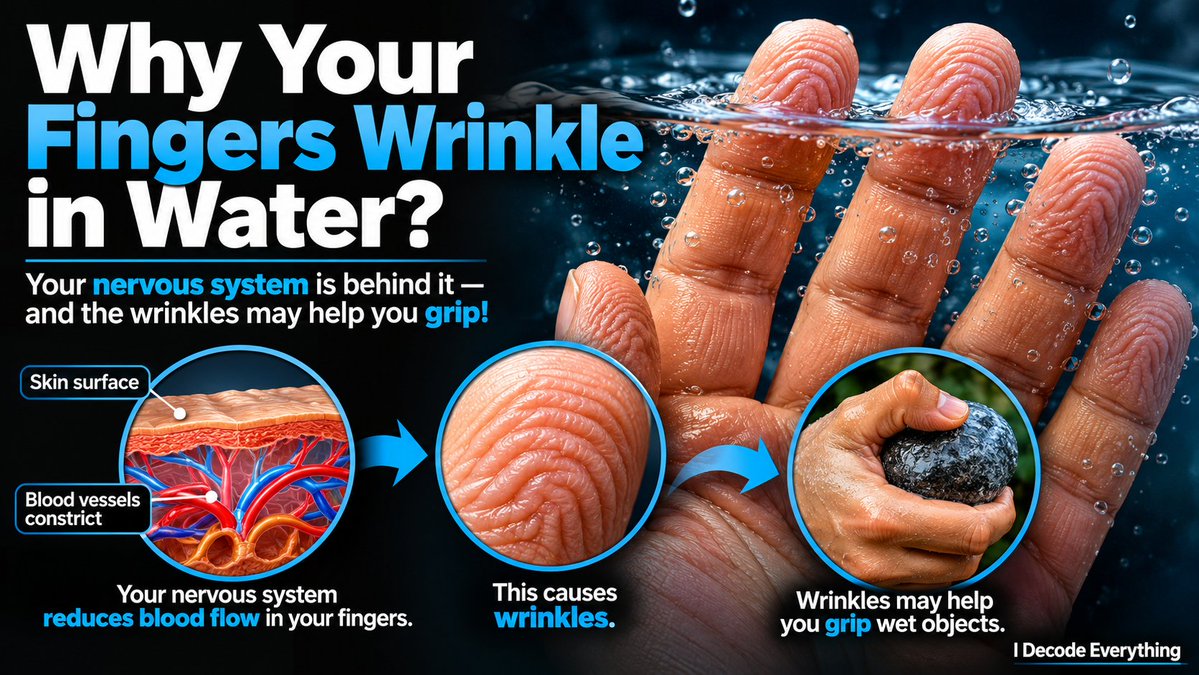
𝐘𝐨𝐮𝐫 𝐖𝐫𝐢𝐧𝐤𝐥𝐞𝐝 𝐅𝐢𝐧𝐠𝐞𝐫𝐬 𝐀𝐫𝐞 𝐃𝐨𝐢𝐧𝐠 𝐌𝐨𝐫𝐞 ��𝐡𝐚𝐧 𝐘𝐨𝐮 𝐓𝐡𝐢𝐧𝐤
Your fingers don't wrinkle in water because they're simply soaking it up.
Your nervous system is actually involved.
And the reason might surprise you.
When your fingers stay underwater for several minutes, tiny blood vessels beneath the skin constrict.
This reduces the volume of tissue beneath the surface, causing the skin to fold into deep wrinkles.
But here's where things get interesting.
Scientists believe these wrinkles may help you grip wet objects more effectively, almost like the treads on a tyre help it maintain contact with the road.
Research has found that people with wrinkled fingers can handle certain wet objects more efficiently.
However, the evidence isn't conclusive.
Some studies have failed to find the same advantage.
So, the next time your fingers wrinkle in the bath, remember:
Your body isn't just reacting to water.
Your nervous system is actively changing your fingertips, and those wrinkles may help you handle slippery objects.
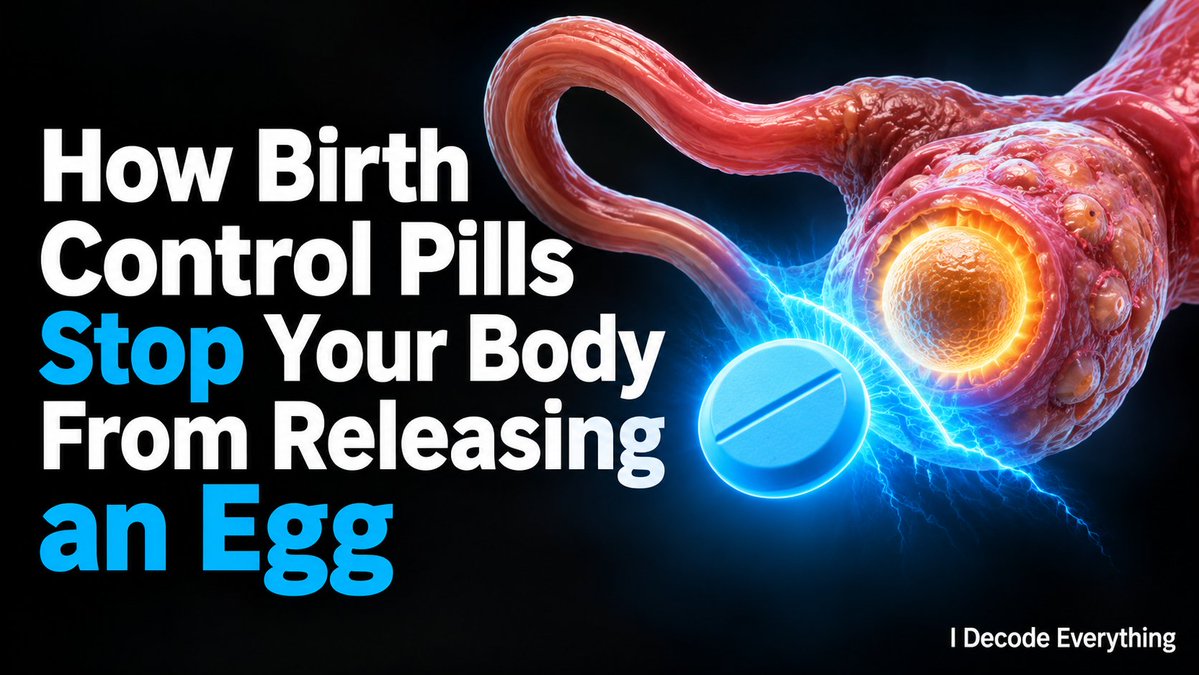
𝐇𝐨𝐰 𝐎𝐧𝐞 𝐓𝐢𝐧𝐲 𝐏𝐢𝐥𝐥 𝐒𝐭𝐨𝐩𝐬 𝐘𝐨𝐮𝐫 𝐁𝐨𝐝𝐲 𝐅𝐫𝐨𝐦 𝐑𝐞𝐥𝐞𝐚𝐬𝐢𝐧𝐠 𝐚𝐧 𝐄𝐠𝐠
Without the usual LH surge, the egg is generally not released.
But that's not all.
The pill also thickens cervical mucus, making it harder for sperm to pass through the cervix.
It can also make the uterine lining thinner.
Not all birth control pills work in exactly the same way.
The mini-pill contains progestin only. It thickens cervical mucus and, depending on its formulation, can also prevent ovulation.
Here's what makes it fascinating:
Birth control pills don't need to destroy sperm or remove an egg.
They mainly prevent the reproductive process from reaching the stage where an egg is released.
𝗢𝗻𝗲 𝗶𝗺𝗽𝗼𝗿𝘁𝗮𝗻𝘁 𝘁𝗵𝗶𝗻𝗴: Birth control pills prevent pregnancy, but they do not protect against sexually transmitted infections.
How can a woodpecker hammer its beak against a tree again and again without suffering a concussion?
The surprising answer is not a special shock-absorbing skull.
A 2022 study challenged that popular explanation.
Researchers filmed six woodpeckers from three species as they pecked wood, then analysed 109 high-speed videos.
Their heads moved more like stiff hammers than cushioned impact systems.
Why? A skull that absorbs too much energy would make each strike less effective.
The bird needs that energy to drive its beak into the wood.
So its skull stays relatively rigid during impact.
That still leaves the biggest question: what about the brain?
The researchers used measurements and biomechanical models.
They found the estimated brain pressure in the studied birds stayed below concussion thresholds established for primates.
The birds' small brains and the shape of their braincases help explain how they tolerate these impacts.
But be precise: the study examined three species.
It does not prove every woodpecker is immune to brain injury.
The real surprise? The woodpecker's skull is not acting like a helmet's padding.
Its head works more like a carefully adapted hammer, while its small brain and anatomy help it withstand the blows.
In 1752, people in Britain went to bed on September 2 and woke up to September 14.
Eleven dates had vanished from the calendar.
But nobody had stolen eleven days. The explanation goes back more than 1,700 years.
For centuries, much of Europe used the Julian calendar, introduced under Julius Caesar.
It treated a year as 365.25 days.
That is close to the solar year, but not exact. The difference was small: about 11 minutes every year.
Those minutes added up.
By the 1500s, the calendar had drifted about 10 days against the seasonal year.
This mattered to the Church because the date of Easter was tied to the spring equinox.
A correction was needed.
In 1582, Pope Gregory XIII introduced a revised calendar.
In the first places that adopted it, Thursday, October 4 was followed by Friday, October 15.
Ten dates were skipped to bring the calendar back into alignment.
The change did not happen everywhere at once.
Many Protestant countries resisted or delayed adopting a reform introduced by a Catholic pope.
Britain finally changed in 1752.
By then, it had to skip 11 dates: September 2 was followed by September 14.
The reform also changed the leap-year rule: century years are not leap years unless divisible by 400.
That is why 2000 had a February 29, but 1900 did not.
The dates disappeared from the calendar, not from people's lives. Time kept moving.
That tiny hole in an airplane window is there on purpose.
It lets cabin air pass through the inner pane, helping equalise pressure between the window layers so the outer pane bears most of the pressure difference.
A tiny hole doing a big safety job.
Did the ancient Library of Alexandria disappear in a single great fire?
The evidence doesn't allow us to say so.
Historical accounts connect Julius Caesar's war in 48 BCE with the burning of books, but this doesn't prove the entire library was destroyed.
Its final fate remains one of history's mysteries.
He spent his whole life making money, only to realise he had lost what money couldn't buy.
A wealthy old man sat alone on his birthday.
An untouched cake stood before him.
Across the table was an empty chair. 👇
Beside him was an old photograph of his daughter as a little girl.
He remembered all the birthdays he had missed, all the promises he had broken, and all the times he had said, "Next time."
Now, he had all the money he ever wanted.
But he couldn't buy back a single moment.