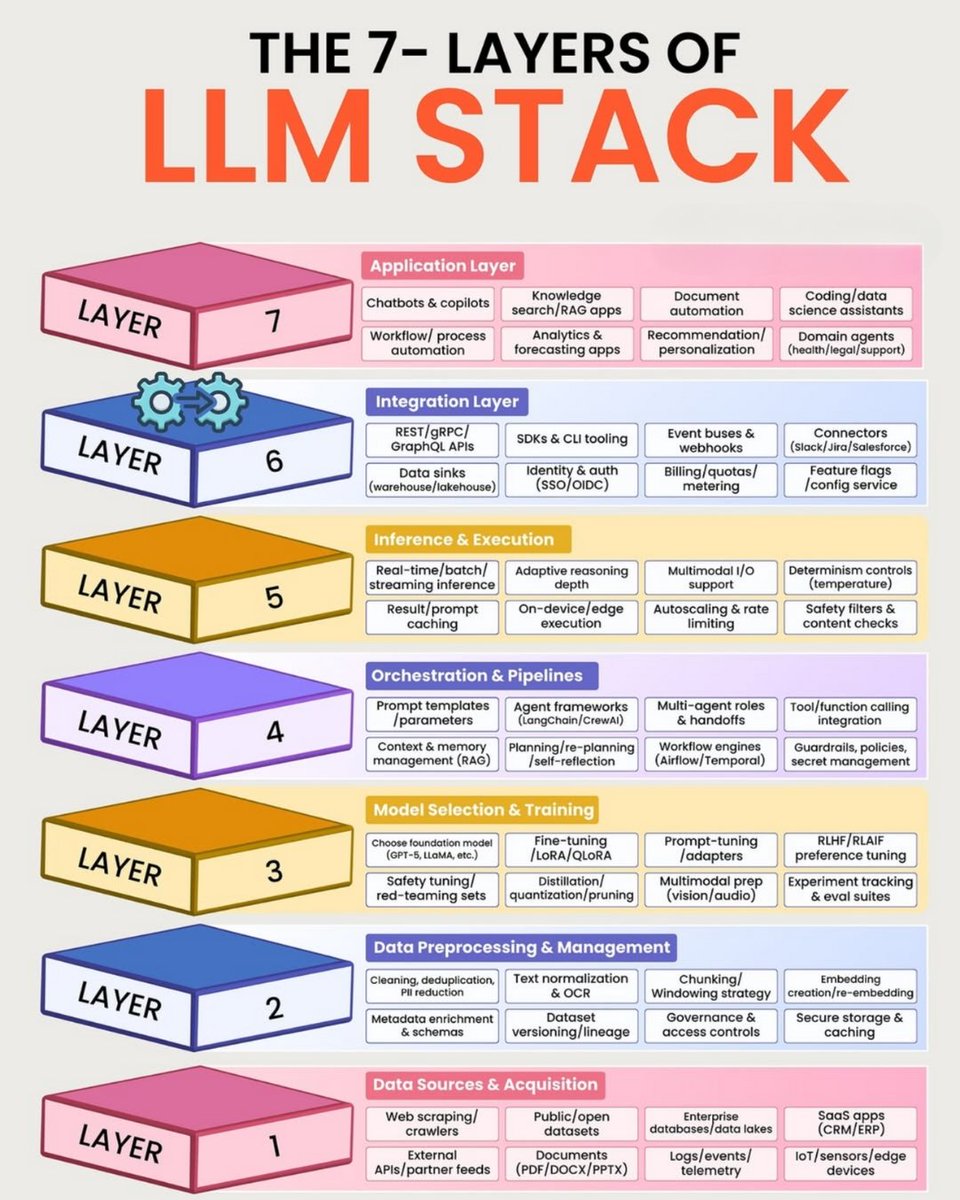
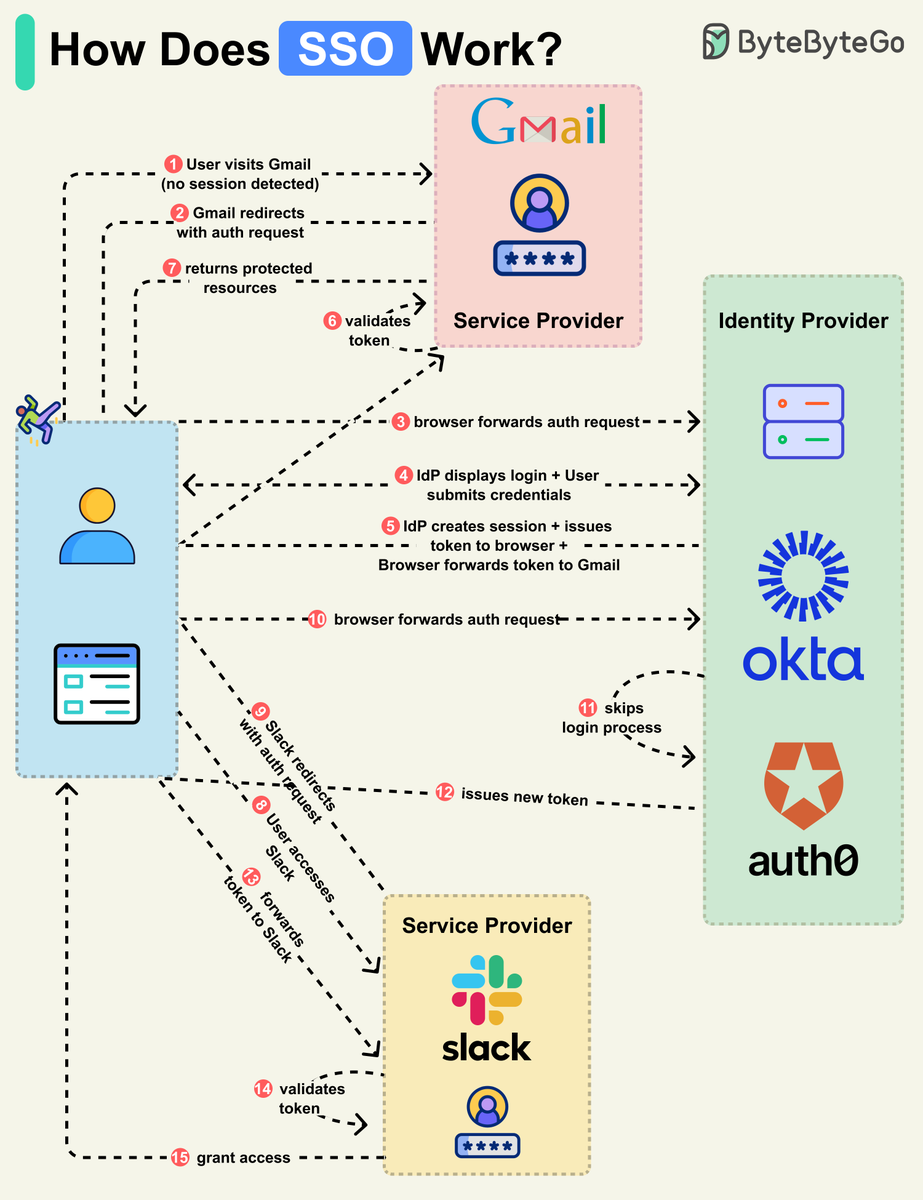
𝗦𝗦𝗢 𝘃𝘀 𝗢𝗔𝘂𝘁𝗵 𝘃𝘀 𝗢𝗜𝗗𝗖 𝘃𝘀 𝗦𝗔𝗠𝗟.
Do you know the differences?
𝗦𝗦𝗢 is a user experience, not a protocol. It lets users log in once and access multiple apps without re-authenticating; providing seamless access across tools. It relies on protocols like SAML or OIDC.
𝗢𝗔𝘂𝘁𝗵 is for authorization. It lets apps access user data or services without sharing credentials. It controls what an app can access, not identity.
𝗢𝗜𝗗𝗖 is an authentication layer on top of OAuth 2.0. It verifies user identity and provides user info via ID tokens (usually JWTs). It’s the standard for login + identity in modern apps.
𝗦𝗔𝗠𝗟 is an older, XML-based standard primarily used for enterprise SSO. It’s still widely used in legacy and enterprise systems, though newer applications increasingly adopt OIDC. It’s powerful but more complex than OIDC.
OAuth = access.
OIDC = identity.
SAML = older enterprise SSO.
SSO = the experience.
But getting identity right doesn’t solve the whole access problem.
As more apps and AI agents connect to production data, managing permissions separately in every tool gets harder.
Retool centralizes that with SSO, role-based permissions, and Data Access Enforcement, giving teams shared guardrails underneath the apps and agents they build.
Build with the tools you already use. Run with Retool's enterprise controls.
𝗚𝗿𝗲𝗮𝘁 𝘀𝗵𝗼𝗿𝘁 𝗿𝗲𝗮𝗱 𝗼𝗻 𝗵𝗼𝘄 𝗶𝘁 𝘄𝗼𝗿𝗸𝘀 → https://t.co/NPyc5W8kjn
What else would you add?
——
💾 Save it for later.
🙏 Thanks to @retool for sponsoring this post.
➕ Follow me to improve at system design and AI engineering.
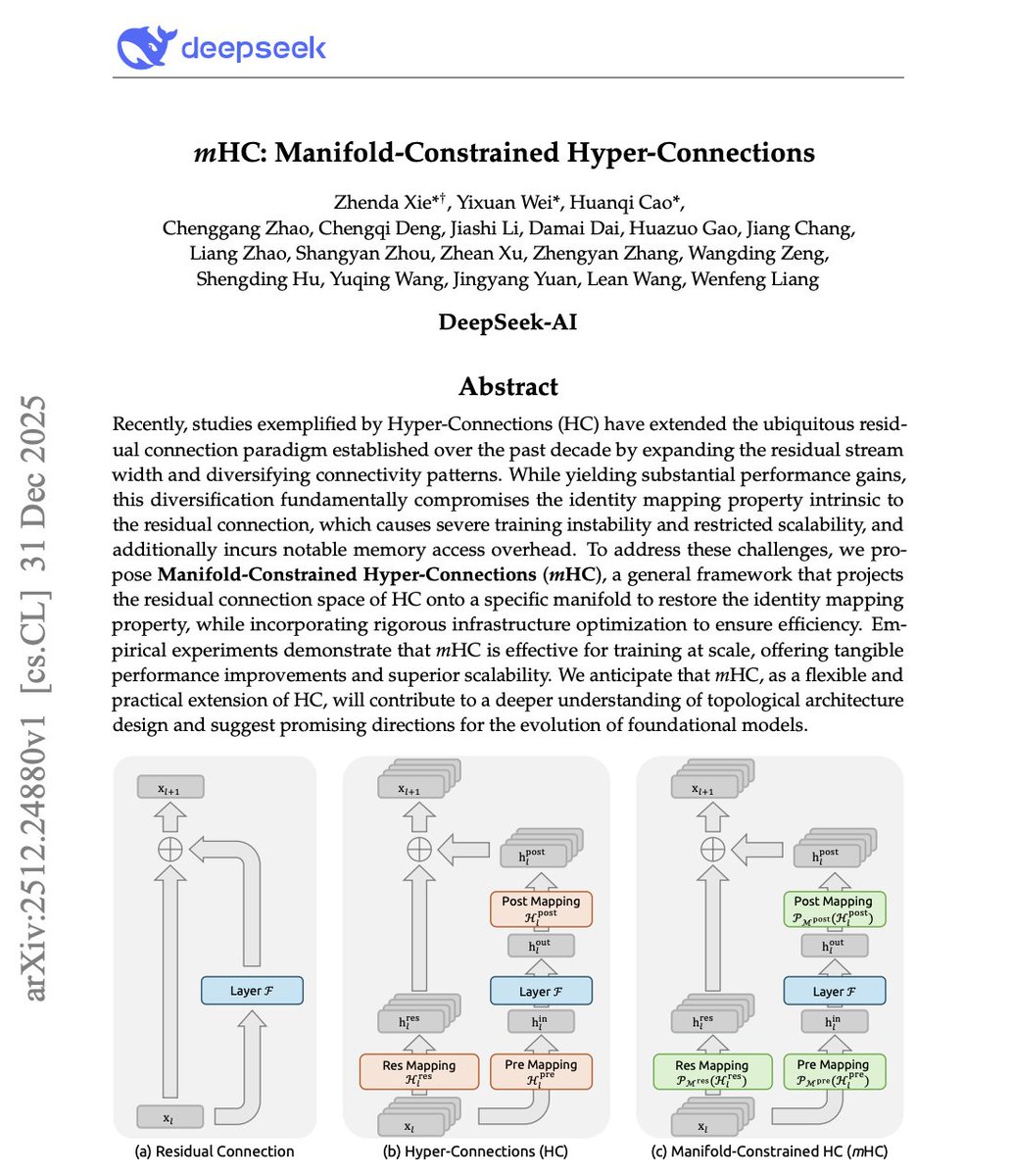
🚨 DeepSeek just dropped a paper that quietly exposes why modern neural networks get unstable as they scale.
It’s called mHC: Manifold-Constrained Hyper-Connections, and the core idea is deceptively simple:
Neural networks keep breaking their own geometry.
Here’s what that means.
Modern deep models stack layers and then add skip connections everywhere. Residuals, dense connections, cross-layer shortcuts. These help gradients flow, but they also do something subtle and bad: they mix representations that live on different manifolds as if they were compatible.
They usually aren’t.
Each layer learns features that lie on a low-dimensional manifold shaped by that layer’s transformations. When you add or concatenate features from distant layers without constraints, you’re effectively stitching together points from incompatible geometric spaces. Training still works, but the representation becomes distorted, noisy, and brittle.
mHC fixes this by enforcing a rule most architectures ignore:
Only connect layers if their representations are geometrically aligned.
Instead of free-form skip connections, mHC introduces hyper-connections that are manifold-aware. Before information flows across layers, it’s projected, constrained, and aligned so it stays on a consistent manifold. The shortcut isn’t removed; it’s disciplined.
What’s clever is how they do it.
mHC uses a lightweight constraint mechanism that learns a shared latent manifold across connected layers. Information is routed through this shared structure, ensuring that skip connections don’t violate the geometry each layer has learned. No heavy retraining tricks. No massive compute overhead. Just respecting structure.
The results are surprisingly strong.
Across vision and language benchmarks, models with mHC converge faster, generalize better, and are noticeably more stable under distribution shifts. The gains aren’t from bigger models or more data, but from not breaking the math.
This matters more than it sounds.
As architectures get deeper and more entangled (transformers with hundreds of residual paths, multi-branch vision models, agent systems with cross-module feedback), geometry violations compound. mHC is basically saying: if you want scale to keep working, you need to preserve representation integrity.
It’s also a quiet rebuke to brute-force architecture design.
We’ve been adding connections because they help optimization, not because they make representational sense. This paper shows you can get the best of both worlds if you constrain information flow instead of letting everything talk to everything.
The next gains in deep learning won’t come from piling on more layers or parameters. They’ll come from respecting structure manifolds, geometry, and how representations actually live inside these models.
mHC is a small architectural change with a very big philosophical shift.
Paper: mHC: Manifold-Constrained Hyper-Connections
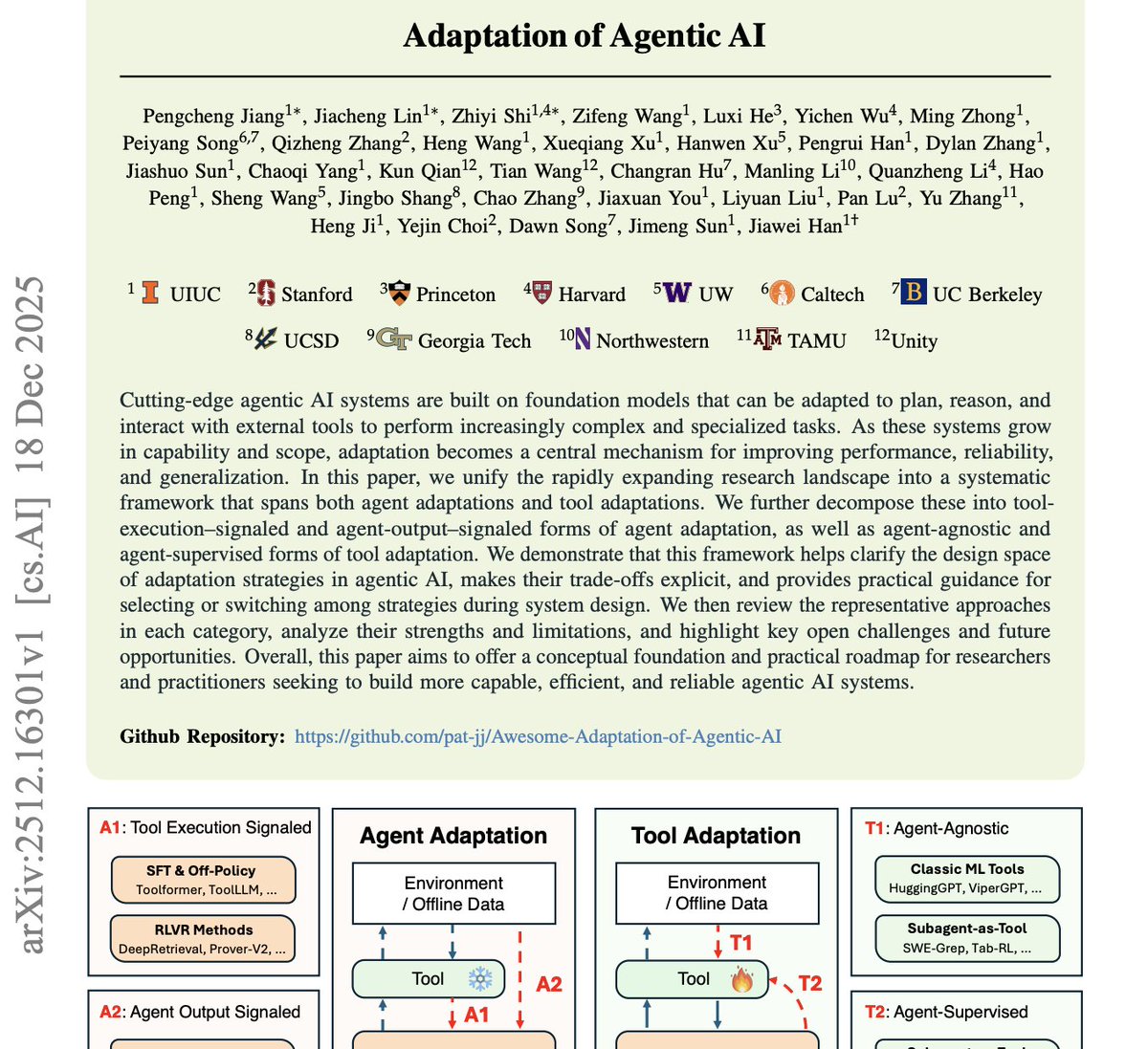
This paper from Stanford and Harvard explains why most “agentic AI” systems feel impressive in demos and then completely fall apart in real use.
The core argument is simple and uncomfortable: agents don’t fail because they lack intelligence. They fail because they don’t adapt.
The research shows that most agents are built to execute plans, not revise them. They assume the world stays stable. Tools work as expected. Goals remain valid. Once any of that changes, the agent keeps going anyway, confidently making the wrong move over and over.
The authors draw a clear line between execution and adaptation.
Execution is following a plan.
Adaptation is noticing the plan is wrong and changing behavior mid-flight.
Most agents today only do the first.
A few key insights stood out.
Adaptation is not fine-tuning. These agents are not retrained. They adapt by monitoring outcomes, recognizing failure patterns, and updating strategies while the task is still running.
Rigid tool use is a hidden failure mode. Agents that treat tools as fixed options get stuck. Agents that can re-rank, abandon, or switch tools based on feedback perform far better.
Memory beats raw reasoning. Agents that store short, structured lessons from past successes and failures outperform agents that rely on longer chains of reasoning. Remembering what worked matters more than thinking harder.
The takeaway is blunt.
Scaling agentic AI is not about larger models or more complex prompts. It’s about systems that can detect when reality diverges from their assumptions and respond intelligently instead of pushing forward blindly.
Most “autonomous agents” today don’t adapt.
They execute.
And execution without adaptation is just automation with better marketing.
If you’re serious about learning agentic AI,
here’s a pathway I’ve found highly effective:
I’ve been diving deeper into how to build multi-agent systems.
A lot of courses out there are shallow in coverage.
To build real AI agents, you need more than just tool usage or prompt chaining.
You need a strong grasp of concepts like agent reasoning, orchestration, state management, and more.
Building multi-agent systems adds a whole additional layer of complexity on top.
I was looking for something that was comprehensive and covered the underlying concepts. While being equally hands-on with building multi-agent systems.
Something that would give me a strong understanding of how to build multi-agent systems, not just how to use the latest trending tool.
Udacity's Agentic AI Nanodegree program checked those boxes.
• It’s framework-agnostic. You’re not just learning one tool. You’re learning how agentic systems work under the hood.
• The projects aren’t basic. You’re challenged to build complex multi-agent systems.
• And there’s actual human feedback on your work from subject matter experts.
Check it out: https://t.co/6yi6Eaw2Eg
It's not for the faint-hearted. The course has a strong level of complexity, which is exactly what's needed.
Udacity gave me early access and offered to sponsor a post if I liked it. Here we are. It’s solid, and a great option if you’re serious about building agentic systems.
💬 Are you actively upskilling in agentic AI? ↓
Agentic AI vs Traditional AI – What Sets Them Apart?
The future of AI is evolving from static tools to dynamic, autonomous agents.
Here’s a detailed breakdown of what makes Agentic AI the next big leap:
1. What is Traditional AI?
These systems follow fixed rules for narrow tasks like spam filtering or image classification.
They lack memory, can’t adapt, and require constant human input.
2. What is Agentic AI?
Agentic AI can reason, plan, act, and adapt.
It breaks tasks into subgoals, collaborates with tools and agents, and works independently to achieve outcomes.
3. Workflow Comparison
Traditional AI gives a one-off answer based on input.
Agentic AI follows a goal-driven cycle: plans the process, uses tools, refines output using memory and feedback - just like a human team would.
4. Agentic AI Components
Powered by LLMs like GPT-4 and Gemini, agent frameworks (LangChain, CrewAI), vector memory (Weaviate, Redis), and tools like code interpreters, APIs, and browsers.
5. Core Differences
Agentic AI is autonomous, dynamic, memory-based, and tool-integrated.
Unlike Traditional AI, it can handle complex workflows and collaborate in teams of agents.
6. Why Agentic AI Is the Future
It minimizes manual prompting, automates multi-step tasks, and works in real-time - paving the way for AI co-workers and full-scale enterprise automation.
Agentic AI isn’t just smarter - it's built to think, act, and adapt like a real assistant.
System Design for Real-Time AI Applications
Mastering real-time AI isn't just about fast models, it’s about the entire system working together seamlessly! Here's a breakdown of the 10 core components you need to know:
1. Stream Processing
Processes live data continuously, enabling instant analysis and response within seconds.
2. Real-Time Inference
Makes predictions immediately on new incoming data to deliver fast, updated results.
3. Event-Driven Systems
Automatically triggers actions when events occur, keeping AI systems reactive and scalable.
4. Data Queues
Organizes and stores incoming data temporarily so systems can process it smoothly without overload.
5. Monitoring and Alerting
Tracks system and model health, sending alerts if issues arise to maintain performance.
6. Auto-Scaling
Dynamically adjusts computing resources based on real-time demand to optimize costs and efficiency.
7. Low-Latency Serving
Delivers AI outputs within milliseconds - ideal for live gaming, trading, and instant-response apps.
8. Real-Time Feature Engineering
Transforms incoming raw data into usable features instantly for AI models to stay updated.
9. Model Optimization
Shrinks and simplifies AI models for faster and more efficient real-time processing.
10. Edge Computing
Runs AI models close to the data source (like IoT devices) to reduce delay and save bandwidth.
⚙️ Building real-time AI applications is about combining all these pieces into a high-speed, low-latency, resilient system!
📌 Save this if you're working on AI systems and follow me @goyalshaliniuk for daily insights.
LLM = Smart, but works only with what it “remembers” from training.
RAG = Smart + can “look things up” to be more informed and up-to-date.
Agent = Smart + can “decide what to do next” to achieve a goal using tools, memory, or plans.
You can now generate fake passports with GPT-4o.
It took me 5 minutes to create a replica of my own passport that most automated KYC systems would likely accept without blinking.
The implications are obvious --any verification flow relying on images as “proof” is now officially obsolete. The same applies to selfies. Static or video , it doesn’t matter. GenAI can fake them too.
Photo-based KYC is done. Game over.
The only viable path forward is digitally verified identity, like eID wallets mandated by the EU.
One of the companies ahead of this shift is our portfolio startup @authologic. If you're running KYC in banking, insurance, travel, crypto, or anywhere else — it’s time to upgrade your process. Your users deserve better. So does your compliance team.
Join @andrewshikiar, FIDO Alliance Executive Director & CEO, to hear about the Alliance’s vision for passkeys and beyond, and to learn why and how your company can benefit from FIDO Alliance membership.
Get the details!
REGISTER: https://t.co/laH4KeHUDI 🗓️ March 20