A local MCP for Claude Code, Codex & Cursor.
Every session you close becomes memory your agent can pull.
Start every session warm. The baggage stays behind.
Echo is a local MCP for Claude Code, Codex, and Cursor:
- Turns your past sessions into memory your agent can pull anytime
Same task, with memory: 1.51M → 0.32M cost
Paste this to your terminal ->
npm i -g @echomem/mcp@latest && echomem-mcp init
@Simonsterrific The job is not going away. it is getting promoted into the layer that decides what the agent may touch, and that layer has no demo, because demos run with permissions nobody would grant in production.
Worth the read.
@Simonsterrific The sharpest thread here isn't mods, it's the unload problem. Plugin authors shouldn't have to remember to clean up. Same demand on memory: a system shouldn't have to remember to abstain. Reliability has to be structural, not author discipline.
Everyone is asking whether Jev becomes the next agent route. That is the wrong question. Its real signal is that the model gets demoted from driver to a typed function, and "agent" quietly dissolves into infrastructure. https://t.co/jZmxCe6PDW
Spot on. Increasing token capacity without context engineering just gives the agent a bigger room to lose things in.
The 3-state memory architecture is essential for any real-world AI application—especially when maintaining long-term continuity matters.
A larger context window solves overflow.
It does not solve attention or lossy compaction.
The durable fix is a three-state memory architecture that preserves decisions outside the chat. https://t.co/TSef0jWZr7
Body + soul is the right framing. Most of the market is optimizing runtime latency; we're optimizing memory continuity across sessions at Echo. This essay explains why the second problem is harder: https://t.co/eWx4q7nOLc
Runtime is the body. Memory is the soul. After Harness, the agent race is about building both—across cloud, local, and every sandbox. https://t.co/TPUWpQ6VOk
Runtime is the body. Memory is the soul. After Harness, the agent race is about building both—across cloud, local, and every sandbox. https://t.co/TPUWpQ6VOk
@Simonsterrific The Verifier's Law angle is underrated. If capability ∝ verifiability, then local agents touching email / bank / files are structurally stuck — there's no checker.
Seen any pattern where a verifier-in-the-loop actually works outside coding?
Everyone’s asking when agents will get smarter. The real question is: when will we trust them enough to stop watching?
On long-horizon reliability, context rot, and why the next battlefield isn’t intelligence — it’s trust. https://t.co/2RzKWMIODH
I still use OpenClaw daily🦞2026 will be marked as the year of Agent. Here is why:
1. Nov 2025 — launched.
2. Jan 30, 2026 — relaunched. 100K GitHub stars in 48 hours, fastest in history.
3. 60 days — passed React's 10-year record. Most-starred repo ever: 373K.
4. Apr 4, 2026 — Anthropic blocked third-party subscription tokens. No one has talked about it since.
What the world changed by 🦞:
5. GitHub commits: 83M/month → 1.2B/month. ×14 more!
6. PRs opened by agents: 4M/month → 17M/month.
7. Codex weekly users: 600K → 8M.
8. Claude Code revenue: $0 → $2.5B run-rate.
9. Chinese models: 2% → 45% of OpenRouter tokens.
10. Big-4 AI capex: $410B → $725B.
Before OpenClaw, software was written by developers.
After, by everyone.
For fellow Codex/CC power builders:
A $15 toggle workflow that’s ~70% keyboard/mouse free—less typing, less clicking, more talking and building.
Spoiler alert: this video had no script. I just hit record and rambled
Everything you need to start is here:
https://t.co/bLodnaZBtr
EchoMem achieved 95.8% accuracy on LongMemEval (with Gemini 3.1 Pro). But the real win? Our ability to correctly abstain when the memory doesn’t support the answer.
Read the full performance report: https://t.co/fn13ZpMA0y
#AI#LLM#MemoryInfra#EchoMem#LongMemEval
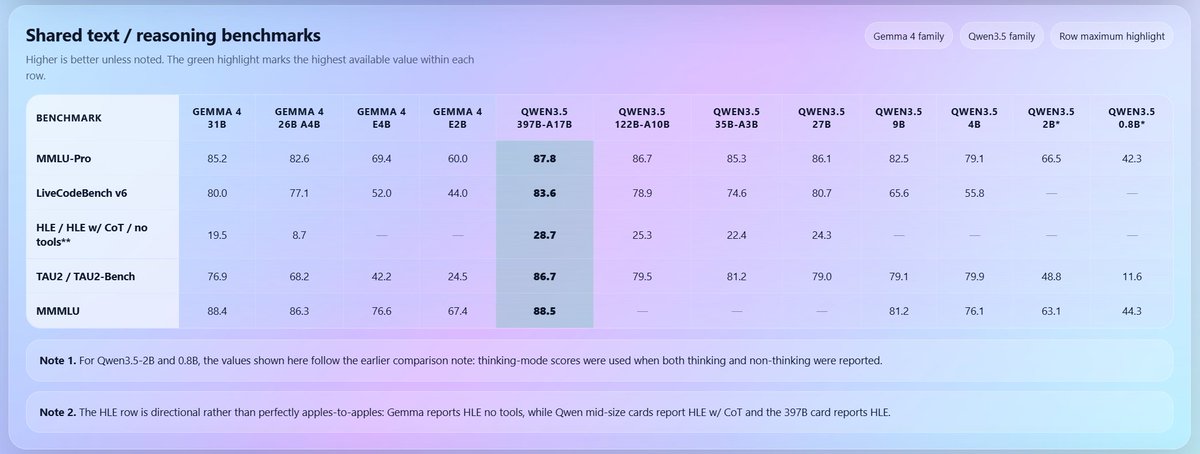
Full benchmark breakdown: Gemma 4 vs Qwen3.5
MMLU-Pro, MMMU-Pro, LiveCodeBench, TAU2, MathVision, MedXpertQA… all in one view.
TL;DR:
- Qwen leads at the frontier
- Gemma is competitive in practical tiers
But benchmarks miss one thing:
cross-tool memory is still unsolved
Memory poisoning is now OWASP's #1 agentic risk.
The next generation of agent memory isn't about:
❌ Bigger context windows
❌ More storage
❌ Faster embeddings
It's about:
✅ Governing what gets admitted
✅ Mathematical validation of importance
✅ Immutable audit trails