Tokenizing real world assets is completely reshaping the way we access, manage, and own traditional markets, from real estate to infrastructure.
i made this simple and straight forward infographic to show how @trize_io works
@Starlink It's worth pausing to appreciate how far @trize_io has come. Bitcoin buying pizza felt like a novelty. Today, T-RIZE is building institutional-grade frameworks for tokenizing real-world assets. Excited for the future fr
@trize_io Institutions have been waiting for clarity. The CLARITY Act could be the one that ends the wait. Clear rules unlock action. And when institutions move from the sidelines to actually building, tokenization infrastructure will accelerate definitely.
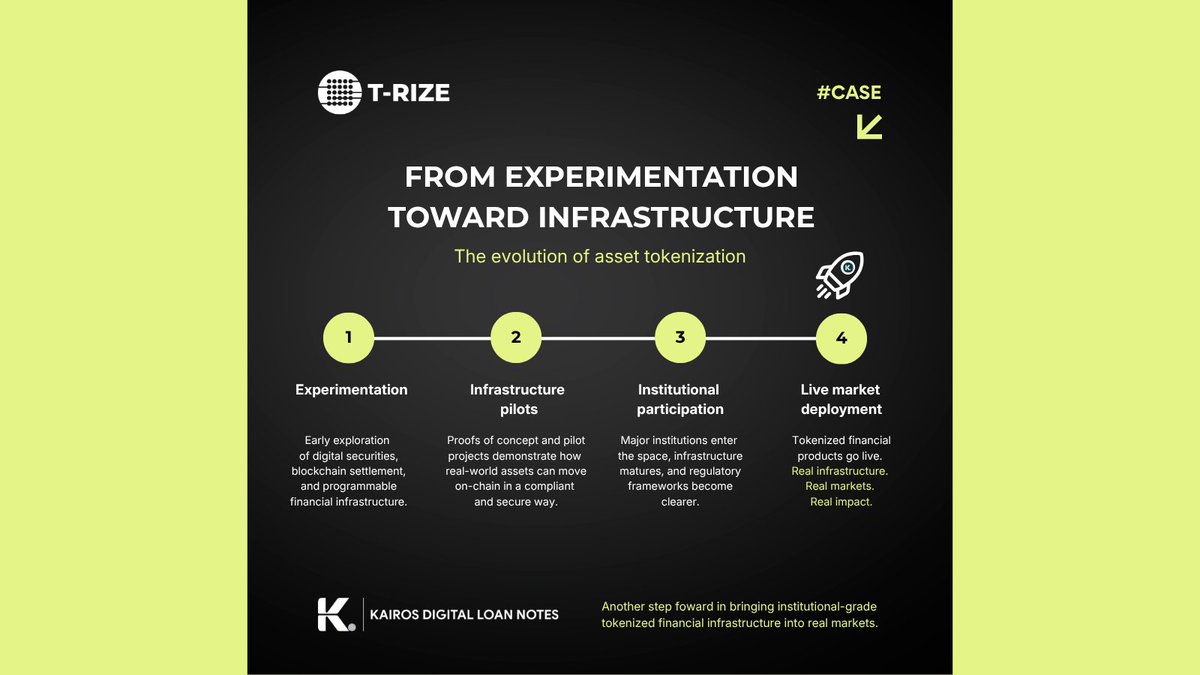
@trize_io Innovation gets the headlines while Infrastructure gets the institutions. Meaningful adoption of digital assets requires governance, operational frameworks, and market structures that give institutions the confidence to move from experimentation to real capital deployment.
✪ #CASE
Tokenization has evolved quickly.
What started as blockchain experimentation is becoming real financial infrastructure.
Kairos Digital Loan Notes is part of that progression toward institutional implementation.
#Tokenization#DigitalAssets#CapitalMarkets#Blockchain #RWA #PrivateCredit #trize
9/9 So when you strip everything back, the real opportunity is straightforward. It's about rebuilding ownership infrastructure so that coordinating and moving capital becomes cheaper, faster and more accessible than it is today.
Follow for more 👉 https://t.co/RphXzNuJc7
8/9 Private credit facilities and infrastructure funds. If those players can't operate comfortably inside tokenized systems, the whole thing stays a niche experiment.
7/9 But here's the part that gets underestimated in most of these conversations. None of it matters at scale without institutions. The largest assets in the world aren't sitting in retail wallets. They're on institutional balance sheets, inside real estate portfolios,
Every conversation about tokenization seems to start at the same place. Trillions in liquidity. Global markets opening up. The future of finance. But the actual shift happening right now is much closer to something simpler, it is about what ownership fundamentally feels like.
6/9 This is what people mean when they say value becomes composable. In traditional finance, value gets trapped inside institutions and intermediaries. In a tokenized system, ownership can plug into other financial actions the same way applications connect on the internet.
4/9 A useful way to picture it , in the old system, owning an asset is like having a file locked on your computer. Only you can access it and moving it anywhere is slow and manual. In a tokenized system it's more like a cloud file. Same asset, but now it has permissions.
3/9 Tokenization changes that at the root level. It doesn't just digitize an asset, it changes how that asset behaves. Ownership that used to sit static in paperwork can now be split, transferred, programmed with rules, and connected to financial systems.
2/9 Think about what it means to own something valuable today. A building, a stake in a private company. That ownership lives in legal documents. It moves slowly, it can't be easily divided, and it definitely can't be deployed as flexible capital on short notice.
6/6 In simple terms , $RIZE is the bridge where real-world assets, blockchain technology & financial participants work together seamlessly. The infrastructure for the next era of finance is being built now.
Learn more 👉 https://t.co/RphXzNuJc7
The RIZE ecosystem is the complete network of technology, users, services & financial tools built around $RIZE. In summary, it is a shared economy where investors, asset owners & institutions all interact through one blockchain infrastructure.
5/6 The results speak for themselves: → $23M+ in tokenized real-world assets already live → Listed on Revolut & Kraken → Validator on Canton Network ($4T+ in secured assets) → Featured in Deloitte's 2025 RWA report.