Starting a new series of threads on designing an MFT strategy, almost everything will be shared publicly.
As usual, the goal is to not fuck up too much.
I will explain the issue I currently have and hope I can get some feedback on whether or not I'm doing the right thing.
- I have HFT strategies making decent $ on uncompetitive exchanges.
- It's great for now, but it may not last: I'm exposed to strong counterparty risk and the capacity is low.
I have some cash to park in a strategy, and I think the best ROI I can get is from custom-made active strategies.
I need a strategy that can handle a capacity of 100k–500k, which leaves a lot of room for trading small-capacity alphas.
I already did a few tests, and I can get decent MM-style execution on Tier 1/2 DEXs.
I now want to design a system that will output weights that my MM will target, slowly trading towards my desired exposures.
The current plan is to create factor-style features (both time-series and cross-sectional) targeting 1h forward returns, blend them in a smart or street quant way, and trade continuously towards the optimal exposures, updating them every minute or so.
Does this sound like a good idea, and any advice on this?
The next posts will be on the approach for feature research and universe selection.
@ScottPh77711570@therobotjames@macrocephalopod
I would like to trade in some CEXs but due to tax / safety issues I won’t KYC on those exchanges.
Is there a way through a service giving access to sub accounts to trade on those markets?
Or do I have to go through setting up an offshore company to do it?
Part 3 of the MFT series: features and the next steps I have to figure out.
- Handling turnover to compare features (some features turn over a lot some don't)
- Going from raw feature to prediction
As always, I love the feedback thanks! https://t.co/QHCLNAwAYg
MFT series
I got pretty busy over the last few days with my other job, but I'm preparing the post on feature research.
I'm thinking hard about an issue right now and wanted to share it: evaluating feature predictiveness.
I do it as follows:
1. Compute the feature using data up to time t.
2. Compute forward returns for each asset from t + 30s to t + 1h 30s.
3. Divide the forward returns by the volatility measured from t + 30s to t + 24h.
4. Group the volatility-adjusted forward returns into 10 bins by feature value and plot the average for each bin.
The recent change I made was to adjust returns using forward volatility instead of past volatility, because of possible contamination.
That said, I'm worried the forward volatility window could cause some fuck-ups: it overlaps with the return window, so large moves inflate their own denominator.
I might just switch to a longer window, like a rolling 20-day volatility, which should be more stable and less sensitive to any single period.
Would really appreciate feedback on this
@weaponizedFOMO@therobotjames@ScottPh77711570 This is a part of the problem I’m yet to figure
I meant clipping as in sizing less in the tails because that’s where the fuckery happens.
I don’t believe clipping is a good solution for this particular problem
I need help from my street quants.
When I create features, I plot quantiles of the feature value vs forward returns, I often get this kind of results: linear positive relation in the middle, and reversion at the tails of the feature.
I added an example, of feature= 10 days returns / 10 days std. the three lines are just the same feature but on 3 terciles of the universe by ADV.
In the end, I want to use a linear model so it won’t pickup this behavior.
1. I could use a non-linear model (will probably overfit)
2. I could apply a transform to the feature such that larger values of the features gets lower.
3. I could ignore this issue
Still not figured out what the best solution is, any advice ?
@derimonkeyfin More parameters so more likely to overfit
Not saying it can’t work if done properly.
Just another thing to look out for, that I don’t necessarily want to bother with
Part 2 of the series where I design an MFT system: building the dataset and computing forward returns.
As always, I’m looking forward to your feedback and comments!
Writing these helps me think first and then dig into the data, which is a good way of doing it imo. You should think really hard about how you’re doing things and what it implies before you start going crazy with features and testing.
One tip I use for this process: I go outside with just something to take notes on and think about how I’m going to do things.
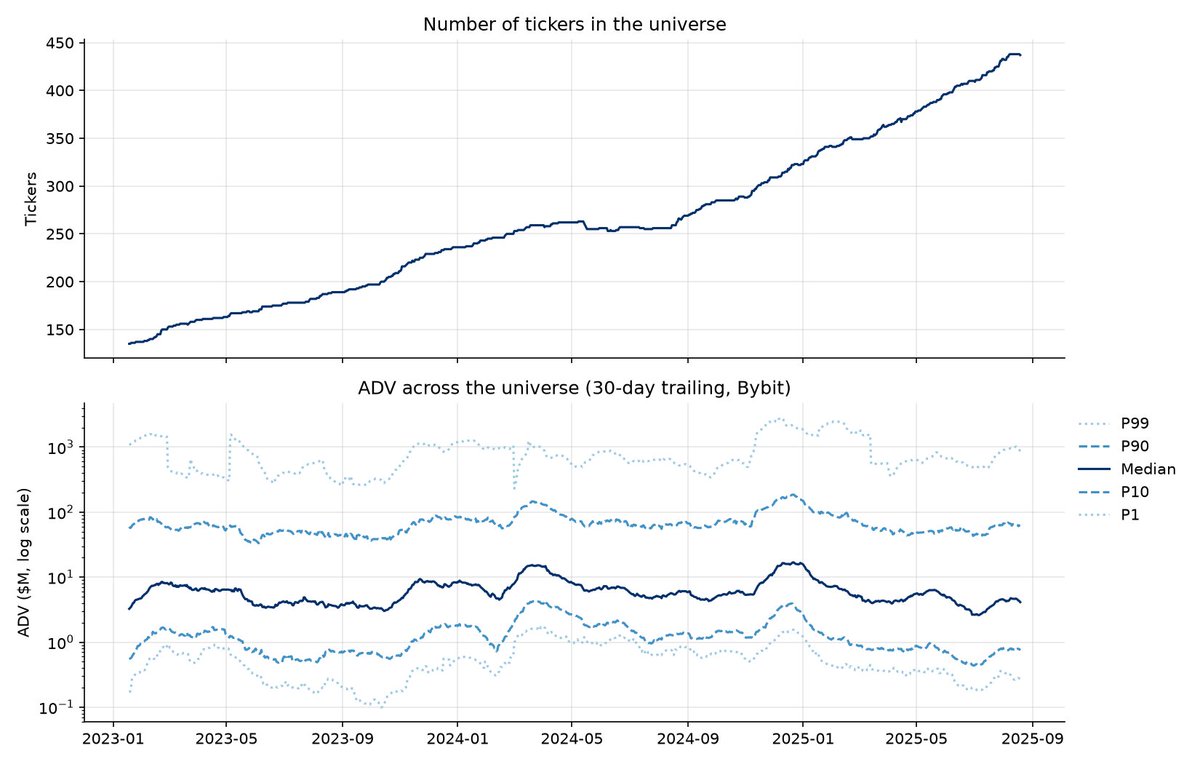
I first focused on building a clean dataset from public sources. I used Binance and Bybit data from 2023 to August 2025 for the training set.
Here’s what I’ve collected:
Binance
- Hourly klines for perpetuals
- AggTrades for perpetuals and spot
- Funding rates
- Depth snapshots at 0.2% and 1% market impact
Bybit
- Mid snapshots every 30s
For now, my universe is all the tickers on those exchanges. Depending on the feature analysis, I’ll decide whether to create sub-universes for the whole portfolio or per feature. Feature behavior varies across assets, e.g. trend works better on liquid stuff, reversion on illiquid stuff… Selecting the right universe is as important as the feature itself, and I think it’s often overlooked.
It’s also worth noting that anything under $1M ADV needs to be included carefully: there isn’t a continuous flow of trades during the day, so rebalancing positions in an MM fashion comes with its own problems.
I’ll use the Bybit mid snapshots to compute returns for the analysis. Using candles is a fuck-up because the close price is the last trade, not a price you can execute at. That’s a big fuck-up if you’re looking at short-horizon intraday returns, especially on assets with wide spreads: you’ll find effects that aren’t tradeable.
I use a 30s embargo between the last timestamp of a feature and the price used to compute forward returns. This is important to avoid too-good-to-be-true results from latency issues and from contamination by the market impact of trade-based features.
The next step, and it’s a big one, is creating features and figuring out whether I can use them based on their ability to predict returns (across time or cross-sectionally), their turnover, which part of the universe they work on…
I’ll start with the basics: trend, momo, carry and size. Then there are many transforms to explore on trades and order books.
If you have feature ideas and want them tested, just post them below. That could be interesting!
The next post will be on the protocol I use for testing features (by protocol I mean which plots I will be eye fucking, that’s how science is done).
Starting a new series of threads on designing an MFT strategy, almost everything will be shared publicly.
As usual, the goal is to not fuck up too much.
I will explain the issue I currently have and hope I can get some feedback on whether or not I'm doing the right thing.
- I have HFT strategies making decent $ on uncompetitive exchanges.
- It's great for now, but it may not last: I'm exposed to strong counterparty risk and the capacity is low.
I have some cash to park in a strategy, and I think the best ROI I can get is from custom-made active strategies.
I need a strategy that can handle a capacity of 100k–500k, which leaves a lot of room for trading small-capacity alphas.
I already did a few tests, and I can get decent MM-style execution on Tier 1/2 DEXs.
I now want to design a system that will output weights that my MM will target, slowly trading towards my desired exposures.
The current plan is to create factor-style features (both time-series and cross-sectional) targeting 1h forward returns, blend them in a smart or street quant way, and trade continuously towards the optimal exposures, updating them every minute or so.
Does this sound like a good idea, and any advice on this?
The next posts will be on the approach for feature research and universe selection.
@ScottPh77711570@therobotjames@macrocephalopod
@quantyboi I like Scott
But my capacity is way smaller than what they are targeting so I think I can do better. I also have less constraints, I can use multiple exchanges…
@ScottPh77711570@therobotjames Most of the time, people find short-term edges but can't monetize them. I have the opposite problem: I run an HFT system on an exchange that makes money without any alpha (it's purely a latency edge).
How would you go about incorporating alpha into this system?