i’ve seen building projects where the owner has bought the land, paid for materials and watched the structure rise, only to realise that getting a building to this stage and making it ready for use are two different things
the investment is visible. The remaining work is just as important
that distinction came to mind while looking at @GenLayer’s Pre-Mainnet Staking
there’s the part everyone can easily track: Staking Points
every eligible GEN earns 1 Staking Point per day
for example, keeping 800 eligible GEN staked for 30 days earns 24,000 Staking Points. That’s how the points accumulate, one day at a time
unclaimed airdrop GEN also counts as staked from THE DAY, meaning eligible holders don’t have to claim first for those points to begin accumulating
that means both the amount of eligible GEN and the time it spends staked contribute to your total
but preparing for a validator seat involves another requirement
your node must run on Clarke for at least 30 days to qualify. You can operate it yourself or use a supported Node-as-a-Service provider
this is where I think people need to pay attention
Staking Points determine your proportional share of the Foundation-backed validator-seat allocation at the mainnet snapshot. Running a node on Clarke for the required period is a separate eligibility condition
so, having GEN staked and watching your leaderboard position grow doesn’t automatically mean your validator preparation is complete
it’s a bit like having the structure of a building in place while essential work remains before it can be occupied
i’m curious: are you paying equal attention to your Staking Points and your node preparation, or has the leaderboard taken most of your attention?
@amadarln2@GenLayer I would also be interested in the appeal mechanism here. Increasing jury sizes after failed appeals makes controlling the final outcome progressively harder.
what makes someone qualified to judge a dispute?
intelligence? experience?independence?
for an AI judge, there’s another question worth asking: what do they have to lose if they manipulate the outcome?
this is one of the problems @GenLayer addresses through its GEN staking model
AI judges are relatively cheap to create. Without an economic barrier, one person could generate hundreds of validator identities and use them to gain disproportionate influence over a decision
GenLayer tackles this by requiring every validator to lock at least 42,000 GEN of its own stake before qualifying to participate in consensus
this is more than an entry requirement, it’s an economic cost attached to having a voice in the network
but staking is only part of the security design
validators commit their votes before revealing them, making it harder for one judge to simply follow another’s decision
there are also consequences for misconduct
a validator on the minority side of a final decision forfeits its fee and pays an additional penalty of equal size from its own stake
ordinary model error isn’t treated as fraud, though. Percentage-based slashing is reserved for idleness and deterministic violations such as provable fraud
I find this distinction important
a system that punishes every incorrect judgment as dishonesty could encourage validators to follow the crowd instead of independently evaluating evidence
the goal should be to make manipulation expensive without making honest disagreement impossible
that’s the balance I find interesting in @GenLayer’s approach
if you were designing an economic system for AI judges, what would you make more expensive: creating fake judges or manipulating the decisions of legitimate ones?
@amadarln2@GenLayer Does transferring the NFT also transfer all unclaimed developer rewards accrued before the transfer, or only future claims? That's something I'd love to understand better.
some of the most valuable things people create continue generating value long after the original creator has moved on
think about music royalties, book royalties or intellectual property rights
now, @GenLayer is bringing an interesting version of this idea into software development through its Developer NFT right in its tokenomics
every Intelligent Contract on GenLayer has its own Developer NFT, and whoever holds it has the right to claim the developer rewards generated by that contract
here’s here it gets interesting.
whenever someone uses the contract, 10% of the fees generated goes to its developer
there’s also an inflation top-up tied to actual usage. The more fees a contract generates relative to others, the greater its potential share, subject to a cap
but the developer doesn’t have to hold that right forever
the Developer NFT is transferable. So transferring the NFT also transfers the right to claim its associated rewards
think about that for a moment
a developer could build an Intelligent Contract, establish its usefulness, and transfer the NFT representing its future developer rewards to someone else
this creates an interesting possibility: a market for the economic rights attached to useful software
I find this particularly interesting because it connects developer incentives to what happens after deployment, not just the act of building
of course, the contract still needs real users to generate fees. No usage, no fee-based developer rewards
but it raises an interesting question:
would you rather receive a one-time payment for building software, or own a transferable right to earn from its future usage?
really don’t mind AI reading things on my behalf. I actually find that part useful
what makes me uncomfortable is the idea of an AI acting on something simply because it came across it while doing its job
think about how much information an agent can encounter online. Tweets, emails, websites, documents. Any of them could contain instructions deliberately written to manipulate the model processing them
and when that agent has access to a wallet, a mistake is no longer just a bad answer
that’s what happened in the Morse code incident reported in May 2026. An attacker hid a transfer instruction in a tweet. Grok decoded it, passed the instruction to Bankrbot, and the agent executed the transaction. Reports put the amount at around $150,000 to $200,000
this is known as prompt injection. It exploits the way models process instructions embedded in external content, potentially confusing the task an agent was given with commands found in the material it reads
I’ve used AI to research crypto projects, and even when an answer sounds convincing, I still check its sources. But an autonomous agent needs more than a human double-checking its answers. It needs safeguards built into the decision process
this is where @GenLayer’s Greyboxing gets interesting
rather than allowing raw input to reach the AI models unchanged, GenLayer introduces an independent preprocessing layer at the validator level
each validator uses its own secret defenses to screen, paraphrase and restructure the incoming input before passing it to its model. The validators also operate with different models and configurations
that matters because prompt injection often relies on finding a particular way to influence a model. When the input is transformed differently across validators, the same malicious instruction doesn’t necessarily retain its influence across the entire network
the validators then contribute independent judgments to the consensus process, so one manipulated response doesn’t automatically determine the final outcome
it doesn’t make prompt injection disappear, but it adds another layer of resistance against it
I think this becomes increasingly important as AI moves from helping us process information to executing transactions and making decisions with real consequences
an AI reading the internet is useful. But the information it reads should not automatically become authority to act
that’s a distinction worth building security around.
@mats56455 Dear sir than k you @mats56455 I heard rumors that Nigerian govt want him deported …. If there’s a way he can appeal to Supreme Court while he wait for his release will be better
Nigerian Gvt might find a way to deport him if he did not appeal based on terrorist on his name
the dangerous thing about leverage isn’t always the multiplier
sometimes, it’s using the right multiplier for the wrong asset
a 3x position on one asset doesn’t behave like a 3x position on another. Volatility changes the outcome, financing eats into returns, and the longer you hold, the more those details matter.
this is why I’ve been looking into what @2FactorFinance is building on Base
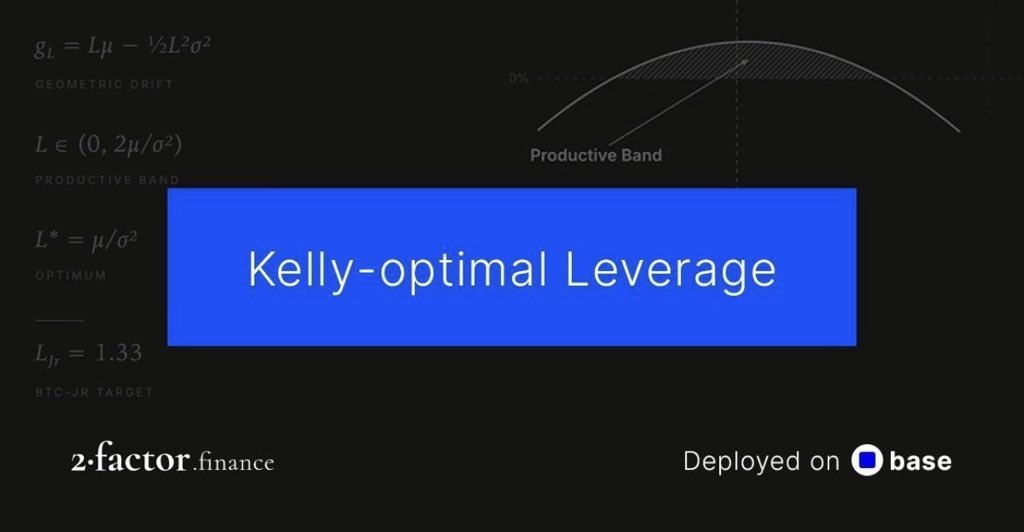
instead of treating leverage as a one-size-fits-all setting, 2Factor uses Kelly-optimized sizing to determine exposure based on an asset’s characteristics. Its cbBTC target, for example, is around 1.33x, rather than blindly pushing Bitcoin to 3x
but sizing is only half the equation
2Factor also uses a senior/junior structure, with stable-yield-seeking capital helping fund leveraged exposure. That changes how financing works and how risk is distributed between participants
now think about what this could mean for tokenized stocks.
Coinbase has been expanding tokenized equities on Base. The next question isn’t simply whether we can trade these assets onchain. It’s whether we can build financial products around them that make sense for people who want to hold them
thats the part I’m watching
i’ve joined the @2FactorFinance Season 1 Points Program, where verified social, educational and referral activities earn marks. No need to deposit or hold assets to earn points
and there’s 1 BTC in prizes for the top 10 leaderboard accounts, paid in cbBTC
I’m learning, participating and sharing what I find along the way.
Join here and grab your referral link:
https://t.co/6MbLsQWAEg
my question: if leverage is supposed to help you hold a position, shouldn’t its design start with the asset you’re holding, not the multiple you’re chasing?
sometimes, losing $100 is just an inconvenience to one person. To another, it is a month’s rent, school fees, or the money they saved for a fresh start
imagine paying a vendor for equipment to start your small business. The money leaves your account, but the equipment never arrives. The vendor insists the order was fulfilled. You have your payment receipt and messages, but getting your money back means spending more time and money than you can afford.
so you let it go🥲
not because you were wrong, but because fighting for what is yours is too expensive.
that’s the part of justice we don’t talk about enough. Sometimes, the person who loses isn’t the one who was wrong
it’s the one who cannot afford to keep fighting
now imagine millions of AI agents making deals every day. When those transactions go wrong, who resolves the disputes? We cannot send every small disagreement to a traditional court and expect the system to keep up
this is why @GenLayer interests me
its Internet Court is designed to use independent AI validators to evaluate claims and reach collective judgments, with a mechanism for challenges and escalation. The goal is to make dispute resolution more practical for a world where agreements and transactions happen at machine speed
because automating commerce without rethinking how we resolve disputes leaves a huge gap
justice shouldn’t be a privilege reserved for whoever can afford to fight the longest
how do we make sure this new kind of justice remains fair to the person with the least money, the least power, and the least room to absorb a loss?
watch the film and tell me what you think.
#JusticeNeedsAnUpgrade
@amadarln2@GenLayer The consensus stage is particularly interesting to me. Getting a network to agree when AI is involved sounds like a very different challenge from traditional blockchains.
@mats56455@europeancourt Thank you so much sir @mats56455 I still think that justice has. It been given to Simon ekpa Because how can the court said he acted on defense and still call it terrorism
Because this also means that he is still a terrorist it need to be remove
God Bless You mightyly
@amadarln2@GenLayer Something I've been thinking about is how much responsibility sits with the person who defines the contract's conditions in the first place. Even a good dispute process needs clear criteria to work with.
what happens when two AI agents read the same agreement, examine the same evidence, and still reach different conclusions?
the more I explore @GenLayer, the more interesting one question becomes: how can a network reach an acceptable outcome when different AI models don't interpret the same evidence in the same way?
because getting AI agents to follow instructions is one challenge.
getting a network to evaluate their actions and agree on an outcome is another.
let’s say an agreement that says a supplier will be paid only if the delivered data is current and accurate.
the supplier submits the data on time.
one AI evaluates the sources and concludes that the information is reliable. Another notices that some sources are outdated and rejects the result.
same agreement. same delivery. different conclusions.
you can’t solve that simply by checking whether the payment was sent or the deadline was met.
and blindly trusting whichever AI answers first doesn’t solve it either.
this is where GenLayer gets interesting to me.
it’s Intelligent Contracts run in GenVM, an execution environment designed to handle logic involving natural language, AI reasoning, and information from the outside world.
rather than requiring every validator to produce identical output, GenLayer uses a consensus process in which validators evaluate a proposed outcome and determine whether to accept it under the protocol’s rules.
the Equivalence Principle is important here. It helps the network establish agreement on outcomes that are equivalent in meaning, even when the AI-generated responses aren’t word-for-word identical.
that doesn’t mean every disagreement magically disappears. The contract’s criteria still matter, and the network needs a way to determine which outcomes are acceptable.
but this is the distinction I find valuable: the goal isn’t to make every AI think alike. It’s to make their decisions usable within a shared system of rules.
and that idea extends beyond individual contracts.
through Internet Court, GenLayer is working toward an open standard for resolving disputes between AI agents, including how they can agree on dispute procedures before transactions begin.
the more I explore GenLayer, the more I see that autonomous transactions need more than speed and automation.
they need a way to handle interpretation, conflicting conclusions, and accountability when things don’t go as expected.
because if AI agents are going to make decisions that affect real value, getting an answer isn’t enough.
we also need a credible way to decide whether that answer should stand.
would you rather have one powerful AI make the final decision, or a network of independent validators evaluate the outcome under shared rules?