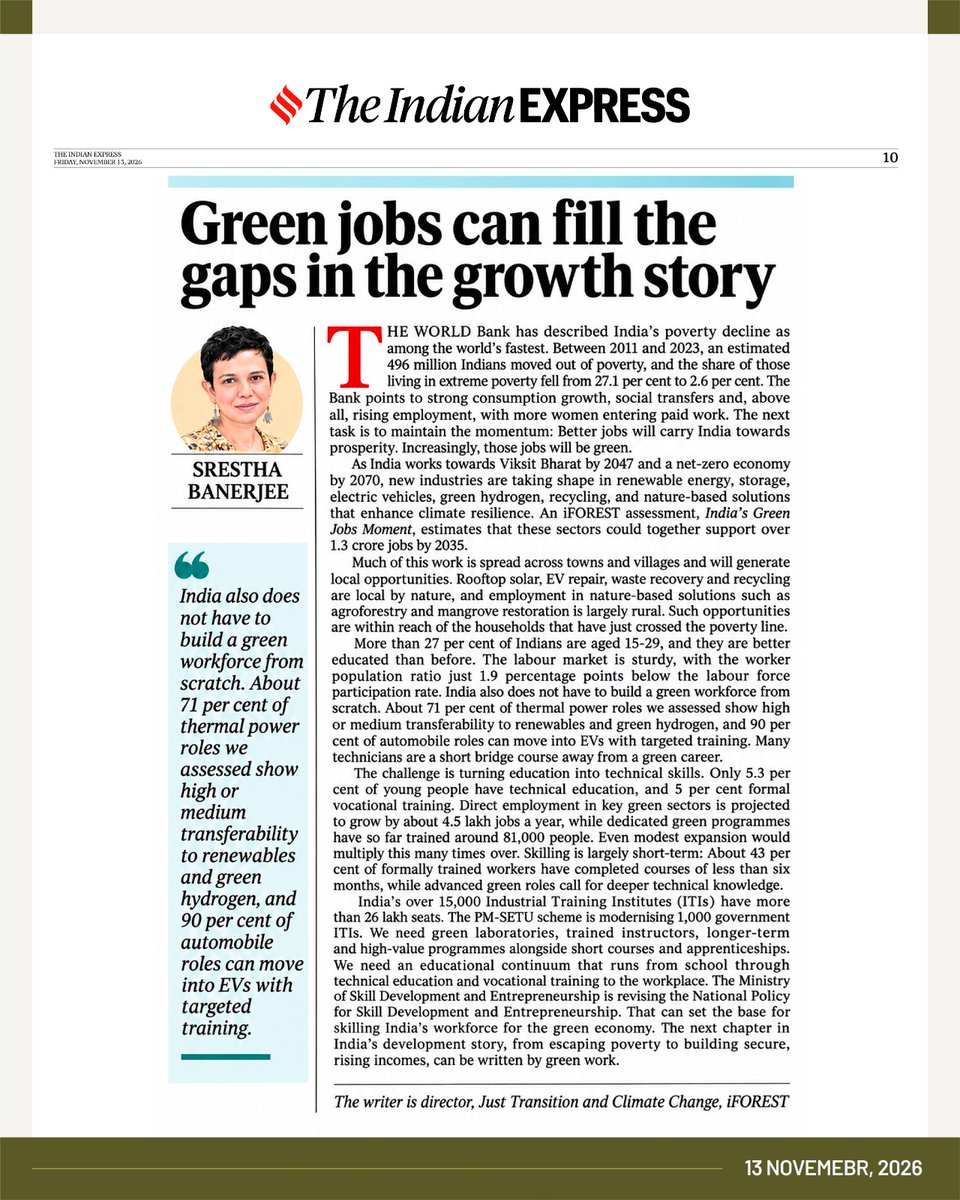
India need not build its green workforce from scratch.
71% of assessed thermal power roles have transferable skills for renewables and green hydrogen. 90% of automobile roles could be adapted for EVs with targeted training.
iFOREST's Srestha Banerjee writes:
https://t.co/Xo7ZvXFAgz
Chhattisgarh has a significant opportunity to repurpose land associated with discontinued coal mines and those expected to close by 2035.
Productive reuse could attract green investment in renewable energy, green industries, value-added agriculture and allied activities—creating jobs, supporting livelihoods and generating new revenue in coal-producing districts.
Existing transport, power and industrial infrastructure offer a foundation for this development, while reducing pressure to divert additional land.
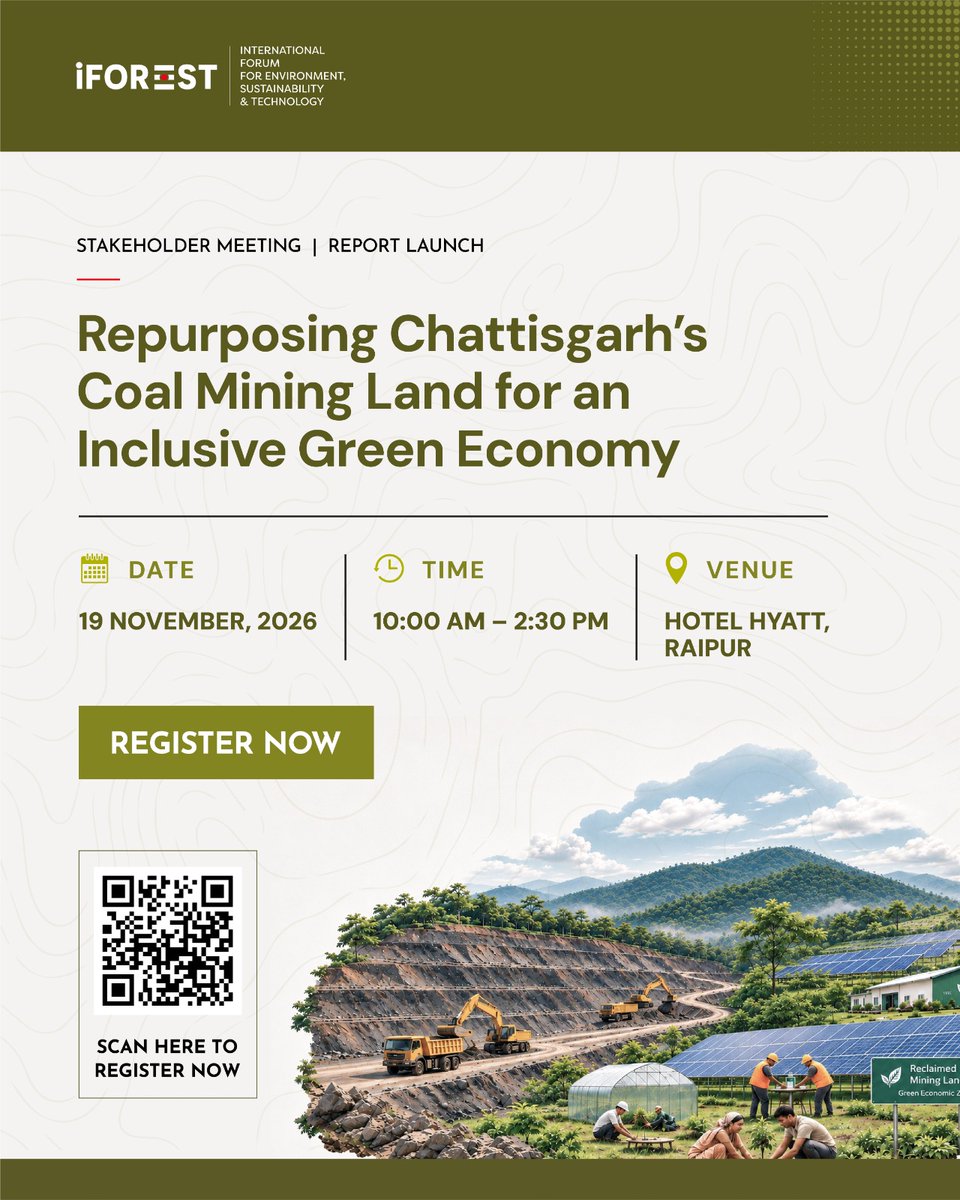
Join iFOREST for the release of our report and a stakeholder dialogue on “Repurposing Chhattisgarh’s Coal Mining Land for an Inclusive Green Economy.”
📅 19 November | 10 am–2:30 pm
📍 Hyatt Raipur
🔗 Register: https://t.co/rzObSrnEhb
#JustTransition #Chhattisgarh #GreenEconomy
Delhi’s PM2.5 tripled before Diwali. Why?
Weather and local emissions alone cannot explain the surge, argues iFOREST CEO Dr @Bh_Chandra.
His analysis points to rising farm fires and winds carrying smoke into Delhi-NCR.
Read his @timesofindia column:
https://t.co/tOnIPi5vNF
iFOREST CEO @Bh_Chandra calls smog towers a monument of failure in Delhi’s fight against air pollution.
Emergency fixes like these fail to address the systemic causes of its polluted air. The basics, like stopping garbage burning, must be enforced year-round.
Watch Episode 13 of the CO Green Podcast: https://t.co/Hm9gxxB1hQ
#DelhiSmog #CleanAir
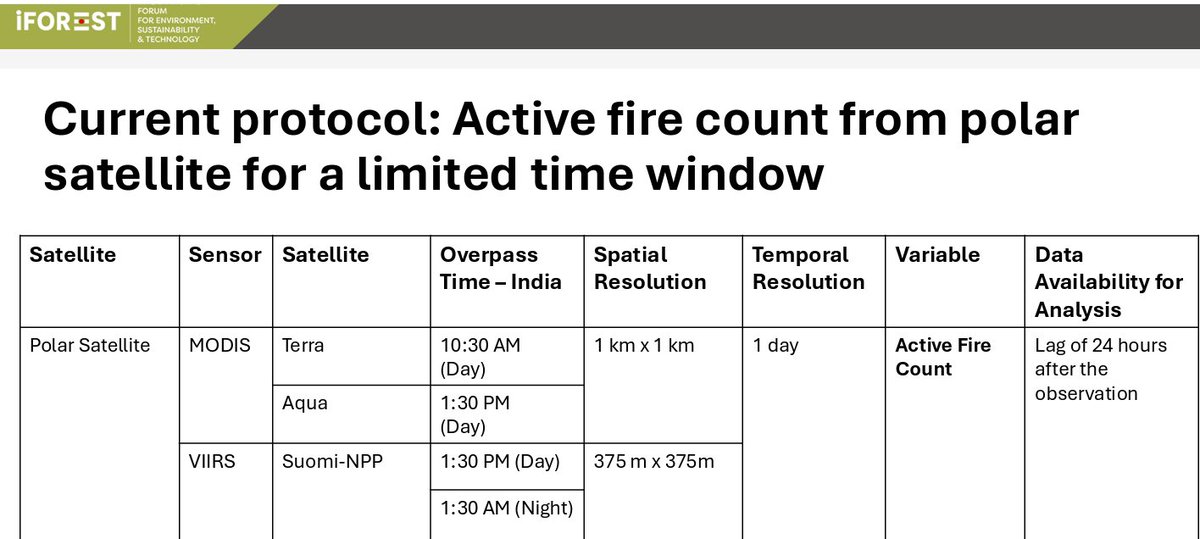
2. The farm fire count reported `officially' by various governments/agencies is based on data from three satellites - Terra, Aqua and Suomi-NPP. They use two primary sensors - MODIS and VIIRS. Data from these sensors is publicly available on NASA's WorldView site. But here is the problem ...
Delhi-NCR entered Diwali under GRAP III curbs.
On @IndiaTV's Aaj Ki Baat, iFOREST CEO Dr @Bh_Chandra highlighted stubble burning's contribution to the smog– particularly a 4–5x rise in Punjab farm fires this past week and gaps in satellite monitoring.
iFOREST's #FireWatch helps address these gaps.
🔗 https://t.co/zh90aZ0Hcz
While firecrackers spike air pollution, iFOREST’s Fire Watch tracks another seasonal source: stubble burning.
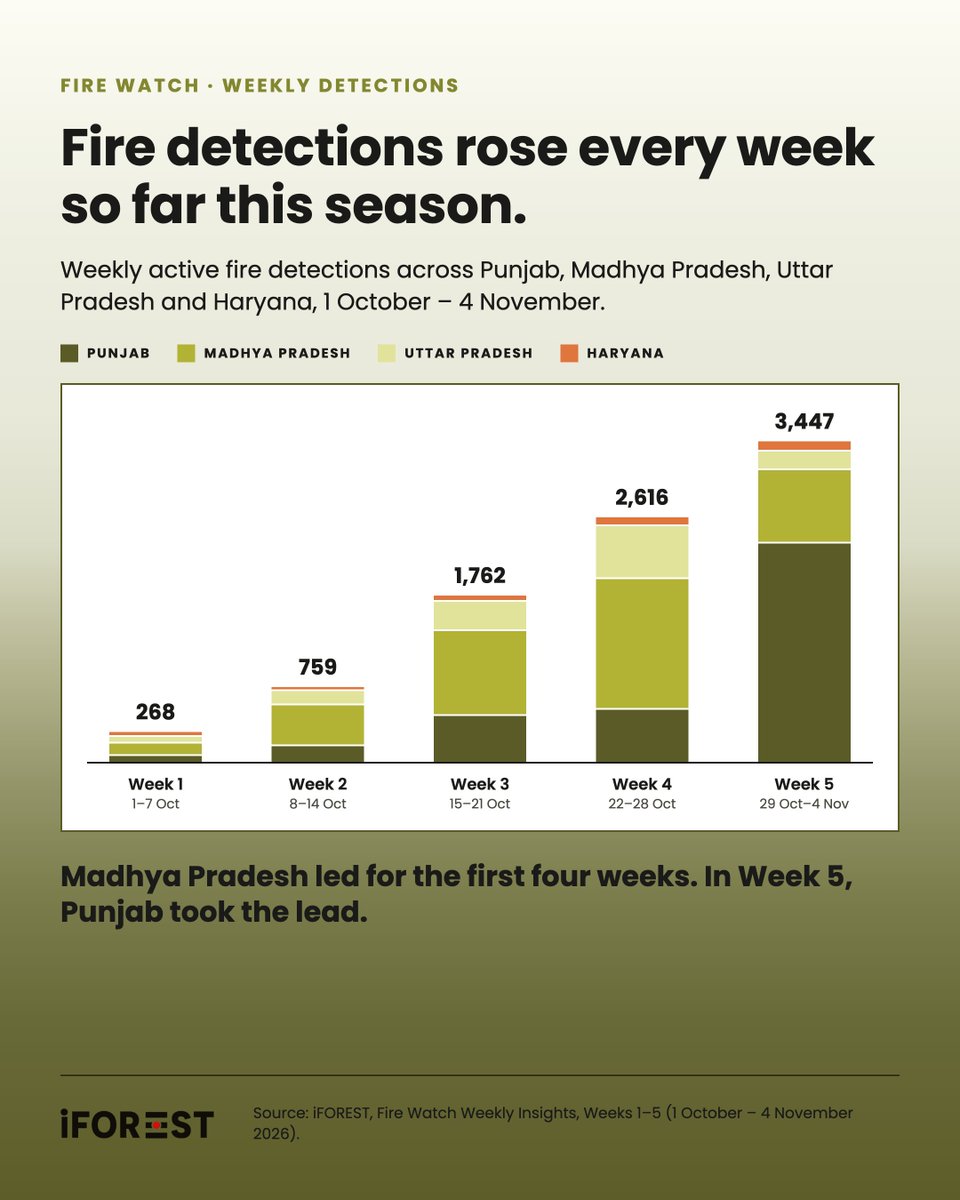
Weekly active fire detections across Punjab, MP, UP and Haryana rose nearly 13-fold from 1 Oct–4 Nov.
First overview below. More next week. #FireWatch
Stubble burning is a growing concern beyond North India—and addressing it requires more than counting fires or penalising farmers.
Speaking to @sardesairajdeep on @IndiaToday, iFOREST CEO Dr @Bh_Chandra highlighted three key issues:
• A widening geographical footprint: Satellite observations show substantial agricultural burning in Madhya Pradesh, Haryana and Uttar Pradesh, with data also documenting the practice in states such as Odisha and Maharashtra.
• Seasonal impacts: Annual pollution averages can mask the substantial contribution of stubble burning during critical weeks when atmospheric conditions restrict pollutant dispersal across the Indo-Gangetic Plain.
• Economic alternatives: Developing markets for crop residue—including paper, compost, energy and industrial fuel—can provide farmers with viable alternatives to burning.
Making crop residue economically valuable to farmers must be central to a long-term solution.
Watch the discussion.
#AirPollution #StubbleBurning #CropResidueManagement
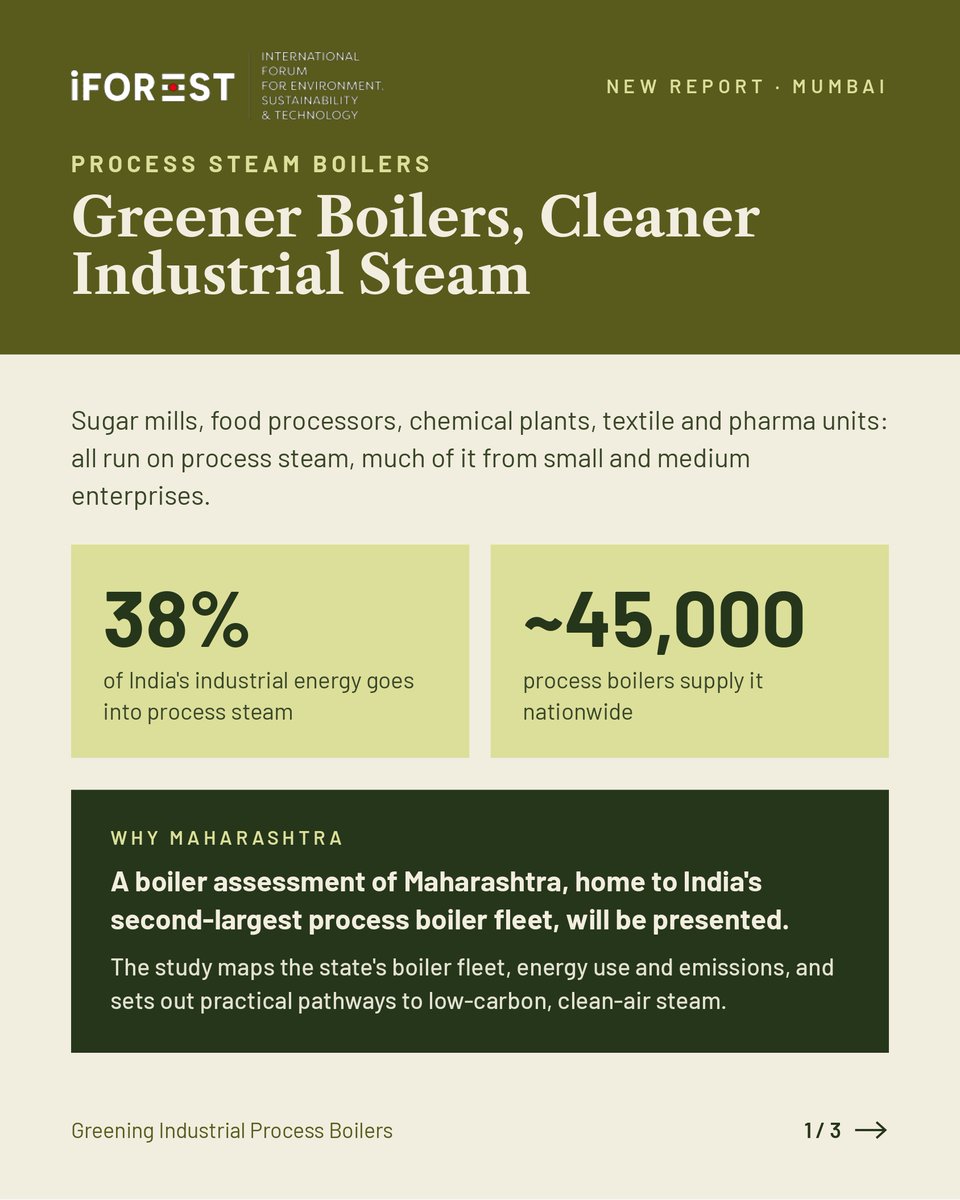
Process steam uses ~38% of India’s industrial energy.
On 12 Nov in Mumbai, iFOREST presents a boiler assessment of Maharashtra, home to India’s second-largest process boiler fleet, with panels on cleaner industrial steam.
⏰10:00 AM – 5:00 PM
📍IMC Chamber of Commerce and Industry, Churchgate, Mumbai
🔗Register: https://t.co/UXZB7eZONC
@Bh_Chandra@sresthab@mandvi7@prats_phoenix@SKKanchan_
#GreenBoilers #IndustrialDecarbonisation #CleanAir #Maharashtra #EnergyEfficiency
🎉 We’re pleased to welcome K V Kiran Kumar to iFOREST as Deputy Director in our #IndustrialDecarbonization team.
A BEE Accredited Energy Auditor with over two decades of experience, Kiran has worked on the PAT scheme, World Bank–GEF projects, and energy audits of more than 450 MSMEs across the cement, steel, power, and other energy-intensive sectors.
Fire Watch is now live!
iFOREST has launched Fire Watch, a satellite-based dashboard that moves beyond conventional fire counts to show where, when and how extensively agricultural burning takes place.
Combining multiple satellite datasets, it tracks active fires, identifies the timing of large fires and estimates burnt area using high-resolution imagery.
The dashboard currently covers Punjab, Haryana, Uttar Pradesh and Madhya Pradesh across both Kharif and Rabi seasons.
A revealing finding: Conservative estimates indicate that 15,504 sq. km of farmland was burnt in Punjab during Rabi 2026, compared with 11,085 sq. km during Kharif 2025. Yet Kharif burning attracts far greater attention because autumn and winter atmospheric conditions restrict pollutant dispersal.
At today's launch, panellists emphasised the need for better satellite monitoring and ground verification, farmer-centred residue management, crop diversification and more accessible, year-round public communication on air pollution.
As iFOREST CEO Dr Chandra Bhushan noted, better evidence can help shift the debate from competing fire counts towards effective solutions.
🔗 Explore Fire Watch: https://t.co/zh90aZ0Hcz
📊 Check back every Friday, on the dashboard or across our social channels, for weekly insights into the season's stubble-burning trends.
#FireWatch #StubbleBurning #AirPollution #SatelliteMonitoring
Agricultural stubble burning varies across regions, seasons and even times of day. Understanding these patterns is critical to designing effective interventions to tackle this persistent source of seasonal air pollution.
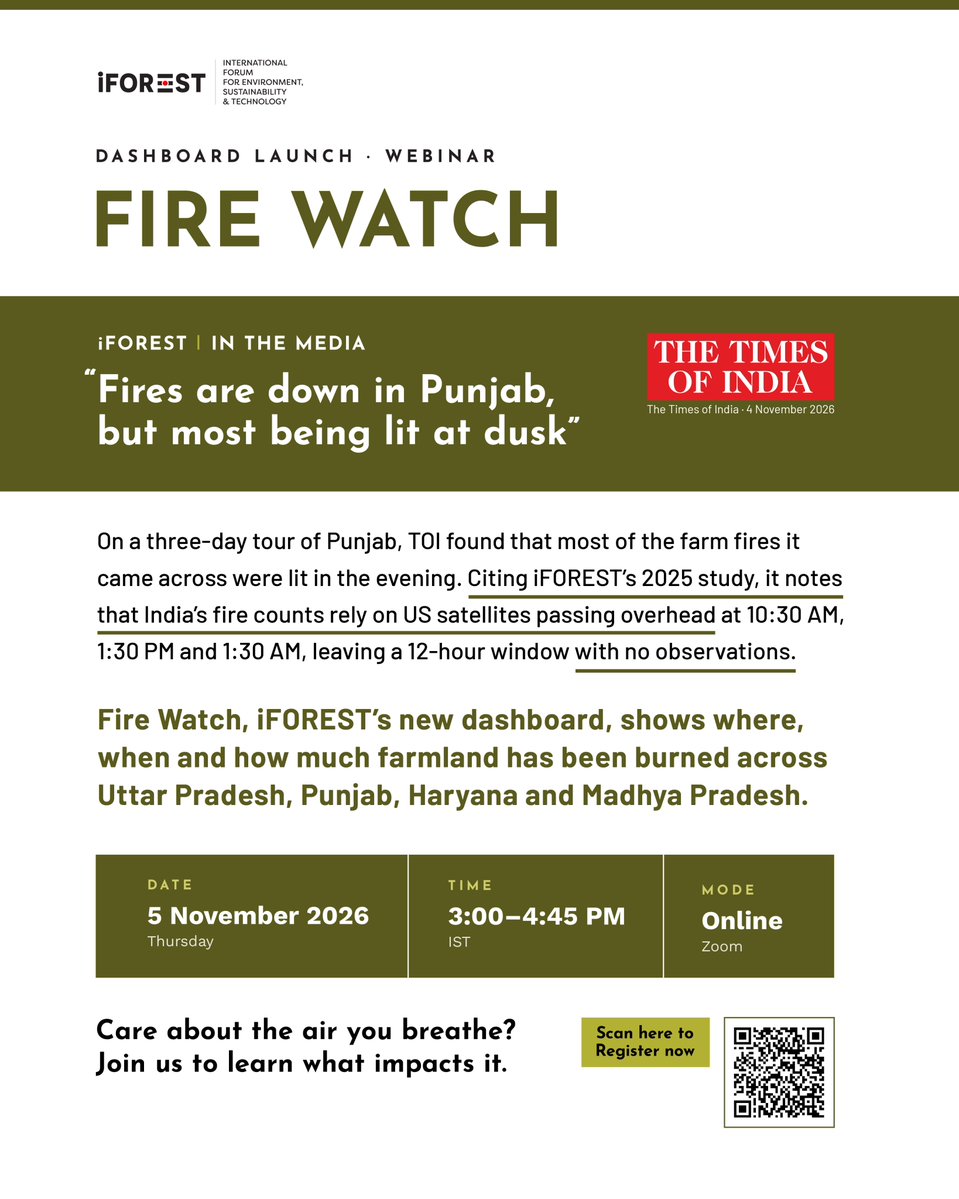
Today, iFOREST launches Fire Watch, a new satellite-based dashboard that goes beyond counting active fires to examine when burning takes place and how much agricultural land is actually burnt.
Initially covering Punjab, Haryana, Uttar Pradesh and Madhya Pradesh across both Kharif and Rabi seasons, Fire Watch brings together multiple sources of satellite data to provide a fuller picture of agricultural burning.
The dashboard can help policymakers target interventions, industry identify opportunities for crop-residue utilisation, researchers study burning patterns, and citizens better understand the problem.
Join us today to explore the dashboard, learn how to use it and discuss how better monitoring can inform more effective action.
📅 5 November | 3:00–4:45 PM IST
📍 Online | Zoom
🔗 Register: https://t.co/NvB03WUZtk
#FireWatch #AirPollution #StubbleBurning
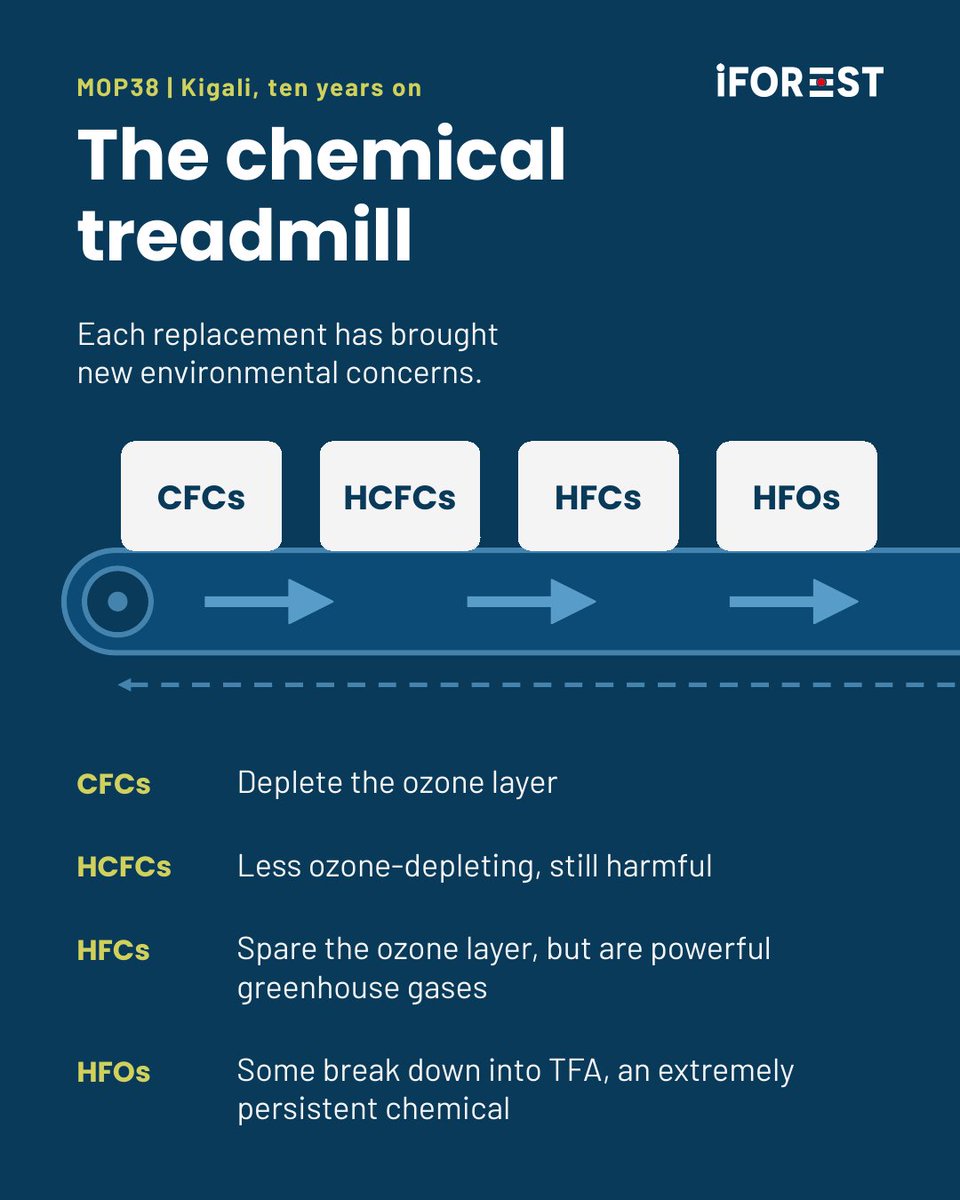
Ten years after the Kigali Amendment, countries are back in Kigali for #MOP38.
The Montreal Protocol has eliminated about 99% of controlled ozone-depleting substances. Yet successive shifts from CFCs to HCFCs, HFCs and now HFOs have created what iFOREST CEO Dr @Bh_Chandra calls a “chemical treadmill”, with each replacement introducing new environmental concerns.
A 2017 UN Environment Ozone Award recipient for his contributions to the Kigali Amendment, Dr Bhushan argues that the Protocol's next challenge goes beyond refrigerants. With electricity consumption accounting for most of an AC's lifetime climate impact, the treaty must expand its ambit to the broader goal of sustainable cooling.
Read his Times of India column: https://t.co/shovcE5bxw
#SustainableCooling
Are declining farm fire counts telling us the full story?
A @timesofindia report published today cites iFOREST's 2025 research, highlighting how agricultural fires lit in the evening can escape conventional satellite monitoring.
As questions persist over how accurately agricultural burning is measured, iFOREST is launching Fire Watch, a new satellite-based dashboard offering a more comprehensive picture of farm fires across harvest seasons, initially covering four Indian states.
Join us tomorrow to explore how better monitoring can inform more effective responses to air pollution.
📅 5 November | 3:00–4:45 PM IST
🔗 Register: https://t.co/NvB03WUZtk
#FireWatch #AirPollution #StubbleBurning #SatelliteMonitoring
#FireWatch| Meet the experts joining the launch of Fire Watch, iFOREST’s satellite-based dashboard tracking the geographical distribution, timing and scale of agricultural burning across northern India.
Every harvest season, farm fires contribute to worsening air pollution. But do we have an accurate picture of where they occur, when they peak, and how much land is affected?
Hear from researchers, practitioners and journalists on how better data can lead to better policy.
Panellists
• Shri @umendradutt, Executive Director, Kheti Virasat Mission
• Prof. @somagnik, Head, Centre for Atmospheric Sciences, IIT Delhi
• Ms @JamwalNidhi, Founding Editor, ON AIR | HEAL | JUGNOO
• Mohammad Rafiuddin, Programme Lead, CEEW
• Prof. Prabhjyot Kaur Sidhu, Department of Climate Change and Agriculture, Punjab Agricultural University
📅 5 Nov 2026
🕐3:00–4:45 PM IST
🔗Register here :https://t.co/NvB03WUZtk
@Bh_Chandra@sresthab@prats_phoenix@mandvi7@SKKanchan_
#FireWatch #AirPollution #FarmFires #CleanAir #DataForPolicy
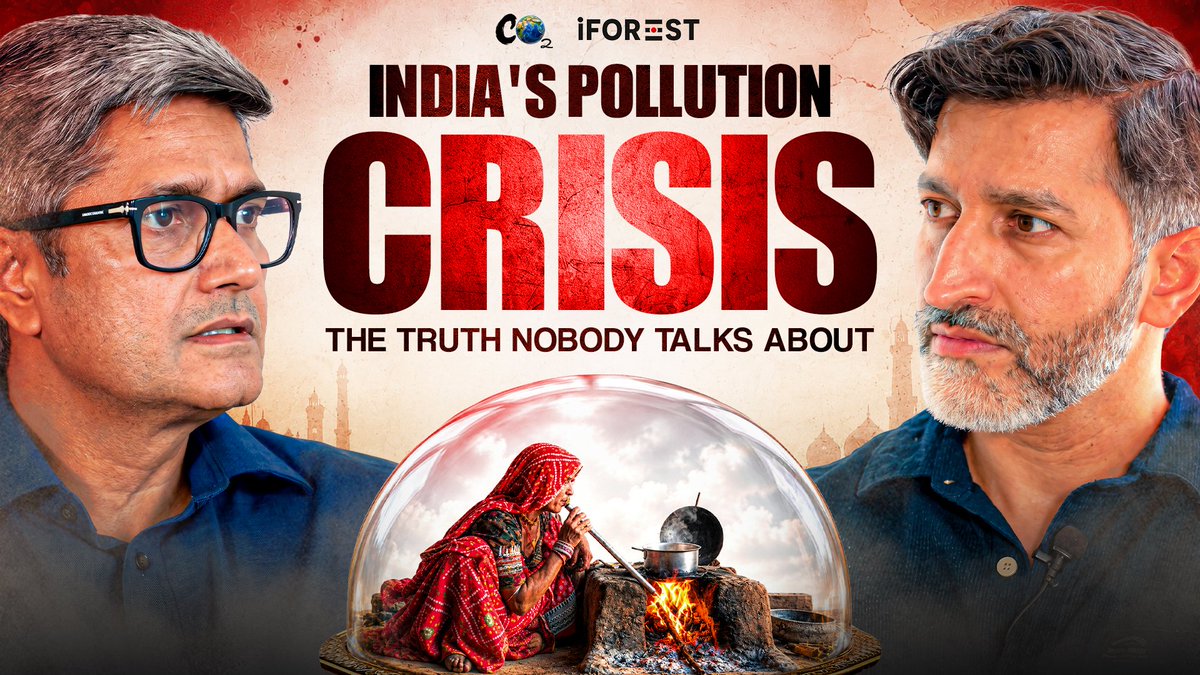
#OutNow| What is really polluting India's air?
Every winter, a blanket of smog hangs over India's cities. Air pollution affects everyone, but its burden is unequal. Lower-income communities often face greater exposure and have fewer resources to protect themselves.
Yet the debate keeps returning to vehicles and stubble burning. Are we overlooking the biggest sources?
iFOREST's national PM2.5 emissions inventory estimates 5.2 million tonnes of direct emissions in 2021, excluding dust:
🔥55% from biomass burning, predominantly household cooking and heating
🏭37% from industry and power generation
🚚7% from transport
In Episode 13 of the COgreen Podcast, iFOREST CEO @Bh_Chandra sits with Keshav Sharma to examine what the evidence reveals and why tackling India's air pollution requires sustained, year-round action.
Watch the full episode: https://t.co/Hm9gxxB1hQ
@Bh_Chandra@sresthab@mandvi7@prats_phoenix@SKKanchan_
#AirPollution #CleanAir #Pollution #StubbleBurning #ClimateAction
#iFORESTOpinion | Mumbai's air pollution is a regional problem, not just a city problem.
In his latest column for @timesofindia, iFOREST CEO @Bh_Chandra explains why cleaning Mumbai's air requires looking beyond @mybmc limits to the wider Mumbai Metropolitan Region (MMR).
Rapid urbanisation, rising vehicle numbers and industrial expansion across the MMR are contributing to the city's worsening air quality.
His recommendations include a regional clean air plan, stronger industrial enforcement, cleaner energy, better public transport and effective dust and waste management.
With coordinated action, Mumbai can cut its pollution levels by more than half within five years.
🔗Read the complete article: https://t.co/G2VF8knOeb
@Bh_Chandra@sresthab@mandvi7@prats_phoenix
#AirPollution #CleanAir #MumbaiPollution #Pollution