Every year, the same debate returns: Is stubble burning responsible for the poisonous air that engulfs Delhi-NCR from late October, or is the city simply choking on pollution from its own vehicles and industries? It is time to settle this debate.
Between 26 October and 5 November, Delhi’s PM2.5 levels tripled—from 72 to 226 µg/m³. What drove this surge in pollution?
Read my latest column in @timesofindia to understand the anatomy of Delhi’s air pollution.
👉 https://t.co/z13Pachqno
@ramanmann1974 My analysis examines sudden rise in pollution between 26 October-5 November, while Dr. Beig’s focuses specifically on Diwali day. The two address different questions. There is no need to frame this as Diwali versus Parali. Both are sources of pollution, and both need to be addressed.
Every year, the same debate returns: Is stubble burning responsible for the poisonous air that engulfs Delhi-NCR from late October, or is the city simply choking on pollution from its own vehicles and industries? It is time to settle this debate.
Between 26 October and 5 November, Delhi’s PM2.5 levels tripled—from 72 to 226 µg/m³. What drove this surge in pollution?
Read my latest column in @timesofindia to understand the anatomy of Delhi’s air pollution.
👉 https://t.co/z13Pachqno
@sandeep_PT@sandeep_PT My analysis is from 26th October to 5th November to explain the sudden surge pollution levels in 10 days. Gufran Beig comment is not a counter argument because it is only about Diwali day. Please read carefully. Thanks for your attention.
Every year, the same debate returns: Is stubble burning responsible for the poisonous air that engulfs Delhi-NCR from late October, or is the city simply choking on pollution from its own vehicles and industries? It is time to settle this debate.
Between 26 October and 5 November, Delhi’s PM2.5 levels tripled—from 72 to 226 µg/m³. What drove this surge in pollution?
Read my latest column in @timesofindia to understand the anatomy of Delhi’s air pollution.
👉 https://t.co/z13Pachqno
From Nagpur to New York- a breathtaking journey!
Our 2020 Anjani Mashelkar Prize winner, Dozee, pioneered an under-mattress sensor https://t.co/MtjPcZXlcY
It tracks 8+ vitals (including continuous BP) without ever touching the patient, instantly alerting nurses to any danger.👇
What began as a way to convert COVID ward beds into ICUs in 2 mins is now US FDA cleared, saving 10M+ nursing hours globally.
Proud to have backed their spark!
Join us to champion the next breakthrough at the 2026 Anjani Mashelkar Prize ceremony on Nov 17. 👇
@PuneIntCentre@doctorsoumya@aparanjape@sushilborde@dinakholkar@Girbane
Fire Watch is now live!
iFOREST has launched Fire Watch, a satellite-based dashboard that moves beyond conventional fire counts to show where, when and how extensively agricultural burning takes place.
Combining multiple satellite datasets, it tracks active fires, identifies the timing of large fires and estimates burnt area using high-resolution imagery.
The dashboard currently covers Punjab, Haryana, Uttar Pradesh and Madhya Pradesh across both Kharif and Rabi seasons.
A revealing finding: Conservative estimates indicate that 15,504 sq. km of farmland was burnt in Punjab during Rabi 2026, compared with 11,085 sq. km during Kharif 2025. Yet Kharif burning attracts far greater attention because autumn and winter atmospheric conditions restrict pollutant dispersal.
At today's launch, panellists emphasised the need for better satellite monitoring and ground verification, farmer-centred residue management, crop diversification and more accessible, year-round public communication on air pollution.
As iFOREST CEO Dr Chandra Bhushan noted, better evidence can help shift the debate from competing fire counts towards effective solutions.
🔗 Explore Fire Watch: https://t.co/zh90aZ0Hcz
📊 Check back every Friday, on the dashboard or across our social channels, for weekly insights into the season's stubble-burning trends.
#FireWatch #StubbleBurning #AirPollution #SatelliteMonitoring
Agricultural stubble burning varies across regions, seasons and even times of day. Understanding these patterns is critical to designing effective interventions to tackle this persistent source of seasonal air pollution.
Today, iFOREST launches Fire Watch, a new satellite-based dashboard that goes beyond counting active fires to examine when burning takes place and how much agricultural land is actually burnt.
Initially covering Punjab, Haryana, Uttar Pradesh and Madhya Pradesh across both Kharif and Rabi seasons, Fire Watch brings together multiple sources of satellite data to provide a fuller picture of agricultural burning.
The dashboard can help policymakers target interventions, industry identify opportunities for crop-residue utilisation, researchers study burning patterns, and citizens better understand the problem.
Join us today to explore the dashboard, learn how to use it and discuss how better monitoring can inform more effective action.
📅 5 November | 3:00–4:45 PM IST
📍 Online | Zoom
🔗 Register: https://t.co/NvB03WUZtk
#FireWatch #AirPollution #StubbleBurning
IMPORTANT: Where @Bh_Chandra explains how stubble burning is now a ‘national’ phenomenon , not just confined to Punjab, in fact this year it is Madhya Pradesh that has seen max cases of stubble burning. Listen in.
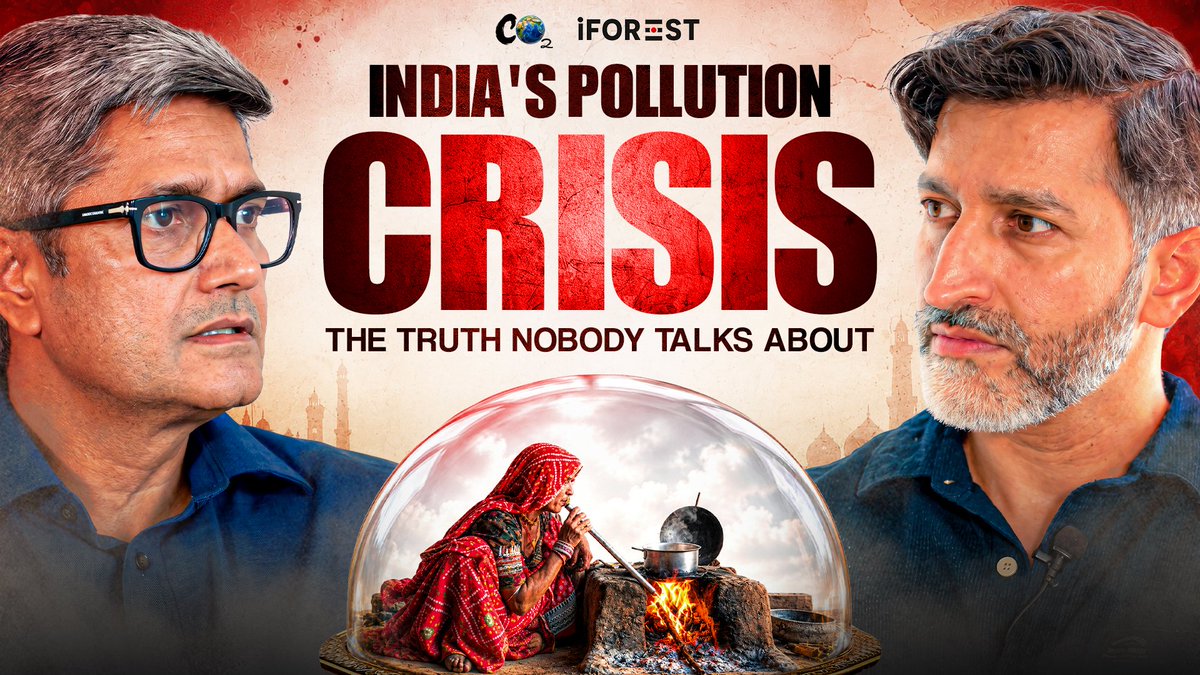
#OutNow| What is really polluting India's air?
Every winter, a blanket of smog hangs over India's cities. Air pollution affects everyone, but its burden is unequal. Lower-income communities often face greater exposure and have fewer resources to protect themselves.
Yet the debate keeps returning to vehicles and stubble burning. Are we overlooking the biggest sources?
iFOREST's national PM2.5 emissions inventory estimates 5.2 million tonnes of direct emissions in 2021, excluding dust:
🔥55% from biomass burning, predominantly household cooking and heating
🏭37% from industry and power generation
🚚7% from transport
In Episode 13 of the COgreen Podcast, iFOREST CEO @Bh_Chandra sits with Keshav Sharma to examine what the evidence reveals and why tackling India's air pollution requires sustained, year-round action.
Watch the full episode: https://t.co/Hm9gxxB1hQ
@Bh_Chandra@sresthab@mandvi7@prats_phoenix@SKKanchan_
#AirPollution #CleanAir #Pollution #StubbleBurning #ClimateAction
#iFORESTOpinion | Mumbai's air pollution is a regional problem, not just a city problem.
In his latest column for @timesofindia, iFOREST CEO @Bh_Chandra explains why cleaning Mumbai's air requires looking beyond @mybmc limits to the wider Mumbai Metropolitan Region (MMR).
Rapid urbanisation, rising vehicle numbers and industrial expansion across the MMR are contributing to the city's worsening air quality.
His recommendations include a regional clean air plan, stronger industrial enforcement, cleaner energy, better public transport and effective dust and waste management.
With coordinated action, Mumbai can cut its pollution levels by more than half within five years.
🔗Read the complete article: https://t.co/G2VF8knOeb
@Bh_Chandra@sresthab@mandvi7@prats_phoenix
#AirPollution #CleanAir #MumbaiPollution #Pollution
iFOREST has signed a Memorandum of Understanding with the West Bengal State Electricity Distribution Company Limited (@WBSEDCL1 ) to support West Bengal in clean energy initiatives.
The MoU was signed on 30 October 2026 at Bidyut Unnayan Bhaban in Presence of Shri Santanu Basu, IAS, Principal Secretary, Department of Power, Government of West Bengal.
Under the MoU, iFOREST will provide technical support on renewable energy planning, policy , capacity building and implementation.
This builds on iFOREST's ongoing clean energy work with state governments across eastern India.
@Bh_Chandra@sresthab@mandvi7@prats_phoenix@SKKanchan_
#CleanEnergy #RenewableEnergy #EnergyTransition #WestBengal
Just released | BRSR Disclosure: ESG Performance Assessment of the Cement Sector (FY24 & FY25)
India’s cement industry is more energy-efficient than the global average. Yet rising emissions, increasing groundwater use in water-stressed regions, deteriorating occupational health and safety performance, and gaps in voluntary disclosures reveal significant challenges.
Launched today at India Habitat Centre, New Delhi, iFOREST’s new report assesses 18 cement companies, representing nearly 87% of India’s cementitious material production, across 107 ESG indicators.
The launch was attended by industry experts and leaders from the cement sector, government and the ESG community.
📄 Read the report for a detailed assessment of the sector’s ESG performance, disclosure practices and areas requiring attention:
🔗 https://t.co/ghnWBjPdQU
@Bh_Chandra@sresthab@prats_phoenix@mandvi7@SKKanchan_@ACCLimited@AmbujaCementACL@AdityaBirlaGrp@Dalmia_Cement@theHCIndia@TheIndiaCements@JKCementIndia@JKLCofficial@KcpLimited@MangalamCement@NuvocoVistas@PrimeCementRw@RamcoCements@sagarcements@shreecementltd@UltraTechCement
#BRSR #ESG #CementIndustry #Sustainability #Decarbonisation
Today in Lucknow, iFOREST launched its new report, Powering Uttar Pradesh’s Green Economy: Jobs, Skills and Entrepreneurship Opportunities, in partnership with the State Transformation Commission, Government of Uttar Pradesh.
The report was released in the presence of Chief Guest Mr. Manoj Kumar Singh, CEO, @Stc_upgov and other government officials and industry experts.
The study assesses what UP’s investments in renewable energy, electric mobility, green hydrogen and bioenergy mean for jobs and the state’s workforce.
Read the complete report here: https://t.co/PpvmAkHP02
@Bh_Chandra@sresthab@prats_phoenix@mandvi7@UPNEDA_Agency@ALIndiaOfficial
#GreenJobsUP #GreenJobs #UttarPradesh #GreenGrowth #SkillDevelopment #SustainableDevelopment #GreenEconomy #FutureOfWork #RenewableEnergy #JustTransition #iFOREST #UPDevelopment
Air pollution is not only Delhi’s or Mumbai’s problem. It is a subcontinental crisis.
The real progress in controlling air pollution will begin only when we acknowledge the true scale and sources of our pollution crisis.
Every winter, a vast arc of brown haze engulfs the Indo-Gangetic Plain, stretching across thousands of kilometres.
The satellite animation below shows how dramatically this haze expanded and shifted between 18 and 23 October 2026. On 22 October, it stretched across vast areas of Gujarat, Rajasthan, Punjab, Haryana, Delhi, Uttar Pradesh and beyond.
And this is only the beginning.
As winter sets in and stubble burning intensifies, a massive blanket of haze, reaching up to 3 km in thickness, is likely to spread across much of northern and eastern India—from Gujarat and Punjab to West Bengal, Assam and Tripura. Its influence will extend into peninsular India, affecting cities such as Mumbai.
Yet, despite knowing the major sources of pollution, we will spend another winter arguing about who is responsible. Governments will announce emergency measures, impose restrictions and implement GRAP. And, as in previous years, these reactive measures will do little to address the underlying problem.
We cannot solve a subcontinental pollution crisis through fragmented, city-centric emergency responses.
It is time we moved beyond the optics of odd-even schemes, GRAP, construction bans and artificial rain. The real solutions are well known: eliminate open burning and transition decisively from polluting fuels to cleaner fuels and technologies across industry, transport, households and other sectors.
No country has successfully overcome its air pollution crisis without fundamentally changing how it burns fuels and manages emissions.
India will be no exception.
Source: NASA Worldview satellite imagery, 18–23 October 2026.
@BjornLomborg has become a broken record. Since The Skeptical Environmentalist, his refrain has barely changed: environmental problems are exaggerated, climate action is too expensive, and growth should come at all costs. In three decades, the science has moved, the evidence has mounted and clean energy costs have plummeted, but Lomborg has stayed exactly where he was.
His column, “Eyes now on Viksit, net zero later”, published in @EconomicTimes on October 16, follows the script. This time the target is India. He argues that India’s ambition to become a developed country by 2047 and its commitment to net-zero emissions by 2070 “work at cross-purposes”, presenting an “immense trade-off” in which trying to achieve both will make Indians poorer.
But there is one little problem: his conclusions are based on distortions and misrepresentations of facts. I have challenged his arguments in my latest column in @EconomicTimes today. Shubh Vijayadashami!
Links:
1. https://t.co/uEOn0ho8a1
2. https://t.co/9fQp7QvtJL