Borgu: We Must Never Normalise the Killing of Nigerians
The reports emerging from Borgu, Niger State, are becoming increasingly difficult to comprehend and deeply painful to contemplate. On 27 August, I expressed my anguish over the reported abduction of about 600 Nigerians, many of them women, children and elderly people, alongside the killing of others. I described it then as “one case too many” and urged that it be treated with the urgency it deserved.
Today, that anguish has become even deeper. We are now confronted with continuing reports of the gruesome killing of some of those abducted, while many others remain unaccounted for.
In another disturbing incident, a bandit group reportedly beheaded a Nigerian and sent his severed head to a community leader over a ₦50 million levy. If the reported killing was intended to increase pressure on the community and extract more money for those still being held, then we must recognise the terrible reality before us: human life is being deliberately turned into a bargaining instrument.
One person is killed to terrorise an entire community, while others are kept alive as hostages for more ransom. This is not merely criminality; it is the systematic devaluation of human life. These are not statistics. They are Nigerians. They are mothers, fathers, children, brothers, sisters and elderly people. Their only offence was to live in communities where the protection of the state has become increasingly inadequate.
We must therefore ask ourselves a fundamental question: At what point do we, as a nation, decide that this is no longer acceptable? We cannot continue to normalise the kidnapping of hundreds of citizens, the killing of innocent people, the imposition of levies on communities, the displacement of entire populations and the payment of ransom as though these are unavoidable features of Nigerian life.
The consequences of insecurity go beyond those abducted or killed. Families are displaced, farms abandoned, businesses destroyed, children deprived of education, and citizens forced to seek safety elsewhere. Insecurity ultimately destroys both lives and public confidence in government.
Nigeria cannot continue reacting only after lives are lost. We need intelligence-led operations, stronger community security, rapid response, better coordination and equipment for our security forces, effective border protection, and sustained action against criminal networks.
The primary responsibility of government is the security and welfare of its citizens. While politicians prepare for elections, Nigerians are asking for something more fundamental: the right to live. We must never accept a Nigeria where kidnapping, ransom, criminal levies and the killing of innocent citizens become normal. Every Nigerian life matters. Every victim deserves justice. Every community deserves protection.
Our prayers must be matched with action. No criminal group should determine who lives or dies anywhere in Nigeria. Nigeria must restore security, justice, and the dignity of human life.
A New Nigeria is POssible. -PO
Today we celebrate the birth of a little girl who would be called to become the Mother of her Creator, the Mother of God. Yet, she is born simply as a little girl, like the daughters and granddaughters we hold in our arms. We bestow upon her the most exalted and noble titles, such as Our Lady and Queen, but God’s way was and remains simpler and quieter, yet no less powerful and transformative. It is the way of Jesus Himself. #NativityOfMary
Do not be afraid to sow without immediately seeing the fruits. The sowing belongs to you; the growth belongs to God. No gesture carried out in the name of Christ is useless.
Peter Obi’s political journey has been one of persistence, resilience and service. From Anambra to date, through every storm, he has remained standing.
Today, the Rock is also the Rising Sun, a beacon of hope, renewal and a brighter Nigeria.
#NigeriaWillBeOK
“Nobody needs to d!e because of an election. Nigerians should not vote for any politician who violates the Peace Accord ahead of the 2027 elections.”
His Excellency Mr. Peter Obi -NDC Presidential Candidate.
By Making Excuses for Unverified Certificates, We Are Planting Poison in the Soul of Our Society
A nation that tolerates unverified academic credentials at any level of leadership, regardless of who is involved, risks destroying the very standards upon which a society is built. The issue is not about an individual. It is about standards, accountability, and the values we choose to pass on to the next generation.
We cannot continue to excuse blurred, missing, questionable, or unverified credentials simply because they belong to someone we support. The process through which people attain positions of responsibility matters greatly. How we get into leadership is as important as what we do with leadership.
If we normalise the abandonment of basic verification today, tomorrow we may have professors who never attended a university, doctors who never studied medicine, and judges who never studied law.
That is the dangerous precedent we must never allow. Nigeria cannot sacrifice its future on the altar of today's transactional politics. We must build a society where truth is not partisan, standards are not negotiable, and accountability applies equally to everyone.
History will judge us not only by those we defended, but by the principles we were willing to defend. We must choose truth over convenience, standards over sentiments, and the future over political expediency.
A New Nigeria is possible, but only if we are willing to do the right thing, even when it is inconvenient. -PO
“If I love Jesus, I ought to resemble Him. If I love Jesus, I ought to love what He loves, what He prefers to all else: humility” ~ St. Peter Julian Eymard
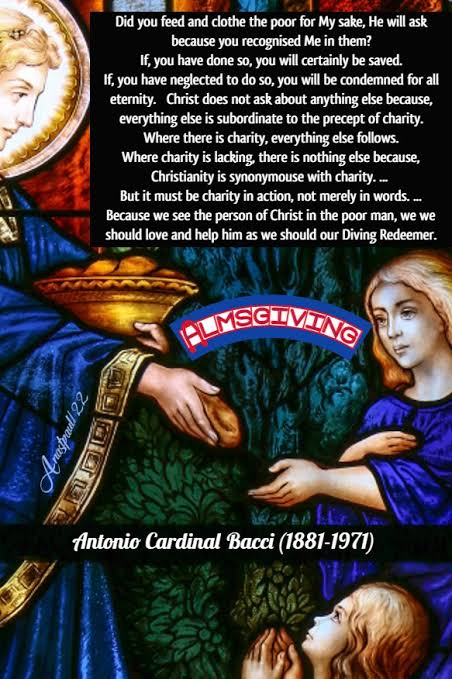
Almsgiving
1. The view has been expressed that almsgiving is useless and degrading. It is useless, it has been said, because the implementation of social justice should be sufficient to provide for the needs of everybody; and it is degrading, it has been held, because it places the poor man in a position of inferiority to the rich man, and makes him beg for that which is really his right.
This is a false line of reasoning. Social justice can and should do a great deal to achieve a more equal distribution of wealth among men. But social justice cannot do everything.
Until the end of the world the weak will always succumb in the battle of life before the energy and enterprise of the strong. There will always be unfortunates who by reason of some tragic accident are unable to fend for themselves. No matter what form it takes, the State will not be able to provide fully for the disabled and infirm.
There will always be plenty of scope for Christian charity, which does not proceed with the measured stride of justice but with the swift wings of the love of God. It seeks out sorrows which need to be assuaged and wants which need to be relieved. There will always be suffering and want upon earth. “The poor you have always with you,” (Mt. 26:11) Jesus has told us.
It cannot be said that almsgiving is degrading because it makes the receiver inferior to the giver. This may be so if alms are given from motives of mere philanthropy. But when almsgiving is accompanied by charity and understanding and the donor sees in the poor man the person of Jesus Christ, there is no difference of status between the two individuals. They are brothers who wish to love and help one another, since both are members of the mystical Body of Christ. In this case it is more blessed to give than to receive.
Christian almsgiving is the fulfilment of an obligation and is a source of merit for the giver. As for the receiver, not only are his wants relieved, but he is the means by which his wealthier brother can acquire merit and fulfil his obligations.
2. Even if it is not very great, wealth is a dangerous thing. It is a burden which hampers us spiritually unless it is enriched by charity. Of itself, wealth is opposed to the spirit of the Gospel. In the Church of God, therefore, the only fitting role which rich men can assume is to place their abundance at the service of charity and become the servants of the poor.
St. Thomas Aquinas says that wealth can be an instrument of virtue and that it is only in this sense that it can be called good. If it impedes the practice of virtue, then it is evil. (Contra Gentes, 111:134) Let us make good use of our assets, therefore, and give generously to those who are in need without allowing our motives to become tainted with self-interest.
“Sell what you have and give alms,” said Christ. “Make for yourselves purses that do not grow old, a treasure unfailing in heaven where neither thief draws near nor moth destroys.” (Luke 12:33) It is the possession of this kind of treasure that will comfort us at the hour of death.
3. We must be detached from the goods of this world because they are corruptible and cause us to forget God. Even if we have been placed in easy circumstances, let us be poor in spirit. We can be poor in spirit by giving alms from motives of Christian charity. We need the mercy of God, and Our Lord has told us that He will be merciful only to those who show mercy to others.
We need God's forgiveness for all our sins, and the Holy Spirit assures us that our iniquities are redeemed by almsgiving. “Redeem thou thy sins with alms and thy iniquities with works of mercy to the poor.” (Dan. 4:24) Almsgiving is a means to our personal sanctification. (Antonio Cardinal Bacci)
So three Sundays ago, I gave First Holy Communion to a young man after I had baptized him. He is a footballer and had been attending catechism classes for a while.
After Mass he came to give me a testimony.
That he had been experiencing great pain on his leg and couldn’t kneel but since he had to kneel to receive Holy Communion he did his best. He confessed that he stopped feeling the pains after receiving the Holy Communion.
I asked him to observe and come back and tell me if the pains return.
Now he even attends weekday Masses and I see him kneeling comfortably. Sometimes the Spirit makes intercession for us even when we do not expect it. God is good. All the time.
Every ex-Catholic that I know who has become Protestant has done so for one of two reasons.
Either they didn't like some priest; or,
Being Catholic made too many demands upon them and how they lived their lives.
Every Protestant that I know who has become Catholic has done so for one - and only one - reason.
They had decided that Catholicism was the One, True, and Holy Church.