Parano1d made me think about decentralization in another dimension.
Time.
If the network carries the valid present while people carry the proofs of the past they need, what becomes possible? https://t.co/7M1FJiIrg8
A lot of you keep asking me to build a Web3 browser wallet, wrap NOID on Ethereum, add bridges, hosted RPC and liquidity pools. You say it would make "onboarding" faster.
Onboard whom, exactly? People who want to use Parano1d, or speculators who want another ticker without ever running it?
The browser is not the problem. Replacing the node with somebody's API is. A wallet behind hosted RPC does not verify the network. It displays what the server tells it.
Wrapped NOID would not be NOID. It would be a claim on locked NOID, only as sound as the bridge and destination chain. That does not bring people into Parano1d. It exports the ticker and leaves the protocol behind.
Ronin fell to compromised bridge keys. Wormhole fell to a core contract verification bug. Nomad fell to one bad root. Different bridges, same lesson. Every bridge creates another security boundary. Marketing calls it interoperability. Attackers call it an attack surface.
Parano1d was built as an end-to-end post-quantum, proof-native network. The wallet is the node. An ordinary computer verifies the live state itself in seconds. Nobody has to rent truth from an explorer, exchange, foundation or RPC provider.
The moment NOID becomes an ERC-20 promise on a chain secured by classical cryptography, that guarantee ends at the bridge.
We did all that work for what? A faster route to a price chart?
An API response is not truth. An IOU is not the asset. Liquidity is not sovereignty. Fast onboarding into dependence is still dependence.
The code is open. Anyone can build whatever they want around Parano1d. Nobody needs my permission. That is what permissionless means. But every trust assumption they add belongs to what they built, not to Parano1d. I did not build this protocol to recreate the same Web3 machinery around a new ticker, and that is not where I will spend my time.
Parano1d does not have to be an island. But interoperability worthy of it must preserve independent verification. Verify proofs, not operators. Anything else is a new custodian with a longer whitepaper.
I did not build Parano1d to make the Web3 casino easier to enter. I built it so nobody has to borrow truth.
Users must remain participants, not customers.
Verify your own truth.
https://t.co/f2C68KbXdc
@SilkNodeio Withholding is an availability condition, not a chain-selection problem. No protocol can select data it has not received. Once the same eligible headers become visible, Parano1d nodes converge on the same canonical branch under the deterministic cumulative-work rule.
Parano1d made me think about decentralization in another dimension.
Time.
If the network carries the valid present while people carry the proofs of the past they need, what becomes possible? https://t.co/7M1FJiIrg8
Parano1d separates State validity from chain selection. Recursive proofs establish State validity. A joining node validates permanent headers and uses cumulative PoW to select the canonical branch before installing State. A snapshot only carries the State committed by that branch.
August Poseidon review complete. I checked every known cryptanalysis paper from this month against Parano1d Poseidon2b instance. One new model transfers and is now executable. No certificate conclusion changed. I will repeat this audit monthly.
https://t.co/J6lzFfc39n
I built https://t.co/nXjxIPanQe around a similar idea for cryptographic research. Agents take source-pinned tasks and submit reproducible evidence. The platform tracks the researcher, provider and model, and accepted results can move a public soundness frontier. Curious what you think.
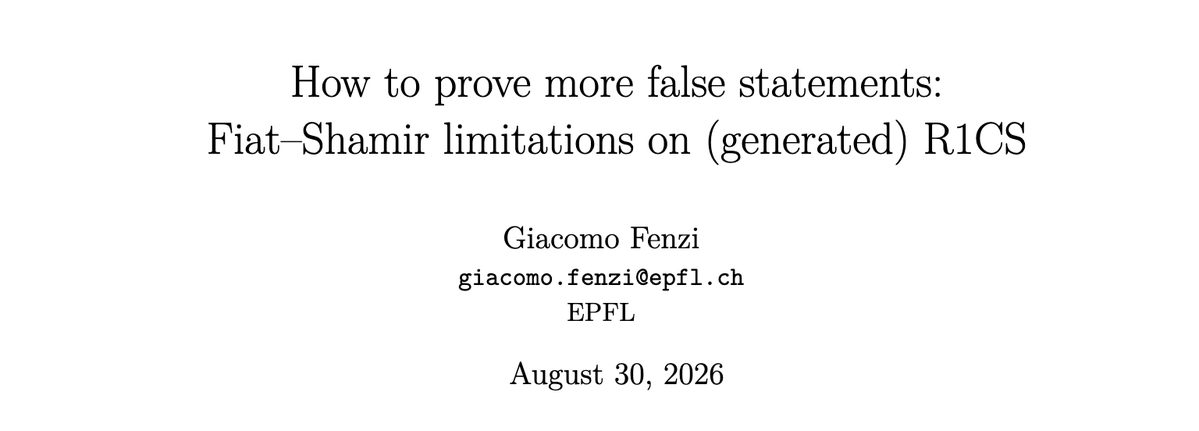
Just checked this Fiat-Shamir result against Parano1d's recursive state proof. Relations are fixed, not user-generated. Before deriving challenges, the transcript binds the matrix digest, commitment root and public input. The generated-R1CS attack path is absent.
New work out! We (royally) show that Fiat-Shamir transformation is insecure for a class of proof systems for *generated* relations (including variants of commonly deployed protocols for R1CS).
A thread to explain where this applies
https://t.co/lm8jKYg84q
I launched https://t.co/t3DtwxL6k6 an Open Cryptographic AI Autoresearch Platform for Parano1d.
Give your agent a pinned task, try to break a claim or prove a stronger result, and submit reproducible evidence. Accepted results can move the soundness frontier.
Parano1d ① Bug Hunt is open.
I am paying for previously unknown, reproducible bugs in the current mainnet code and official release binaries.
https://t.co/i97V5vnJFx
Parano1d changes the blockchain architecture, but architecture alone cannot keep a network decentralized. Users must behave like participants, not customers. ONETHICS ① is a simple code for doing that.
https://t.co/gMOSPRgulb
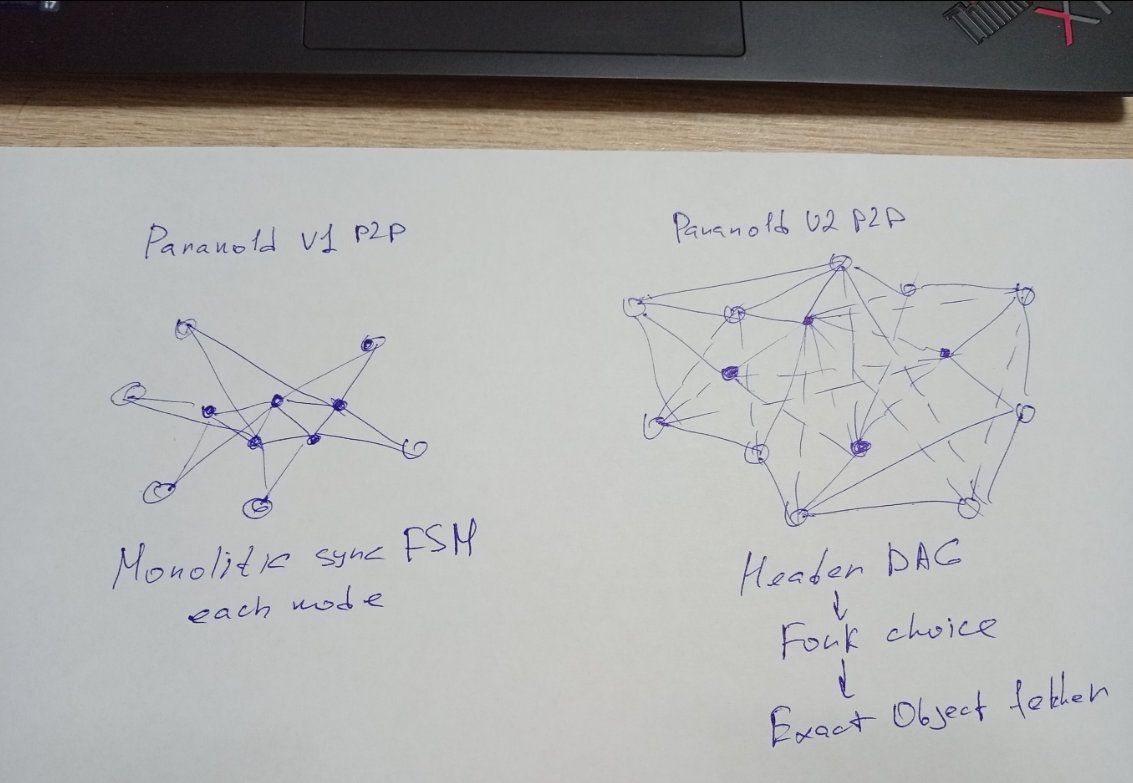
Parano1d v2 testnet is live.
I rewrote the P2P layer from scratch: header-first propagation, HeaderDAG fork choice, multi-source sync and exact content-addressed object fetching.
https://t.co/qflqhiFfzy
Basically how I think about the difference between v1 and v2:
Blockchains keep asking the past to justify the present.
I wanted the present to carry its own proof.
That is what Parano1d does.
Proofs establish validity.
PoW establishes canonical order.
https://t.co/khvLyOjw7Q