A lot of people seem shocked by China's heavy-handed retaliatory actions on Mbappé. They assumed once the Chinese understood the context - that the Mao meme was self-deprecating, that the "Chinese dictator" line was not malicious - the whole thing would get walked back as a giant misunderstanding.
Let me explain why this kind of thinking is wrong, and why they were never going to backpedal.
What happened to Mbappé is the modern version of that famous 1937 Stalin photo with Nikolai Yezhov. After Yezhov fell out of favor, the photo got retouched so comprehensively that the space where he had once stood was filled in with canal water and railing. It was as if he was never there. It's the same playbook here - once the system decided someone or something or some event is a problem, the record gets airbrushed until the problem no longer exists.
Dan Wang, in his excellent book Breakneck, describes China as an engineering state run by technocrats who excel at construction and large-scale execution. He contrasts this with America’s lawyerly society that is process-heavy, rights-oriented, and tends to get stymied by obstruction.
The same mindset that builds high-speed rail, factories, and manufacturing process knowledge also extends into social engineering that treats society, narratives, and public sentiment as systems to optimize. Wang’s examples include the One Child Policy and zero-COVID, both of which locked in once launched because the system prioritizes outcomes and consistency over flexible correction.
You'll notice that the system tends to lurch to the extremes. These numbers - One Child, Zero Covid - are seriously autistic in its drive and focus to achieve overtly neat outcomes that are humanly impossible. The targets are unrealistic and sound like engineering specs, because leaders that are literal-minded end up seeing human activity as flows that can be turned on or off with valves.
Mao remains the founding leader in official historiography; jokes or “dictator” labels challenge Party legitimacy and the narrative of national rejuvenation. Back in 2018, the Law on the Protection of Heroes and Martyrs came into effect which criminalizes the slander of those officially designated as heroes and martyrs.
So once the reaction to Mbappé's clip ignited (Weibo outrage, coordinated brand statements), however erroneous it was, however much of a misunderstsanding it was, the engineering state executed a full response that left no room for nuance or de-escalation:
> Chinese state media canceled La Liga broadcasts indefinitely
> Companies dropped him
> His face was scrubbed from all ads in China
> His products were removed from shelves
> Mbappé has been removed from Chinese versions of major football video games
> Platforms muted or restricted accounts and promotional material that mentions him.
While a lawyerly society such as ours might weigh context, free speech, the light tone, or other extenuating circumstances, the engineering state doesn't do that. It cannot self-correct mid-course. It is built to solve problems and the problem here is to protect heroes and martyrs, restore face, and deter future incidents. Partial retreat would leave the “problem” half-solved and look like incomplete execution.
This is why the CCP proactively shapes historical memory and public sentiment. Mao’s status is non-negotiable. Tiananmen has to stay scrubbed from collective memory at all costs. Admitting the reaction was excessive or that the joke was harmless would concede ground on a foundational myth and imply the engineered social order is contestable.
The funniest part is that the lengths they went to protect the narrative boundary meant they couldn’t even accurately report on what Mbappé said. “Chinese dictator” would itself be slandering a hero. So the Chinese people were told he had insulted China, with vague references to “inappropriate remarks.”
Behind the Great Firewall, people are outraged and have purged Mbappé from everyday life while having no idea exactly why. It's basically like The Borg from Star Trek, operating as a hive-mind. Not to mention, "face" (面��) matters a lot in Chinese culture and the manic devotion to "saving face" makes about-turns almost impossible.
This is why Mbappé’s, Javier Tebas’s, and Real Madrid’s apologies have zero impact. The engineering state acknowledged the apology (while still not being able to tell the Chinese people what it was for), but it will not meaningfully restore the contracts and licensing deals. The system is driven toward decisive, all-or-nothing execution on any problem it decides is important and to the Chinese, Mao is VERY important.
Reversing course would be a public admission that the original solution was flawed. In a system that presents its policies as scientifically rational and historically correct, that’s moral and even civilizational suicide.
That said, the system can be reversed. The one-child policy was eventually relaxed in 2015 and then ended. Zero-COVID was abandoned very abruptly in late 2022 after widespread protests (very rare in China), signaling that the costs of maintaining it was too high.
What will likely happen here is what happened after the Chinese canceled the NBA and Houston Rockets over Daryl Morey's innocuous tweet supporting the Hong Kong pro-democracy movement in 2019. There will be no formal public reversal. Instead what you will see is a gradual and low-key restoration of the status quo.
Daryl Morey left the Houston Rockets in 2020 and then by 2022, fully two and a half years later, Chinese state TV (CCTV) fully resumed regular NBA broadcasts. It was all very discreet.
The lesson here is: never apologize. It's pointless. You only compromise your own integrity.
The over-the-top reaction is a feature of the Chinese system, not a bug. It's not just because of different values, it's also because you're trying to do business with a culture that has implemented a specific institutional and cognitive style that treats society as yet another engineering problem to solve. There is no mechanism to self-correct so you just have to wait it out.
This is an incredible video. Deep down, we’ve always known this.
Qatari officials ADMITTED that America forces the Arab nations to spend their money on useless projects and lavish sports tournaments.
Arab money is held in US banks, and the Arabs have to ask permission from the Americans whenever they wish to withdraw and spend their own money. They’re like a 16-year-old kid asking their Dad for permission to use his credit card.
If an Arab ruler wanted to spend his billions on new factories, shipyards, and new strategic industrial projects, America would refuse to give him permission.
But if the Arab ruler wanted to spend his billions on new music concerts, tennis tournaments, and luxurious hotels, then America would give him permission to spend the money.
America doesn’t want you to be strategically independent of them, because they would lose their leverage and control over you. They want these small, divided, and weak Arab states to be dependent on the US forever.
America uses modern industry and comfort to hold you hostage. These golden handcuffs ensure that you will never defy the Americans. Your electrical grid, antibiotics, refrigerators, and machinery are all dependent on US supply chains. If you dare defy America, they will shut off your imports and your people will starve.
It’s not like the people in Riyadh and Doha know how to farm. They live in skyscrapers and they buy their food from local grocery stores which rely on modern equipment and global imports.
Breaking this cycle of dependence relies on breaking the very supply chains which keep millions of people fed and housed.
In a perverse way, being developed makes you more dependent. That’s why nations like Afghanistan and Yemen are more able to defy America, simply because they’re less developed and less reliant on imports.
@anasaltikriti was being interviewed by @DillyHussain88 on this issue.
There was a deeper reason why the film NAZA left the entire audience speechless.
This film isn’t about the tangible, visible horror of Gaza. It was about something more hidden, something far closer to home.
This was about the horror lurking within each of us. What the German-Jewish philosopher Hannah Arendt called “the banality of evil”.
We were stunned, I think, by the realisation that the 24 Israelis up on the screen – each of whom admitted, often dispassionately, sometimes a little proudly, carrying out the most monstrous of crimes – could have been our son or daughter, our brother or sister.
The only reason to applaud, as happened at the Venice Film Festival, it seemed to me, was to drown out the still, small voice of one’s conscience asking, “Might I have done as they did? Might my children?”
NAZA is a gut punch not because it tells us anything we did not already know or suspect about Israel and Gaza.
The enclave’s Palestinian journalists showed us daily the evidence of the genocide, before each was picked off by Israel’s AI machinery – in the largest slaughter of media personnel ever recorded.
No, the film tells us something far more shaming. It tells us who we are. It tells us exactly what the pillars of our western “civilisation” stand on.
Today’s western privileges were built on a long history of naked, racist colonialism – of greed, of pillage, of slavery, of genocide – that we have never truly renounced or forsaken.
Israel continues that tradition for us, both in sharpening colonialism’s technical efficiency with endless, murderous experimentation on a captive Palestinian population and in obscuring our own complicity in this barbarity.
That is the reason why it was so effortless for our leaders to collude in Israel’s genocide: to supply the bombs, to pass on the intelligence, to provide the diplomatic cover, to excuse the “excesses”, to crush the protests.
NAZA silences us not because of the monstrosity of what Israel did but because it serves as irrefutable proof of our own monstrosity. Our societies watched it all and did nothing. We are all guilty.
This is an extract from my latest article NAZA is not just about Israel and Gaza. It’s about the evil lurking in us all. Find a link to the rest in the reply post below ⬇️
BRITISH COLONIAL OFFICERS DESCRIBE HOW IBN SAUD SOLD PALESTINE TO THE BRITISH
Abd al-Aziz Ibn Saud is the founder of the modern day state of Saudi Arabia.
Up until the present, all the Saudi kings have been his sons (i.e., up until King Salman).
Ibn Saud built his state by annexing Ottoman territories with the aid of the British.
This required agreeing to Britain's transfer of Ottoman Palestine to the Jews for the purpose of establishing the state of Israel.
Lieutenant Colonel Harold Richard Patrick Dickson (4 February 1881 – 14 June 1959) was a British colonial administrator in the Middle East from the 1920s until the 1940s.
He describes key events from Ibn Saud's life in his book Kuwait and her Neighbors (London: Geroge Allen and Unwin, 1956).
In one famous passage, Dickson describes the colonial officer Percy Cox drawing up the borders of various Gulf states, including Saudi Arabia and the Gulf. Ibn Saud begs Cox for more land, but insists that since Cox has created him and his kingdom from nothing, he will do whatever Cox demands.
Dickson says:
On the sixth day Sir Percy entered the lists. He told both sides that, at the rate they were going, nothing would be settled for a year. At a private meeting at which only he, Ibn Sa’ud and I were present, he lost all patience over what he called the childish attitude of Ibn Sa’ud in his tribal-boundary idea. Sir Percy’s Arabic was not too good, so I did the translating. It was astonishing to see the Sultan of Najd being reprimanded like a naughty schoolboy by H.M. High Commissioner, and being told sharply that he, Sir Percy Cox, would himself decide on the type and general line of the frontier. This ended the impasse. Ibn Sa’ud almost broke down, and pathetically remarked that Sir Percy was his father and mother, who had made him and raised him from nothing to the position he held, and that he would surrender half his kingdom, nay the whole, if Sir Percy ordered.
p. 274 Dickson, Kuwait and her Neighbors (London: Geroge Allen and Unwin, 1956).
Later on Dickson speaks of Ibn Saud's stance on British decisions on who will get the land of Palestine. Prizing his relationship with the British over the Palestinians, Ibn Saud agrees to submit to British decisions no matter what happens to the Palestinians. In return, for him sacrificing the Palestinian cause, the British offer him gifts.
Dickson says:
My personal reactions to all I had seen and heard in Riyadh can be briefly summed up.
While the people of Sa’udi Arabia, and especially the religious leaders, were manifestly in great excitement over the Palestine question, the King was definitely in control and would keep his people in hand. Though himself indignant and distressed at the trend of policy in Palestine, particularly the scheme for partition, he was determined not to jeopardize the friendly relations existing between him and the British Government. Hence he would make no move at all of an anti-British nature in Arabia, beyond giving advice and offering suggestions.
Nevertheless his policy of remaining neutral was going to harm his prestige in Arabia, and he could see this. I felt that if the British Government could grant him some sort of quid pro quo for standing aloof in the present crisis—something that would be of immediate benefit to the Arabs of the Arabian peninsula proper, and that could be seen and appreciated by all his peoples—the British Government would be wise to grant him such. He would have his own way of explaining the gift to his subjects, and a less hostile atmosphere among the Arabs would, I felt, follow. Any quid pro quo would, however, have to err on the very generous side. Anything niggardly would spoil all.
p. 414 Dickson, Kuwait and her Neighbors (London: Geroge Allen and Unwin, 1956).
This latest article from Thomas Pikkety, the renowned French economist and leading authority on wealth inequality, should be essential reading here in the UK.
His argument is simple.
France has never been wealthier. Yet education funding per student has fallen by 20% since 2017, public services are struggling, and inequality is deeply embedded in the system.
Sound familiar?
The problem isn't that our countries have run out of wealth. It's how that wealth is distributed, who controls it, and the political choices made to protect it.
For decades, we've been told that austerity, declining public services and falling living standards are unavoidable consequences of economic crises, yet those same decades have seen extraordinary concentrations of private wealth.
Socialise the costs. Privatise the gains.
This is the reality we all need to wake up to.
These aren't inevitable economic outcomes. They're the consequences of political choices, made over time, that have prioritised the accumulation of private wealth over the needs of society.
And as public anger grows, we're seeing a deeply concerning response: The rise of the far right, directing that anger towards immigrants, disabled people, those claiming welfare and other vulnerable groups, rather than towards the economic structures responsible for the inequalities people are rightly furious about.
As @NaomiAKlein describes fascism, "it's capitalism's most ferocious threat response. A way of directing public anger downwards at the vulnerable, rather than upwards at the system."
Fascism doesn't challenge the status quo. It protects it by giving people someone else to blame.
The fundamental question isn't whether our societies can afford something better. It's why, when we've never been wealthier, we're repeatedly told we must accept less.
We need to fundamentally rethink an economy built around extraction, exploitation and wealth concentration, and start building one that delivers equitable, sustainable prosperity for everyone.
And with the UK Budget next week, this should be a serious warning to @UKLabour.
If the Budget fails to acknowledge this fundamental reality, and instead offers another round of "difficult decisions" that protect concentrated wealth while asking ordinary people to shoulder the burden, then @andyburnham really hasn't understood what's happening across Europe.
What's unfolding in France isn't an isolated protest. It's a warning of what happens when people stop accepting that a society growing ever wealthier somehow can't afford to give them a better life.
This isn't something politicians can keep kicking down the road.
The warning signs are everywhere. The question now is whether those in power are prepared to confront the causes, or continue defending the very system that's driving the anger.
@ZackPolanski@jeremycorbyn@KemiBadenoch@Nigel_Farage
In a 2008 interview after leaving the Élysée, Jacques Chirac was asked about France's relationship with Africa. His answer was not a diplomatic dodge. It was a confession.
"A large part of the money in our wallets comes precisely from the exploitation, over centuries, of Africa. Not only. But much of it comes from the exploitation of Africa. So we need a little common sense. I am not saying generosity. Common sense, justice, to give back to Africans what we took from them."
He called it "justice." Not charity. Not aid. Justice. He said it was necessary "if we want to avoid the worst convulsions or difficulties, with the political consequences that entails in the near future" .
The quote is documented by Franceinfo and cited in academic and activist publications . It is not a viral screenshot. It is a recorded statement from a man who led France for twelve years.
We are seeing the product and consequences of what he said in the streets of France today.
As the resources tap closes owing to the oppressed people's determination to end their oppression, it was inevitable that we will see this play out on the streets of France.
A few months after I lost my job for my advocacy on Palestine, I found myself feeling particularly defeated one afternoon.
When I was speaking to Papa, he could sense it in my voice.
That is when he told me the story of Sultan Mahmud of Ghazni, who was defeated 16 times in the same battle, but won the 17th time.
Papa insisted on reminding me that day that it is not the multiple failures that define one’s legacy, but the determination and courage of continuing to try.
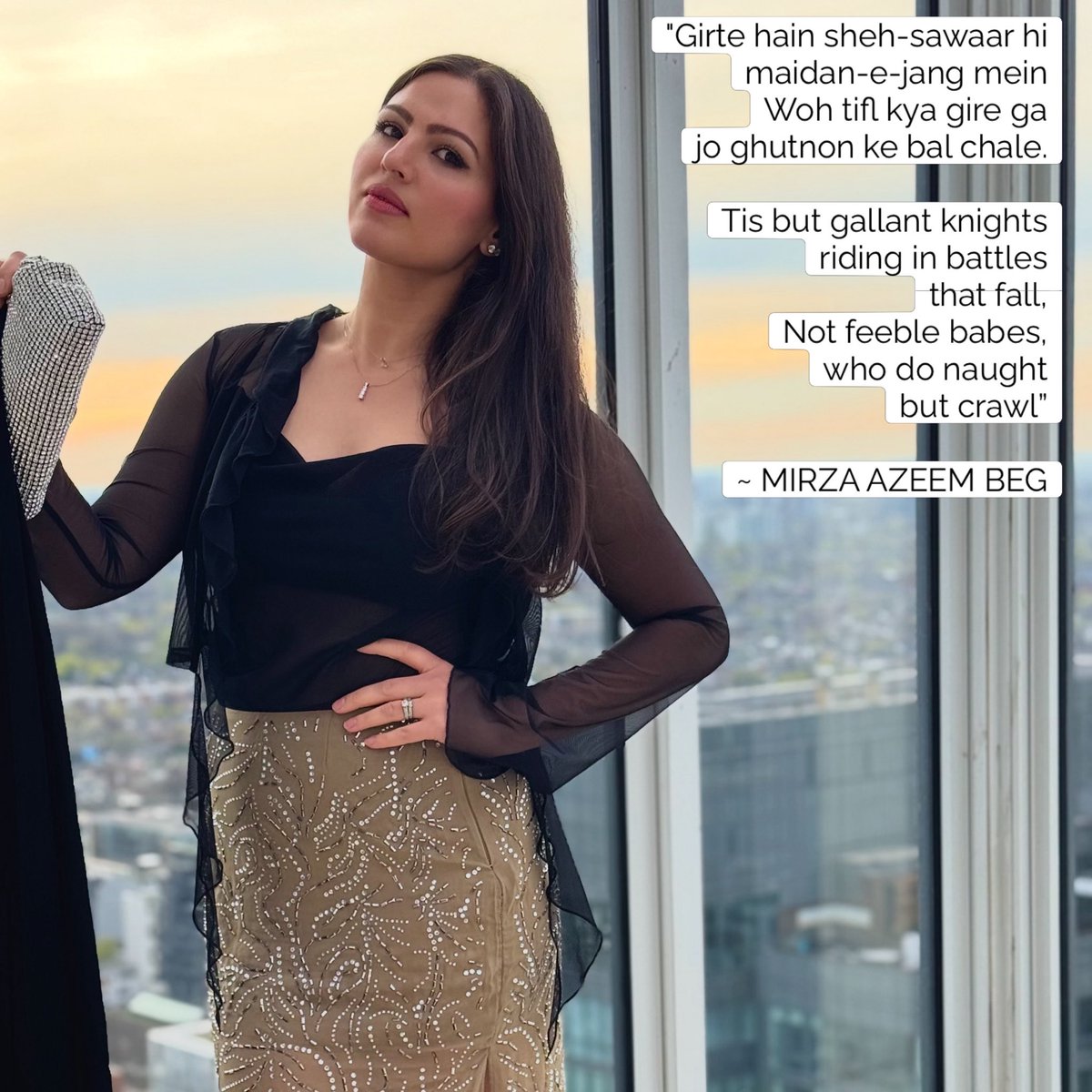
And, by reciting this Mirza Azeem Beg poem to me, my father insisted on drilling it into me that failures are nothing but proof of one’s determination and courage - “you have a bravery and resilience I am proud of, don’t let a small failure steer you off-course”, he said.
Sharing long (like, seriously long) inspiring stories and powerful poems that I sometimes didn’t understand and had to google were my Pushtoon father’s hugs and kisses.
I lost him a year later to the day. May God have mercy on his soul, and grant him the highest rank of paradise. 🤲🏼
I always say, my mother gave me my resilience and my father gave me my strength.
Today, as I launch my new docuseries, I am reminded of my father’s lesson.
They may have defeated me 16 times, but this was the 17th battle, and I won.
Alhamdolilah.
Always remember, “Tis but gallant knights riding in battles that fall, not feeble babes, who do naught but crawl.”
Go to https://t.co/Mn1p9vE6JL to watch episode 1 releasing today.
On her second day in America as an immigrant from China, Fei-Fei Li went with her father to a gas station in New Jersey. Something was wrong with his car, and he needed her to explain it to the mechanic.
Li was fifteen. She had barely arrived and spoke little English herself. Her father had been in the country for three years, but he knew even less. Somehow, with a few words and a lot of gestures, she made herself understood.
It was a small errand. It was also an early lesson in what her family would ask of her: learn this new place quickly, then help us find our way through it.
Last month, the company AMD announced an agreement to buy World Labs, the artificial-intelligence company Li co-founded, for $8.2 billion. Do not convert that to Kenya shillings.
World Labs is the answer to a question Li had spent decades working on that sounds simple until you try to teach it to a computer: How do we understand the world we see?
Li grew up in Chengdu, China, reading science fiction, books about nature and European novels. Her father encouraged her curiosity. Her mother encouraged her to read widely. Their life was comfortable enough, but her mother’s opportunities had been constrained by the family’s political history, and Li’s parents began planning a future elsewhere.
Her father went first, leaving for America when Li was twelve. The plan was for Li and her mother to join him soon. Visa delays stretched their separation beyond three years. Li later recalled feeling, as a child, that her parents had chosen a dream she could not understand over the family being together.
When she and her mother finally reached Parsippany in 1992, the family had less than twenty dollars. Li found the suburb unnervingly quiet after Chengdu’s crowded streets. At high school, she studied unfamiliar subjects in a language she was still learning, relying on a dictionary so large she remembered it as a brick. After school, she worked in restaurants to help her parents.
Isitoshe,
Her math teacher, Bob Sabella, saw how far she could go. The school did not offer the advanced course she needed, so he taught her during lunch. One teacher, one student. When Princeton offered Li a scholarship, she asked two advisers to check the letter because she could hardly believe it.
College brought possibility, but her parents still needed an income. With borrowed money, including help from Sabella and his wife, Li bought a small dry-cleaning shop for the family. She studied physics at Princeton during the week and returned to Parsippany from Friday through Sunday to help run it. Because she spoke English, much of the business fell to her. She kept it going for seven years, including her first years of graduate school in California.
During her first year at Princeton, her mother needed heart surgery. Li arranged to take an exam at the hospital so she could stay nearby and translate for her mother and the doctors. Later, when a well-paid consulting job offered a way to ease the family’s financial strain, Li seriously considered leaving science. Her mother urged her to choose the work she loved.
That work led Li to study vision. People learn to recognize a cat whether it is facing them, hiding under a chair or partly lost in shadow. Computers at the time struggled with such changes. Li came to believe they needed many more examples of the world, not just better instructions.
As a professor at Princeton, she began building ImageNet with other researchers. They gathered and labeled millions of photographs so computer systems could learn to identify objects, and scientists could test their progress against the same images. Some colleagues doubted the value of spending years on a database. In 2012, another research team used ImageNet to make a dramatic leap in image recognition. The project Li had fought to build helped change the course of AI.
World Labs is her attempt to go further. Its first product, Marble, can take a written description, photograph or video and create a three-dimensional place a person can explore and edit. The company is researching how AI might understand spaces well enough to help with design, simulations and, eventually, robotics. AMD wants that research team to work alongside the people building the hardware on which such systems run.
Once the acquisition closes, Li will become AMD’s chief scientist.
The $8.2 billion for an immigrant who did not understand as a word in English at some point in her life.
May the day break
This guy utterly dismantles the populist politics of Reform and Restore in 90 seconds. It’s actually quite beautiful.
Take decades of deep-rooted problems in Britain and convince people that a relatively tiny proportion of the population is responsible for all of them. Housing, the NHS, crime. Blame illegal migrants for everything.
Suddenly, you don’t need credible solutions to the housing crisis, NHS waiting lists or crime. You just need increasingly extreme policies on immigration.
And by the time people realise you never had meaningful answers to the vast majority of Britain’s problems, you’re already in power, handing out tax cuts to your donors.
Keeping everyone (including Africans) completely ignorant about Africa and the central role it plays in the economic and natural world is a core feature of Europeanised education, not a bug.
You're not supposed to know that the DRC is the most resource-rich country in the world, with an estimated $24 trillion sitting under its soil. You're not supposed to know that the rise of "western civilisation" from the 15th century on was entirely made possible by European contact with Africa, and that the resources and labour extracted from coastal West Africa from 1492 onwards are the entire reason why both American continents exist in their current form.
You're not supposed to know that both WW1 and WW2 were essentially wars fought over the right to African colonial domination and expansion, and that even the uranium that was used in "Little Boy" and "Fat Man" dropped on Hiroshima and Nagasaki came from Shinkolobwe uranium mine in eastern DRC. You're not supposed to know that the reason the country of France exists in its current form is because tens of thousands of conscripted West African soldiers fought and won against the Nazis in Europe, and the French thereafter shipped them back to West Africa and massacred them at Camp Thiaroye in Senegal to avoid paying them their due wages.
You're not supposed to know that there was nothing cold about the so-called Cold War, because the vast majority of the hot theaters it was physically fought in were on the continent of Africa. (Zimbabwe, DRC, Mozambique, Namibia, South Africa, Angola, Eritrea, Zambia etc). You're not supposed to know that the ongoing Ukraine war and the war in the Sahel are in fact the same conflict being fought by the same 2 sides, and that the reason France is desperately pushing funding and arms to Ukraine even as it falls into internal crisis is that Ukraine is acting as its proxy army in West Africa, as it tries to regain its lost colonial territories there, especially Niger where the cheap yellowcake uranium for its famously cheap nuclear energy used to come from before the 2023 revolution.
You're definitely not supposed to know that the entire global economy and system of trade as you know it is built on ruthless extraction from Africa and ensuring that Africa does not control anything it exports. You're not supposed to know that "Italian leather" doesn't come from Italy - it comes from Kano, Nigeria. You're not supposed to know that "Swiss chocolate" does not exist because cocoa does not grow anywhere in Switzerland or Europe - it comes from Ghana, Cote d'Ivoire and Nigeria. You're not supposed to know that Israel and the UAE control the global diamond and gold markets even though Israel has no diamond mine and the UAE has zero gold mines, because both resources are literally being stolen from the DRC and Sudan on an industrial basis.
You're basically not supposed to understand that the entire geopolitical world as you know it, rests entirely on extraction from Africa, poverty of Africans, and your own ignorance about where everything you use comes from.
Completely deliberate 500+ year-old feature, not accidental bug.
Just come across this mosaic view of Gaza in the Church of St Stephen, Um ar-Rasas, Jordan. It was constructed in 756CE by the mosaics artists Stauranchius & Euremius, 120 years AFTER the Islamic conquests. The people were still using Greek, still building churches (there are 16 in Um ar-Rasas alone). This is important evidence the continuities of population in this region, masked by changes of language and religion. The idea that the Arabs swept in and kicked out or forcibly converted the population of Palestine is unhistorical nonsense: the population of Palestine was majority Christian until the time of the Crusades. They took two hundred years to use Arabic as their main language. Six hundred to convert to Islam.
𝐓𝐡𝐞𝐲 𝐥𝐢𝐯𝐞 𝐢𝐧 𝟐𝟎𝟐𝟔… 𝐛𝐮𝐭 𝐄𝐫𝐢𝐭𝐫𝐞𝐚𝐧 𝐰𝐨𝐫𝐥𝐝 𝐬𝐭𝐨𝐩𝐩𝐞𝐝 𝐅𝐨𝐮𝐫 𝐝𝐞𝐜𝐚𝐝𝐞𝐬 𝐚𝐠𝐨.
No ATMs.
No debit cards.
No credit cards.
No digital money.
No social media.
No AI.
No real access to the modern world.
While the rest of humanity moves forward,
𝐄𝐫𝐢𝐭𝐫𝐞𝐚𝐧𝐬 𝐚𝐫𝐞 𝐤𝐞𝐩𝐭 𝐝𝐞𝐥𝐢𝐛𝐞𝐫𝐚𝐭𝐞𝐥𝐲 𝐢𝐧 𝐭𝐡𝐞 𝐝𝐚𝐫𝐤 𝐥𝐨𝐜𝐤𝐞𝐝 𝐨𝐮𝐭 𝐨𝐟 𝐭𝐞𝐜𝐡𝐧𝐨𝐥𝐨𝐠𝐲, 𝐥𝐨𝐜𝐤𝐞𝐝 𝐨𝐮𝐭 𝐨𝐟 𝐨𝐩𝐩𝐨𝐫𝐭𝐮𝐧𝐢𝐭𝐲, 𝐥𝐨𝐜𝐤𝐞𝐝 𝐨𝐮𝐭 𝐨𝐟 𝐟𝐫𝐞𝐞𝐝𝐨𝐦.
Isaias Afwerki does not lead a nation.
He holds an entire people like hostages in their own land.
An entire generation has grown up without knowing what the rest of the world takes for granted while the regime controls every breath, every movement, every chance at a better life.
They cannot speak.
They cannot leave.
They cannot even dream out loud.
𝐒𝐨 𝐰𝐞 𝐦𝐮𝐬𝐭 𝐬𝐩𝐞𝐚𝐤 𝐟𝐨𝐫 𝐭𝐡𝐞𝐦.
Share this.
Amplify this.
Refuse to look away.
The world must finally hear the silenced people of Eritrea.
Their silence is not consent.
It is survival under a dictatorship that treats human beings like property.
𝐑𝐚𝐢𝐬𝐞 𝐲𝐨𝐮𝐫 𝐯𝐨𝐢𝐜�� 𝐟𝐨𝐫 𝐭𝐡𝐞 𝐯𝐨𝐢𝐜𝐞𝐥𝐞𝐬𝐬.
Eritrea is not free.
And the world can no longer pretend it doesn’t know.
🇪🇷 𝐅𝐫𝐞𝐞 𝐄𝐫𝐢𝐭𝐫𝐞𝐚. 𝐏𝐫𝐨𝐭𝐞𝐜𝐭 𝐭𝐡𝐞 𝐄𝐫𝐢𝐭𝐫𝐞𝐚𝐧 𝐩𝐞𝐨𝐩𝐥𝐞.
#𝐅𝐫𝐞𝐞𝐄𝐫𝐢𝐭𝐫𝐞𝐚 🇪🇷
#𝐇𝐮𝐦𝐚𝐧𝐑𝐢𝐠𝐡𝐭𝐬
#𝐄𝐧𝐝𝐀𝐫𝐛𝐢𝐭𝐫𝐚𝐫𝐲𝐃𝐞𝐭𝐞𝐧𝐭𝐢𝐨𝐧
#𝐔𝐍
#𝐀𝐟𝐫𝐢𝐜𝐚𝐧𝐔𝐧𝐢𝐨𝐧
#𝐀𝐦𝐧𝐞𝐬𝐭𝐲𝐈𝐧𝐭𝐞𝐫𝐧𝐚𝐭𝐢𝐨𝐧𝐚𝐥
#𝐇𝐮𝐦𝐚𝐧𝐑𝐢𝐠𝐡𝐭𝐬𝐖𝐚𝐭𝐜𝐡
#𝐄𝐧𝐨𝐮𝐠𝐡𝐈𝐬𝐄𝐧𝐨𝐮𝐠𝐡
As a pilot for 20 years I have questions:
- where are the cabin crew here?
- where are the oxygen masks that automatically drop during a rapid emergency descent?
- how did the Capt manage to open the door while being stabbed?
- Omani pilots were not allowed to fly to Israel, why was he allowed?
- how did the offending pilot get a weapon onboard?
- why has this happened so close to elections?
- how are passengers walking around while apparently in a nosedive?
- who else was injured? Nose dives cause significant g force incidents
- why is there two perfectly positioned people recording the incident and not helping?
- why did a plumber take control and not the 2 pilots onboard who would certainly know when an aircraft was in a nosedive?
- why was the plumber speaking in English to Bibi after the flight
- why was he still in his blood soaked clothes 8 hours after the incident
False Flags have been a very effective mechanism to influence public opinion
Hitler burnt down the Reichstag just before his parliament elections and he won the election…changing the course of history.
A full and independent investigation should be carried out here.
Hopefully independent journalist will be allowed to view this too.