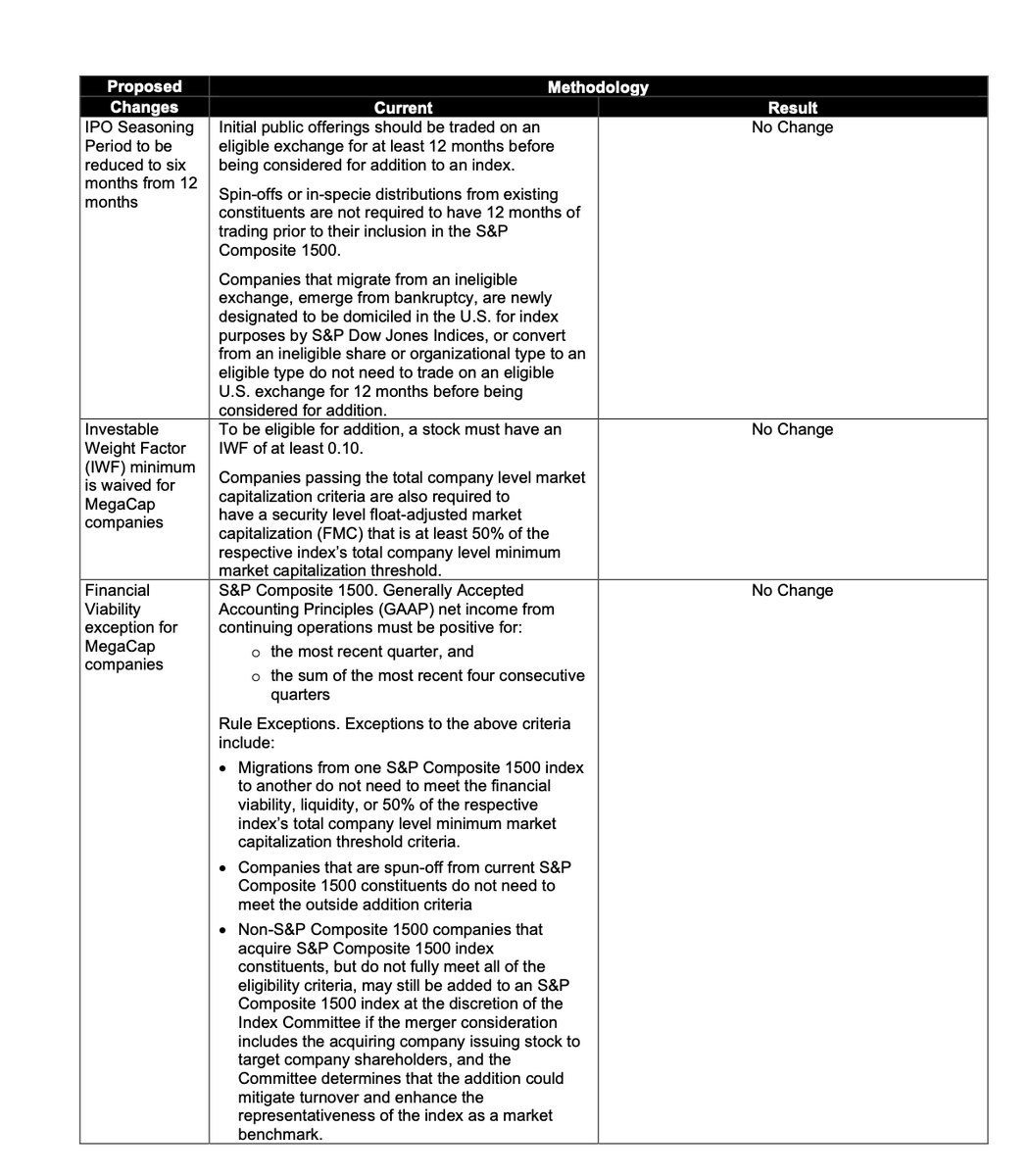
Wow, the S&P Dow Jones Indices has just officially announced that they will NOT be changing their inclusion rules to make it easier for “MegaCap” companies (such as @SpaceX) to be fast-tracked into the S&P 500.
Their reasoning:
"S&P DJI determined that exceptions to the financial viability, seasoning, and IWF requirements should not be granted solely based on market capitalization. The decision not to adopt the proposed exceptions preserves core index principles by maintaining consistent application of these key requirements. Although there may be trade-offs between strict adherence to these eligibility requirements and broad representativeness, the current methodology provides substantial market coverage and sector balance. As a result, the indices can continue to meet their stated objectives while preserving their role as representative and investable benchmarks for the U.S. equity market.
No changes will be made to the eligibility criteria including financial viability screens, seasoning period, or minimum IWF, for the S&P 500, S&P MidCap 400, or S&P SmallCap 600 as a result of the S&P Dow Jones Indices consultation on the treatment of MegaCap companies. Accordingly, there will be no changes to existing methodology for this index family."
This means that the earliest @SpaceX could be eligible to be added to the S&P 500 would now be June 2027.
The requirements that will now remain in place are:
• No changes to S&P 500 eligibility rules for mega-cap companies.
• Mega-cap companies will still need to wait 12 months after their IPO before being considered for S&P 500 inclusion.
• S&P will not waive profitability requirements for mega-cap companies. The company must have positive GAAP net income in the most recent quarter, and the sum of the most recent four consecutive quarters.
• S&P will not waive minimum public float requirements for mega-cap companies. At least 10% of a company's shares must be publicly tradable ("free float").
The S&P rejected proposals that would have:
• Reduced the IPO seasoning period from 12 months to 6 months
• Waived profitability requirements
• Waived minimum public float requirements
it’s really inspiring to see the collective response of humanities professors on twitter whenever an academic says something positive about artificial intelligence. it feels like getting the whole gang together again for one last hurrah before turning off the lights for good.
Humanists could own this territory. But to tell this story credibly you have to know what "AI" actually can do in 2026 (how astoundingly and terrifyingly capable these tools are now!). Embarrassingly few are willing to make the leap.. that is the maddening part!
I am in strong agreement with @akoustov here. In fact, I'd go with a more dire diagnosis. The in-group signaling and circling-the-wagons dynamics are supercharged precisely because the humanities and most of social science lack objective standards.
Another thing I'm learning from my recent ethnographic engagements with humanities professors is the prevalence of the "AI as plagiarism" frame over the "AI as RA" frame in their tribes.
If you are a regular person or researcher, you mostly just want to get things done. If you already relied on various assistants or human agents (!) for that, using AI agents to do the same thing better is a no-brainer.
But if your whole existence is premised on mostly solo-authored human creativity and provenance with few objective standards (no shade, folks!), then any AI tool is clearly a moral violation and should be verboten.
Because the humanists have a valuable story to tell: deep reading, sustained attention, slow conversation are what we need more of as we march into our crazy future. (ironically Cal Newport a computer scientist! is the leading voice on this front)
I would like to know what these goods are. The ones I can think of are patently less valuable than the “goods” produced by the sciences. Obviously humanities are valuable experientially but let’s not pretend research in humanities (and much of social science) is on equal footing
But many fields are not like that & never have been. The goods they deliver are not quantifiable or practical but humanistic - yet no less valuable. What we rightly care about in them would be effaced or destroyed by heavy use of AI. Academia’s distortions can blind us to this.
A lot of the messiness in this discourse comes from a terminological confusion. Many humanities folks use the word AI to mean "chatbot" and are genuinely unaware of how these tools are used in science and engineering (e.g. as coding agents). There are good arguments for banning AI for writing essays but a blanket ban on AI for coding would be absurd.
Pakistan is now world's #2 solar panel importer.
More than India, more than entire Gulf.
Almost none of it policy-driven. Grid power is costly & unreliable so households go solar.
But does that push grid fees higher for everyone left behind?
More soon: https://t.co/In5lBaF2ox
Kenya is another interesting energy transition story. Not because it followed western pathway, because it largely skipped it.
Most industrial economies evolved through:
Coal → Oil → Gas → Renewables
Kenya evolved through:
Hydro → Geothermal → Wind → Distributed Solar
That difference matters.
While many developing economies locked themselves into imported fossil fuels, Kenya steadily built one of Africa’s cleanest electricity systems around domestic renewables, particularly geothermal from the Great Rift Valley.
By 2025:
• Geothermal ~39%
• Hydro ~33%
• Wind ~13%
• Solar ~3%
• Fossil generation ~10%
• Renewables ~90%
And this transition wasn’t primarily driven by ideology.
It was driven by economics, energy security and system resilience.
Imported diesel was expensive.
Fuel volatility hurt the economy.
Geothermal was domestic.
Wind and solar kept getting cheaper.
So the system flipped.
Fossil generation steadily got squeezed while renewables became the backbone.
What makes Kenya especially interesting is that it may represent an early prototype for future African energy systems:
• Renewable-heavy
• Decentralised
• Modular
• Less dependent on massive fossil infrastructure
• Increasingly integrating distributed solar + storage
In many rural regions, rooftop solar and mini-grids are scaling faster than traditional centralized expansion ever could.
And that may be one of the biggest underappreciated global stories right now:
Developing economies may no longer follow the historical western industrial pathway.
Cheap renewables, batteries and decentralised systems are starting to change the sequence itself.
Kenya is one of the clearest real-world examples of that shift becoming visible.
Battery storage is growing at record speed, with 2025 additions 40% higher than in 2024
From balancing grids to shifting solar power across the day, storage is emerging as a versatile tool for modern day power systems around the world
The full analysis: https://t.co/KoR561QiKH
Sunny Poland☀️🇵🇱 set a new all-time monthly high for solar in April of 2.7 TWh (+22% over April 2025)
The highest solar generation is usually observed in May-August, so there might be more records to come.