LEDs are producing revolutionary advancements in Horticulture. IHS bring together key LED manufacturers, and their experience to offer custom growing solutions.
How do LED grow lights affect bees?
Bees are vital to our planet’s ecosystem. They have a key role in pollinating plants, helping to keep growth and production of fruits, vegetables and even nuts.
Click below to find out how #LEDs are affecting them.
https://t.co/aB6kEqvAVR
Blue light sits between 420-470nm on the visible spectrum. With benefits to plant biomass and even flowering, blue light is often utilised within horticultural light, and for good reason.
https://t.co/ORw43bC5KP
What is Qualified #Bluetooth Mesh?
QBM is particularly useful & relevant for Lighting Controls to enable configuration of dimming, occupancy sensing & daylight harvesting quickly into existing and new installations.
Check out the article below 👇
https://t.co/KCmTOlxwgC
We are exhibiting at the South West Growers Show - 4th October. Please come along and check out our new horticultural range! Stand #42
https://t.co/d2ViFR3jYo
We are exhibiting at the South West Growers Show on the 4th October at the Matford Centre in Exeter!
Come and visit us at stand 42 to see all our new innovative IHS horticultural LED grow lights.
https://t.co/hHctgHY3kX
More growers are considering vertical farms and LED solutions due to their sustainability and efficiency. Through vertical farming, harsh weather conditions can be avoided, and all-year-round growing is possible.
https://t.co/a6vSFz0SL1
New Roma horticultural LED Grow Light. A perfect solution for large-scale indoor growing, designed to replicate crucial wavelengths for installations lacking natural daylight. Complete with dimmable driver and mounting ropes, it is easy to get started.
https://t.co/lkoIbJ0Ml7
Often in horticultural lighting, the overall light hue is red-purple. This is a combination of two key wavelengths: blue and red. Both colours are key and have benefits to plants' health and quality.
Read more about the benefits of red light here. https://t.co/hYqtz7skDa
ams OSRAM has extended its OSLON® Optimal family of horticultural lighting LEDs with a new 640 nm Red LED, which enables indoor farmers to produce faster and healthier plant growth.
Learn more in our latest press release: https://t.co/wV0YdvHGL3
#horticulture#OS#IL
If you are interested in researching with these OSLON Square Hyper Red LEDs, our range of development PCBs will be launching soon - get in touch for more info
The new generation OSLON® Square Hyper Red 660 nm is unmatched in its class of High Power LEDs. With an industry-leading efficacy of 76% WPE, the new generation OSLON® Square Hyper Red delivers performance levels that cannot be refuted: https://t.co/MbwJ9c0Dcm
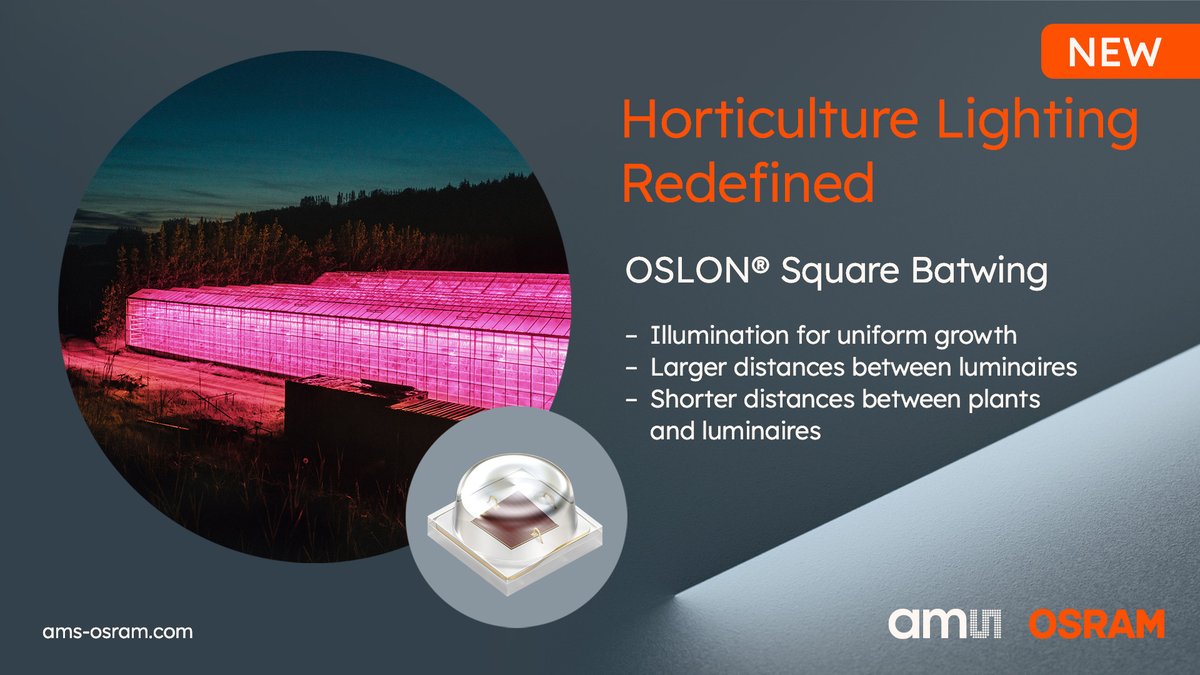
ams OSRAM introduces world’s first batwing optic LED family for horticulture lighting applications for more homogenous light distribution. The OSLON® Square Batwing extends our comprehensive Horticulture LED portfolio with four new devices: https://t.co/fLRNJYT0vv
An ever-expanding knowledge base in horticulture is demonstrating how plants require different spectral illumination and control. LEDs can be utilised in various ways, depending on the application and what the end goal is.
https://t.co/xlXsLfWY28
Did you know that UV light can be seen by bees? It reflects off flower petals and the bees use it to direct themselves to the pollen.
Find out more interesting facts about UV light in this article from @ILEDUK at https://t.co/D8l1wRCfQm
#LED#UV#InterestingEngineering
Did you know that UV light can be seen by bees? It reflects off flower petals and the bees use it to direct themselves to the pollen.
Find out more interesting facts about UV light in this article from @ILEDUK at https://t.co/D8l1wRCfQm
#LED#UV#InterestingEngineering