Kazakhstan's latest billionaire began as a car salesman selling Ladas when the USSR collapsed. Now he's a retail tycoon and owns art https://t.co/H4H8MQKmfQ
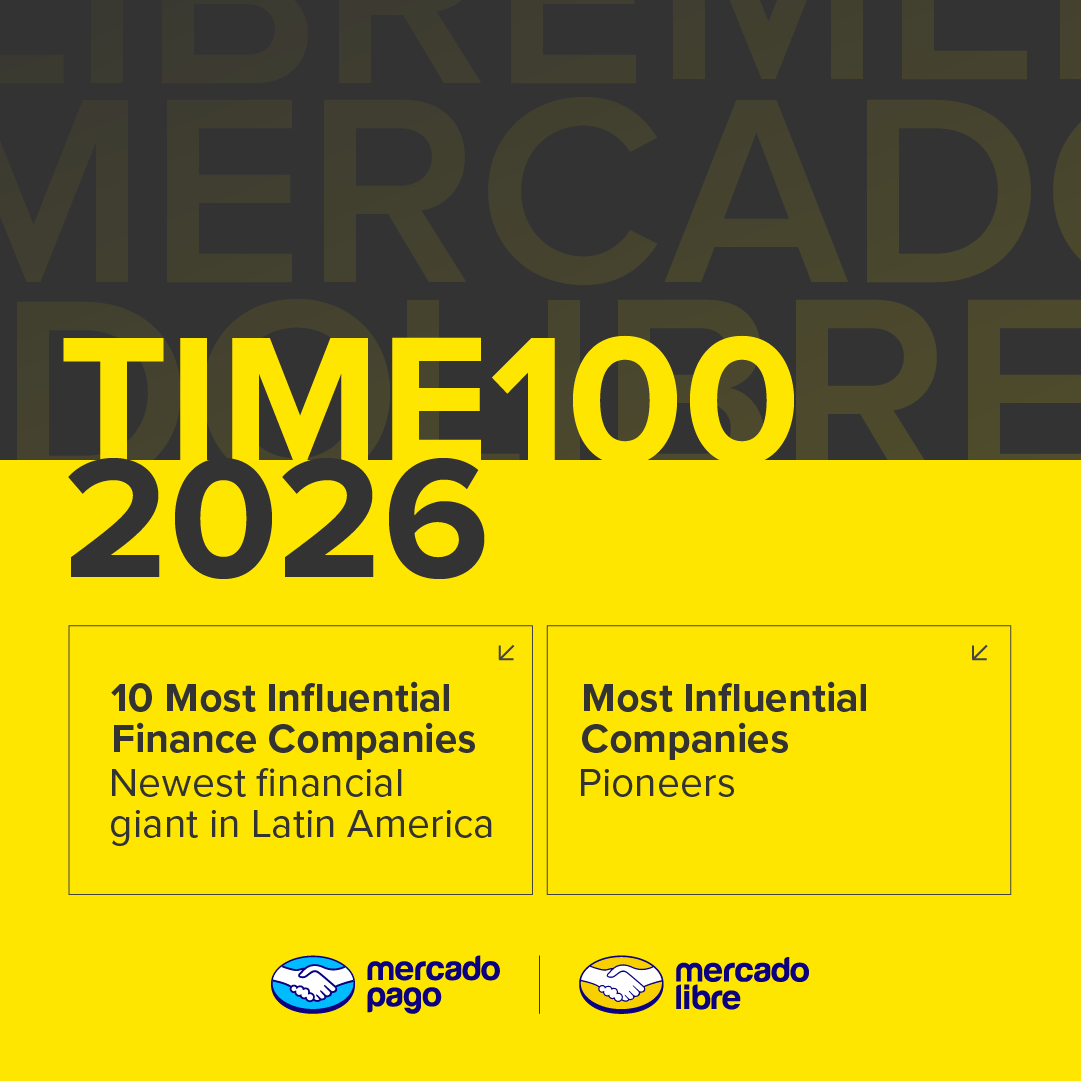
Orgulloso de ver a @Mercadolibre y @Mercadopago destacadas por @TIME como una de las "100 Most Influential Companies" y "10 Most Influential Finance Companies" en el mundo (🤯) respectivamente.
Este es un reconocimiento al trabajo que nuestros equipos vienen haciendo hace años y al impacto que nuestro ecosistema tiene en la vida cotidiana de millones de personas y negocios de América Latina.
Con talento local y tecnología propia vamos a seguir construyendo soluciones que fortalezcan el comercio electrónico y el acceso a los servicios financieros en la región.
Lista completa de las 100 empresas más influyentes según TIME: https://t.co/JtRtGLQBGH
10 empresas financieras más influyentes de 2026: https://t.co/hvx91wSjbB
Sorry to see this. Ricky did it the right way, and was never afraid to speak his mind along the way. Wishing him all the best and thanks for the learning over th years!
$NU reportó resultados impresionantes una vez más ayer. Acabo de digerir todo.
Me encanta cómo están construyendo las bases para su expansión internacional. $NU es una marca con potencial global. Tienen todo para seguir expandiendo el TAM más allá de Latam.
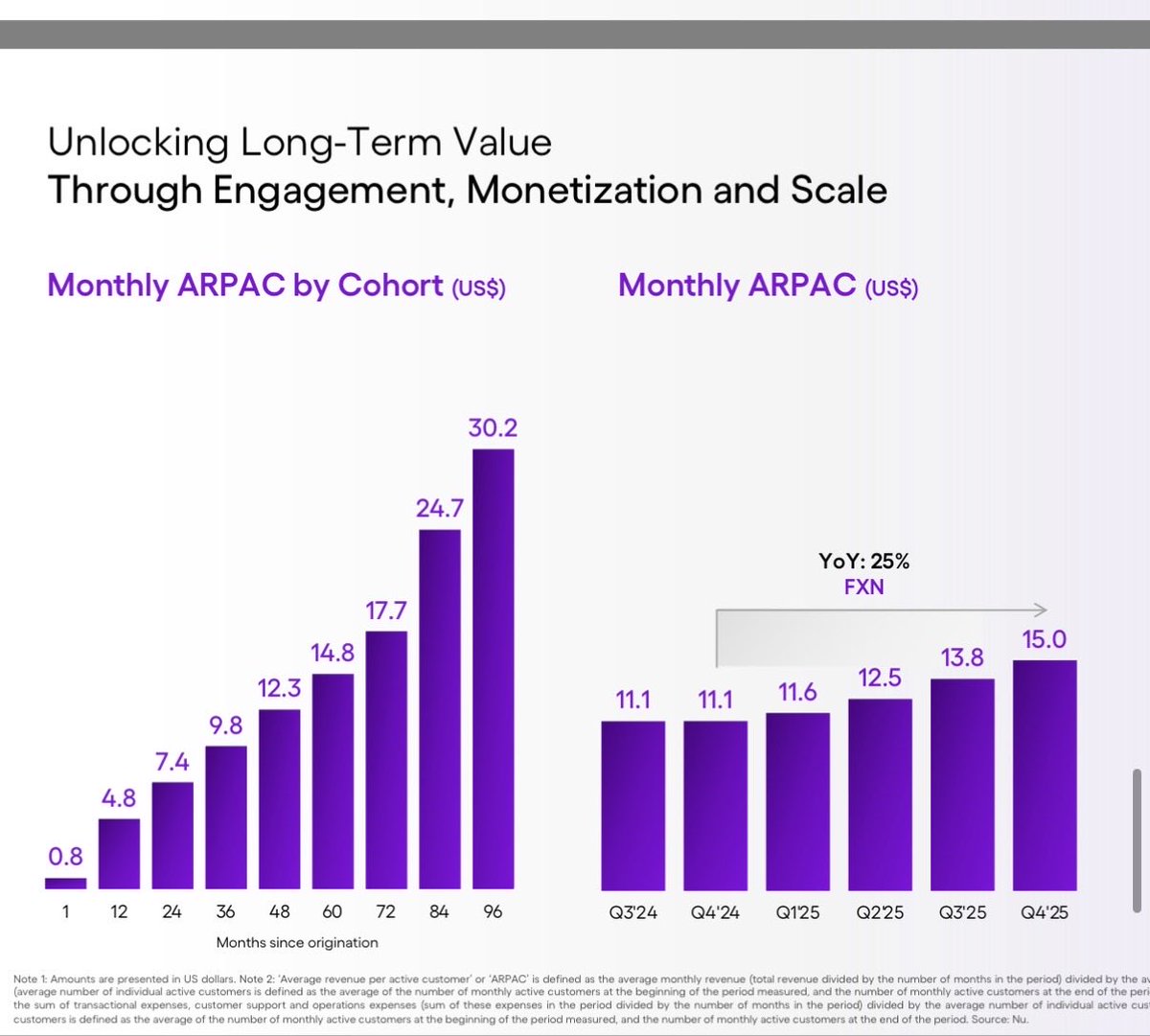
Pero el verdadero diferenciador sigue siendo el engagement y la monetización a escala.
Este gráfico es EL killer chart de toda la presentación IMHO. Y lo voy a explicar como si le estuviera explicando a mi abuela:
Imaginen que la abuela empieza a comprar en una tienda nueva (en este caso productos de $NU). El primer mes gasta apenas $0.80. Pero después de 8 años siendo clienta fiel… ¡gasta $30 al mes! Va descubriendo más cosas, confía más, compra más. A $NU le cuesta casi cero el cross sell.
Eso es exactamente lo que pasa con los clientes de $NU. Cuanto más tiempo llevan, más gastan. Y el promedio general ya subió un 25% vs el año pasado, de $11 a $15 por mes.
En palabras simples: sus clientes no solo se quedan… cada año que pasa, valen más. Eso es lo que hace un tech company world class.
A eso se le llama un negocio con poder de permanencia extraordinario. La calidad de los slides es espectacular. Órdenes de magnitud mejor que cuando yo estaba ahí.
Va a ser un top holding para mí por mucho, mucho tiempo. Los felicito por el execution.
Estos son Delta Force como el management de $MELI. Estan simplemente en otra liga.
So, here we are with $MELI trading well below valuations set in the midst of 2022 panic. Gotta love the high beta crazy, regular opportunities are periodically presented by this phenomenal business, like clockwork.
@ReturnsJourney Valuation and growth rate is not LFL. How much more valuable is a business that is able to grow 2-3x faster for a decade? The answer is several times.
@ReturnsJourney Easier to underwrite XYZ growth for MELI and multiple compression vs XYZ growth for Kaspi and more subjective multiple expansion. Dividends sure but have to pay tax vs for MELI can just let it run for a long time. Again I like both though, KSPI is great
@ReturnsJourney Better growth but more importantly longer runway for such growth, better jurisdiction, much stronger ecosystem (if include Hepsi for Kaspi), better execution. MELI’s margins still maturing vs Kaspi’s more or less end-state ex Hepsi.
Let's take a look at how Seattle's DoorDash law actually turned out.
In 2024, Seattle implemented "PayUp" — a minimum wage law for food delivery drivers, setting the rate at $26.40/hour. The intent was to protect workers. Here's what actually happened:
DoorDash added a $5 fee to every order. Customers stopped ordering. Within two weeks, 30,000 fewer orders. UberEats volume dropped 30%. Drivers — the people the law was supposed to help — saw their available deliveries cut in half and earnings per hour fall 25%.
A new National Bureau of Economic Research study confirmed what the numbers already showed: higher per-delivery pay was completely offset by fewer deliveries and lower tips. Active drivers saw zero net gain in monthly earnings.
KUOW reported this week that two years in, the results are undeniable — Seattle is now the most expensive delivery market in the country. Denver, Portland, and San Francisco, cities without these laws, saw delivery revenue grow 20-40%. Seattle stagnated.
The parallel to what's happening with WA tax proposals is obvious. SB 6346 would impose a 9.9% income tax on high earners. The QSBS add-back bills would strip federal tax exclusions from founders. The argument is always "just a small tax on those who can afford it." But capital moves. Founders move. Companies incorporate elsewhere.
The DoorDash data gives us a controlled experiment: same company, same product, same time period, different policy environments. The city with the heaviest regulation saw the worst outcomes — including for the workers it tried to protect.
Incentives matter. Every time.
https://t.co/0rusleqBbk
#StartupLaw #WashingtonState #PolicyMatters #QSBS #Founders #waleg
A day after China sentenced Jimmy Lai to 20 years in prison, @MaryMargOlohan spoke to his daughter about her father's fate and their family's enduring faith in God.
https://t.co/whOp3naJzu