Chinese Bytedance just dropped a protein folding model better than Google's AlphaFold 3!
If you watched Thinking Game, you saw how seminal AlphaFold 2 was in winning the protein folding prediction competition, CASP14 (2020). AF3 came out 4yrs later.
SeedFold builds on top of AF3 and gets SOTA on FoldBench.
You can actually play with it and vibecode a 3D protein viewer!
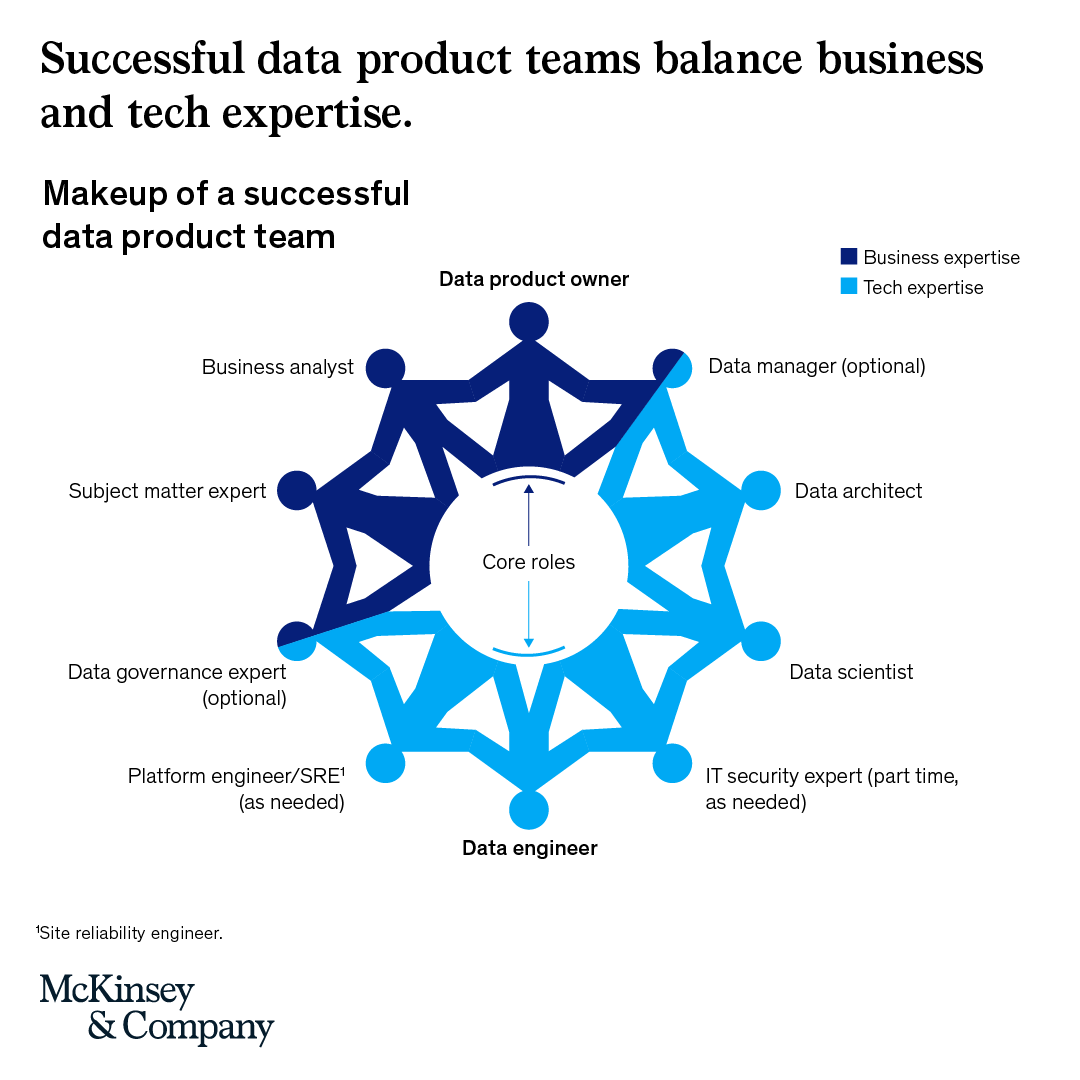
Too many companies treat data products like IT projects, and miss out on real business value.
Success takes strong DPOs who think like business leaders and tight collaboration across teams from day one. Here's how to unlock more value from your data: https://t.co/EWuFQ2cs2n
Everyone is building AI agents.
Very few understand the agentic frameworks that actually power them.
In 2025, two frameworks dominate agent development —
not as competitors, but as complementary layers:
n8n — Visual Workflow Automation
What it does
• Visually connects AI agents with business tools and APIs
• Flow: Trigger → AI Agent → Tools → Action
• Removes integration complexity and speeds up deployment
Think of it as:
The orchestrator that plugs AI into your entire tech stack
—
LangGraph — Graph-based Agent Orchestration (LangChain)
What it does
• Enables stateful, cyclical, multi-step agent workflows
• Flow: State → Agents → Conditional Logic → State (loops)
• Designed for complex reasoning and coordination
Think of it as:
The brain managing advanced agent decision-making
—
When to use n8n
• AI + business tool integrations
• Customer support and ops automation
• No-code or low-code workflows for teams
• Fast shipping with 700+ integrations
When to use LangGraph
• Multi-agent reasoning systems
• Enterprise-grade AI applications
• Cyclical or long-running workflows
• Fine-grained state control and memory
—
Ecosystem strengths
n8n
• Visual builder for non-developers
• Self-hosted, open-source option
• Strong business automation community
LangGraph
• Deep LangChain integration
• LangSmith for observability and debugging
• Advanced state persistence and control
—
The real insight 👇
The best AI systems use both.
n8n → Visual orchestration and tool integration
LangGraph → Agent logic, reasoning, and state
Think in layers: business automation and intelligent decision-making
—
Your turn 👋
What would you build first?
A visually simple, tool-connected agent (n8n)?
Or a deeply orchestrated, reasoning-heavy agent (LangGraph)?
We just dropped a 12 page AI report on how ~500 execs at US enterprises use generative AI.
I read it all so you don't have to. Top 8 takeaways:
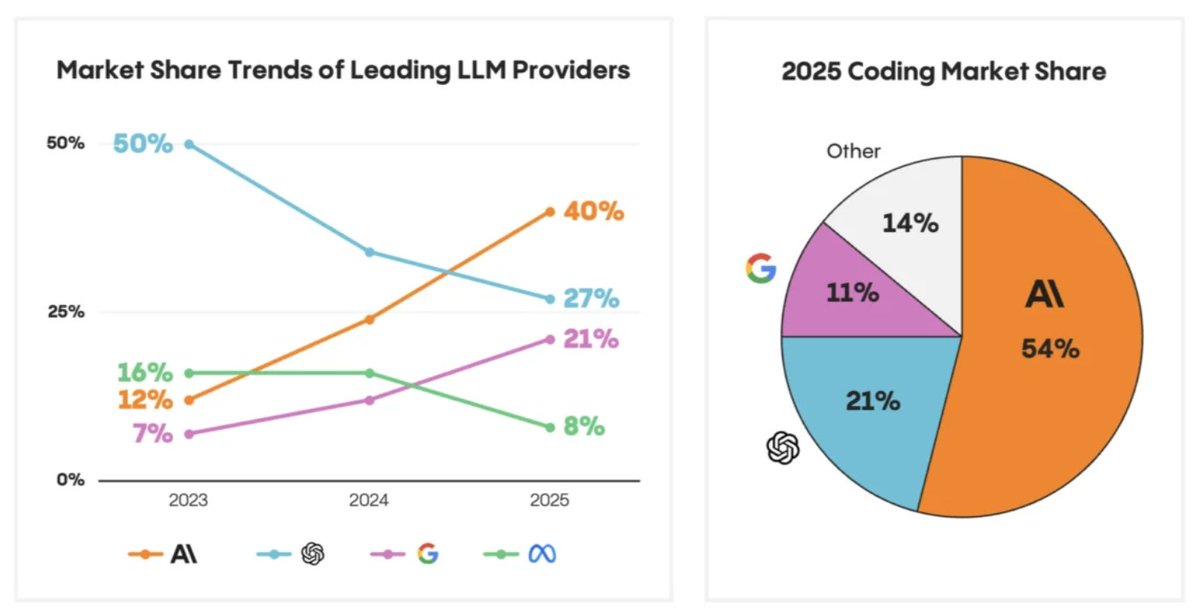
Anthropic is the #1 model provider in the enterprise, with 40% of ~$37B spend, with OpenAI dropping to #2.
1/8
GPT-5 came up with new idea in theoretical physics.
We can now clearly see that AI will accelerate science enormously. Even today’s early, relatively primitive versions are already capable of doing so.
Different energy level at Tesla booth and Waymo below, pics taken at the same time at NeurIPS.
Helps that Tesla has a cool bot on display AND is offering FSD drives. Big miss for Waymo considering they will start San Diego service soon.
“Failure is a part of life. In America, failure is a badge of honor. It means you tried. You get back up on your horse, and you try it again. I’ve failed at a number of things. It doesn’t stop me.”
Neuralink co-founder DJ Seo: "One thing we'll continue to invest tons and tons of money towards is vertically integrating. Pretty much all the things you saw we build in-house; We have our own construction team to build custom buildings for ourselves. That's in Austin, where we are building our HQ."
Neuralink's vertical integration:
• Microfabrication
• Implant manufacturing
• Machine shop
• Robotics
• Surgery
• BCI
• Pathology
• Animal care
• Neuroengineering
• Next generation applications
• Construction
• Imaging
Elon believes a majority of AI workloads will be diffusion models.
I’d pay close attention to Inception Labs, a team of Stanford professors who are doing foundational work here.
In the history of computing, no single ML architecture has been dominant for more than a decade.
McKinsey just dropped its 2025 AI report.
1. Everyone’s testing, few are scaling.
88% of companies now use AI somewhere.
Only 33% have scaled it beyond pilots.
2. The profit gap is huge.
Just 6% see real EBIT impact.
Most are still stuck in “experiments,” not execution.
3. The winners think bigger.
Top performers aren’t cutting costs. They’re redesigning workflows and creating new products.
4. AI agents are emerging.
23% are testing agents.
Only 10% have scaled them (mostly in IT and R&D).
5. The jobs shift is starting.
30% of companies expect workforce reductions next year, mostly in junior or support roles.
TL;DR:
AI adoption is nearly universal. Impact isn’t.
The gap between pilots and profit is where the next unicorns will be built.
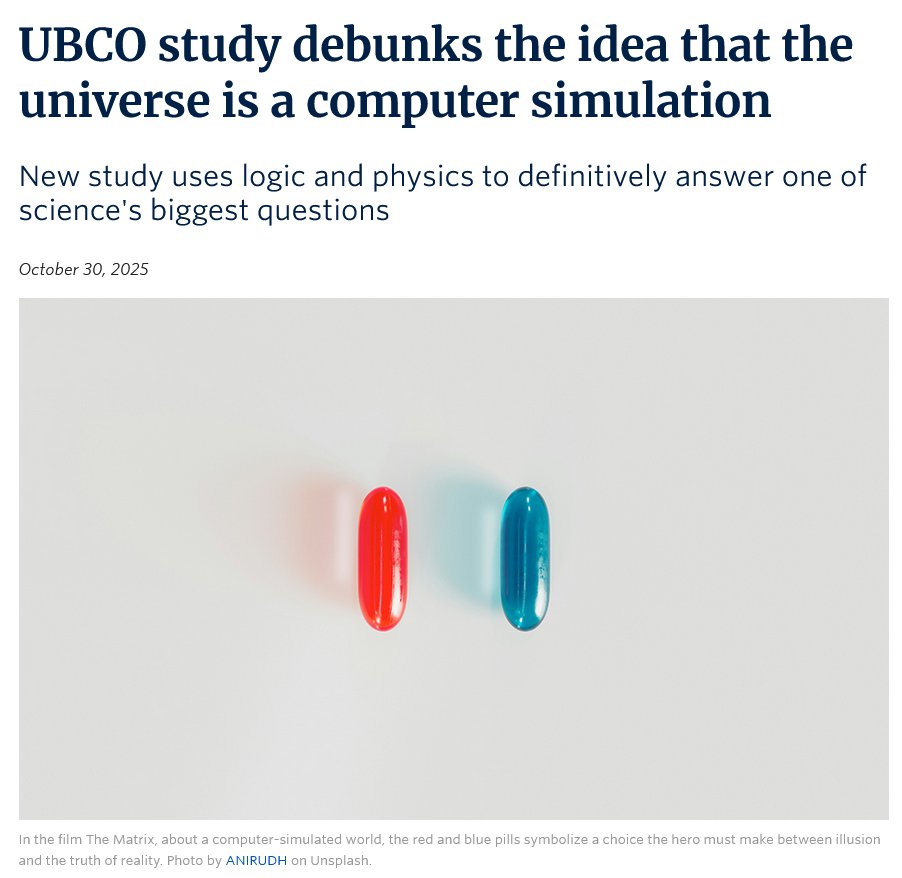
Researchers have mathematically proven that the universe cannot be a computer simulation.
Their paper in the Journal of Holography Applications in Physics shows that reality operates on principles beyond computation.
Using Gödel’s incompleteness theorem, they argue that no algorithmic or computational system can fully describe the universe, because some truths, so called "Gödelian truths" require non algorithmic understanding, a form of reasoning that no computer or simulation can reproduce.
Since all simulations are inherently algorithmic, and the fundamental nature of reality is non algorithmic, the researchers conclude that the universe cannot be, and could never be a simulation.