Our paper was accepted to #ICIP2026 !!
T.Sakai, K.Hotta, "Dynamic Distillation and Gradient Consistency for Robust Long-Tailed Incremental Learning"
https://t.co/iX0h7uDrFx
TTT3R
[ICLR 2026] A simple state update rule to enhance length generalization for CUT3R
https://t.co/0SSs3NOHsX
Modern Recurrent Neural Networks have become a competitive architecture for 3D reconstruction due to their linear-time complexity. However, their performance degrades significantly when applied beyond the training context length, revealing limited length generalization. In this work, we revisit the 3D reconstruction foundation models from a Test-Time Training perspective, framing their designs as an online learning problem. Building on this perspective, we leverage the alignment confidence between the memory state and incoming observations to derive a closed-form learning rate for memory updates, to balance between retaining historical information and adapting to new observations. This training-free intervention, termed TTT3R, substantially improves length generalization, achieving a 2× improvement in global pose estimation over baselines, all while operating at 20 FPS with just 6 GB of GPU memory to process thousands of images.
energy-based transformers by @AlexiGlad
traditional transformers generate tokens in a fixed forward pass. instead, the authors find that generating an output can be reframed as adjusting a guess until its "energy" (an error score measuring how well the output fits the prompt) is as low as possible.
generation is performed iteratively. At each step, the model evaluates its current guess, calculates the energy score, and uses gradient descent to tweak the guess toward a lower-energy (higher quality) result.
They test this across text and visual tasks: EBTs learn faster during training (up to 35% more efficiently) and use extra test-time compute to improve language task performance by 29% over standard transformer baselines, all without needing extra RL reward models or parameter updates!
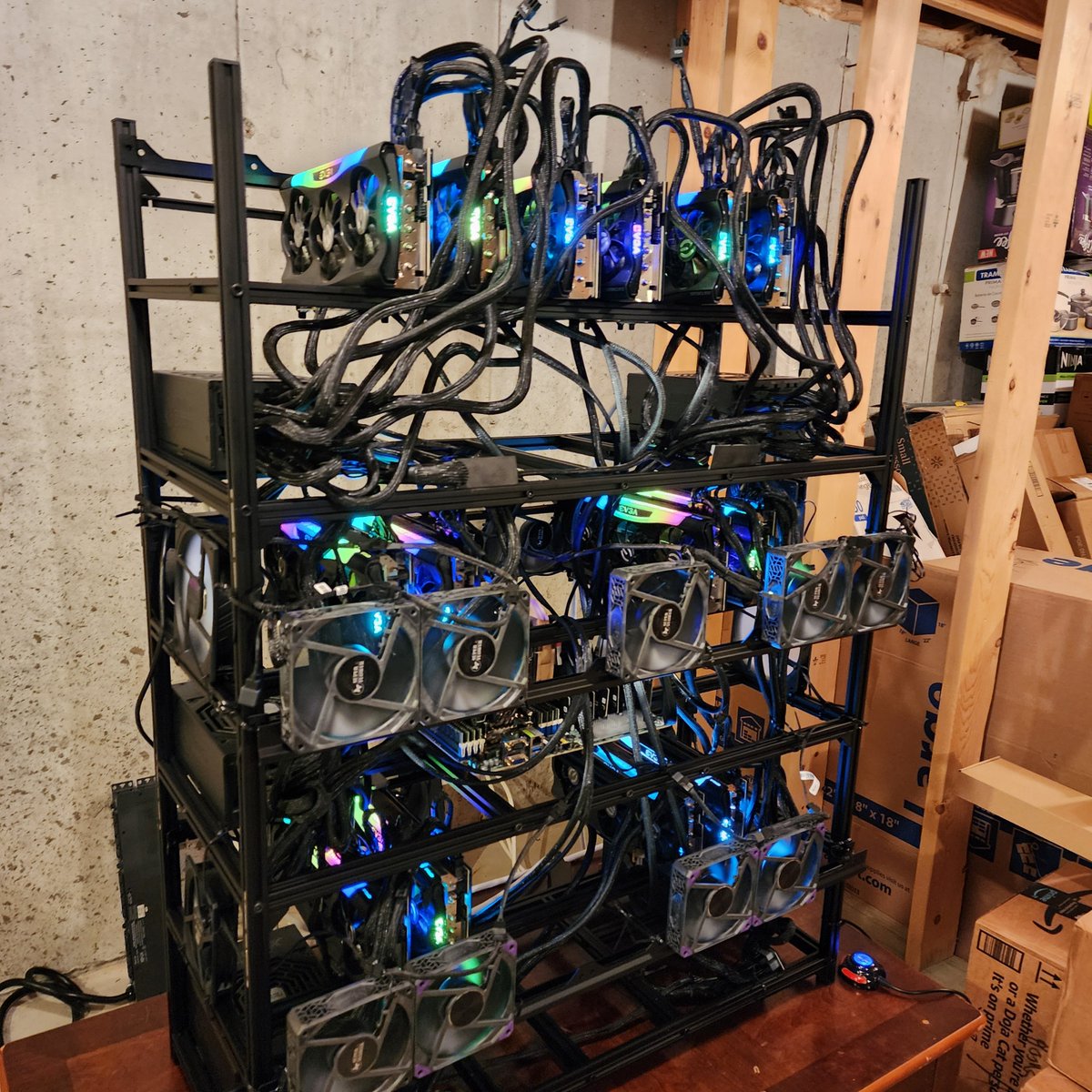
My house has 33 GPUs.
> 21x RTX 3090s
> 4x RTX 4090s
> 4x RTX 5090s
> 4x Tenstorrent Blackhole p150a
Before AGI arrives:
Acquire GPUs.
Go into debt if you must.
But whatever you do, secure the GPUs.
[#ECCV2026 LIMIT Workshop]
This teaser describes a brief abstract at ECCV 2026 LIMIT Workshop in terms of topics, invited speakers, organizers, and website. Please join us in the workshop.
Website: https://t.co/Ayx5bMw2VR
OpenReView (Paper deadline - 6 July): https://t.co/ZPEZAoADHo
Happy to be part of this collaboration and grateful to my co-authors! I'll be at the ECCV workshops in Malmö this year—looking forward to catching up with collaborators, meeting new friends, and discussing vision, neuroscience, and AI. See you there!
dRAE: Representation Autoencoder with Hyper-Spherical Codes
TL;DR: By quantizing feature directions rather than Euclidean distance, dRAE avoids codebook collapse, scales to 131K tokens, and improves reconstruction, multimodal understanding, and image generation.
https://t.co/CagJaECEws
I'm probably the fastest to implement RAM offload inference on the SM120 for Kimi K3.
I downloaded it an hour after it was released and have been working with the agent ever since. I've already solved a few problems and if all goes well, I should be able to do inference in a few more hours.
Moonshot just trained a 1T-parameter model (Kimi K2.5) on 15.5T tokens with zero instability.
The secret? Muon optimizer + one beautifully simple trick: QK-Clip.
Here’s exactly why logits explode, why Muon makes it worse, and how a post-update rescale fixed everything.
Twins: Learn to Predict Unified Representations with Focal Loss
TL;DR: Twins concatenates SigLIP2 and FLUX.2 VAE features into one visual representation, then uses a regression focal loss to balance their learning—unifying understanding, reconstruction, and generation.
https://t.co/ohwboTSr3r
A video is compressed 4D data. 🌍
Today, we’re sharing a preview of our latest research: 4D reconstruction from a single monocular video. 🎬
From one casually captured video, our system reconstructs a dynamic, freely viewable 4D Gaussian scene—recovering geometry, appearance, camera motion, and object motion across space and time.
No multi-camera rig. Just video → 4DGS.
The world has already been captured in video. The next step is to unlock the 4D structure inside it.
Watch the result below. 👇
#4DGS #GaussianSplatting #CVPR #CVPR2026 #AIGC #AI #3DGS
Our paper Chain-of-Visual-Thought has been selected as ECCV Oral!
Check out our project page at: https://t.co/XkRzAMw8tw
Great work led by @wakals111 🎉
StrideDiffusion: Accelerating Diffusion Models for Time-series Generation
TL;DR: An adaptive, training-free sampler that analyzes frequency changes during generation—taking small steps when high-frequency bands are active and larger jumps otherwise. It preserves quality while speeding up time-series diffusion by up to 18.9×.
https://t.co/aMAO3VyPE0





![HirokatuKataoka's tweet photo. [#ECCV2026 LIMIT Workshop]
This teaser describes a brief abstract at ECCV 2026 LIMIT Workshop in terms of topics, invited speakers, organizers, and website. Please join us in the workshop.
Website: https://t.co/Ayx5bMw2VR
OpenReView (Paper deadline - 6 July): https://t.co/ZPEZAoADHo](https://pbs.twimg.com/media/HLvDP0BacAAd9Uf.jpg)