Opportunities for a fully funded PhD in Sport and Exercise Sciences at the University of Bologna. Deadline Jun 15 2026. More info here: https://t.co/W7X1hpHk6S
Reduced "early bird" registration fees for @E_C_S_S Rimini 2025 are available until tomorrow, the 15th of April. We are looking forward to welcome you in Italy this July for an amazing scientific meeting with 3000 attendes expected from all over the world https://t.co/uNrjBwr0pU
Reducing the training load from the previous day appears to be the most effective approach to support recovery.
Thanks to @SamueleMarcora for the invaluable mentorship.
If you're interested in the study you can leave a comment with your email
#Recovery#Soccer#MachineLearning
Excited to share our latest scientific article about subjective recovery in professional soccer players, published in the Journal of Sport Science with @rossi_ale and @DamianoFormenti ⚽📖
Key insights:
Fatigue and muscle soreness are strongly linked to players' subjective recovery, as assessed through the Total Quality Recovery (TQR) questionnaire.
Strategies that minimize fatigue and muscle soreness are crucial to enhance subjective recovery.
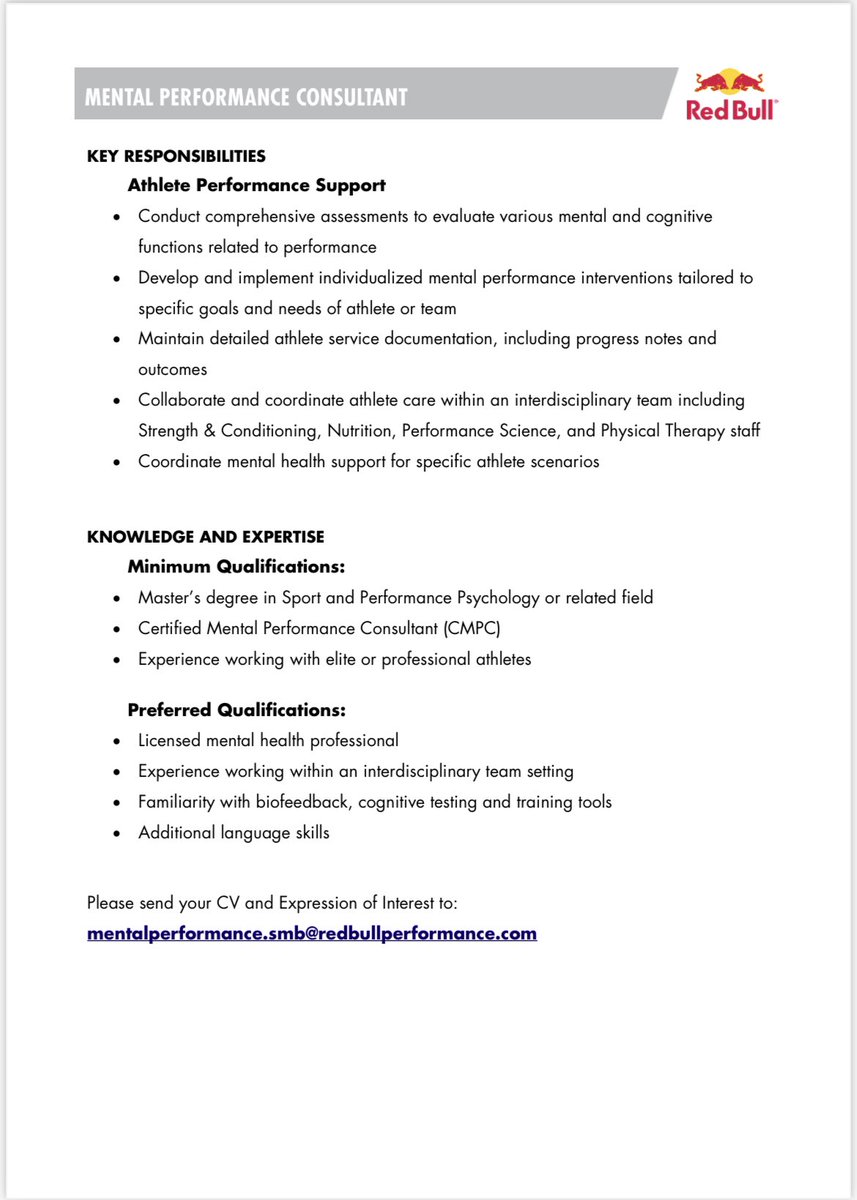
We (Red Bull Athlete Performance Center) are seeking a passionate and versatile Mental Performance Consultant/Contractor to join our team in Santa Monica!
Last few days to apply!
We (Red Bull Athlete Performance) are looking for a passionate, curious and collaborative S&C (Performance) Coach with an analytical mind to join our team accelerating Red Bull Athlete performance in Santa Monica! (..and beyond) https://t.co/8CuVetn26q
Interested in data science and sport? @RugbyAU and @UTSEngage have an exciting opportunity available to undertake a PhD and help grow the sport of Rugby in Australia. More information here: https://t.co/DAdWacHTcV
Siete interessati alla Psicologia dello Sport? Se lo siete vi consiglio questo corso di alta formazione aperto, come in tutto il resto del mondo, sia a laureati in psicologia che in scienze motorie. Open Day questo Sabato, 20 Gennaio. Info a questo sito: https://t.co/xzLnuHtdqS
A Rimini si è tenuta la conferenza "Come l’AI cambierà le nostre vite: nuove opportunità e sfide per la PA e l’impresa": presente anche Carlo Simonelli, Head of Sport Science and Research del Consorzio Vero Volley.
La news ➡️ https://t.co/ulsjxcX5pC
#ForTheLoveOfTheGame 💙
If you are in Italy and want to learn more about sports nutrition, we offer a short postgraduate course at the University of Bologna. More info here: https://t.co/Hf9RT7jVjq
Every Data Scientist needs to know these ideas.
They will blow your mind.
1. Correlation vs Causation
P(A | B) is the probability of A given B. It is the probability that we will observe A given that we have already observed B.
P(A | do(B)) is the probability of A given do(B). It is the probability that we will observe A given that we have intervened to cause B to happen.
In this context, an intervention simply means to take an action of some kind. Therefore do(B) means to take an action which causes B to happen.
The expressions P(A | B) and P(A | do(B)) might seem very similar but they represent very different situations.
2. We can only learn P(A|B) from the data alone.
Bob has an extremely accurate weather app and is always very good about bringing his umbrella when it rains. We observe Bob over several years and we find that whenever it rains, Bob always has his umbrella and he never brings his umbrellas on days when it doesn't rain.
In the language of probability, we say P(Umbrella | Rain) = 1 and P(Rain | Umbrella) = 1 as well.
What we can learn from this data alone is how to predict whether it rains with a 100% accuracy by checking whether Bob has an umbrella. We can also learn to predict with 100% accuracy whether Bob has an umbrella by checking if it's going to rain.
What we cannot learn is what will happen if we give Bob an umbrella on a random day of our choosing. The answer to this question is P(Rain | do(Umbrella) ) and it's unknowable from the data alone.
We need prior knowledge about how the world works to properly interpret the data we collected. We need to know that rain has an effect on Bob's behavior, but Bob's behavior has no effect on the rain.
Information about the effects of interventions are simply not available in raw data unless it is collected by controlled experimental manipulation.
3. Scientific Experiments work because they produce a very special kind of data.
You may have heard of what many people call a scientific experiment. Take a collection of objects, animals or people. Randomly split that collection into a control group and a treatment group. Apply your intervention to the treatment group while leaving the control group alone. If you observe any differences between the treatment group and the control group, it is logical to attribute these differences to the treatment. You can therefore say the differences were caused by the treatment.
In statistics, the procedure I just described is called a Randomized Controlled Trial. It is a procedure for generating a specific kind of data where:
P(Difference | Treatment) = P(Difference | do(Treatment) )
This is why traditional science experiments work. They are designed to capture causal information. This is not the case for vast majority of data that we collect in society.
Without human guidance or access to real world knowledge, statistical algorithms and artificial intelligences can only learn P(A | B) from the raw data. This is a fundamental mathematical limitation on the use of data alone.
That's it for now. This post is part of a series of posts about the concept of causal inference. They are based on the content of the Book of Why by Judea Pearl with lots of commentary from me.
Follow me (@kareem_carr) so you don't miss out on the next post.
Please show support by liking and retweeting the thread.
Hi everyone, is there anyone within my contacts that is familiar with the IRT approach in psychometric questionnaires? If so, I'd like to have an exchange of ideas about a project I'm currently working on. Feel free to share! Thanks in advance.
#IRT
Interested in shaping the future of team sports monitoring? 🤔
Come and join me & @ric_lovell in continuing to explore Submaximal Fitness Tests and monitoring technologies 🦵🫀📃
Apply for @UOW PhD scholarships by Oct 3rd 📅
More info: https://t.co/q3QsyicI5M
DM me for details