I'm excited to share our new paper - an incredible multi-year collaboration with the incomparable Philipp Korber (@KorberLab) driven by one of the most impressive graduate students I've had the pleasure of working with, Iris Langstein-Skora (@ILangstein) https://t.co/pfUfSgrk6Q
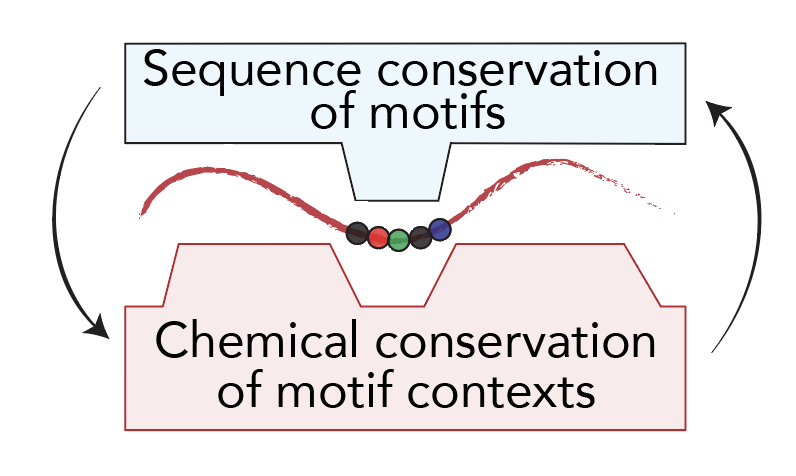
We’re pleased to share our substantially updated (more below on that…) version of our manuscript exploring the relationship between conservation in sequence/function for intrinsically disordered regions (IDRs) https://t.co/rDYOfsKmyT
Disordered proteins are ubiquitous and play myriad important roles in biology. The structural form of these proteins can change when the solution environment changes. But does this translate into function? We answer this question in our new preprint: https://t.co/IcRXpTNSPk
We are happy our review is out!
If you are interested in the impact of nuclear organization on antigenic variation, check it out!
We discuss the role of nuclear organization in mutually exclusive antigen expression and genome stability. https://t.co/VOzZ94QR2S
@NatureMicrobiol
I'm proud to introduce you to the IDRome 👋🍝
We performed simulations of 29,998 IDRs from the human proteome and analysed sequence-ensemble-function relationships.
For a quick intro watch 🎞️👇 and then read: https://t.co/7BamqSlY61
A team led by LMU #molecular biologist Christoph F. Kurat has demonstrated that the way in which #DNA is packaged makes a decisive contribution to a cell’s ability to efficiently double its #genome for cell division. https://t.co/qM0YAuFkz5
I realize that I am very fortunate and lucky to have received this ERC grant, so wanted to give a bit of background for the 10-year process it has been for me to get funding from the ERC. This funding came in my fourth attempt. 1/n
@maj2371 Congratulations and enjoy! I‘m sure it will be a fantastic experience and don‘t worry too much about industry, you most certainly got more transferable skills than you know :)
Excited to share the first paper from my lab. We show that condensates composed of the disordered region of MED1 selectively partition specific functionally related proteins from a complex mixture of biomolecules, regulating gene activation. Free link: https://t.co/DXSHVNDGS9