💻🧓🏽Curious about differences in the conceptualisation of novel technological devices across age-cohorts? Then our new OA paper suits you perfectly!🧓🏽💻 Check it out ⤵️https://t.co/VbKbxOTuCT
@MariannaBolog @BALLab_Rome@CollabraOA We selected those for which all of us agreed they were plausibly basic. Of course, for some concepts, e.g., “oxygen”, it has been hard to do this, but the majority of concepts included in the database are plausibly basic-level concepts.
@MariannaBolog @BALLab_Rome@CollabraOA For each concept—e.g., “pollution”—we asked ourselves: “Does a superordinate category for this concept exist?”. Yes, for instance, “ecology.” “Does a subordinate category for this concept exist?”. Yes, for instance, “acoustic pollution” or “air pollution”.
Have you ever wondered how our mind deeply processes messages with a moral or immoral value? 🧠You can help me in answering this question by taking part in an EEG study I am carrying out at UCC (Cork, Ireland).
Check if you are eligible to participate: https://t.co/qfp9OQbOly
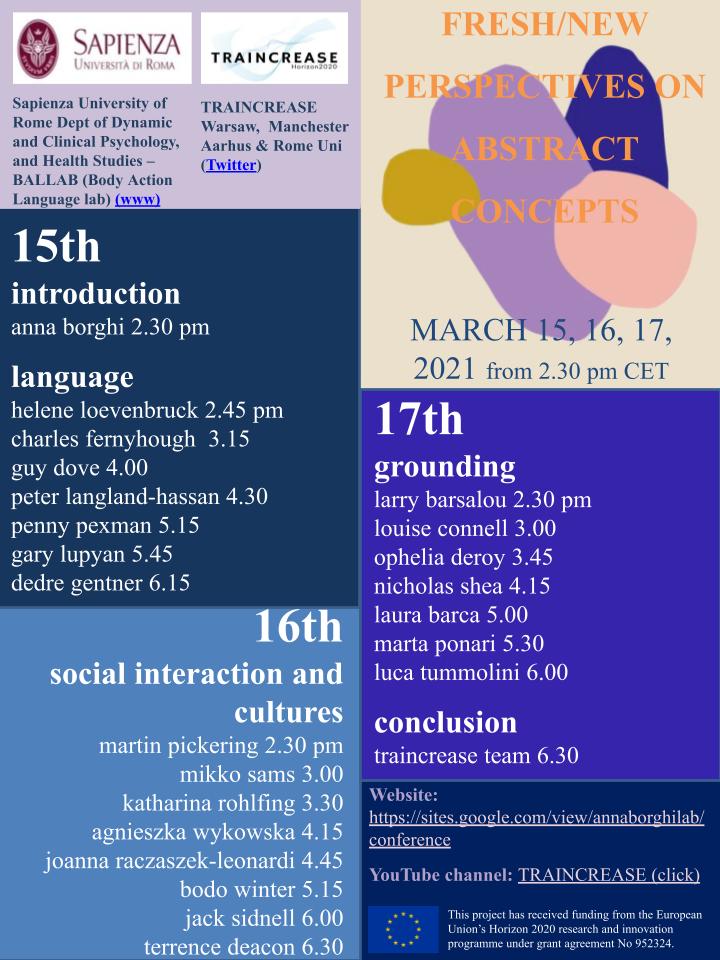
Less than one week to our symposium on abstract conceptual knowledge❕
If you haven't already registered, here is the link https://t.co/2PtShDlzoI.
Let us know you will be there! Stay tuned for more info
@traincrease
How do we use, represent, and acquire abstract concepts? We try to answer these questions in a three-day free, online conference with some of the leading scientists in the field.
Don't miss out on this special occasion! Link to the conference:
https://t.co/yCzRu9h2aI