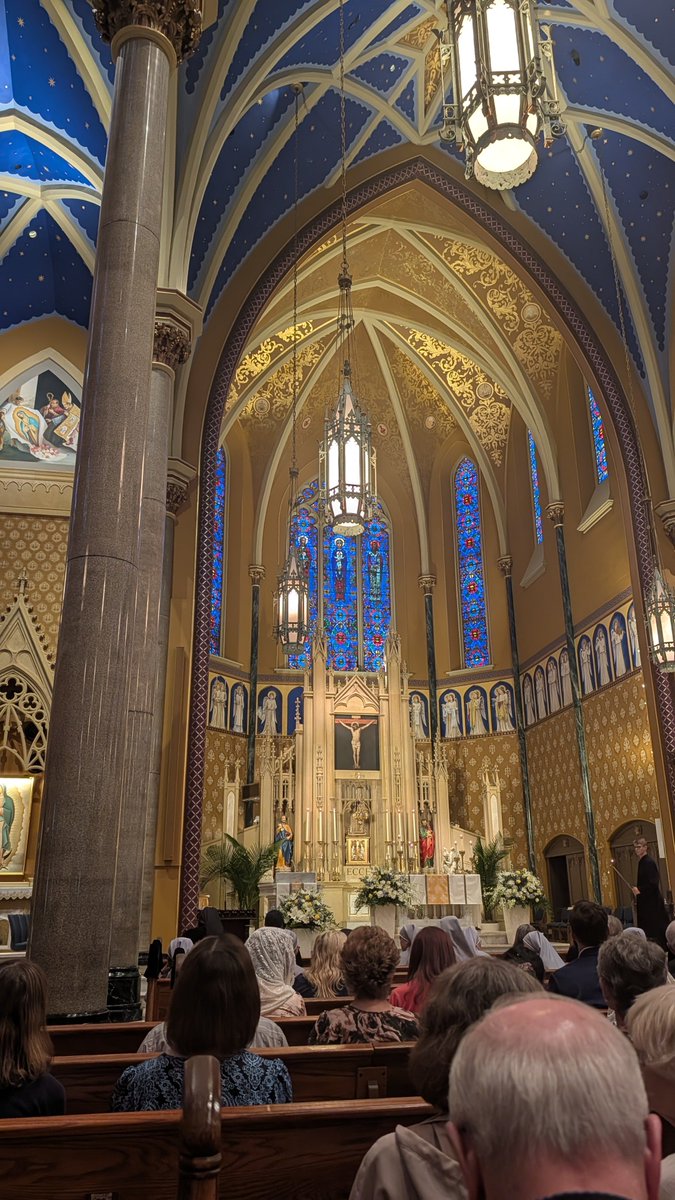
Beyond blessed to attend the Mass celebrating the ordination of Fulton Sheen. In this same Cathedral exactly 107 years ago today, Fulton Sheen was ordained and I was able to attend this ceremony 4 days before his beatification. Fulton Sheen pray for us!
Sorry to do this, but if you have a chance would you pray for me and this upcoming delivery?
I have such an intense anxiety hanging over my head this time around. I’m trying very hard to give it over to God, but it has been difficult.
@filliuscarmeli I believe you still can occasionally, wouldn't make it my primary (just my personal opinion on that piece). Confess elsewhere, maintain Leo is our Pope, and believe that what the Bishops did had errors.
@TridentineBrew@partylike1399 Praying for you, brother. Also praying you'll get some Peoria based distribution. I'll spread the word when you do! I know quite a few beer drinking Catholics here!
Chris Jackson blocked me, so I can't QT him. He's once again put out a 100% AI-generated response to my commentary on the SSPX, but this time in the form of a tweet rather than a Substack article. However, unlike 95% of comments from SSPX supporters, his AI-generated tweet actually engages with the substance rather than just slinging mud at me personally, so I'll at least commend him for that.
As to the substance of his tweet:
(1) He writes "Muse insists that the SSPX must prove every element of its defense beyond reasonable doubt, while he apparently needs only to imagine a plausible justification for Rome’s actions. Read Canons 1321, 1342 and 1720. Who bears the obligation of establishing a punishable delict with moral certainty?"
--This objection confuses the burden of proof incumbent upon an authority in rendering a judgment with the burden of proof incumbent upon a subject in contesting that judgment. In addition to the arguments that I made in the original video (which Jackson ignores), also see canon 124 §2 which establishes that a juridic act posited by competent authority in conformity with the requisite external formalities enjoys a presumption of validity. Hence, if the SSPX wishes to defy the DDF under the pretext that its actions are legally invalid, they carry the burden that I ascribed to them. Not to mention that their habitual disobedience of the commands of lawful authorities carries the same burden.
(2) He writes "Canon 1324 §1, n. 8, expressly provides mitigation even for a culpably erroneous belief in necessity. Section 3 excludes automatic penalties under the applicable mitigating circumstances. Muse attempts to escape this provision through Canon 1325, offering speculative arguments about the bishops’ ignorance without establishing that their judgment actually satisfies that canon."
--This evades the substance of my response -- he dismisses my arguments as "speculative" without explaining why they are insufficient to lend credence to the conclusion that there is an objectively reasonable basis for a judge to conclude that 1325 precludes mitigation under 1324. In addition to the arguments made in the video, there is also the issue that three of the aggravating circumstances mentioned in 1326 apply to this case.
(3) He writes "He then invents a requirement that the SSPX must practically be facing extinction before necessity can justify consecrations. Where does the law say that? Canon 1323 expressly recognizes grave inconvenience."
--At best, 1323 would establish non-punishability rather than liceity. However, 1323 excludes acts that are "intrinsically evil or tend to be harmful to souls" and falls within the scope of 1325. He doesn't address the point in the video that there is a credible argument that the illegal consecrations are intrinsically evil, but its also trivial that the scandal associated with the action would "tend to be harmful to souls" (and thus they would need to prove that the harm was outweighed by a greater benefit that couldn't be adequately achieved by a reasonable lawful alternative). It's also worth noting that "Only situations of necessity of an accidental nature may free from the sanction. This means that the inconveniences which are naturally linked with the fulfillment of a certain law must be accepted and do not authorize one to break the law" The inconveniences cited by SSPX are plausibly covered under that exception.
--I don't claim that imminent threat of extinction is strictly required for necessity, instead I proposed and defended a reasonable alternative that involved dialogue and delay rather than immediate consecrations and explained that to prove the affirmative defense of necessity the SSPX would need to show why that option was morally impossible.
You can't just pick and choose which Bible verses you want to build your theology on. You must take the whole message of the New Testament together.
In Romans, Paul gives us the illustration of the Olive Tree (Israel) to tell us that Jews (Israel in the flesh) will be united to Gentiles (Israel in the spirit) when they believe in Christ. He also tells us that unbelieving Jews (still Israel in the flesh) have been broken off from the source of their life, but they can be restored (grafted back in) through faith in Christ.
St. Paul is clear in Galatians: the promises were made to Abraham and to his seed, “which is Christ” (Galatians 3:16). If you belong to Christ, then you are Abraham’s offspring, heirs according to the promise (Galatians 3:29).
He then closes the letter by calling the Church “the Israel of God” (Galatians 6:16).
It's not a future nation-state. That's what the Zealots wanted. Not a later Protestant denomination. That's what cults think. The one Church Christ founded — the Catholic Church — is the true Israel. The land was the type. The New Covenant people are the fulfillment.
The good news for non-Catholic Christians is that they still have some connection to the Catholic Church by virtue of their Trinitarian baptism, which is recognized by the Catholic Church.