are we gonna acknowledge that a lot of ML papers are genuinely poorly written, and stretch out a concept for 5-10 pages without adequately explaining the initial idea?
after really intensely doing nothing but control RL, training hundreds of models a day, i feel like i understand something about NNs that is hard to understand
that something is: deep learning is magic. it just works
Starting today, 10,000 scientists across every field, from math to chemistry to physics and more, can get Claude through our new Claude Team plan for scientists. Standard seats are free, and premium seats with 5x usage limits are $15 per month, an 80% discount, for one year.
Claude is becoming increasingly capable of scientific work, with recent progress on problems from advanced physics calculations to protein design. Alongside that progress, we've been investing in the research community: Claude Science launched in June, and our AI for Science program funds high-impact projects with free credits. Today's expansion builds on both.
Principal investigators (or equivalent) at academic and nonprofit research institutions can sign up, then add the researchers in their group. Over the coming months, we plan to extend the program well beyond the initial 10,000 seats.
Learn more: https://t.co/RTG1JxWi4Q
I really need you to internalize this:
- the current public frontier is in terms of historical progress 3-6 months behind the private frontier
- most benchmarks are still single-agent and only using a few million tokens, while the latest frontier models are trained for multi-agent operations
OpenAI and Anthropic are both 1.5-2 model iterations ahead, meaning something like GPT-6.1-Astra and Mythos 5.2
they are continuing to race internally
Shopify billionaire co-founder & CEO Tobi Lütke — one of the most analytically rigorous founders alive — uses affirmations.
His exact words:
"If you tell yourself or write down something about yourself 100 times, it writes into the neurofrontal cortex at such a deep level that your brain will start reconciling you to that. It just works."
His personal example:
He was terrified of public speaking.
For one week he sat down every day for 10 minutes and wrote: "I love public speaking."
A week later the fear was gone.
"It's not like a placebo. You just actively change your neurofrontal cortex in this moment."
Your brain starts shaping your behavior around the identity you rehearse most.
once you get access to people who are doing something awesome, you’ll realise how ordinary most such people are.
Most of them don’t have any serious talent for what they do. They all got there by learning and making mistakes.
There’s absolutely nothing stopping you from achieving what they’ve achieved, but you choose to accept yourself as too stupid or too lazy or too weak.
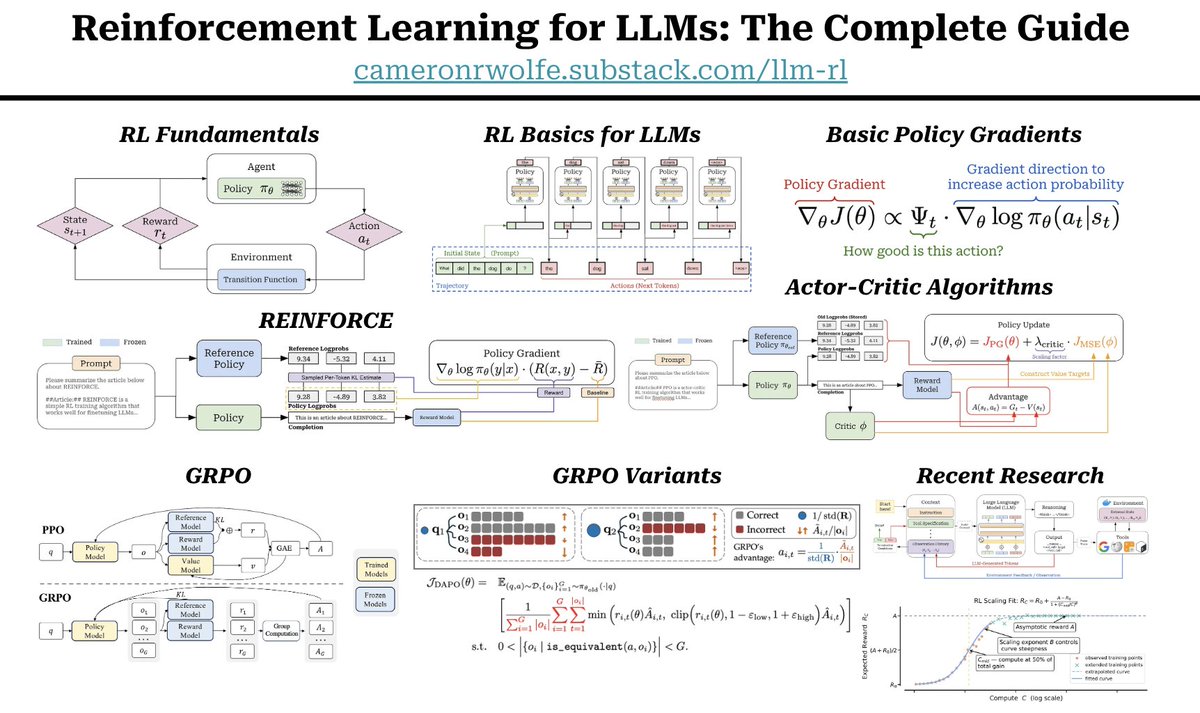
I just published my complete guide to reinforcement learning for LLMs. It's a single, standalone resource for understanding RL from first principles to frontier research.
Read it here: https://t.co/iUMAWUrkQ1
The topics covered are as follows…
RL Fundamentals:
- A general framework for RL (policy, states, actions, transition functions, environment, rewards, trajectories, etc.)
- Core concepts of RL (returns, discounting, action / state / trajectory probabilities, value / advantage functions).
- Formulating and estimating the learning objective for RL.
Basic of RL for LLMs:
- Token-level (MDP) vs. completion-level (bandit) formulations.
- Outcome versus process rewards.
- Value estimation via value models / critics.
- KL divergence, RL setups (RLHF, RLVR, infra, etc.), importance sampling.
Basic Policy Gradients:
- Deriving the RL objective / vanilla policy gradient (VPG) from first principles.
- Different policy-gradient formulations (trajectory returns, reward-to-go, baselines, value functions, and advantages).
- Why policy gradient estimates have high variance (and how baselines help).
- Implementation of VPG.
REINFORCE and its variants:
- REINFORCE as a Monte Carlo implementation of the VPG.
- Completion-level vs. token-level implementations of REINFORCE.
- Reward baselines and KL-regularized rewards.
- RLOO, REINFORCE++ and other critic-free policy gradient algorithms.
Actor-Critic Methods:
- Training value models / critics alongside the policy to estimate advantages.
- Trust Region Policy Optimization (TRPO) and KL-constrained policy updates.
- How PPO simplifies TRPO with a clipped surrogate objective.
- Full PPO details (clipping, advantage estimations, value loss, KL, policy ratios, multi-epoch optimization, etc.) + implementation.
- Generalized Advantage Estimation (GAE) + implementation.
- The memory and computational overhead of actor-critic algorithms.
GRPO:
- Group Relative Policy Optimization (GRPO) as a simpler alternative to PPO.
- Group-relative advantage estimates + implementation.
- Why removing the critic is helpful.
- Limitations of vanilla GRPO algorithm.
- Dr. GRPO, DAPO, GSPO, and other recent improvements.
Recent research topics:
- Online versus offline RL.
- Rubric-based RL.
- RL scaling laws.
- Agentic RL + world modeling.
This post is a synthesis of my writing / learning on RL for over a year. I hope it’s helpful!