As you know the market has been in a downtrend lately and what a time to get a report like this, based on growth catalysts.
If you already have a good portfolio or watchlist, you can match it with these catalysts to see what you might be missing, if not you can use this approach to find where to look and which companies to track.
Let's see how we can do that.
So, if there are 762 growth catalysts across 100 companies, how do you filter them to find where the change is happening first?
More importantly, where are the spending pools growing and where is the money moving?
Yesterday @stockscansin published a report covering 762 growth catalysts.
The first step is to break them into categories.
- Capacity, commissioning and utilisation: 29.0%
- Orders, contracts and customer commitments: 11.9%
- New products, qualification and commercialisation: 11.5%
- Margins, product mix and operating efficiency: 10.1%
- Acquisitions, mergers and portfolio changes: 8.0%
- Capital allocation and balance sheet: 7.6%
- Exports and market expansion: 6.3%
- Distribution and customer reach: 5.0%
- Industry demand, policy and external drivers: 4.9%
- Asset monetisation and project pipeline: 2.4%
- Other or mixed catalysts: 3.3%
See, now you have a starting point.
But these numbers alone don't tell you where the next opportunity is, you need to understand what is changing, why it is happening now and what that change could force the industry to do next.
From the report, three areas stand out to me.
1. Grid Modernisation and Automation
- Substation Automation, Distribution Automation, Protection Relays, Numerical Relays, Power Quality, Grid Stability, etc.
2. Data Centre Power Delivery and Reliability
- Power Distribution, Switchgear Systems, Busbar Systems, Energy Storage, Thermal Management, etc.
3. Aerospace, Space and Defence
- Aerospace Castings, Precision Machining, Engine Components, Surface Treatment, Special Processes, etc.
Why these three?
Because you need to understand where spending is increasing, what new requirements are emerging and which companies can turn those requirements into sustained earnings over the next few quarters.
Let's look at some of the evidence.
Grid and Power
#AparIndustries: Two overseas utilities placed conductor orders worth more than ₹2,800 crore, with deliveries spread over four years.
#DiamondPower: Reported ₹435.71 crore in hyperscale campus orders and another ₹52.86 crore from Aurionpro. Management targeted ₹1,000 crore in data centre orders by March 2027.
Data Centres and Connectivity
#SterliteTechnologies: Reported a US$1.11 billion connectivity award for FY27–FY29, with orders to be placed periodically.
#HFCL: Reported a data centre connectivity order book of more than ₹850 crore.
Battery Materials and Storage
#NeogenChemicals: Management targeted ₹300 crore in FY27 revenue and more than ₹1,000 crore in FY28 as its battery electrolyte business expands.
#Kabra: Reported a ₹133 crore contract linked to its battery energy storage business.
Semiconductors and Electronics
#RashiPeripherals: Reported 131% growth in semiconductor revenue.
#CyientDLM: Reported an order book of ₹2,420 crore.
#SahasraElectronics: Targeted ₹50 crore in semiconductor revenue and had an eSIM commitment for 5–10 million units.
Aerospace, Space and Defence
#RossellTechsys: Reported a multi-year space programme contract worth around ₹400 crore. Management guided for 300–400% combined revenue growth in its space and semiconductor businesses in FY27.
#PTCIndustries: Reported a ₹110 crore BrahMos order for titanium castings and a separate development and supply order from Blue Origin for superalloy castings.
Pharmaceuticals
#KwalityPharma: Its hormone plant targets ₹70–80 crore in FY28 revenue and ₹200 crore by FY29. Management also targeted ₹400–500 crore from bioequivalence-related opportunities by FY29.
Jewellery
#SkyGold: Expanding capacity and targeting an increase in gold metal loans from ₹80 crore to ₹350 crore.
These are just some examples from the report.
But notice something.
A conductor order, a semiconductor revenue target and a space programme contract are not the same kind of signal. They may all point to growth but they tell you different things about how far the opportunity has progressed.
So, before making any decision, you need to understand which stage each opportunity has reached.
Stage 1 — Already Visible: Look for revenue growth, repeat orders, production volumes, utilisation and established customer demand.
Stage 2 — Emerging: Look for large orders, customer approvals, commissioning, production ramp-up and new capacity approaching commercial operation.
Stage 3 — Early / Potential Bottleneck: Look for development programmes, planned facilities, qualification work and early customer discussions.
So, you need to connect three things.
- Where is the spending moving? What is changing on the ground and what new requirements or bottlenecks are emerging?
- Who can benefit? Which companies have the capabilities, customer relationships and financial strength to convert that change into sustained earnings?
- What is the market missing? Are future earnings likely to be better than what the market currently expects?
The first question helps you find the opportunity, the second helps you identify the companies that can capture it, the third helps you determine whether it could become an attractive stock opportunity.
So, the next question is not which companies have the most growth catalysts.
It is which companies can turn these changes into sustained earnings growth and where could the market be underestimating that growth?
Move from identifying growth catalysts to investigating the spending, the bottlenecks, the companies that can benefit and the gap between what the business delivers and what the market expects.
Join Orbit Research for more detailed reports and a clear path to finding these opportunities.
https://t.co/KDOSVT7HyL
When everyone is buying the “hot theme”, what should you be doing?
India has seen a new market darling almost every year.
The problem? By the time a theme becomes popular, a large part of the compounding may already be behind you.
A fascinating study by Persistence Capital looked at 16 major themes from 2015–2023.
The finding: 13 out of 16 themes underperformed the NSE 500 three years after becoming popular.
The first year often looked great. The trouble came later.
The deck goes theme-by-theme, analysing what investors believed at the time vs. what actually happened.
A great exercise in “invert, always invert.”
Before asking “What’s working right now?” ask: “What usually happens to people who chase what’s already working?”
𑁍 Read the full deck: https://t.co/hVHL1WfWvz
Worth 20 minutes for anyone who has ever felt the temptation to chase the hottest theme.
Keep learning, keep compounding.
INSTEAD OF WATCHING AN HOUR OF NETFLIX TONIGHT.
This 1-hour Stanford lecture by Joel Peterson will teach you more about negotiation and getting what you want than most people learn in years.
Bookmark it and give it an hour, no matter what.
This guy literally explained why some people become successful… while others stay average.
And the reason is uncomfortable.
It’s not just hard work.
It’s not luck.
It’s Game Theory.
Once you understand this, you’ll start seeing the “game” behind success differently.
Watch this. 👀
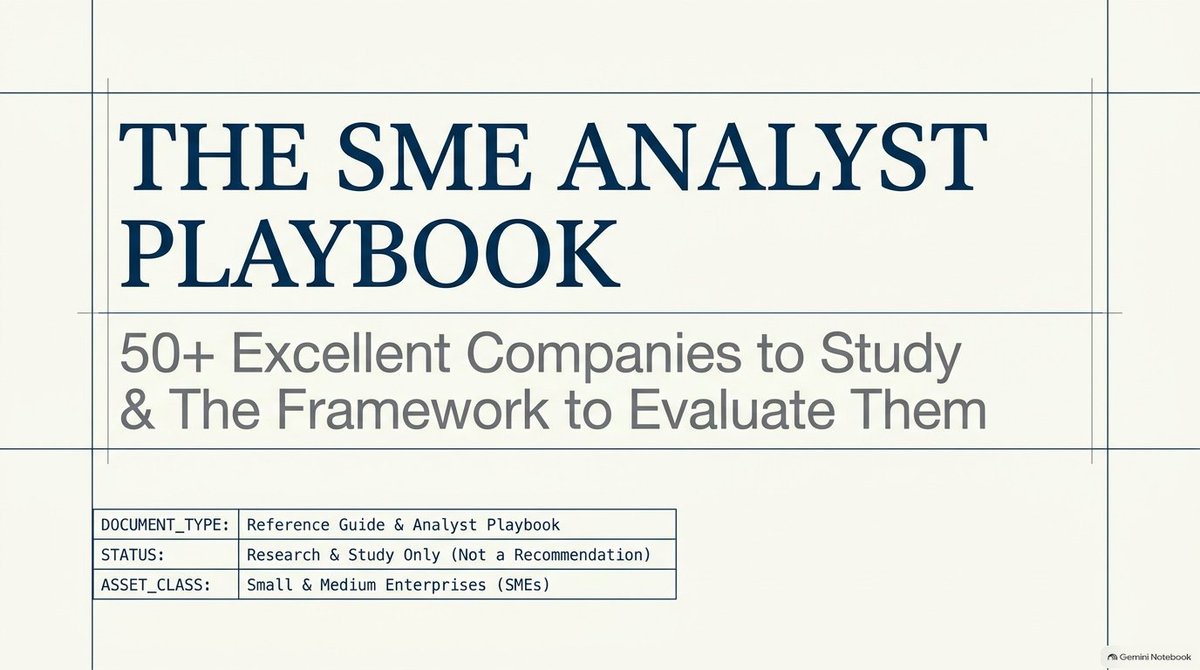
EXCELLENT & HIGH-QUALITY SME COMPANIES TO STUDY & TRACK 🔥🔥🔥
▪️ Shree Refrigerations
▪️ Prizor Viztech
▪️ Danish Power
▪️ Influx Healthtech
▪️ Yash Highvoltage
▪️ Ganesh Infraworld
▪️ Merritronix
▪️ Alpex Solar
▪️ Neetu Yoshi
▪️ Accord Transformer
▪️ Freshara Agro
▪️ Aimtron Electronics
▪️ Unihealth Hospitals
▪️ Millworks Technologies
▪️ Systematic Industries
▪️ Patil Automation
▪️ Baheti Recycling
▪️ Avana Electrosystems
▪️ Anondita Medicare
▪️ Tipco Engineering
▪️ Vivid Electromech
▪️ FlySBS Aviation
▪️ CFF Fluid Control
▪️ Khazanchi Jewellers
▪️ Poojaa Precision Engineering
▪️ OBSC Perfection
▪️ Telge Projects
▪️ Remus Pharmaceuticals
▪️ Energy Mission Machineries
▪️ Sacheerome
▪️ Prime Cable Industries
▪️ Aptus Pharma
▪️ Technocrats Plasma Systems
▪️ Concord Control
▪️ Namo eWaste Management
▪️ Grand Continent Hotels
▪️ L. T. Elevator
▪️ Taurian MPS
▪️ IndosMC
▪️ Pune E-Stock Broking
▪️ Divine Power Energy
▪️ Apsis Aerocom
▪️ Madhusudan Masala
▪️ JD Cables
▪️ Sunlite Recycling Industries
▪️ Afcom Holdings
▪️ Anlon Technology
▪️ Credent Connect N Care
▪️ Pramodini Medicare
▪️ Atharva Poly-Plast
▪️ Bai-Kakaji Polymers
▪️ Poojaa Precision
▪️ Kratikal Tech
▪️ Unified Data-Tech
▪️ Workmates Core2Cloud Solution
▪️ Devson Catalyst
▪️ Avience Biomedicals
WHAT TO STUDY BEFORE TAKING ANY DECISION
Just seeing strong growth or a good stock price performance is not enough.
Go through the company from multiple angles:
▪️ Balance Sheet — debt, net worth, cash, borrowings and overall financial strength
▪️ P&L Statement — revenue growth, margins, profitability and consistency
▪️ Cash Flow Statement — whether profits are actually converting into cash
▪️ Annual Report — business model, strategy, risks, subsidiaries and management commentary
▪️ Concall — management guidance, future plans, order book, capacity expansion and execution
▪️ Investor Presentation — business segments, customers, capacity, expansion plans and growth strategy
▪️ Exchange Announcements — orders, acquisitions, fund raising, contracts, new projects and other important developments
▪️ DRHP / RHP — particularly important for IPO-stage companies; understand the business, promoters, financials, objects of the issue and risk factors
▪️ Management & Promoters — background, track record, holding pattern, pledging and corporate governance
▪️ Order Book & Execution — size of order book, quality of orders and ability to convert them into revenue
▪️ Working Capital — receivables, inventory, payable days and cash conversion
▪️ Capacity Expansion — current capacity, utilisation and whether expansion is supported by actual demand
▪️ Customer Concentration — dependence on a few customers can increase business risk
▪️ Related Party Transactions — study them carefully
▪️ Debt & Interest Cost — understand how growth is being funded
▪️ Promoter Dilution / Fund Raising — track preferential issues, warrants, QIPs and other capital raising
▪️ Valuation — a good business can still demand careful valuation analysis
▪️ Execution — ultimately, management's ability to execute its stated plans matters the most
SME companies can offer interesting business models and growth opportunities, but they can also have higher execution, liquidity, governance and information risks, so deeper research is important rather than relying only on price action or social-media discussions.
Study the business first. Then study the numbers. Then study the management. Finally, study the valuation.
DISCLAIMER
This post is for educational and informational purposes only and should not be considered investment advice, research advice, or a recommendation to buy, sell, or hold any security.
Lincoln P Coelho 🔥
Underrated & Unheard investor from Mumbai, specialising in deep value & niche monopolies.
₹118 Cr Micro-cap portfolio built around a simple idea -
Buy Boring B2B businesses with deep moats and hold them through the toughest cycles.
Just look at the scale of portfolio
2020 - ₹7 Cr across 11 Stocks
2023 - ₹58 Cr across 12 Stocks
2026 - ₹118 Cr across 18 Stocks
Compounding at 59% CAGR since 2020 - Unreal
Shivalik Bimetal alone makes up 56% of his portfolio.
85% of portfolio sits in 3-4 high-conviction bets & rest is spread across small turnaround plays
Don’t wait, Start studying his investing journey 🔥
My Journey Through Depression, the Stigma Around It, and What the Bhagavad Gita Gave Me - Two years ago I couldn't sleep, cried without reason, and two neurologists told me I was fine. A psychiatrist and the Bhagavad Gita changed that. My story, for anyone who thinks depression can't happen to them - https://t.co/8JfthcWJPY
🚨🚨
DELETE 99% OF STOCKS FROM YOUR WATCHLIST.
Here are the filters to find top 1% WINNING STOCKS.
Here's the Technofunda process — fundamentals decide WHAT, charts decide WHEN.
Detailed Screening Guide below: 👇
Read of the day!
I am a big fan of Gaurav {@9onecapital} . He writes with a lot of depth and clarity. I learn a lot from his depth and breadth of coverage.
In this blog, he talks about risks in Banks/NBFCs in a unique way.
https://t.co/OTnifUdRQ7
Prashant Jain 🔥
Via - 3P India Equity Fund
He's playing a massive structural bet on India's Healthcare & Pharma ecosystem wholy
Deployed over ₹1,300 Cr across 7 names
Entero Healthcare: 2.50%
Zota Health: 2.28%
Suven Life: 1.27%
Wockhardt: 1.15%
Sudeep Pharma: 1.05%
AstraZeneca Pharma: 1.10%
Inventurus Knowledge Solu: 1.04%
Backing the infrastructure that will drive healthcare’s next growth phase, intresting times
Two paragraphs that standout to me (the whole letter worth reading though)
It is difficult to overstate the magnitude of the opportunity. It would also be a grave error in our minds to let excitement weaken our investment discipline. In moments of euphoria, investors tend to convince themselves that second- and third-tier assets are actually first-tier. The story becomes so powerful that people stop making distinctions. Capital flows toward the theme rather than the company. Markets begin to reward proximity to the future rather than evidence of enduring quality. Within Silicon Valley in particular, the industry can become fixated on hyper-incremental technological turns rather than where the technology ultimately leads.
We have seen this before, and we will see it again. Technological optimism and investment discipline are not opposites. In fact, the more optimistic we are about the size of a paradigm shift, the more disciplined we must be about where value will be captured. Not every company exposed to an important theme becomes important. Not every company using new technology becomes enduring. Not every fast-growing business is exceptional. And not every exceptional company is a great investment at every price. Our responsibility is to maintain those distinctions.