🔥🔥 Lại chủ đề Kháng lượng tử (Post-Quantum)
I/ Giải thích đơn giản dễ hiểu bản chất
II/ Phương án và lộ trình bảo mật tài sản
——————————
I/ GIẢI THÍCH ĐƠN GIẢN DỄ HIỂU BẢN CHẤT
Thông thường người dùng tương tác trực tiếp với ví không lưu ký (non-custodial wallet) qua Seed phrase hoặc Private key.
Nếu muốn thử vét cạn toàn bộ nghiệm (brute-force)
- Về mặt toán học: Private key ~ Seed phrase (độ khó gần tương đương).
- Về mặt thực tế: Seed phrase khó để brute-force do PBKDF2 làm chậm 10,000 lần (BIP-39 dùng PBKDF2-HMAC-SHA512 với 2048 vòng lặp để nội suy seed từ mnemonic).
⚡️ Kết luận => dùng Seed phrase sẽ an toàn hơn Private key. Tập thói quen dùng ví Multi-chain thay vì Single-chain.
—
Trước giờ loại Seed phrase 12 từ được sử dụng phổ biến nhất, ngoài ra còn có những loại 15,18,21 và 24 từ nhưng hiếm người biết tới và cũng hiếm ví hỗ trợ (Coin98 Super Wallet có hỗ trợ tất cả từ lâu).
Ở đây tôi chỉ so sánh Seed phrase 12 từ và 24 từ, mấy loại khác bỏ qua không quan tâm làm gì.
Wordlist để tạo ra Seed phrase bao gồm 2048 từ gốc tạo ra độ khó tương ứng:
12 từ = 128 bits entropy + 4 bits checksum
24 từ = 256 bits entropy + 8 bits checksum
Giả định:
Nếu brute-force 12 từ mất 1 giây thì brute-force 24 từ mất:
2^128 giây
= 3.4 × 10^38 giây
= 1.08 × 10^31 năm
Tuổi vũ trụ = 1.38 × 10^10 năm
=> Lâu hơn tuổi vũ trụ 10^21 lần
Tại sao Seed phrase 12 từ đáng lo?
2^64 = 1.8 × 10^19 operations
Với quantum computer tương lai:
- Tốc độ giả định 10^15 ops/giây
- Thời gian: 1.8 × 10^19 / 10^15 = ~18,000 giây ~ 5 giờ
12 từ có thể bị crack trong vài giờ
24 từ vẫn cần 2^128 ops => bất khả thi
⚡️ Kết luận => dùng Seed phrase 24 từ mới "tạm" an toàn trước Quantum, tại sao nói tạm thì đọc tiếp.
—
Công nghệ máy tính lượng tử có thể tận dụng sức mạnh tính toán để tấn công trực tiếp Seed phrase cũng như Private key thông qua 2 phương thức:
🔥 Vét cạn toàn bộ nghiệm (brute-force)
Quantum không “bẻ gãy” Seed phrase như bạn nghĩ, không phá hash theo cách exponential như RSA/ECC, nó chỉ dùng được thuật toán Grover để tăng tốc brute-force. Với Classical là 2^n thì với Quantum chỉ còn 2^(n/2) - đây vẫn là tập nghiệm rất lớn.
Tuy nhiên chúng ta có Seed phrase 24 từ vẫn rất an toàn trước Quantum theo hướng tấn công này, nhưng với 12 từ thì không!
🔥 Mối lo ngại thật sự nằm ở đây: Thuật toán Shor - mối đe dọa với khóa công khai (Public key)
Nguy hiểm hơn Grover. Shor phá vỡ ECDSA / secp256k1 (chữ ký Bitcoin,Ethereum,..) trong thời gian đa thức.
Tức là:
- Nếu biết public key, Shor có thể tính ngược Private key
- Bitcoin địa chỉ chưa spend (Public key chưa lộ) tương đối an toàn hơn
- Địa chỉ đã từng send (public key đã lộ on-chain) dễ bị tấn công
⚡️ Đó là lý do tôi nói Seed phrase 24 từ mới "tạm" an toàn trước Quantum mà thôi, an toàn trước brute-force, nhưng vẫn rất hớ hênh đối với Shor.
[1/2]
Xem tiếp phần 2 bên dưới
The Price of Tomorrow by @JeffBooth explains what happens when deflationary technology meets inflationary money.
It’s also a guide for where we might be headed.
“What is coming next in technology changes the rules in a way that too few understand.”
🧵
NGƯỜI HOA NỔI TIẾNG VỚI TÀI BUÔN BÁN GIỎI - VÀ ĐÂY LÀ 11 PHÉP TÍNH "XƯƠNG MÁU" CỦA HỌ
Người Hoa làm ăn kinh doanh không dựa vào lý thuyết mà họ dựa vào những phép tính cực kỳ thực tế để đảm bảo mình luôn "sống sót" và có lãi. Dưới đây là 11 phép tính "xương máu" đó.
1. Điểm hòa vốn (Break-Even Point):
Câu hỏi: "Một ngày tôi phải bán được bao nhiêu bát phở thì mới bắt đầu có lãi?"
Công thức: Điểm hòa vốn = Tổng chi phí cố định / (Giá bán trung bình 1 sản phẩm - Chi phí biến đổi trung bình 1 sản phẩm)
Đây là con số quan trọng nhất, quyết định sự sống còn của quán.
2. Dòng tiền (Cash Flow):
Câu hỏi: "Tiền trong két có đủ để trả tiền nhà, lương nhân viên và tiền hàng tháng sau không?"
Công thức: Dòng tiền = Tiền thu vào - Tiền chi ra
Người Hoa ám ảnh với dòng tiền. Lãi trên giấy không quan trọng bằng tiền thật trong túi.
PHÉP TÍNH TỐI ƯU LỢI NHUẬN
3. Tỷ lệ Lãi gộp (Gross Profit Margin):
Câu hỏi: "Sau khi trừ tiền nguyên liệu, tôi còn lại bao nhiêu phần trăm?"
Công thức: Lãi gộp (%) = ((Doanh thu - Giá vốn hàng bán) / Doanh thu) x 100
Nếu chỉ số này quá thấp, hoặc là giá bán của bạn quá rẻ, hoặc là giá nhập nguyên liệu của bạn quá cao.
4. Tỷ lệ Chi phí Nguyên liệu (Food Cost Percentage):
Câu hỏi: "Tiền nguyên liệu đang chiếm bao nhiêu phần trăm doanh thu?"
Công thức: Food Cost (%) = (Giá vốn hàng bán / Doanh thu) x 100
Với F&B, con số "vàng" là từ 25-35%. Nếu cao hơn, bạn đang gặp vấn đề.
5. Tỷ lệ Chi ph�� Nhân công (Labor Cost Percentage):
Câu hỏi: "Tiền trả lương đang chiếm bao nhiêu phần trăm doanh thu?"
Công thức: Labor Cost (%) = (Tổng lương nhân viên / Doanh thu) x 100
Con số này không nên vượt quá 20-25%.
PHÉP TÍNH QUẢN TRỊ
6. Doanh thu trên mỗi mét vuông (Revenue per Square Meter):
Câu hỏi: "Mỗi mét vuông mặt bằng đang tạo ra bao nhiêu tiền cho tôi?"
Công thức: Doanh thu/m² = Tổng doanh thu / Tổng diện tích quán
Giúp bạn biết liệu mặt bằng có đang được sử dụng hiệu quả hay không.
7. Tỷ lệ Vòng bàn (Table Turnover Rate):
Câu hỏi: "Một cái bàn của tôi một ngày đón được bao nhiêu lượt khách?"
Công thức: Tỷ lệ vòng bàn = Số lượt khách trong ngày / Tổng số bàn
Chỉ số này càng cao, hiệu suất phục vụ của bạn càng tốt.
PHÉP TÍNH VỀ KHÁCH HÀNG
8. Giá trị Đơn hàng Trung bình (Average Order Value - AOV):
Câu hỏi: "Mỗi khách vào quán trung bình tiêu bao nhiêu tiền?"
Công thức: AOV = Tổng doanh thu / Tổng số hóa đơn
Tìm mọi cách để tăng chỉ số này (upsell, cross-sell, combo...).
9. Chi phí Thu hút Khách hàng mới (Customer Acquisition Cost - CAC):
Câu hỏi: "Tôi phải tốn bao nhiêu tiền marketing để có được một khách hàng mới?"
Công thức: CAC = Tổng chi phí marketing / Số khách hàng mới
10. Tỷ lệ Khách hàng Quay lại (Customer Retention Rate):
Câu hỏi: "Bao nhiêu phần trăm khách hàng đã quay trở lại trong tháng này?"
Công thức: Tỷ lệ quay lại (%) = (Số khách cũ / Tổng số khách) x 100
11. Giá trị Vòng đời Khách hàng (Customer Lifetime Value - CLV):
Câu hỏi: "Một khách hàng trung thành sẽ mang lại cho tôi bao nhiêu tiền trong suốt cuộc đời họ?"
Công thức (đơn giản): CLV = Giá trị đơn hàng trung bình x Số lần quay lại trung bình
Đây là lý do tại sao người Hoa cực kỳ coi trọng khách quen.
Bài học cốt lõi:
Kinh doanh không phải là cảm tính. Đằng sau tư duy "làm chủ" của người Hoa là sự ám ảnh với những con số. Họ không cần bằng cấp cao, nhưng họ thuộc lòng những phép tính sinh tồn này. Ai nắm được những con số này, người đó nắm được vận mệnh của doanh nghiệp mình.
Nguồn: Sưu tầm Internet
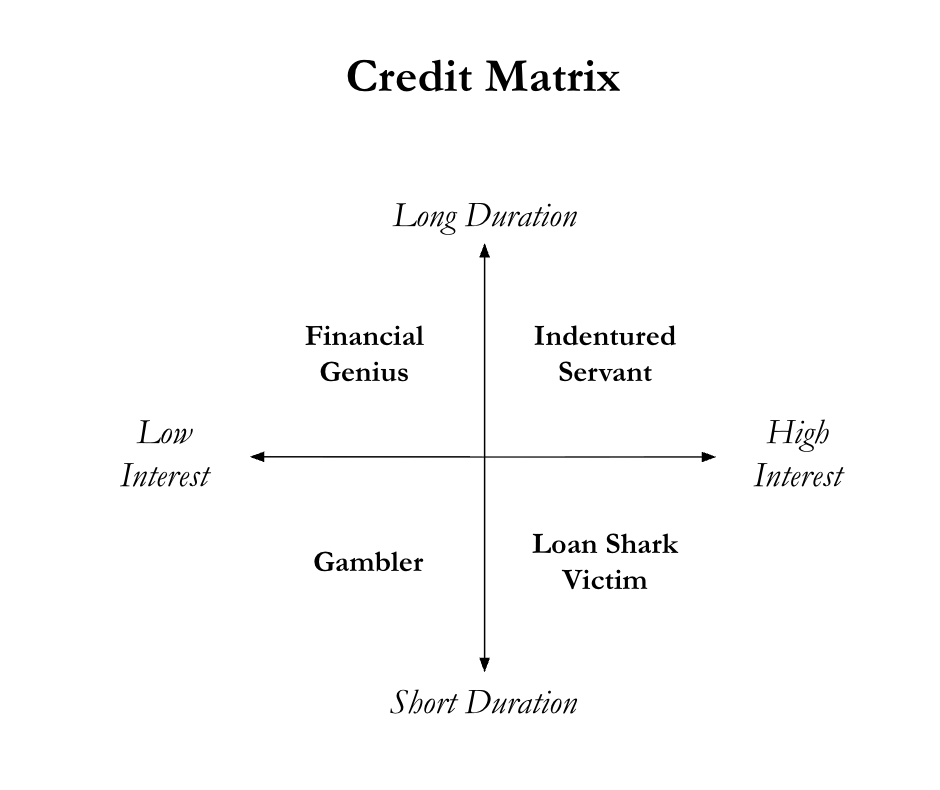
THE CREDIT MATRIX
"If you’re borrowing money over a short duration (<5 years), you’re a gambler, and you risk getting liquidated.
If you’re borrowing short-duration money at a high interest rate (>20%), you’ll become a loan shark victim. (Do not do this—you’re going to get your legs broken!)
Similarly, borrowing money at a high interest rate over a long duration turns you into an indentured servant. You’ll have to work your entire life with nothing to show for it.
Instead, what you want to do is borrow money for a long duration (>10 years) at a low interest rate (<10%).
Strategy is raising money from investors and loaning it to the Bitcoin network.
For example, plenty of people would like to earn 8% interest. We can sell an instrument that gives it to them, and turn around and invest the proceeds at 29%.
When would this not work?
Well, it wouldn’t work if Bitcoin appreciated by less than 8% forever and volatility dropped to zero.
It would be dilutive to the common equity if we sold a fixed credit instrument that paid more than Bitcoin’s expected rate of appreciation, and it would be dilutive to issue equity below NAV.
If Strategy were to raise $10 billion, we would be adding $10 billion of assets to the balance sheet. The interest payments would be so de minimis as to be a rounding error. If we became too leveraged, we could turn around and sell equity to delever. It’s a continuous back-and-forth of progressive leveraging and deleveraging.
Strategy’s leverage ratio (liabilities as a % of assets) ranged between 15% to 30% through the first half of 2025.
The problem is not leverage; it’s deleverage.
If the price of Bitcoin increases, the leverage ratio falls. Therefore, we're naturally deleveraging at a rate of 29% per year."
—Michael Saylor
THE SPEED OF SOUND MONEY
"There’s a certain speed at which an asset can monetize.
There's a certain speed at which we can create ETFs, give banks guidance to hold an asset, fix the accounting, educate all the senators and members of congress, and at which billionaires can figure out the new thing.
We often want everything to progress faster. But would you really feel comfortable if Bitcoin was increasing by 500% per year? Or would that be tempting karma?
The metaphor I like to use is a shock wave.
If an airfoil is moving faster than the speed of sound, air can't get out of the way and creates a shock wave. This results in turbulence (a massive dissipation of energy) and friction.
It’s like breaking the speed limit that nature gave you. When you try to go faster than that speed, you delaminate. That's when you see sparks.
So, it's very healthy if Bitcoin backs down. North of 100% a year is about as fast as you want to be going.
If you have something utterly compelling, hook onto it, hold on, and let that evolve. I think we've got a decade of that evolution—it just takes that long for a signal to move through the civilization."
—Michael Saylor
This week, @DromosLabs is hosting a major event featuring a keynote about @aeroxyz and @VelodromeFi
As Aerodrome grows, we see increasingly more fud across CT.
I'd like to dismantle two of the biggest critiques.
The "printing tokens" critique is economics 101 that people failed:
Critics think token emissions = Zimbabwe hyperinflation (probablyno one thinks about Zimbabwe)
They're missing thirty years of history sitting right in front of them: Japan.
Japan has been on an absolute rampage since the 90s. The government printed money, bought bonds, bought stocks, all on a scale that would make any traditional economist lose their mind. Yet inflation stayed at like 0.2% for decades.
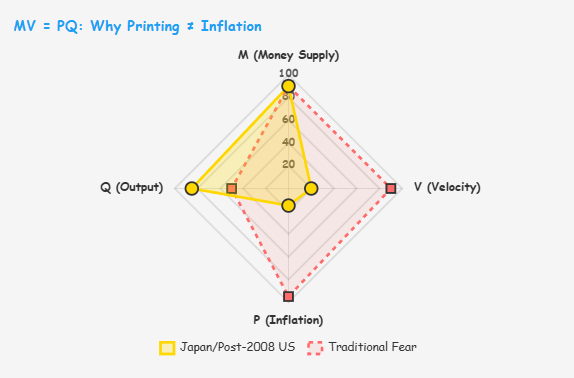
Why? Because these people forgot the formula: MV = PQ
M = money supply
V = velocity (how fast money actually moves)
P = inflation
Q = economic output
You can print money all day. If velocity collapses and output grows, you get zero inflation. Japan proved this. The US proved this post 2008 (400% monetary base increase, barely any inflation).
Now apply this to Aerodrome:
49% of supply is locked as veAERO. That's dead money. Zero velocity. It literally doesn't exist for price discovery purposes.
Do the math:
• Weekly emissions: 3.7m AERO
• Annual emissions: ~192m AERO/year
• 49% of emissions locked: ~94m AERO/year locked immediately
• Circulating new supply: ~98m AERO/year
• Circulating supply base: 912m AERO (51% of total)
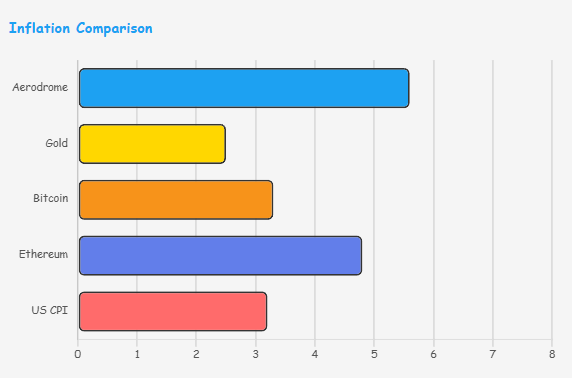
• Net inflation on circulating supply: ~5.6%
That's actually pretty solid for a year 3 protocol. Gold mines ~2-3% annually for comparison.
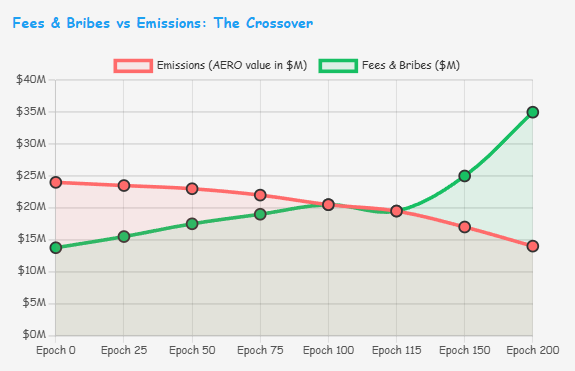
The "emissions > revenue" critique confuses two completely different things:
This one is even more fun because it conflates equity distribution with actual cash expenses.
Google did this in the early 2000s. They paid engineers stock options instead of salaries. The income statement showed "losses" from compensation expense. Except Google never spent a dollar. They diluted shareholders slightly but kept their cash intact.
Amazon did this for twenty years. "Unprofitable" company, everyone said it would collapse. Except Jeff Bezos was deliberately sacrificing short-term profits to build dominance. Reinvesting everything into market share, not burning cash. Now they're worth 1.5 trillion.
Tesla did the same thing. Years of "losses" while they built Gigafactories and locked in EV dominance. Once competitors finally caught up, Tesla already had a decade head start.
This is what Aerodrome's doing.
Aerodrome isn't spending cash on emissions. Zero dollars leave the treasury. They're generating $185m annually in actual revenue while spending zero on their primary "expense."
That's not unprofitable, that's positive cash flow with zero burn rate risk.
veAERO holders get 100% of revenue (literally no other protocol does this) plus rebases that offset dilution. Net dilution for lockers is around 5%, but rebase mechanics eliminate it. They're making 5-6% yearly while the protocol is massively cash positive.
The numbers that matter
• $425m real revenue generated since launch
• $185m annualized revenue growing with Base
• 878m tokens locked (49% of supply)
• 60% DEX market share on Base
• 30% of revenue going to public good fund & team wallet for buybacks and locks
• @coinbase , @circle , @animocabrands and major protocols all accumulating veAERO
This isn't a ponzi. This is blitzscaling from the playbook that created many dominant platform businesses in the last thirty years.
Chainlink Runtime Environment (CRE) is now live. Here's a 101 video that I made with NotebookLM to illustrate what it is.
"We are moving from a world of slow, siloed financial systems, to one where any asset, any piece of value, can be programmed and connected to any other system. The question is no longer if this is going to happen, but what are we going to choose to build in this new hyperconnected world."
Understanding the distribution of risk-return is essential to understanding the Strategy thesis specifically and the BTC-TC thesis more generally.
The first thing we need to understand is that different investors are optimising for different outcomes based on their volatility, risk and return goals.
In order to attract more capital, Strategy creates different products with different risk-return profiles that are deliberately engineered to appeal to different sets of investors.
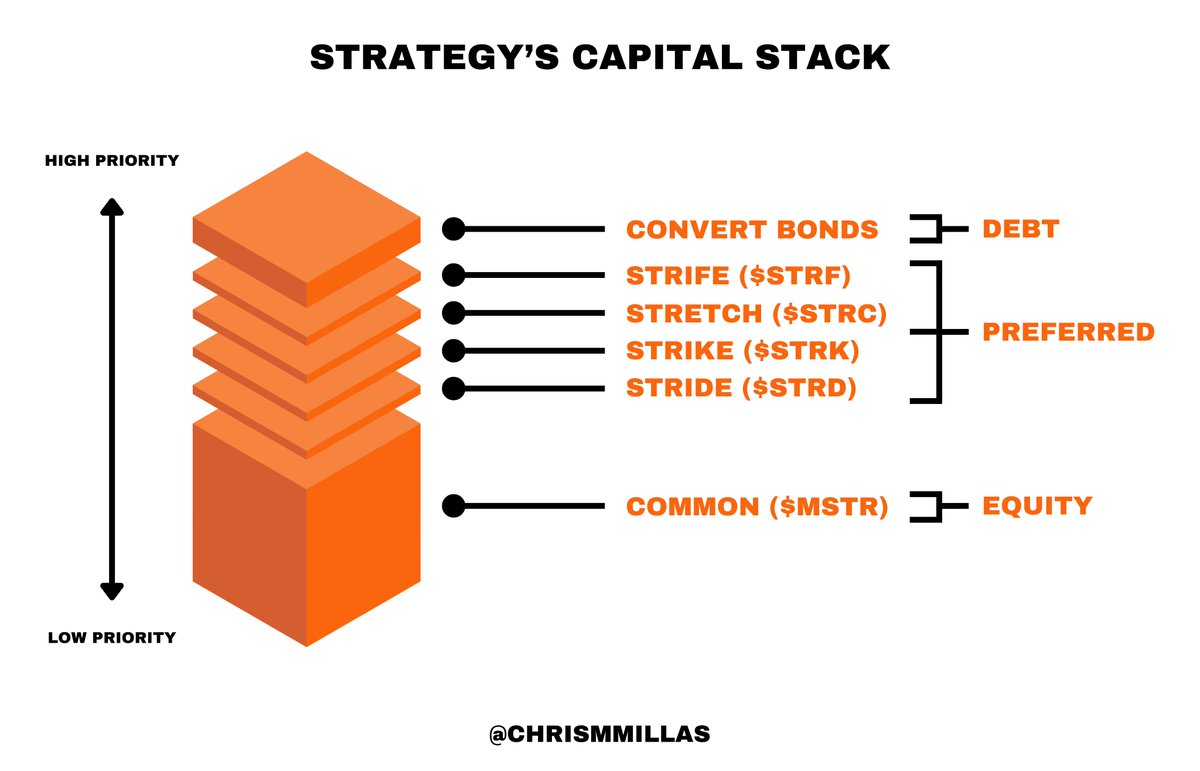
Now let’s look at Strategy’s capital stack.
The capital stack essentially shows the order of priority of claims on a company’s assets.
In other words, who gets paid in what order in a liquidation event.
Top of Strategy’s capital stack are convertible bonds.
Convertible bonds offer investors minimum risk since they’re first to be paid out in a liquidation event but limited relative returns since the upside is capped.
Next we’ve got the preferred stock products starting with Strife.
Strife offers investors low relative risk since it has a target BTC Rating of 10 and investors are second to be paid out in a liquidation event but low relative returns since it pays a fixed 10% dividends at par value.
Stretch offers investors low relative risk since it has a target BTC Rating of 10 and investors are third to be paid out in a liquidation event but low relative returns since it pays a fixed 10% dividends at par value.
Strike offers investors moderate relative risk since it has a BTC Rating of 5 and investors are fourth to be paid out in a liquidation event but high relative potential returns since it pays a fixed 8% dividends at par value and can also be converted into common stock at $1,000.
Stride offers investors high relative risk since it has a BTC Rating of 2-3 and investors are fifth to be paid out in a liquidation event but moderate relative returns since it pays a fixed 11.75% dividends at par value.
Bottom of Strategy’s capital stack is common stock.
Common stock offers investors maximum risk since they’re last to be paid out in a liquidation event but it also offers maximum potential returns since there’s no upside cap.
So what does all this mean?
As illustrated in the second graphic attached, both the excess risk and the excess returns that are stripped away from the convertible bond and preferred stock holders is being absorbed by common stock holders.
So if Bitcoin goes up, commons stock holders capture the upside.
If Bitcoin goes down, common stock holders bear the downside.
As a consequence, convertible bond and preferred stock holders get decreased risk and returns in exchange for certainty while common stock holders get increased risk and returns in exchange for volatility.
& that is why they are playing entirely different games.
Convertible bond and preferred stock holders are playing the game of defense.
Common stock holders are playing the game of offense.
The Blueprint for a New Financial System
Michael Saylor, founder and Executive Chairman of MicroStrategy, returns to explain how Bitcoin is transforming global capital markets and redefining the future of wealth creation. Drawing from his background in science and engineering, Saylor breaks down how Bitcoin’s architecture merges technology, economics, and mathematics to create the first truly engineered form of sound money — one that’s reshaping corporate finance, investment strategy, and even national policy.
In this conversation, we explore why legacy finance is structurally unsustainable, how overcollateralized digital credit could replace sovereign debt, and why Bitcoin’s “refinery model” may ignite a new era of capital efficiency. Saylor details the evolution from digital gold to digital credit, how MicroStrategy’s innovations are setting the blueprint for Bitcoin-backed balance sheets, and why governments, banks, and investors will ultimately be forced to adopt Bitcoin as the foundation of a new global financial system.
Timestamps:
0:00 – Why Bitcoin Is Inevitable
4:12 – How Technology Turned Energy Into Capital
8:27 – Why 99% of Companies Are Locked Out of Capital Markets
12:38 – The “Kerosene” Metaphor: Refining Bitcoin Into Yield Instruments
18:21 – Designing Digital Credit: How It Actually Works
32:55 – How Bitcoin Becomes the Base Layer for Digital Credit
48:12 – Rebuilding Legacy Finance on Bitcoin Infrastructure
56:09 – Turning USD Yield Into Bitcoin Yield
1:12:24 – Why Bitcoin’s Refinery Model Could Spark a New Industrial Revolution
1:24:10 – How Digital Credit Will Outperform Traditional Bonds
1:38:52 – Why Governments and Corporations Will Be Forced to Adopt Bitcoin
1:52:40 – Adapting to Change — Why Relevance Is Earned Daily
Note: This interview was recorded with @1MarkMoss on September 30, 2025, before $STRC, $STRK, $STRD, and $STRF began trading on @RobinhoodApp.
Bitcoin isn’t hedging the system. It’s replacing it.
This isn’t a "trade". It’s a transition.
Bitcoin has no top because fiat has no bottom.
Buy Bitcoin. It’s really that simple.
I’m 34. I’ve been a nurse for 12 years.
My investment portfolio is worth $1.2 million.
My bank account rarely has more than $5,000 in it.
I started investing at 14, working a minimum wage job and putting every dollar into PepsiCo stock.
Graduated college with $32K in debt and paid it off by 25.
Never made six figures from a W2 job.
I pack a lunch every day. I’ve always lived well below my means.
Now I’m happily married, a father of two, and have the financial freedom to cut back my hours, grow my businesses, and travel with my family.
The blueprint going forward:
Buy Bitcoin. Stay disciplined. Keep life simple.




![drofin69's tweet photo. 🔥🔥 Lại chủ đề Kháng lượng tử (Post-Quantum)
I/ Giải thích đơn giản dễ hiểu bản chất
II/ Phương án và lộ trình bảo mật tài sản
——————————
I/ GIẢI THÍCH ĐƠN GIẢN DỄ HIỂU BẢN CHẤT
Thông thường người dùng tương tác trực tiếp với ví không lưu ký (non-custodial wallet) qua Seed phrase hoặc Private key.
Nếu muốn thử vét cạn toàn bộ nghiệm (brute-force)
- Về mặt toán học: Private key ~ Seed phrase (độ khó gần tương đương).
- Về mặt thực tế: Seed phrase khó để brute-force do PBKDF2 làm chậm 10,000 lần (BIP-39 dùng PBKDF2-HMAC-SHA512 với 2048 vòng lặp để nội suy seed từ mnemonic).
⚡️ Kết luận => dùng Seed phrase sẽ an toàn hơn Private key. Tập thói quen dùng ví Multi-chain thay vì Single-chain.
—
Trước giờ loại Seed phrase 12 từ được sử dụng phổ biến nhất, ngoài ra còn có những loại 15,18,21 và 24 từ nhưng hiếm người biết tới và cũng hiếm ví hỗ trợ (Coin98 Super Wallet có hỗ trợ tất cả từ lâu).
Ở đây tôi chỉ so sánh Seed phrase 12 từ và 24 từ, mấy loại khác bỏ qua không quan tâm làm gì.
Wordlist để tạo ra Seed phrase bao gồm 2048 từ gốc tạo ra độ khó tương ứng:
12 từ = 128 bits entropy + 4 bits checksum
24 từ = 256 bits entropy + 8 bits checksum
Giả định:
Nếu brute-force 12 từ mất 1 giây thì brute-force 24 từ mất:
2^128 giây
= 3.4 × 10^38 giây
= 1.08 × 10^31 năm
Tuổi vũ trụ = 1.38 × 10^10 năm
=> Lâu hơn tuổi vũ trụ 10^21 lần
Tại sao Seed phrase 12 từ đáng lo?
2^64 = 1.8 × 10^19 operations
Với quantum computer tương lai:
- Tốc độ giả định 10^15 ops/giây
- Thời gian: 1.8 × 10^19 / 10^15 = ~18,000 giây ~ 5 giờ
12 từ có thể bị crack trong vài giờ
24 từ vẫn cần 2^128 ops => bất khả thi
⚡️ Kết luận => dùng Seed phrase 24 từ mới "tạm" an toàn trước Quantum, tại sao nói tạm thì đọc tiếp.
—
Công nghệ máy tính lượng tử có thể tận dụng sức mạnh tính toán để tấn công trực tiếp Seed phrase cũng như Private key thông qua 2 phương thức:
🔥 Vét cạn toàn bộ nghiệm (brute-force)
Quantum không “bẻ gãy” Seed phrase như bạn nghĩ, không phá hash theo cách exponential như RSA/ECC, nó chỉ dùng được thuật toán Grover để tăng tốc brute-force. Với Classical là 2^n thì với Quantum chỉ còn 2^(n/2) - đây vẫn là tập nghiệm rất lớn.
Tuy nhiên chúng ta có Seed phrase 24 từ vẫn rất an toàn trước Quantum theo hướng tấn công này, nhưng với 12 từ thì không!
🔥 Mối lo ngại thật sự nằm ở đây: Thuật toán Shor - mối đe dọa với khóa công khai (Public key)
Nguy hiểm hơn Grover. Shor phá vỡ ECDSA / secp256k1 (chữ ký Bitcoin,Ethereum,..) trong thời gian đa thức.
Tức là:
- Nếu biết public key, Shor có thể tính ngược Private key
- Bitcoin địa chỉ chưa spend (Public key chưa lộ) tương đối an toàn hơn
- Địa chỉ đã từng send (public key đã lộ on-chain) dễ bị tấn công
⚡️ Đó là lý do tôi nói Seed phrase 24 từ mới "tạm" an toàn trước Quantum mà thôi, an toàn trước brute-force, nhưng vẫn rất hớ hênh đối với Shor.
[1/2]
Xem tiếp phần 2 bên dưới](https://pbs.twimg.com/media/HFbNkPjbwAAl42U.jpg)