@Evri__Delivery I have booked a collection from you since the 28 May. Your courier didn't turn up. I proceeded to re-bookthis collection 3 times via your cutomer service dept and still the courier never turned up! How are you still in business?!
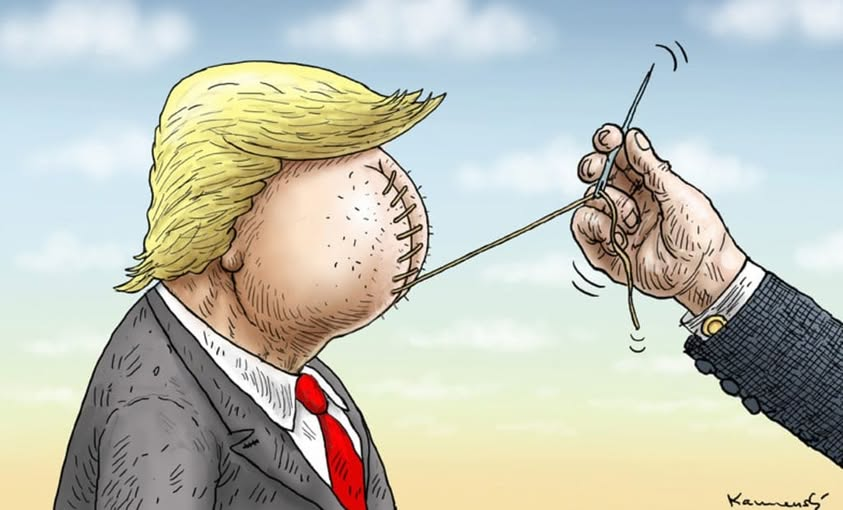
*BRITISH WRITER PENS THE BEST DESCRIPTION OF TRUMP*
Someone asked "Why do some British people not like Donald Trump?" Nate White, an articulate and witty writer from England wrote the following response:
A few things spring to mind. Trump lacks certain qualities which the British traditionally esteem. For instance, he has no class, no charm, no coolness, no credibility, no compassion, no wit, no warmth, no wisdom, no subtlety, no sensitivity, no self-awareness, no humility, no honour and no grace – all qualities, funnily enough, with which his predecessor Mr. Obama was generously blessed.
So for us, the stark contrast does rather throw Trump's limitations into embarrassingly sharp relief.
Plus, we like a laugh. And while Trump may be laughable, he has never once said anything wry, witty or even faintly amusing – not once, ever.
I don't say that rhetorically, I mean it quite literally: not once, not ever. And that fact is particularly disturbing to the British sensibility – for us, to lack humour is almost inhuman.
But with Trump, it's a fact. He doesn't even seem to understand what a joke is – his idea of a joke is a crass comment, an illiterate insult, a casual act of cruelty. Trump is a troll. And like all trolls, he is never funny and he never laughs; he only crows or jeers.
And scarily, he doesn't just talk in crude, witless insults – he actually thinks in them. His mind is a simple bot-like algorithm of petty prejudices and knee-jerk nastiness. There is never any under-layer of irony, complexity, nuance or depth. It's all surface.
Some Americans might see this as refreshingly upfront. Well, we don't. We see it as having no inner world, no soul. And in Britain we traditionally side with David, not Goliath. All our heroes are plucky underdogs: Robin Hood, Dick Whittington, Oliver Twist. Trump is neither plucky, nor an underdog. He is the exact opposite of that. He's not even a spoiled rich-boy, or a greedy fat-cat. He's more a fat white slug. A Jabba the Hutt of privilege.
And worse, he is that most unforgivable of all things to the British: a bully. That is, except when he is among bullies; then he suddenly transforms into a snivelling sidekick instead.
There are unspoken rules to this stuff – the Queensberry rules of basic decency – and he breaks them all. He punches downwards – which a gentleman should, would, could never do – and every blow he aims is below the belt. He particularly likes to kick the vulnerable or voiceless or female – and he kicks them when they are down. So the fact that a significant minority – perhaps a third – of Americans look at what he does, listen to what he says, and then think 'Yeah, he seems like my kind of guy' is a matter of some confusion and no little distress to British people, given that:
• Americans are supposed to be nicer than us, and most are.
• You don't need a particularly keen eye for detail to spot a few flaws in the man.
This last point is what especially confuses and dismays British people, and many other people too; his faults seem pretty bloody hard to miss.
After all, it's impossible to read a single tweet, or hear him speak a sentence or two, without staring deep into the abyss. He turns being artless into an art form; he is a Picasso of pettiness; a Shakespeare of shit. His faults are fractal: even his flaws have flaws, and so on ad infinitum. God knows there have always been stupid people in the world, and plenty of nasty people too. But rarely has stupidity been so nasty, or nastiness so stupid. He makes Nixon look trustworthy and George W look smart. In fact, if Frankenstein decided to make a monster assembled entirely from human flaws – he would make a Trump.
Tice, who said Angela Rayner would resign if she had "any moral decency", did not respond to our latest inquiries about his tax affairs or even acknowledge receipt. Nor did his lawyer or Nigel Farage's team.
However, he has now posted a statement saying of his wider affairs: "Naturally I am always happy to put things right and if numbers need rechecking, of course I will pay what is owed - be that more or less."
Where does that leave us?
- Story #1: Tice avoided £600k in corporation tax by classifying his company as a real estate investment trust in unusual circumstances and benefitting from a loophole meaning he did not have to meet technical rules that otherwise applied. Tice accepts this, and said everyone should seek to avoid as much tax as legally possible.
- Story #2: Tice broke the law by failing to pay at least £92k - or, per further analysis by @DanNeidle, £120k - in withholding tax before paying incorrectly large dividends to himself and his off-shore trust in Jersey. He says the dividends he personally received meant he ultimately paid more income tax, meaning HMRC received the money it was owed, or even more. He has not provided any evidence for this or addressed what tax the trust paid. He has dismissed the fact the law was broken - and the accompanying fact that the company still has an unsettled tax bill - as a "technicality". Farage, when asked to evidence Tice's claim that HMRC received equal/more tax, snapped at a reporter and demanded she provide a "lecture" on the nature of real estate investment trusts.
- Story #3: Tice failed to pay ~£100k in corporation tax on dividends deposited in four shell companies he owned and which were part of a group which donated huge sums to Reform. Last month he gave us contradictory stories as to why dividends were not taxed. a) He said they were tax-exempt. (They were not in this case.) b) He said the parent group suffered losses allowing tax bills to be offset. (This is not the case.) He did not respond to further inquiries which we sent yesterday morning.
Overall, the evidence indicates Tice used unusual measures to avoid £600k, and failed to pay up to £220k on tax owed. Per @DanNeidle the underpayments mean the firms are vulnerable to HMRC investigation which could lead to required repayment plus interest and fines.