No, merging or discontinuing $MEX and $XMN to consolidate everything around $EGLD is the wrong move.
Here’s why it actually hurts more than it helps:
•$MEX is purpose-built for xExchange: liquidity incentives, yield farming, and decentralised governance. It lets the DEX grow its own flywheel and attract dedicated DeFi users/liquidity without constantly pressuring $EGLD.
•$XMN powers the xMoney payments layer, fast cross-border transfers, machine-to-machine flows, and upcoming regulated stablecoins. It creates a specialised incentive layer for high-frequency usage that $EGLD alone can’t optimally serve.
$EGLD remains the undisputed core: gas fees, staking, security, and value accrual. Tail inflation + adaptive burns already tie it to real usage.
Forcing every sub-sector onto one token overloads it, kills targeted incentives, and reduces the ability to bootstrap new capital.
Look at what works: Ethereum thrived with thousands of tokens while ETH stayed gas/settlement, king. SOL, AVAX, and other scalable L1S all use ecosystem tokens to drive specialised adoption.
Specialisation funnels activity and value back to the base layer, it’s not dilution, it’s antifragile growth.
MultiversX is already shipping elite tech (Supernova upgrades incoming) with a coiled-spring setup. Separate tokens attract new users and liquidity instead of spreading the same pool thinner.
Merging would be a step backwards.
Real models and on-chain mechanics beat hot takes.
Keep building.
TWO NEW MVX RELEASE DONE OVER THE WEEKEND AND YESTERDAY, ALL IN PREPS FOR SUPERNOVA 🔥
The team has been working extra hard during the last weeks, integrating new discoveries, releasing new upgrades, and improving on newly discovered challenges from the battle of nodes competition.
Calling on the best technical minds to take a deep look at the new supernova network, pressure-test its limitations, and make some good submissions for issues or improvements!
$50k in battle of nodes rewards are still on, and up for grabs for the most interesting critical issues we discover.
SUPERNOVA. IS. COMING.
A new beginning. A new frontier. A state-of-the-art, ground-up reinvented, technological foundation.
Built through maximum pain and fire. Earned through sweat, and blood, and tears, every ounce of its resilience, strength, and performance.
Unmatched in speed, throughput, UX, and decentralization. And still, the markets are deeply asleep.
As we prepare to cross into uncharted territory, there is only one question left.
*Are you ready?*
To show up. To own it. To fight.
To ride or die, into a new chapter.
The actions and energy you bring to this moment decide everything that follows.
SUPERNOVA.
Supernova is live on Battle Net.
Here's what changed under the hood and why it matters.
The paradigm shift nobody's talking about:
Every blockchain in the industry is measured on two metrics: block time and throughput.
Faster blocks = better chain. More TPS = better chain.
----------
Supernova breaks this framing entirely.
For the first time in the blockchain industry, block finality is faster than block slot allocation.
Let me explain what that means.
How every other blockchain works:
Traditional blockchains follow Execute → Propose → Vote. Validators must execute every transaction before proposing a block.
The block slot is the clock. Finality can never be faster than the slot, because execution is in the critical path.
Ethereum: 12.8s slot, ~12.8 minutes finality.
Solana: 400-600ms slot, 13 seconds finality.
Sui: variable, ~500 to 1000 ms for complex transactions.
In every case: finality ≥ block slot. This is treated as a law of physics.
It's not.
----------
How Supernova works:
We flipped the model to Propose/Vote → then Execute.
Consensus proceeds independently of execution. Validators agree on transaction ordering first. Execution results are notarized in subsequent block headers via inclusion proofs.
The inclusion proof is the key innovation: it allows a block to be finalized with cryptographic proof that its transactions will execute correctly, before the execution itself completes.
The virtual state tracker in the transaction pool maintains a deterministic view of account states (nonces, balances, pending transactions) so consensus can validate without waiting for full execution.
Result: the block is finalized faster than the block round itself.
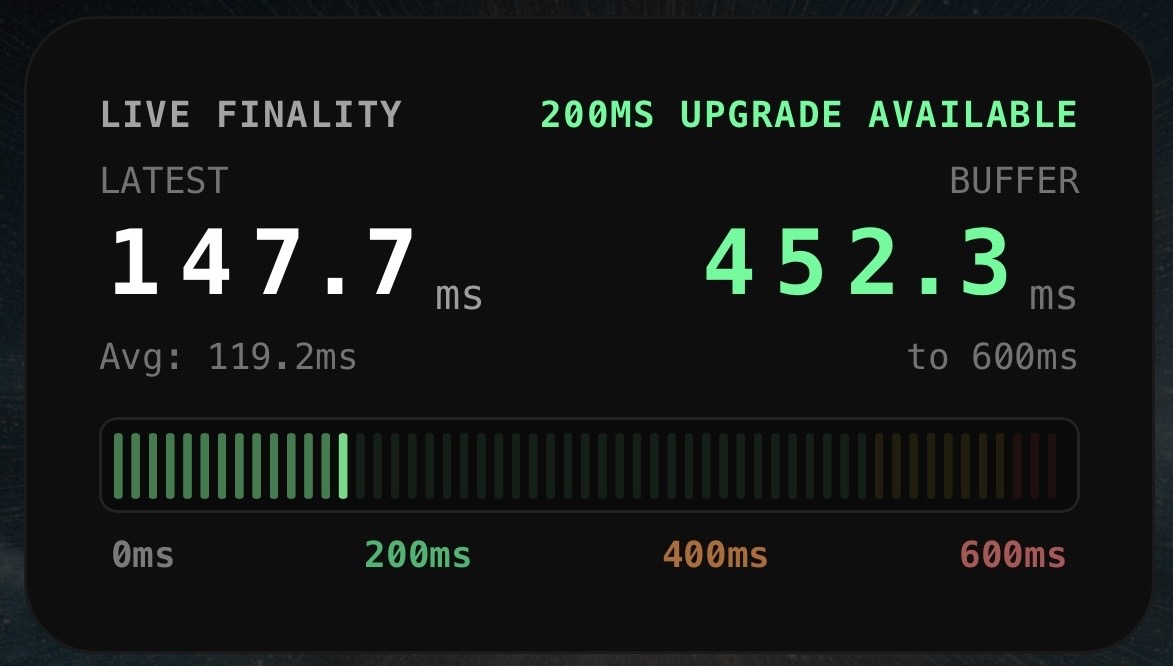
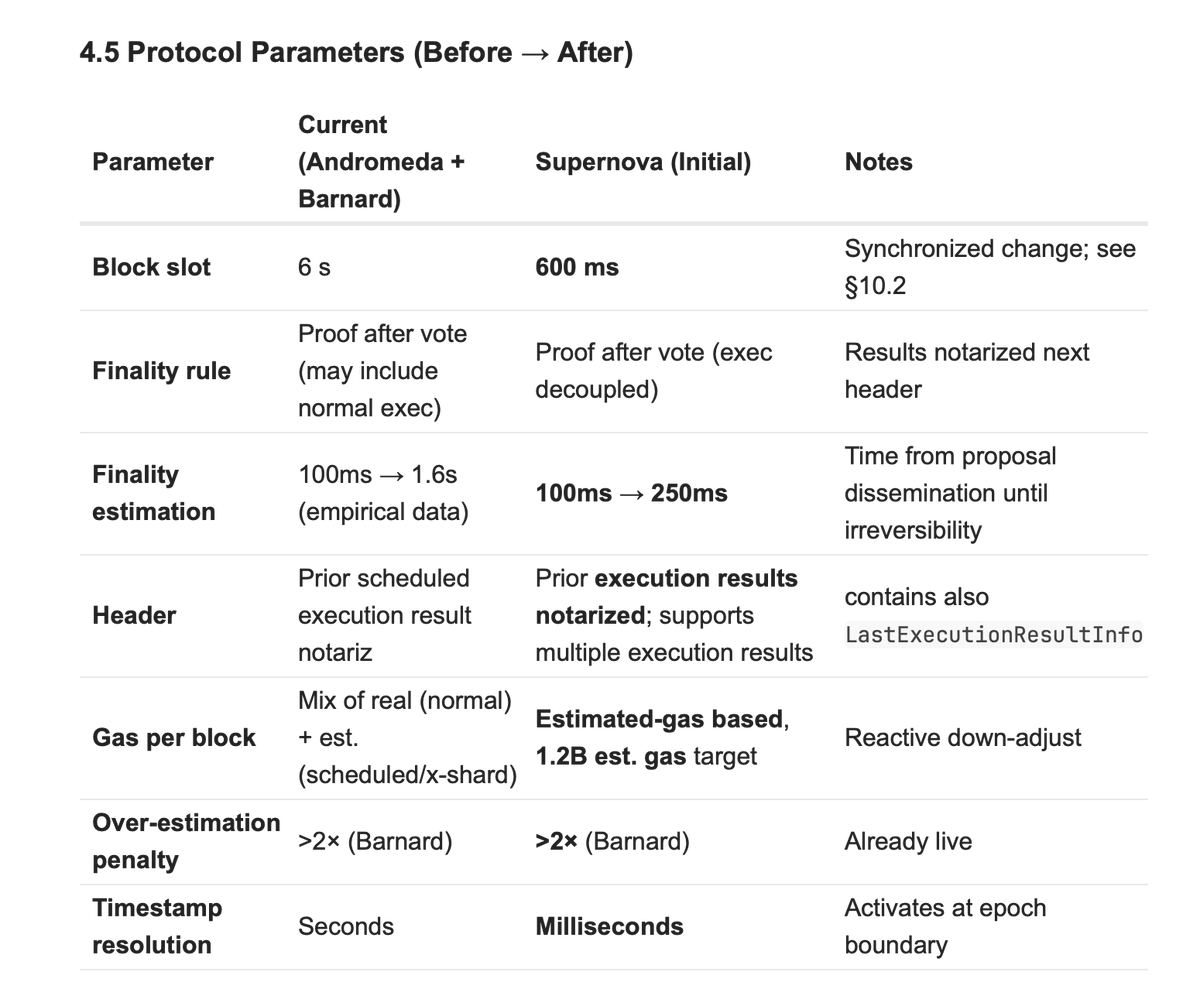
88ms finality measured in testing. Sub-200ms under real-world conditions. On 600ms block slots.
Finality < block slot. First time in the industry.
----------
The throughput story:
With the same hardware specification as pre-Supernova mainnet, the network now achieves ~120,000 transactions per second in burst mode. Same nodes. Same machines. 10x the block production cadence.
This is the same validator infrastructure running fundamentally better software.
The backpressure system (Execution-Result Inclusion Estimator) ensures this scales safely - dynamically adjusting per-block gas limits if execution lags behind proposals, so minimum-spec nodes never get overwhelmed.
What this means in context:
- Block time: 6s → 600ms (10x)
- Finality: ~88ms measured (first blockchain where finality < slot time)
- Throughput: ~120,000 TPS burst mode (same hardware)
- Architecture: consensus fully decoupled from execution
- Sharding: 3 execution shards + metachain, fully preserved
- Validators: 3,200+ nodes, no hardware upgrade required
----------
Battle of Nodes is stress-testing all of this right now. $150K in prizes to find what breaks. Validators, security researchers, builders, and guilds pushing the limits.
If Supernova survives this, it ships to mainnet.
150,000 lines of new protocol code. 20 months of engineering. The most significant upgrade since genesis.
Supernova is live.
The largest network upgrade in MultiversX history has been activated on our Battle Net.
Over the next week, validators, developers, and community members will push it to its limits and harden its security.
Live, in public, with real stakes.
Hi everyone,
Grand Theft Auto VI will now release on Thursday, November 19, 2026.
We are sorry for adding additional time to what we realize has been a long wait, but these extra months will allow us to finish the game with the level of polish you have come to expect and deserve.
@beniaminmincu Powerful and inspiring.
Thank you, Beniamin, for the vision, honesty, and clarity.
US Foundry Sessions mark a bold new chapter for MultiversX. Grateful to witness this journey. 🚀🇺🇸 #MultiversX#EGLD#Supernova
The Clarity Act and American Dynamism
- why it matters, 3 applied insights, a crack in the liquidity dam -
1. Why it matters
The Clarity Act represents another pivotal inflection point for U.S. leadership in the age of digital transformation. Much like the Securities Act of 1933 catalyzed nearly a century of dominant capital markets by establishing clear guidelines, investor protections and disclosure standards, the Clarity Act seeks to establish the same for crypto and blockchain. It applies the same proactive regulatory foresight the GENIUS Act brought to stablecoins, by expanding it to a much broader space, laying the foundation for responsible innovation across decentralized technologies, including blockchains, stablecoins, digital commodities, and even the on-chain architecture powering AI. This is a timely and vital open declaration that the U.S. intends to lead the next financial and technological epoch by offering clarity where others offer chaos. and very conducive to US leadership, offering a competitive environment for the frontier technologies of today: crypto and AI.
2. Three applied insights
- First, the Act creates a definitive regulatory category for digital commodities, removing the ambiguity that has stifled legitimate projects and kept institutional capital on the sidelines.
- Second, it introduces coherent oversight mechanisms for blockchain-native intermediaries, from exchanges to token protocols, bridging innovation and compliance.
- Third, it offers a robust yet flexible framework for consumer protection, embedding trust into the system without stifling innovation.
Together, these provisions unlock an instrumental operational feedback loop, giving confidence to builders, and strategic clarity for investors.
3. Specific implications for DeFi
Perhaps the most immediately clarifying insight lies in the Act’s forward-thinking treatment of DeFi. By clearly distinguishing between custodial intermediaries and decentralized protocols that do not take user funds, it exempts the latter from burdensome licensing regimes while introducing eligibility criteria, such as not acting as intermediaries or exerting control over user assets. This establishes DeFi as a legitimate, non-custodial financial architecture under U.S. law, enabling it to scale safely and credibly. It’s a regulatory green light for composable finance to thrive onshore.
4. Is this the crack in the liquidity dam?
For years, pent-up capital has watched from the sidelines, interested but constrained by regulatory fog. The demand for tokenized assets, yield opportunities, and AI-integrated finance is undeniable, but trapped behind an uncertain framework. The Clarity Act may be the moment the dam begins to crack. If this act is passed, it will signal the start of a new market phase, with massive capital flows, institutional participation, and developer momentum, turning potential energy into kinetic force.
In one move, once passed, this could transform the U.S. from reactive regulator to a proactive architect, and defacto global leader, opening up the flood gates of the new digital economy.
What will the rest of the world do?
For nations, the cost of hesitation is compounding. Those bold enough to act with courage and conviction in moments of great change, like today, will catch generational winds that carry them across decades.