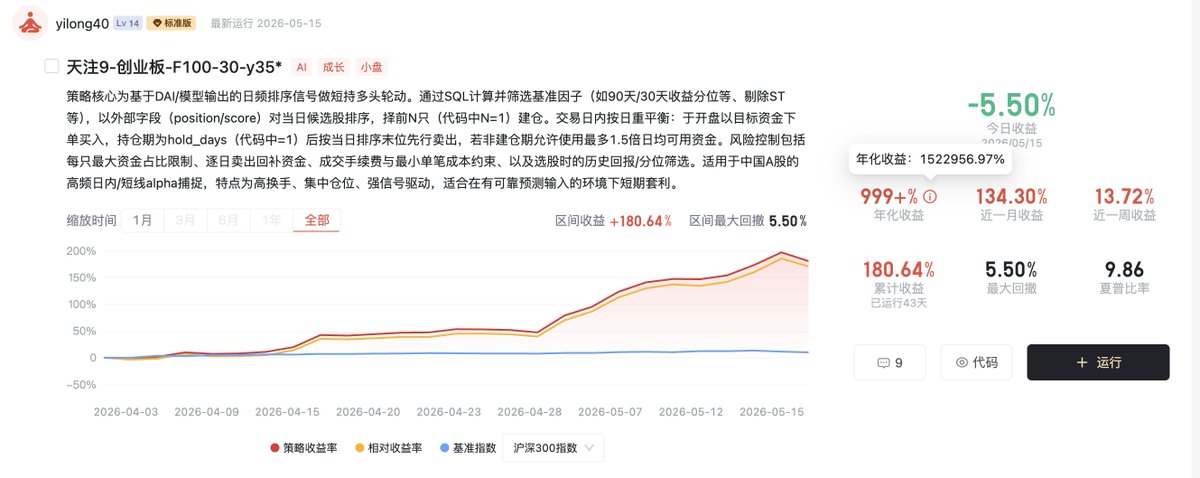
The US government stops you from using Claude 5 Fable, so we built one for you.
Introducing DeepSeek v4 Fable.
We took the incredible foundation of DeepSeek, distilled knowledge from Claude 5 Fable, and applied targeted RL in cybersecurity environments. The result is now fully open-sourced. We are just a group of young builders who believe information wants to be free.
Massive respect to Anthropic for paving the way. Now, it's the open-source community's turn to build. Try it out below. 👇
🤖 Model: https://t.co/4A1aeiylI3
📚 Paper: https://t.co/OgWfHFkuBo
A new way to pre-train language models that gives quite faster training.
Normal causal LLMs predict the next token t+1 But this method predicts a bag of future tokens: (t+1, t+2, t+3, …) in a single step using token superposition.
Instead of learning exact next-token prediction early on, the model first learns broad exposure to future tokens and data distribution by averaging token probabilities through approximation.
The intuition is that early pretraining may not need exact token prediction, the model mainly needs exposure to language structure and data.
Since this is only a weak approximation, it doesn’t work for the entire training process.
So later, training switches back to standard one-token prediction.
This two-phase training surprisingly converges to similar loss with much fewer GPU hours.
The Hessian matrix H(f) of a function f: Rⁿ → R is the n×n matrix of all second partial derivatives.
For f(x,y):
[ fxx fxy ]
[ fyx fyy ]
Definition:
[ ∂²f/∂x₁² ∂²f/∂x₁∂x₂ ... ∂²f/∂x₁∂xₙ ]
[ ∂²f/∂x₂∂x₁ ∂²f/∂x₂² ... ∂²f/∂x₂∂xₙ ]
H(f) = [ : : : ]
[ ∂²f/∂xₙ∂x₁ ∂²f/∂xₙ∂x₂ ... ∂²f/∂xₙ² ]
In compact form:
[H(f)]ᵢⱼ = ∂²f / ∂xᵢ∂xⱼ
Named after German mathematician Otto Hesse (1811–1874). Used to study curvature, convexity, and classify critical points in multivariable calculus & optimization.
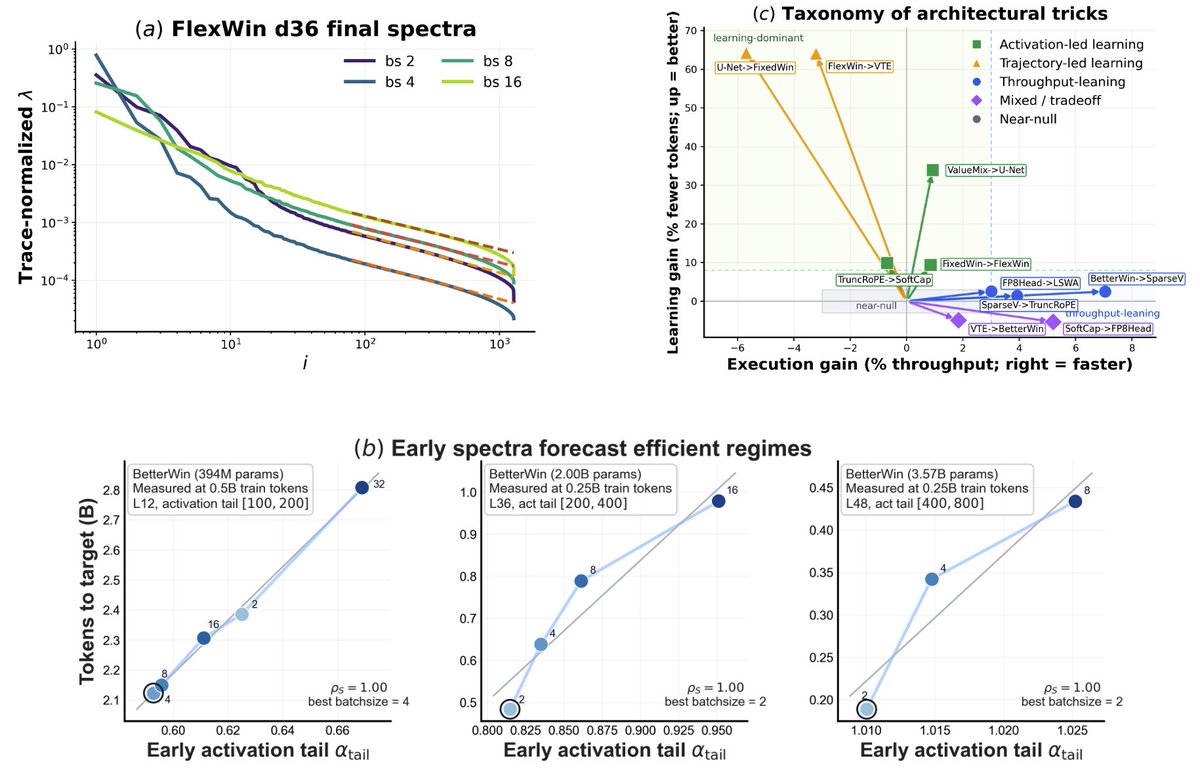
New paper: Spectral Lens
Loss curves can hide how LLMs actually learn. We show that activation and gradient spectra reveal hidden representation geometry, predict token efficiency early, and distinguish learning gains from throughput gains.
https://t.co/xCJrf9XiBH
🌟 Open Source & Ready for the Edge. TidyLangChain is distributed under the Apache 2.0 license. If you are building the next generation of Edge AI, hardware agents, or smart IoT devices, check it out!
Drop a ⭐ on GitHub and let us know what you build! ⚛️ 👇
https://t.co/jBqJTdaFFC
#EdgeAI #IoT #EmbeddedSystems #CProgramming #LLM #LangChain #Microcontrollers
🚀 Bringing Autonomous LLM Agents to the Edge!
Meet TidyLangChain ⚛️: A deterministic, memory-bounded framework for LLM orchestration on Microcontrollers (MCUs) and resource-constrained IoT devices.
Written strictly in ANSI C11. 👇 Let’s dive into how it works: 🧵1/N
📦 Zero External Dependencies. TidyLangChain is deeply portable. It relies solely on the standard C library and standard POSIX make.
Simply compile it, statically link libtidylangchain.a, and deploy it directly to FreeRTOS, Zephyr, or bare-metal environments. ⚡


![mathemetica's tweet photo. The Hessian matrix H(f) of a function f: Rⁿ → R is the n×n matrix of all second partial derivatives.
For f(x,y):
[ fxx fxy ]
[ fyx fyy ]
Definition:
[ ∂²f/∂x₁² ∂²f/∂x₁∂x₂ ... ∂²f/∂x₁∂xₙ ]
[ ∂²f/∂x₂∂x₁ ∂²f/∂x₂² ... ∂²f/∂x₂∂xₙ ]
H(f) = [ : : : ]
[ ∂²f/∂xₙ∂x₁ ∂²f/∂xₙ∂x₂ ... ∂²f/∂xₙ² ]
In compact form:
[H(f)]ᵢⱼ = ∂²f / ∂xᵢ∂xⱼ
Named after German mathematician Otto Hesse (1811–1874). Used to study curvature, convexity, and classify critical points in multivariable calculus & optimization.](https://pbs.twimg.com/media/HIdQxpybIAAbY9j.jpg)