I finally took the time to build a lil personal site. Missed the simplicity of building something from scratch with just HTML & Vanilla JS, just pure coding joy - oh, and some ASCII art of course 💻 https://t.co/GI0J7Sf49y
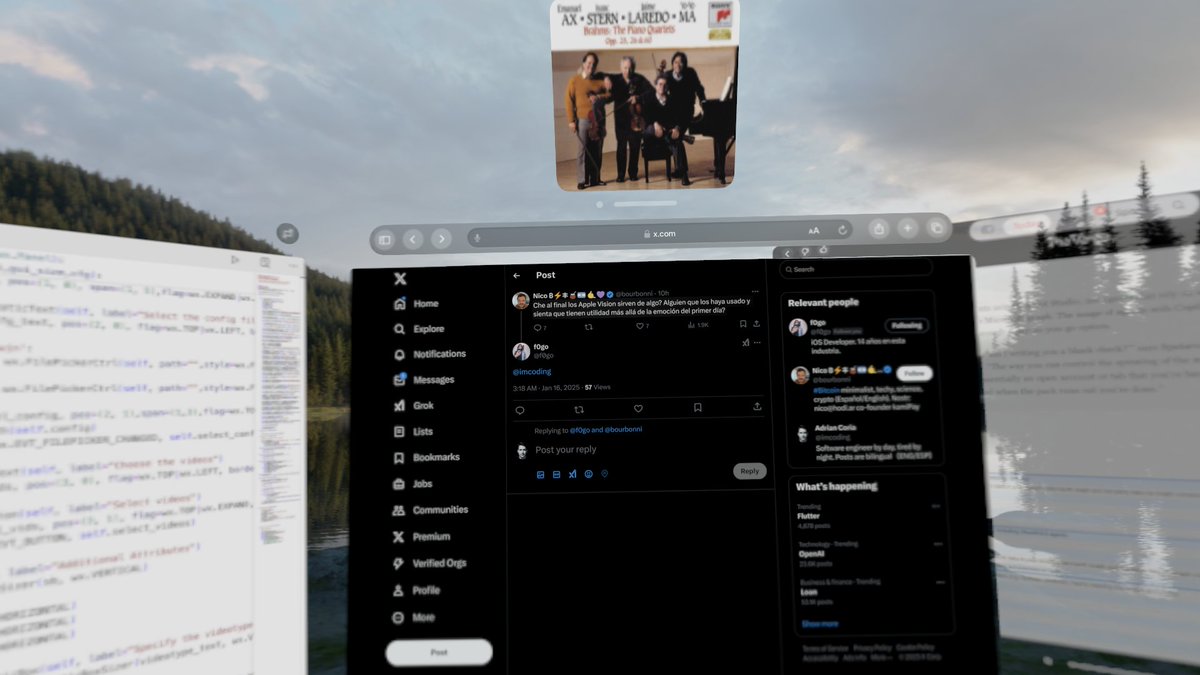
@bourbonni@f0go 1. Depende de tu condición. Si tenés miopía severa, podés usar los ZEISS Optical Inserts: https://t.co/LUmzDTLlZq
2. Es cómodo (más de 4K por ojo), pero para uso prolongado necesitás accesorios como el Belkin Head Strap o el Annapro, sino estas ajustándolo constantemente.
@f0go@bourbonni Son útiles y se justifican si viajas seguido(?)
Los uso principalmente como Virtual Display para Mac y multitarea entre Vision/Mac. También para CADs, entretenimiento (películas, YouTube), probé juegos pero no me atrapó como el Quest.
Con el tiempo, generas cierta dependencia 🙃
@MartinBekerman I agree from a creative perspective. I used to genuinely enjoy designing, creative coding, or taking pictures. But now, everything now feels quite similar to consuming content if I only need to write a prompt. I still find joy in solving “complex problems,” but for how long?
Adding 3D to your Bolt app is super easy now with @threejs!
You can use it to make games, add visualizations to your site, or just make the logo spin - with a single prompt!
Everything you love about generative models — now powered by real physics!
Announcing the Genesis project — after a 24-month large-scale research collaboration involving over 20 research labs — a generative physics engine able to generate 4D dynamical worlds powered by a physics simulation platform designed for general-purpose robotics and physical AI applications.
Genesis's physics engine is developed in pure Python, while being 10-80x faster than existing GPU-accelerated stacks like Isaac Gym and MJX. It delivers a simulation speed ~430,000 faster than in real-time, and takes only 26 seconds to train a robotic locomotion policy transferrable to the real world on a single RTX4090 (see tutorial: https://t.co/bEkIlCKqdf).
The Genesis physics engine and simulation platform is fully open source at https://t.co/DhBv7NdyqH. We'll gradually roll out access to our generative framework in the near future.
Genesis implements a unified simulation framework all from scratch, integrating a wide spectrum of state-of-the-art physics solvers, allowing simulation of the whole physical world in a virtual realm with the highest realism.
We aim to build a universal data engine that leverages an upper-level generative framework to autonomously create physical worlds, together with various modes of data, including environments, camera motions, robotic task proposals, reward functions, robot policies, character motions, fully interactive 3D scenes, open-world articulated assets, and more, aiming towards fully automated data generation for robotics, physical AI and other applications.
Open Source Code: https://t.co/DhBv7NdyqH
Project webpage: https://t.co/SBNyhFB0yn
Documentation: https://t.co/3yuBoaealV
1/n