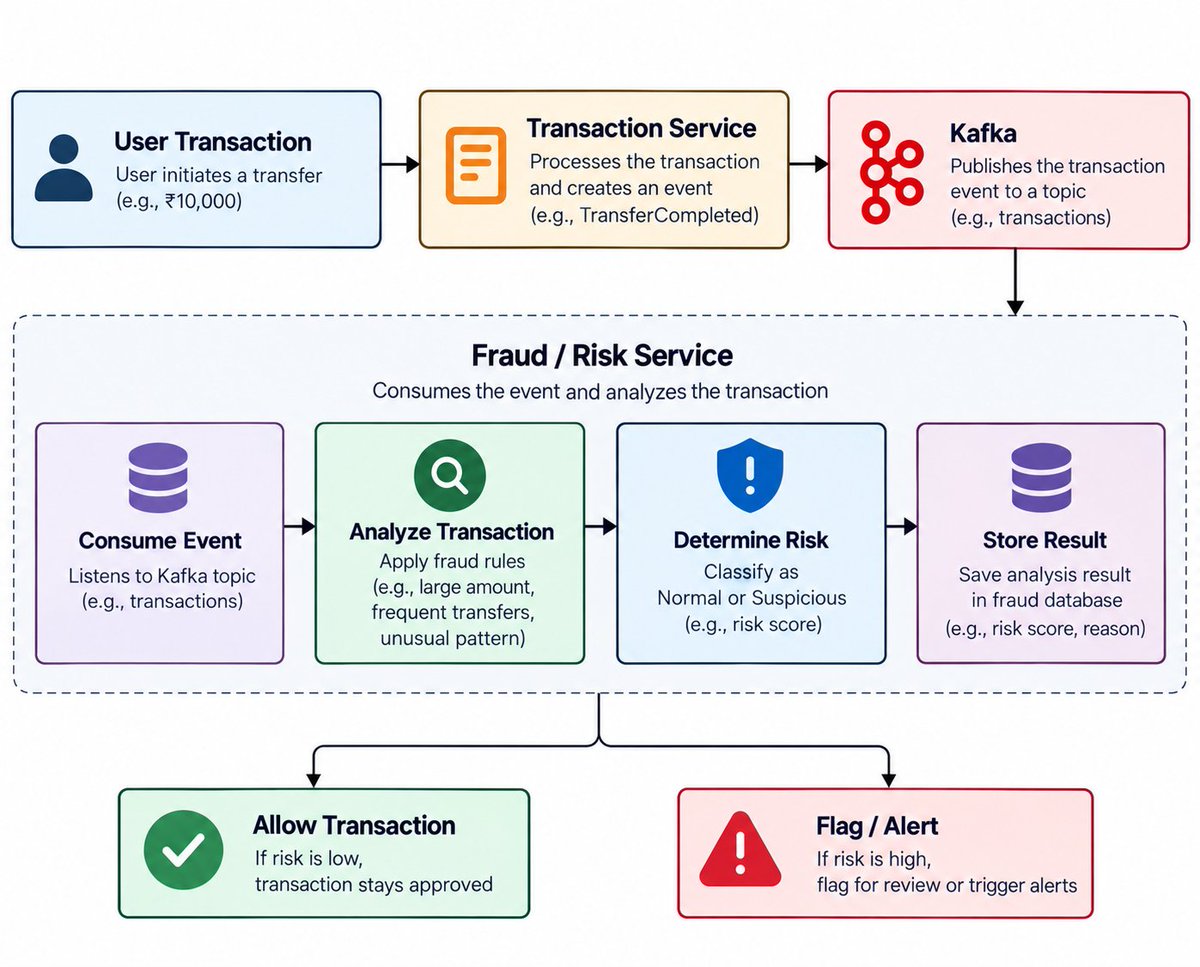
So an event can travel through the system. But what happens when that event needs to be checked for
risk?
I added a separate Fraud/Risk Service that consumes transaction events and evaluates them independently
Event → Risk Engine → Decision
One transaction. More intel.
@rfleury@notch@ZackPlaza Can't argue with that. The moment I catch myself asking an agent to write massive walls of repetitive config or glue code, it's usually a red flag that I need to step back and rethink the underlying abstractions
@rfleury@notch@ZackPlaza Exactly this. LLMs are an incredible advancement for generating boilerplate, but building a real system still requires a human architect. Nobody is vibe coding their way to a scalable, distributed architecture without understanding the underlying design
@matthewcp You could probably script a decent MVP of this right now with a GitHub Action that passes the git diff to an agent, generates a Mermaid.js chart, and auto-commits the visual diff to the README. Honestly, sounds like a fun weekend project
@kamilbaranek_ Dockerizing a vibe-coded app isn't just for deployment, it's a mandatory containment strategy. If an AI hallucinates a random rm -rf, I want that strictly confined to an isolated container, not my host machine
@themishra4402 Vibe coding stops working the exact moment you actually have to care about race conditions, memory management, or deterministic state. It's great for assembling boilerplate MVPs, but building the underlying engines requires actual architecture
@Samaytwt Reversing a binary tree on LeetCode is cool, but it doesn't teach you how to build a full stack app, deploy infrastructure, or manage state. Real engineering happens on GitHub
@aslambeg84 Bloom Filters. It's a probabilistic data structure that can tell you if a username is definitely not taken in O(1) time without ever having to touch the actual database
@KingBootoshi Exactly. If your entire identity was just translating Jira tickets into boilerplate syntax, AI is definitely going to feel like a threat. But if your identity is actually building systems, having a thought-to-reality compiler is the ultimate upgrade
@simonw Felt this heavily while working on MCP infra for browser automation. An agent can write the boilerplate in seconds, but if you lack the discipline to enforce strict state control and safety layers from the start, it just generates technical debt at the speed of light
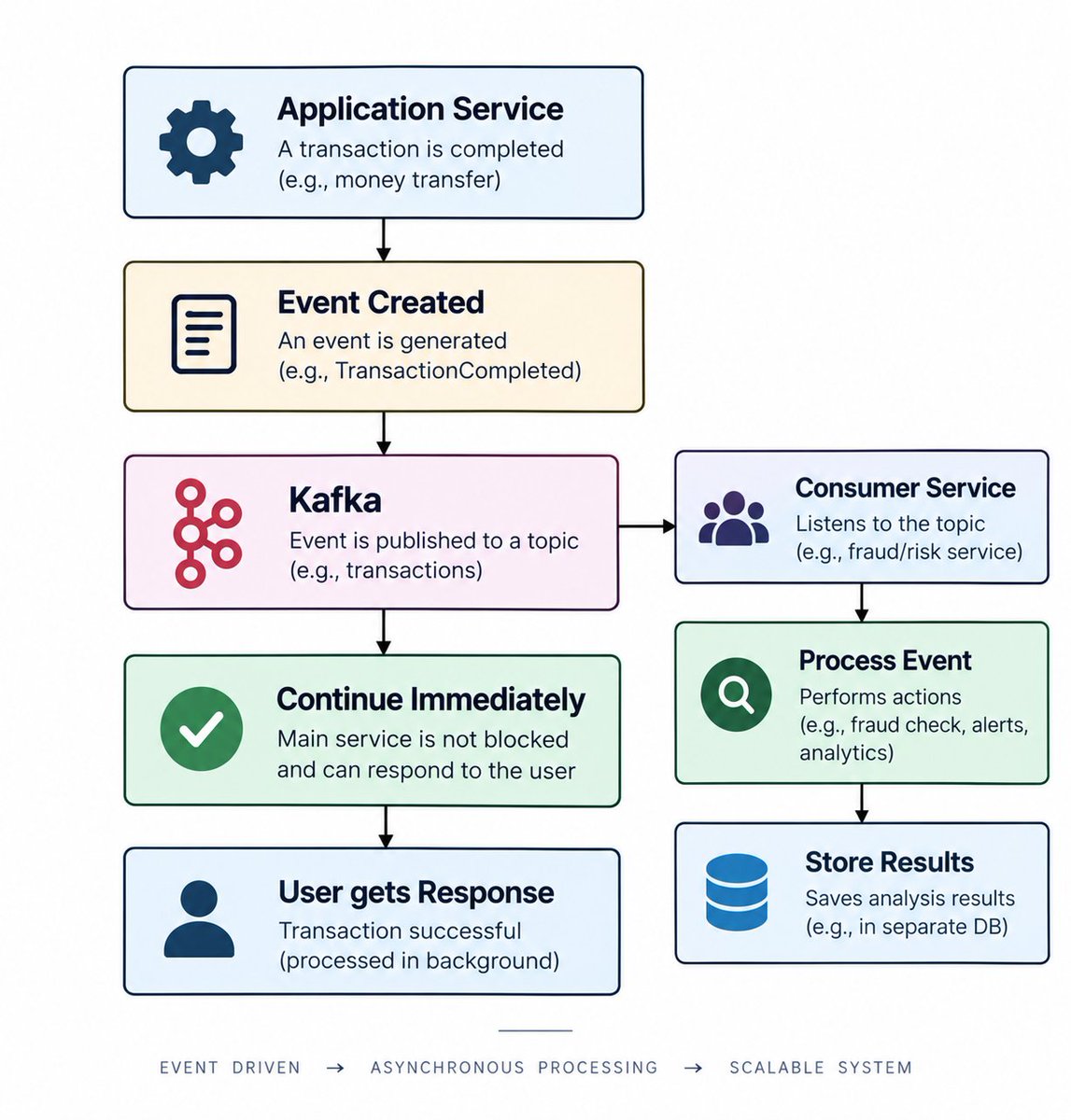
A transaction is completed.
But what if another service needs to know about it?
Instead of making services depend on each other, I’m using Kafka to pass events between them.
Transaction → Event → Kafka → Consumer
One event. Multiple services.
@neerajjj6785 Race condition! Checking to see if the idempotency lock is actually atomic, or if it's just a slow SELECT then INSERT that tripped over itself
@Umesh__digital Session storage, API rate limiting, and Pub/Sub queues. Though we all know we started with caching before realizing what it could actually do
@Diacritic@1carringtone@ChombaBupe Nick is spot on. Let's worry about math breaking cryptography after we fix all the tissue thin web apps currently failing basic security. Great debate guys
@Diacritic@1carringtone@ChombaBupe Exactly this. We aren't denying your AI timeline. We're saying your timeline is irrelevant because a closed network port doesn't care how advanced the agent trying to ping it is
@awss1i Supporting 15 agentic harnesses out of the box is huge. Building MCP infrastructure for browser extensions usually means fighting with massive overhead from standard testing frameworks. A CLI first approach built specifically for this is exactly what the ecosystem needs right now