In January, astronaut Mike Fincke lost the ability to speak for twenty minutes in orbit.
NASA brought him home early, the first medical evacuation in the space station's 25-year history. He never got a diagnosis.
#SpaceMedicine#MikeFincke#ISS#NASA#CosmicLab
Strip away the personality. Strip away the politics.
What remains is the most capable rocket in history pointed at Mars.
Here's the space science story. 👇 https://t.co/VWqDvDmFcv
In 5 days the deepest lunar eclipse until December 2028 happens. And it's 96% which means it's almost as dramatic as a total Blood Moon.
A 96% partial lunar eclipse is happening on August 28 the deepest partial lunar eclipse until December 2028. Live coverage is available, with viewing tips and the latest updates.
Here's exactly what you'll see and when:
A 96% partial lunar eclipse means 96% of the Moon's disc will be inside Earth's darkest shadow the umbra at maximum coverage. The shadowed portion will glow in the characteristic deep red colour produced when Earth's atmosphere bends and filters sunlight around the planet's rim into the shadow zone.
Only a thin sliver of the Moon's edge will remain in Earth's penumbral shadow partially illuminated creating a dramatic contrast between the blood red shadow and the bright crescent.
At 96% this is visually almost indistinguishable from a total lunar eclipse without the technical distinction of complete coverage.
Unlike a total solar eclipse which requires precise positioning in a narrow corridor, this lunar eclipse is visible from anywhere on Earth where the Moon is above the horizon during the event.
No special equipment. No travel required. No narrow viewing path. Just find the Moon on the night of August 28 and watch it turn red.
After this month's extraordinary triple event solar eclipse, Perseids peak, and six-planet alignment all on August 12 the sky has one more gift before the month ends.
And in 8 days after that August 30 the Roman Space Telescope launches.
August 2026 is refusing to be ordinary.
�� Follow @CosmiclabSpace, Set your reminder now.
#LunarEclipse #August28 #BloodMoon #CosmicLab #SpaceEvent
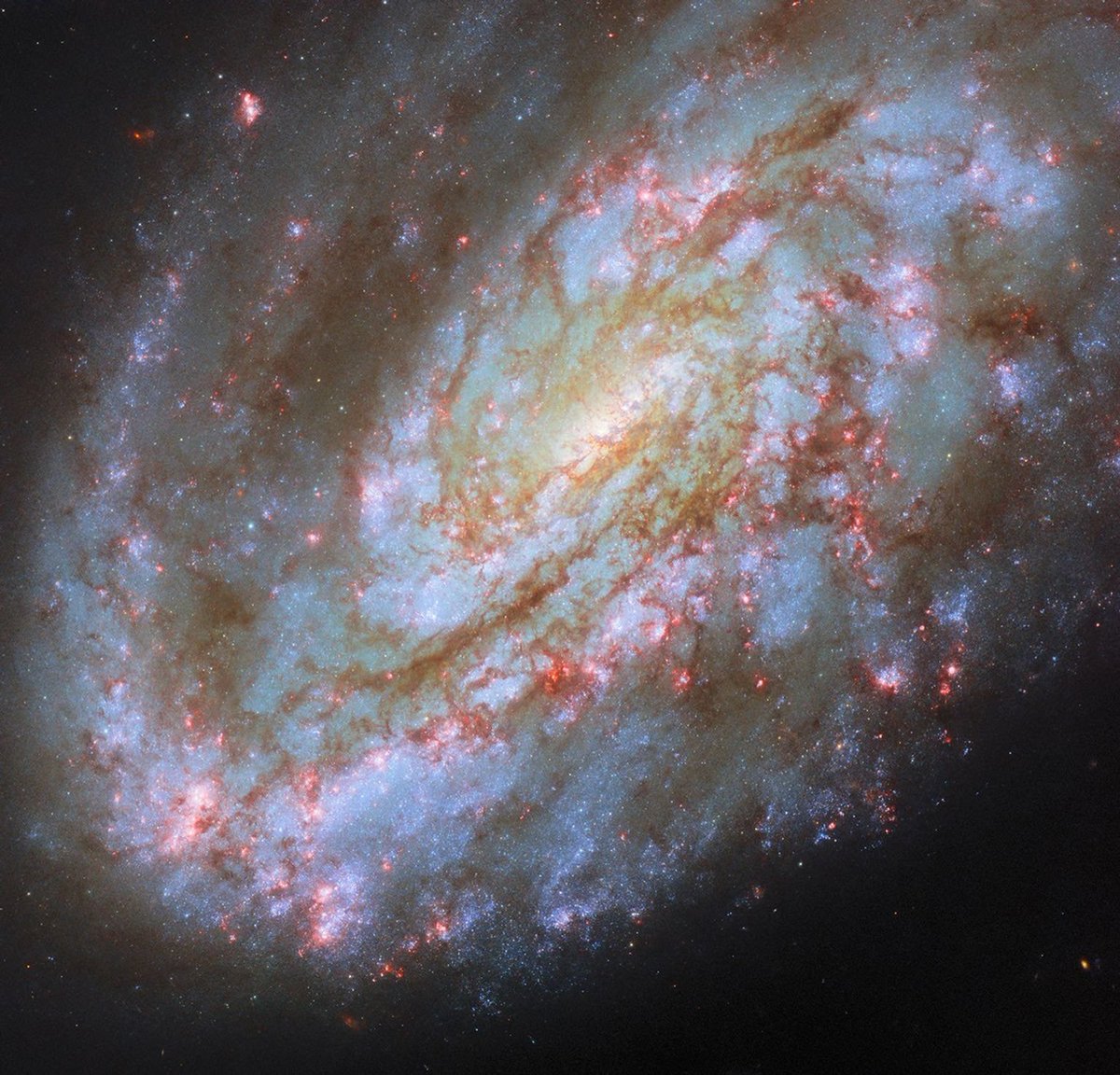
This galaxy is struggling against titanic forces on a cosmic scale. And the evidence of that struggle is written across its entire face.
This is NGC 4654 an intermediate spiral galaxy located 72 million light-years away in the constellation Virgo. It is part of the Virgo Cluster, one of the most massive and populous galaxy clusters in our cosmic neighbourhood.
Look at it carefully. Something is wrong.
A normal spiral galaxy has two arms mirror images of each other, curving symmetrically around a central core. NGC 4654 has one arm that is rich with stars, bright pink nebulae and active star formation. The opposite side is almost bare stripped of stars, trailing gas off into the darkness beyond the image frame.
One side lush. One side bare. The galaxy looks like it lost half itself.
It did. Two separate forces attacked it. Simultaneously. From different directions.
The first attacker: the Virgo Cluster itself.
NGC 4654 moves through the Virgo Cluster at such high velocity that it sweeps up and rams through the hot, rarefied gas filling the space between the cluster's galaxies. This intracluster medium exerts a ram pressure on the galaxy compressing its leading edge and dragging its gas behind it, creating an elongated tail that stretches beyond the field of view of this image.
Ram pressure stripping. The galaxy is moving so fast through the cluster's gas that the gas is being physically torn from its trailing side like water being blasted off a car moving at high speed. Except the car is a galaxy. And the water is star-forming gas.
Many galaxies that undergo ram pressure stripping suffer reduced star formation rates as the cold gas that collapses to form their stars is pulled away and lost.
The second attacker: a neighbouring galaxy.
NGC 4654 was also subjected to the gravitational force of fellow Virgo Cluster galaxy NGC 4639. While the two galaxies are far apart now, it is thought that a fly-by interaction between them around 500 million years ago ripped away NGC 4654's gas along one side limiting star formation there and creating the asymmetry in its shape.
500 million years ago when complex animal life was only beginning to diversify on Earth two galaxies passed close to each other in the Virgo Cluster. The gravitational tidal forces of that encounter tore gas from one side of NGC 4654.
The asymmetry you see today is the 500 million year old scar of that near collision.
Here's what makes this galaxy genuinely remarkable beyond its damaged appearance:
NGC 4654 is still forming nearly two Suns' worth of stars every year a rate comparable to other galaxies of similar size.
Despite losing gas from ram pressure. Despite the ancient gravitational assault from its neighbour. Despite having one arm stripped to near emptiness.
It is still building stars at a completely normal rate.
The bright pink bubbles visible across NGC 4654 from its forward spiral arm, to around its weak bar, and out to the edge of its disk are areas where newborn stars shine inside clouds of energised gas.
The pink you see scattered across the galaxy's surviving arm is stellar nurseries gas clouds being illuminated from within by the ultraviolet radiation of newborn massive stars. Life continuing in the half of the galaxy that survived.
A galaxy battered by two separate cosmic forces across hundreds of millions of years.
Still making stars. Still building. Still here. The universe attacks from every direction.
Some galaxies keep going anyway.
🌌 Follow CosmicLab, the most resilient things in the universe are also the most beautiful.
#Hubble #CosmicLab #SpaceFacts #MindBlown #SpaceNerd
From absolute nothing to the universe becoming aware of itself.
13.8 billion years of cosmic history in one Article.
We are the universe’s autobiography. Still being written.
#Space#Universe#Cosmos#Astronomy#Science https://t.co/7G8k2StzkE
The maximum duration of totality will be 2 minutes and 18 seconds. 180 miles wide.
Everything outside that strip gets a partial eclipse. Everything inside gets something that cannot be adequately described only experienced.
In 72 hours the Moon will eat the Sun. And mainland Europe hasn't seen this in 27 years.
On August 12, 2026 a total solar eclipse will sweep across Greenland, Iceland, northern Russia, the Atlantic Ocean, Spain and a small corner of Portugal.
A new study suggests dark stars could solve three major mysteries of the early universe simultaneously.
Dark stars are a theoretical class of object proposed in 2007 by physicist Katherine Freese.
Before the first stars there may have been something stranger. Dark stars.
JWST has revealed a strange early universe filled with ultra bright "blue monster" galaxies, mysterious "little red dots," and black holes that seem far too massive for their age.
Let's run the logic:
For Earth to be flat, every space agency on the planet - NASA, ESA, ISRO, CNSA, JAXA, Roscosmos, representing countries that have fought wars against each other for centuries would need to be coordinating a seamless global deception in perfect silence.
A dark dust lane cutting across it like the brim of a hat. Unmistakable. Iconic.
Then JWST looked at it. Not in visible light. In infrared heat. And everything we thought we were seeing disappeared.
Hubble showed us the Sombrero Galaxy for decades. We thought we understood it. We didn't.
The Sombrero Galaxy M104 sits 30 million light years away in the constellation Virgo. In every Hubble photograph it's one of the most dramatic objects in the sky. A blazing, luminous core.
Their approach relies on a detailed theoretical model grounded in Einstein's theory of general relativity describing how a black hole interacts with material in its immediate environment including dark matter that cannot be seen directly.
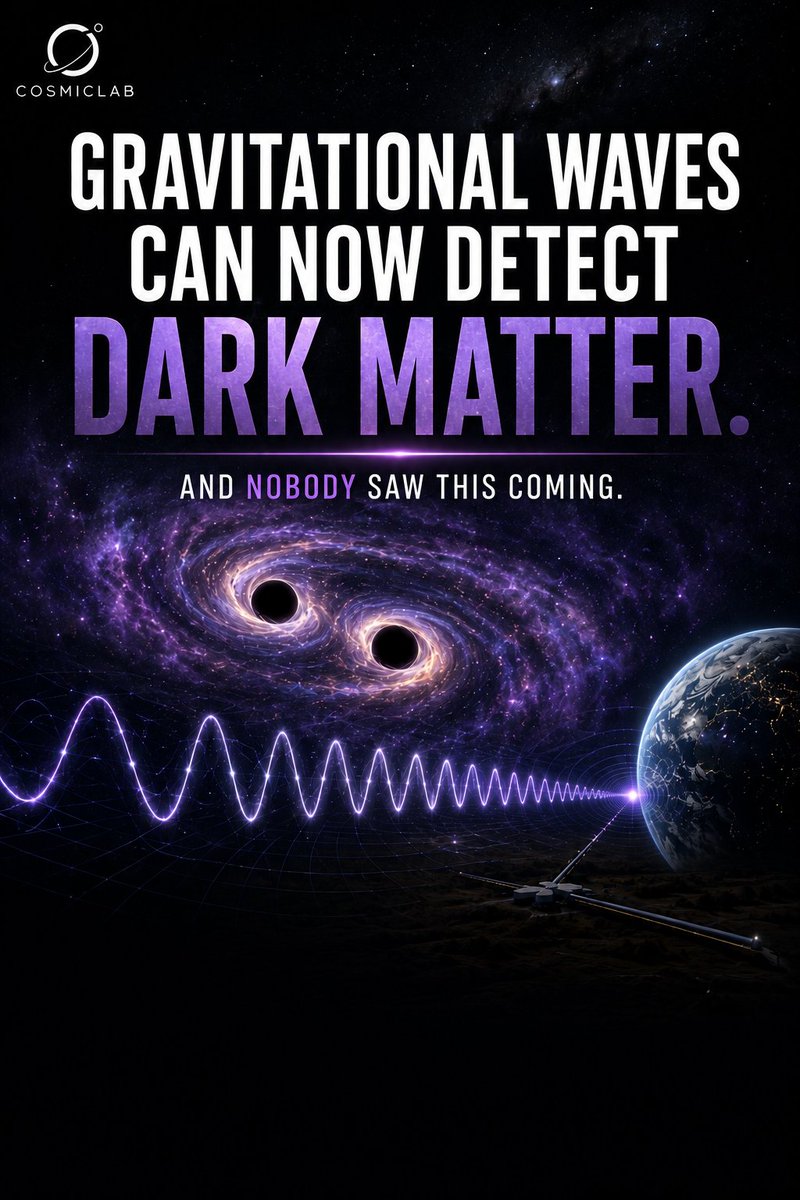
Gravitational waves can now detect dark matter. And nobody saw this coming.
Scientists at the University of Amsterdam have developed a new way to use gravitational waves from black holes to uncover the presence of dark matter and learn more about its behavior.
When JWST began operations, one of its earliest surveys revealed multiple objects appearing as "little red dots" compact, with unusual V-shaped spectra and emission from high velocity hydrogen gas.
They all exist very early in cosmic history.
For four years JWST kept finding tiny red dots scattered across the early universe.
Hundreds of them. In every deep field image. Where they had no business being.
The rocket about 45 feet long and 12 feet wide crashed with the force of nearly 3 tons of TNT, slamming into the lunar surface at 5,400 miles per hour.
This morning at 2:35 AM, a school bus sized piece of a SpaceX rocket crashed into the Moon.
A wayward 8,800-pound SpaceX Falcon 9 rocket booster slammed into the Moon in a rare case of a human made collision with the lunar surface.
#spacex#nasa#falcon9