Do you read books? Good. I found an entry I made on my journal in Q1 2025. "I'm never gonna read" Fast forward to to Q4, I'm reading
- Blue Ocean Strategy
- 5 AM club by @RobinSharma
- $100M Leads by @AlexHormozi
- Ikigai (Already finished)
Where else can you find us over the course of @token2049 week? 👀 @zara_nlr will be out and about to chat community collabs, partnerships & Web3 education-- here's where you can find her:
⭐️Verifying Intelligence: Where ZK Meets AI by @HouseofZK & @boundless_xyz - 29th Sept
🧩Multichain Day by @wrappedxyz - 30th Sept
👾Agents Day by @epicweb3 - 1st Oct
Here's where you can find us at the @token2049 side events! ✨
🔺Avalanche Campus Connect by @avax - 29th Sept
✨Stark Cafe by @Starknet & @KaitoAI - 1st Oct
🩵SheFi Summit Singapore by @shefiorg - 3rd Oct
Drop us a DM if you'd like to:
⭐️ Talk partnerships
⭐️ Talk community & ambassadorship
⭐️ Enroll in our bootcamps
Or, even if you'd just like to chat and get to know us! :')
Stories have always been the gateway to understanding, especially for children.
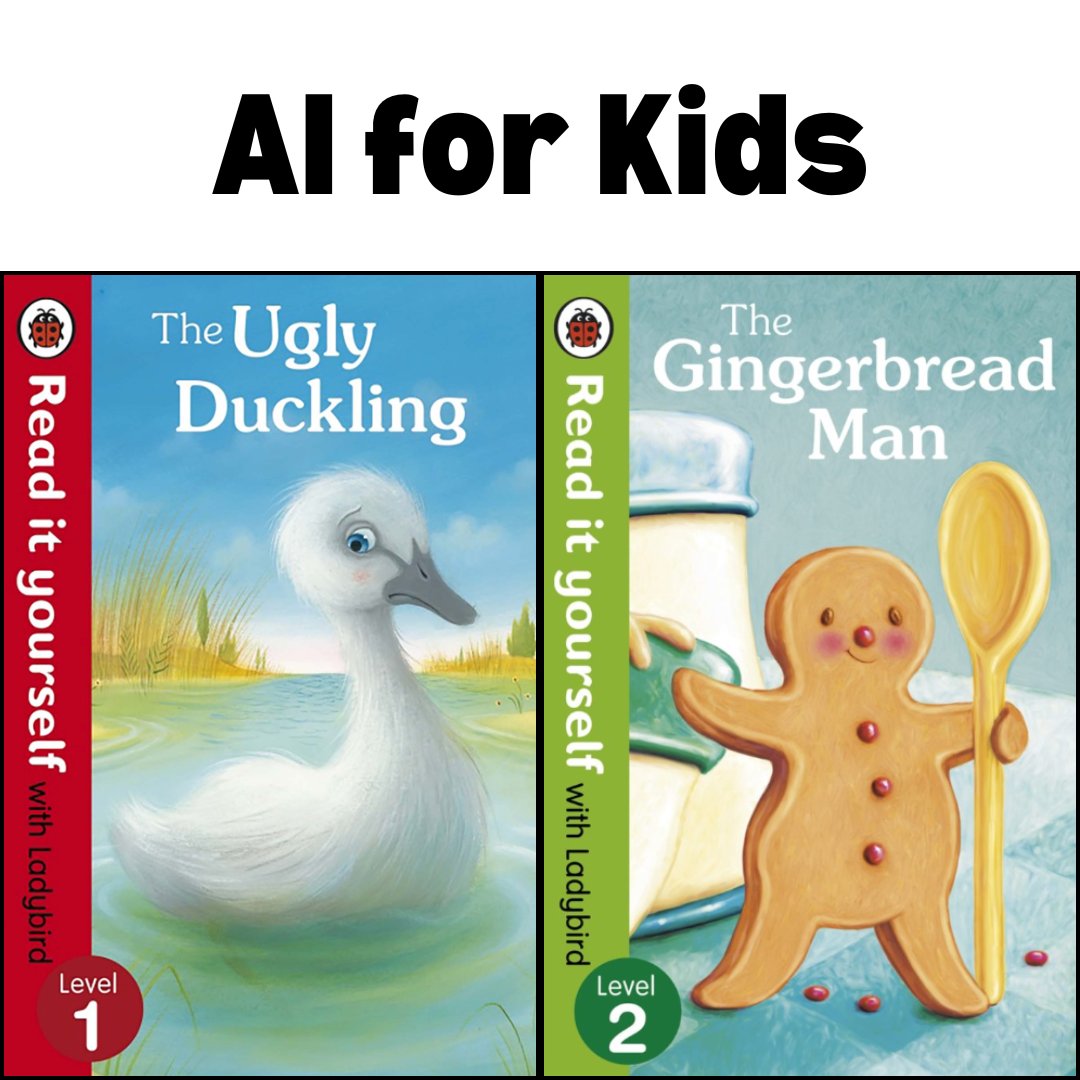
Think back to tales like The Ugly Duckling or The Gingerbread Man. These weren’t lessons written on a blackboard. They were emotional journeys. Children didn’t memorize “don’t judge others” or “don’t run away from safety.” Instead, they felt the loneliness of the duckling, or the fate of the gingerbread man. The story - its characters, pictures, and emotions - anchored the lesson in their imagination.
Now imagine applying this same approach to artificial intelligence education.
• Kindergarten: A story about a little robot who learns by watching patterns (like how the sun rises every morning). The robot becomes the AI “mascot” that grows with the children.
• Elementary: A “magic sorting hat” that always picks blue marbles until kids help it learn fairness, teaching them about bias.
• Middle School: Stories or simulations where an AI assistant faces everyday dilemmas for example, whether to prioritize speed over accuracy in helping with homework. This allows students to engage in conversations about fairness, responsibility, and the trade-offs that come with technology.
• High School: Interactive, game-like experiences similar to how coding is taught through challenges in CSS or logic puzzles but centered on AI. Students could experiment with prompt engineering, bias detection, or decision-making scenarios, where mastering nuance and precision becomes the key to “winning” the challenge.
This approach doesn’t just teach technical concepts. It creates a shared mythology of AI characters and stories that evolve with students, making abstract ideas relatable and memorable.
This is why the United Arab Emirates’ new nationwide initiative is so inspiring. Starting in the 2025–26 school year, AI will become a mandatory subject from kindergarten to grade 12 in public schools, with private schools expected to follow.
The curriculum is said to be carefully structured across seven learning areas: foundational concepts, data and algorithms, software use, ethics and bias, real-world applications, innovation and project design, and policy and community engagement. Importantly, the lessons will be delivered through stories, play, and projects, not extra hours - integrated into existing subjects and taught by specially trained teachers.
The UAE is not just teaching students what AI is. They are shaping how it is experienced, ensuring children grow with it the way previous generations grew with fairy tales. That is how you prepare a generation for a tech-driven future.
#UAE #Teaching #For #The #Future #EdTech #AI #Educators #Training
AI is reshaping education. It processes vast information, generates new content, and even supports decision-making through predictive analyses. But this transformation has also shifted the classroom dynamic: from teacher–student to teacher–AI–student.
This shift raises critical questions:
1. What is the teacher’s role when AI mediates learning?
2. What competencies do educators need to guide students responsibly in the AI era?
Today, few countries have formally defined these competencies or developed national programmes to train teachers in AI, leaving many educators without the tools to navigate this new reality.
That’s why the UNESCO AI Competency Framework for Teachers is so significant.
It defines the knowledge, skills, and values teachers must master, built on principles of:
• Protecting teachers’ rights
• Enhancing human agency
• Promoting sustainability
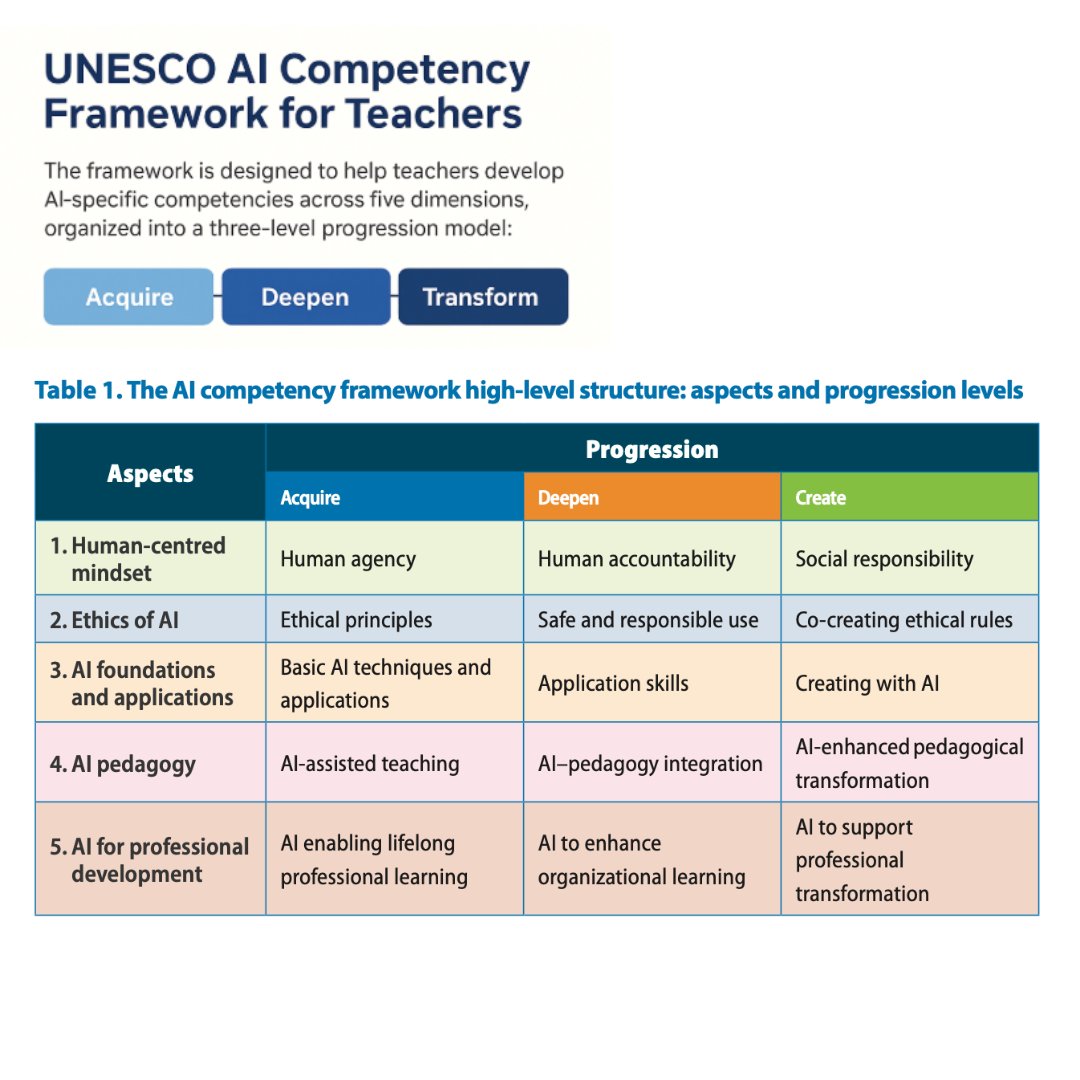
The framework outlines 15 competencies across 5 dimensions:
1. Human-centred mindset
2. Ethics of AI
3. AI foundations and applications
4. AI pedagogy
5. AI for professional learning
Competencies are scaffolded through three levels:
Acquire → Deepen → Create.
As a global reference, this framework is a tool for:
• Guiding national education policies and training programmes
• Designing teacher development pathways
• Embedding AI literacy and ethics into everyday classroom practice
I've added as visual of the framework, and here's how to read it. Think of it as:
Aspects = What to Learn
Levels = How far to go
For example: A teacher at Acquire level of AI Pedagogy might just use an AI tool to generate quiz questions. At Deepen level, they integrate AI into lesson planning and adapt it to student needs. At Create level, they design new AI-based teaching strategies or even collaborate in creating ethical AI edtech solutions.
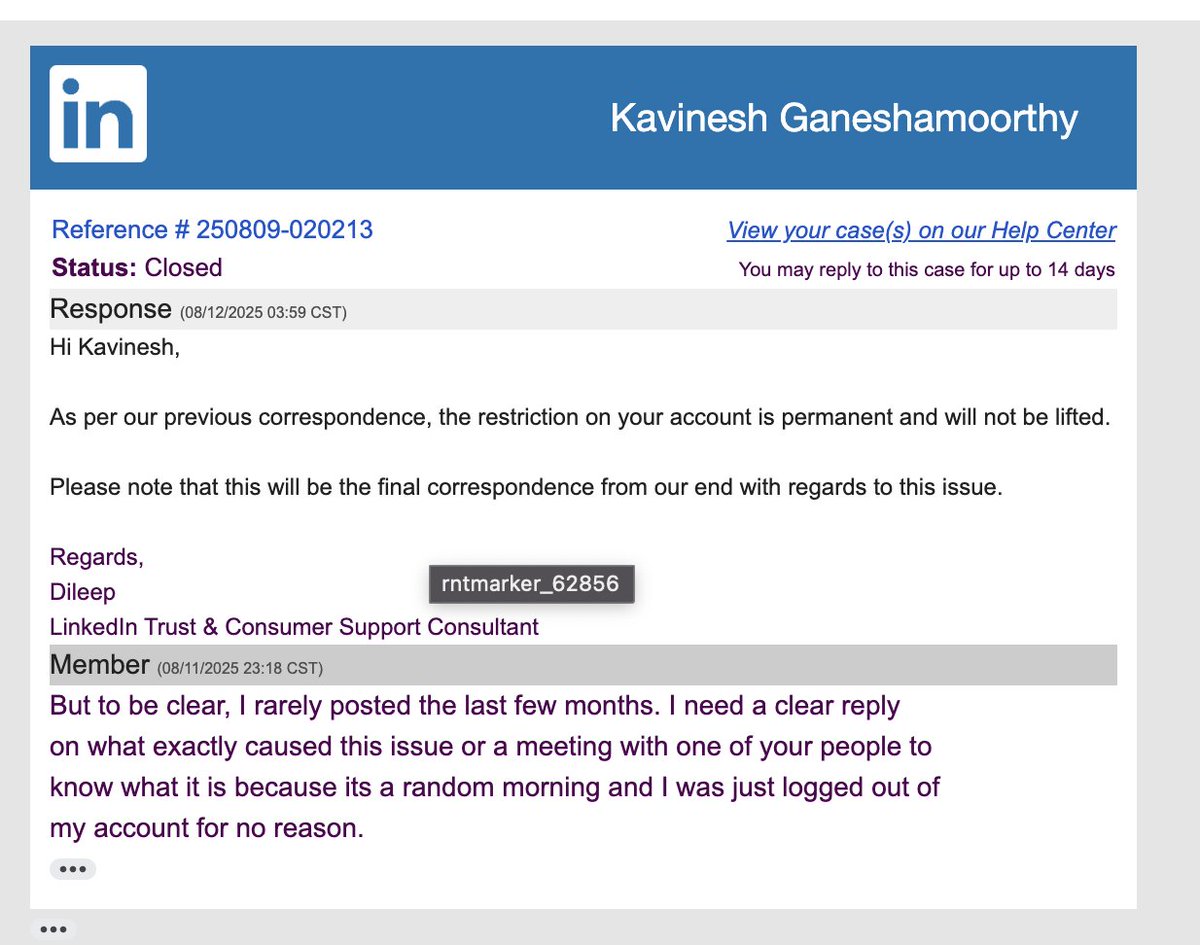
hey @LinkedIn . my account got restricted for no absolute reason and your customer service is not giving me a proper reply on why my account has been restricted.
who can i reach out to on this ? ASAP
This has been happening a lot, They need to at least state the reason and activity that got the account banned in the first place! My friend's account got banned 3 times (all new, not the same) without any proper reason stated. @LinkedInHelp@LinkedIn needs to work on their customer support and strive to help the customer base.
As part of our long term vision @MetanaHQ, we’ll be launching our own LMS platform soon 🚀. Why? Because we teach what gets you hired at a highly personalized level and for that we had a ton of custom requirements. When it comes to instructing and guiding our students
@clickup Would be great if the uses could be reset, apparently my dev team had experimented alot and run out of the uses for all types, mostly sprint related
@clickup isn’t ideal anymore. I’ve been using it for a while, and while it keeps adding features to be the “all-in-one” PM tool, it’s become bloated and restrictive. I even upgraded my whole team to ClickUp Pro. But here’s the catch:
1.Timeline views are limited
2.Sprint points are capped
3.Gantt charts are behind a paywall
https://t.co/Nhp8dvnfEv history is restricted
We’re still paying more just to unlock basic project management features. At this point, I’m seriously considering a self-hosted tool or a solid @NotionHQ template. Might even vibe-code my own in a day.
Thoughts?
Our podcast with @unicastai is officially live! And Ashane Perera just dropped some serious insight on what skills are hot right now (and what’s about to blow up) in the Web3 job market 🔥
Whether you’re already in the space or thinking about jumping in — this episode’s a must-listen.
Watch the full episode now on YouTube:
🔗 https://t.co/5C4LeRNCF6
Weird. I got my account on hold for a charge of $4,600 on @Replit as informed by @NationsTrustLK. Going back and forth on what happened. Feels like a customer credentials data leakage on replits end. However NTB is not keen on sharing screenshots or evidence
@NationsTrustLK Would be great if someone can be share the full transaction details:
Merchant ID
Processor or Acquirer name
Authorization code
Date/time
Descriptor line (if any)
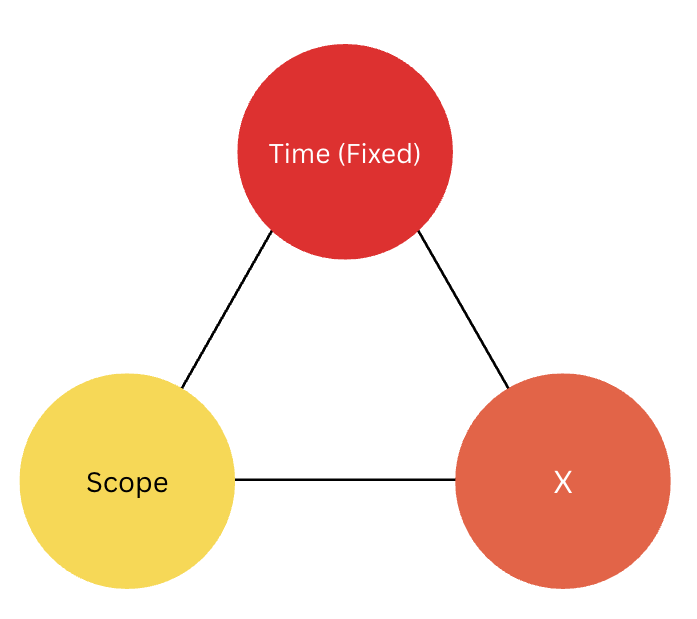
You're not cut out for project management if you think your job is putting everything on a nice board.
We scaled from 5 to 40+ in 2 years. Patterns repeat. Mistakes repeat.
PM isn't about tools. It's about owning the timeline, understanding every part, and preventing failure from repeating.