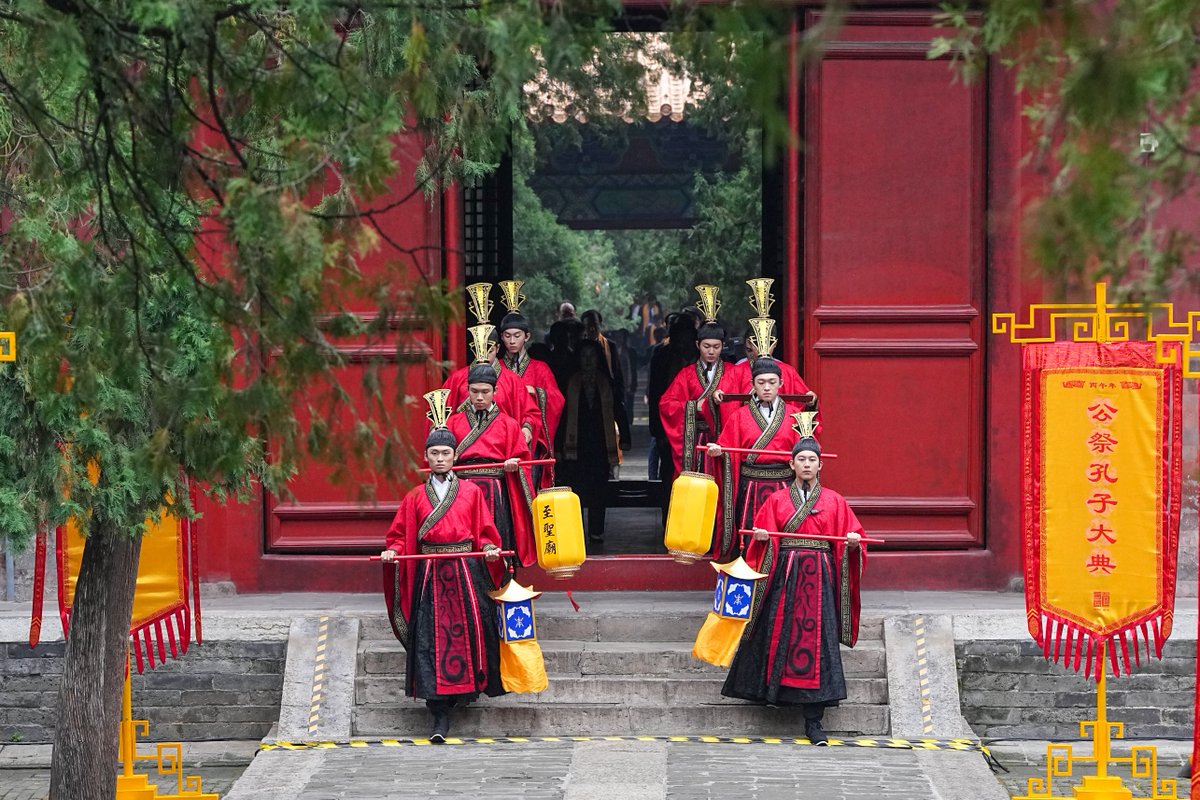
More than 2,500 years after Confucius (孔子) was born, his 80th-generation descendants still return to his hometown, Qufu (曲阜), in east China's Shandong Province, to take part in annual ceremonies honoring him.
An American scholar once said to me, more than two thousand years ago, there were Confucius, Socrates, Plato, and Aristotle. Today, we no longer know where the descendants of Socrates, Plato, or Aristotle are. But the descendants of Confucius are still here.
The scholar, a specialist in comparative philosophy and former university vice chancellor, called this "the continuity of Chinese civilization."
Recently, I was invited to Qufu to attend ceremonies marking the 2,577th anniversary of Confucius's birth, as well as the Nishan Forum on World Civilizations (尼山论坛).
The Nishan Forum was launched in 2010 to promote exchanges among scholars of Confucius and dialogue across civilizations. The theme of its first gathering immediately caught my attention: Dialogue between Confucian Civilization and Christian Civilization. 16 years later, this year's theme is Civilization, Order, and Justice.
Being in Qufu, attending both the ceremony and the forum, I found myself considering three questions:
How does a civilization preserve its memory?
How do different civilizations understand one another?
And in a world full of distrust and competition, how can order be rebuilt?
In many ways, these are the questions Confucius was grappling with two millennia ago.
Qufu is one of the oldest place names still in use in China. In Chinese, the name literally refers to a "curving hill." The name already appears in texts predating Qin Shi Huang (秦始皇).
Just a few days ago, President Trump, while visiting the US National Archives with the Chinese leader, referred to China as a civilization with a history of five thousand years (he actually said six thousand years, which is not necessarily wrong either based on current archeology). In Qufu, those vast stretches of time suddenly become tangible.
Chinese tradition generally regards the Yellow Emperor (黄帝), who is said to have lived more than four thousand years ago, as one of the founders of Chinese civilization. In some ways, his place in Chinese cultural memory can be compared with Zeus in the Greek world, Menes in ancient Egypt, Emperor Jinmu in Japan, or Manu in India. According to legend, he won the support of various tribes and became their supreme ruler. His wife was said to have taught people how to make silk.
According to legends, Qufu was the birthplace of the Yellow Emperor and later became the capital of his son. These stories, however, have not been confirmed by archaeology.
Qufu's more clearly traceable place in Chinese history begins around three thousand years ago. At that time, China was ruled by the Shang dynasty (商), which brought bronze casting to extraordinary heights and produced the oracle-bone inscriptions, the earliest known systematic form of Chinese writing. Horse-drawn chariots, which had spread eastward from the Eurasian steppe, also became common during this period, showing that China was already connected to wider networks of exchange across Eurasia.
The last Shang king was remembered in later tradition as a cruel and decadent ruler, notorious for heavy drinking, sexual excess, and brutality. His reign eventually provoked rebellion, and the Shang dynasty was overthrown by the Zhou (周) people from northwestern China.
Over time, the story of the Shang's fall became increasingly legendary. What began as a struggle between rival powers was transformed into an epic filled with gods, spirits, and heroic figures. In this form, the story bears some resemblance to the Trojan War in the Western tradition.
After the Zhou victory, King Wu rewarded two of the men closest to him with lands in what is now Shandong Province. One was his chief strategist, Jiang Ziya (姜子牙). In popular mythology, he was imagined as someone who could command the gods and even decide their place in the divine hierarchy. He was granted the state of Qi in northern Shandong.
The other was King Wu's younger brother, later known as the Duke of Zhou (周公), who was granted the state of Lu in southern Shandong. Yet he probably spent little time in his own fief. King Wu died soon after the Zhou conquest, leaving a young heir on the throne, and the Duke of Zhou was called upon to assist his teenage nephew.
The Duke of Zhou was a conscientious regent. He suppress rebellions. He used measurements of the sun's shadow to identify Luoyang (洛阳) as the center of the realm. He also developed an elaborate system of ritual, combining ceremony with music to lay the foundations of the social order of his time.
Over time, the Duke of Zhou acquired an unexpected second career: dream interpreter. The man remembered for helping build the Zhou political order also became, in popular folklore, an authority on what our dreams might mean. A dream book attributed to him became so famous that, when I was growing up in China, "ask the Duke of Zhou" was almost shorthand for looking up the meaning of a dream.
About five centuries later, on the land of the state of Lu that had once been granted to the Duke of Zhou, one of the most influential thinkers in Chinese history was born: Confucius.
The world Confucius faced was no longer the relatively stable Zhou order of the Duke of Zhou's time. It was an age of competing states and collapsing norms, what later Chinese tradition described as a time when "rites had broken down and music had fallen into disorder."
Confucius responded by turning that ritual tradition into something more explicitly philosophical and ethical. What had largely been part of an aristocratic political order became, in his thought, a path of self-cultivation open to ordinary people. He was deeply concerned with a basic question: what kind of person should one become?
Education was central to Confucius's vision. His idea of "education without distinction" challenged the notion that learning belonged only to hereditary elites. He also believed that good government depended on the moral character of rulers. Wealth and military strength were not enough; rulers also had to use authority properly, observe accepted norms, care for the people, and lead by example. This became an enduring standard for judging political authority in Chinese culture.
But Confucius himself had few opportunities to put these ideas fully into practice.
That is not difficult to understand.
In an age when the old ritual order was breaking down and warfare was becoming more frequent, rulers were preoccupied with armies, territory, and power. A thinker who kept telling them to restrain themselves and govern through virtue was not necessarily the person they most wanted to hear from.
Confucius did not transform the world during his lifetime. The truly remarkable part came after his death.
His teachings were preserved, interpreted, and developed by generations of disciples and scholars, and eventually became part of the political and educational foundations of China, influencing much of East Asia as well. Even in eighteenth-century America, Founding Fathers such as Thomas Jefferson, John Adams, and Benjamin Franklin spoke of Confucius with considerable reverence.
Confucius had more than seventy disciples. That sometimes makes me think of another teacher who traveled with followers and whose influence became far greater after his death: Jesus.
Of course, the nature of their teachings was very different.
Confucius was primarily asking:
What does it mean to become a morally cultivated person? How can an orderly society be built?
Jesus was more centrally concerned with questions such as:
What is the relationship between human beings and God? How can human beings attain salvation?
Yet there is an interesting similarity between them. Neither reached a powerful position in his lifetime. Neither commanded an army. What ultimately changed the world was the tradition built after their deaths by disciples, texts, scholars, and generations of interpreters.
After Confucius died, his former home was turned into a temple in his honor, and the same site has continued to serve as a place of commemoration for more than two millennia. His burial ground gradually became the cemetery of the Kong family, where generation after generation of his descendants were laid to rest. More than seventy generations later, it remains in use today and is regarded as the world's largest continuously used family cemetery.
The ways these civilizations remember their great thinkers are very different. Confucius is still commemorated through a living family lineage and rituals that have endured for more than two thousand years, while the descendants of Socrates, Plato, and Aristotle can no longer be traced.
But when it comes to legend, East and West can look surprisingly similar.
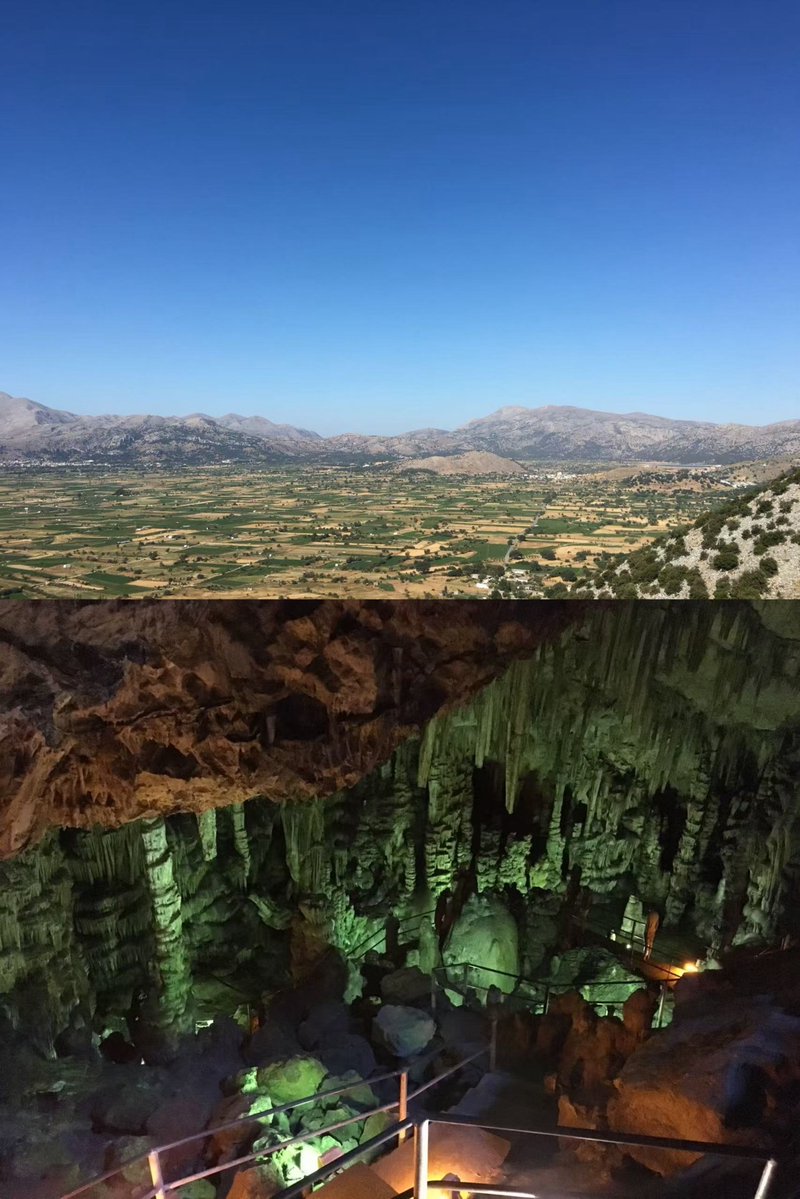
Ten years ago, I traveled overland by train from Beijing to Rome, and from there flew to Crete, a place I had long dreamed of visiting. On the island, I hired a taxi driver to show me around. At first I was a little uneasy-I had previously been overcharged by taxi drivers in both Russia and Poland-but he quickly won my trust with his warmth, reliability, and remarkable knowledge of the island. After taking me to several archaeological sites, he insisted that I visit a large cave in the mountains. According to local tradition, he told me, it was the birthplace of Zeus (top right).
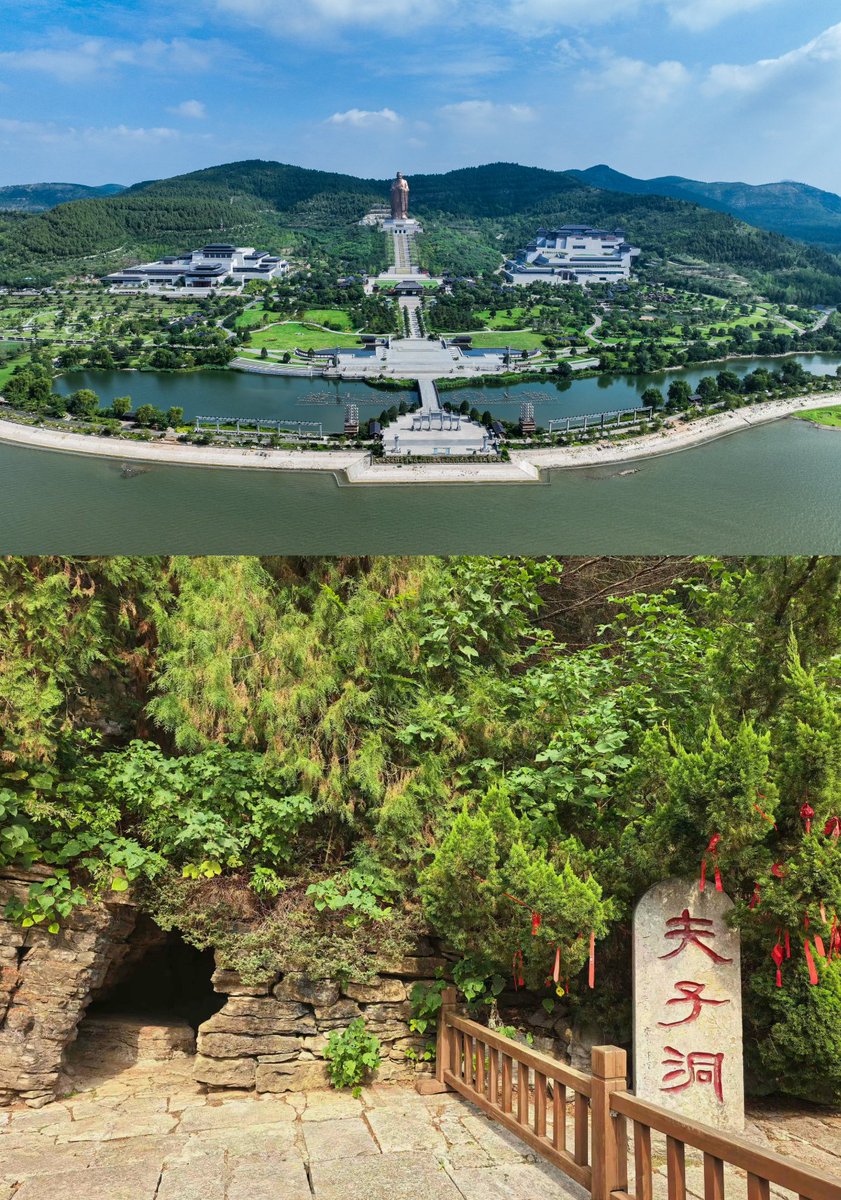
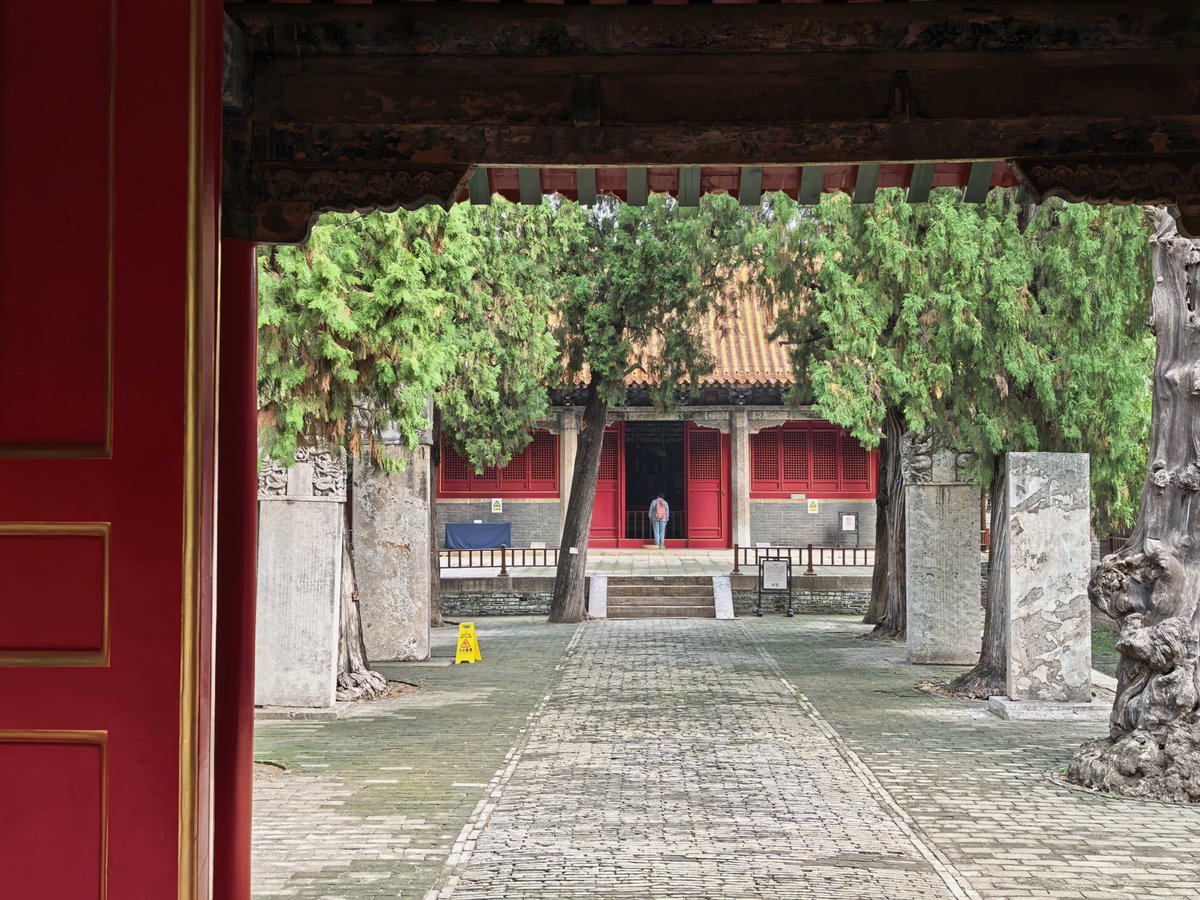
At the Nishan Forum this time, I learned that not far from the conference venue stands a Confucian temple more than a thousand years old, built to commemorate what tradition holds to be the birthplace of Confucius (bottom left). The buildings that survive today mostly date from the Ming and Qing dynasties (1368-1911), but many of the old trees on the grounds are around a thousand years old, reaching back to the temple's earliest days. Beside the temple is a cave that tradition also associates with the birth of Confucius (bottom right).
One story concerns the birth of the supreme god of ancient Greece; the other, the birth of ancient China's most influential thinker.
Thousands of miles apart, two civilizations located the birth of an extraordinary figure in strikingly similar settings: a mountain, a cave, and a story passed down from generation to generation.
Civilizations can be profoundly different and yet preserve memory in surprisingly similar ways. But recognizing such similarities is only the beginning. The harder question comes when civilizations actually enter one another's worlds: can they encounter traditions different from their own without trying to erase them? Can they respect one another's rituals and sense of order?
Some Westerners may have the impression that China in earlier times did not welcome Christian missionaries. In fact, many Chinese people have the same impression. Yet there is a little-known chapter in this history.
By the 17th century, after decades of sustained effort by Catholic missionaries, Christianity had already gained a significant number of converts in China. The first two emperors of the Qing dynasty, Shunzhi (顺治) and Kangxi (康熙), both placed considerable trust in the missionaries; Shunzhi even wrote poems praising Catholicism. In 1692, Kangxi issued an edict of toleration. Catholicism was, in effect, granted a recognized place alongside Buddhism and Daoism and given room to establish itself in China.
This was an extraordinary window in the history of exchanges between Chinese and Western civilizations. Unfortunately, the Roman Church failed to make good use of this rare opportunity. Some within the Church regarded Confucian rites as religious in nature and therefore forbade Chinese converts from taking part in ceremonies honoring Confucius. One of the most prominent figures was Charles Maigrot. In 1693, just one year after Kangxi issued his edict of toleration, Maigrot ordered Christians in his own vicariate not to participate in rites honoring Confucius or in ancestral rites.
Apparently, this ungrateful old dude failed to appreciate how exceptional, and how fragile, this opportunity was.
He soon brought Kangxi and Rome into conflict. From Kangxi's perspective, if a religious authority thousands of miles away in Europe claimed the right to tell the Chinese that rituals practiced for generations were impermissible, then the issue was no longer simply how one should practice a religion. It raised a much more fundamental question:
Who has the right to define the rituals of the Chinese people?
Even then, Kangxi showed considerable patience. For years, he continued to receive papal envoys and sought to resolve the dispute through dialogue. It was only in 1706, after meeting Maigrot in person and becoming outraged by his manners, that Kangxi finally ordered him expelled from China.
In 1715, the pope issued a decree prohibiting Chinese practices associated with the veneration of Confucius. In 1721, Kangxi responded: "From now on, there is no need for Westerners to preach their religion in China. It may as well be prohibited, so as to avoid further trouble. Thus decreed."
Because of the rash actions of a few, a precious chapter in the history of exchange between China and the West came to an abrupt end.
Do we still have such an opportunity today? I believe we still do.
Traditional theories of international relations tend to put interests first. They are remarkably good at explaining war, rivalry, alliances, and the balance of power. They tell us why states mistrust one another, why they compete, and why they seek security through strength. But they are much less good at answering a different question: how can states live together over the long term without allowing mistrust and competition to become permanent conditions?
Huntington went even further, arguing that different civilizations were bound to conflict. In my view, that idea is totally mistaken. In Chinese policy circles, I have said more than once that this theory makes conflict seem natural, inevitable, and even intellectually justified, providing ammunition for conflicts the world does not need.
Confucian thought offers another way of looking at international relations. For instance:
Ren (仁), or humaneness, means that while a community pursues its own interests, it must also remain conscious of the existence and needs of others. It reminds us that truly durable interests cannot be built on the assumption that others must always lose.
Yi (义), or righteousness, means that not every interest we are capable of securing is necessarily worth pursuing. Power can tell a country "What am I able to do?" But yi asks a different question: "What ought I to do?" If international relations are reduced entirely to calculations of power, then power itself can become the source of legitimacy. Yi seeks to establish limits on conduct beyond power alone.
Zhi (智), or wisdom, is the capacity for judgment. It requires a country to look beyond immediate gains and losses and to understand the long-term consequences of its decisions. Winning a single contest does not necessarily mean making a wise choice.
Xin (信), or trustworthiness, is credibility. The long-term stability of international relations depends to a considerable degree on countries believing that words spoken today will still carry weight tomorrow, and that rules accepted today will not be arbitrarily reinterpreted when circumstances change. For example, documents signed decades ago by the United States, Japan, and China all clearly stated positions that Taiwan's a part of China. Yet today there are still people in both countries seeking to distort the meaning. If words can be redefined whenever they become inconvenient, trust itself begins to lose its meaning.
And when trust breaks down, countries fall back on power. If every country must rely increasingly on power to secure itself, security becomes more costly and more fragile.
Seen in this light, Confucian thought does not seek to replace interests with morality, nor does it ask the international community to become an ideal world without competition. What it may offer is a more complex form of realism: states naturally have interests, and they also need power. But interests must be constrained by yi; and a stable order ultimately requires at least some degree of ren.
Power can win a contest. It cannot, by itself, build an order in which others are willing to live.
Confucian thought does not offer a complete answer to the problems of the modern world. But in asking how power should be restrained, how trust can be sustained, and how people and states with different interests can live together, it remains an enduring point of reference for all of us thinking about the future.
@AngelicaOung I work in this sector and have been saying this and if you include other factors like Japan and China's development it's far worse then you think
This painting is older than the Quran.
Older than the Kingdom of England.
Older than every cathedral in Paris, London, or Cologne.
It has survived nearly 1,400 years of dynasties, wars, conquest, and revolution:
Emperors owned it.
A Mongol princess treasured it.
China's last emperor secretly carried it out of the Forbidden City.
Then, amid the chaos of Japan's defeat in 1945, it disappeared.
A year later, it resurfaced in Beijing's antique market.
Someone was preparing to sell it abroad. And one man sold his home to save it.
Today, it is one of the treasures of the Palace Museum in Beijing.
Its name is: Spring Outing (游春图).
The scroll measures 43 centimeters high and 80.5 centimeters wide-less than a meter across. Attributed to the Sui Dynasty painter Zhan Ziqian (展子虔), it is regarded as the earliest surviving Chinese painting associated with a named master.
So what did spring look like in China 1,400 years ago?
Unroll the painting, and the first thing that greets you is not an emperor, a battle, or some immortal realm. But a spring day.
Green mountains rise and fall across the landscape, while fresh leaves emerge from the trees and water stretches through the center of the painting.
Mist drifts between the hills and valleys, and a red temple is half-hidden among the trees (top right).
A stream winds gently downhill. To the right of a red arched bridge, a man rides a white horse, followed by two companions taking in the spring scenery along the way. Farther down, two more riders appear. One carries a long red stick, which some scholars have suggested may be a polo mallet (bottom left).
The water opens into a broad expanse. A light breeze passes over the surface, making it shimmer.
A small boat drifts across the water. Several women sit aboard, apparently deep in conversation, their enjoyment almost visible even at this tiny scale (bottom right).
On the opposite bank, two figures stand quietly admiring the flowers.
No names. No story. And yet, this painting marked an important transition in Chinese art.
Before this period, Chinese landscape painting was often relatively simple and highly stylized. Human figures could appear disproportionately large compared with the mountains around them. In Spring Outing, however, people have become small within the landscape. Mountains, water, trees, and human activity begin to belong to the same visual world.
Nature is no longer merely a backdrop. It has become the subject.
The Sui dynasty was remarkably short-lived. Its founder, Yang Jian (杨坚), had been a powerful general under the Northern Zhou (北周), a northern dynasty whose ruling elite had deep nomad roots. In 581, he ruthlessly forced the young emperor, his grandson, to abdicate and established a new empire.
Years later, Yang's armies crossed the Yangtze River and unified China. After more than two centuries of political division, China was unified once again, in 589.
Yang Jian's son, Emperor Yang of Sui (隋炀帝), or Yang Guang (杨广), was one of the most ambitious, and controversial, rulers in Chinese history.
He dramatically expanded and integrated China's canal network, linking the Yellow River, the Huai River, the Yangtze, and the waterways of the prosperous south. Grain and other goods from southern China could now be transported northward far more efficiently and at much lower cost.
Later dynasties continued to expand, repair, and depend on this north-south waterway system. Its influence on China's economic geography lasted for more than a thousand years.
The Sui also became deeply involved in the politics of East Asia. It confronted the Turks on its northern frontier and fought back against Goguryeo's invasion. Japan sent envoys to the Sui court, and Sui envoys traveled to Japan in return.
Emperor Yang also turned his attention toward the seas southeast of China.
Chinese records describe an island polity called Liuqiu (流求) that bluntly refused to acknowledge Sui authority. In 610, the emperor dispatched a military expedition to punish the defiance. After a series of battles, the Sui forces defeated the local ruler, captured several thousand people, and returned to the mainland.
The records describe Liuqiu as lying east of what is now Fujian and reachable in roughly five days by sea.
Where exactly this ancient Liuqiu was located remains debated. Traditional Chinese scholarship has often identified it with Taiwan, while other scholars have argued that it may have referred to the Ryukyu Islands.
When Sui warships were sailing toward Liuqiu in 610, Muhammad was beginning his prophetic mission in Arabia, and England did not yet exist.
This was the world in which Spring Outing was created.
But Emperor Yang's enormous military campaigns and massive canal projects placed an extraordinary burden on the population. Rebellions spread across the empire, and in 619, the Sui dynasty collapsed.
In 623, Tang dynasty defeated the rival regimes and reunified China, once again.
But here's the strange part. The Tang didn't overthrow the Sui the way a foreign conqueror would. They overthrew their own cousins.
The founder of the Tang, Li Yuan (李渊), was related to the Sui imperial family: his mother and the wife of Yang Jian were sisters. In other words, the founders of the Sui and Tang dynasties belonged to the same aristocratic family network.
What happened to Spring Outing during the Tang dynasty is unknown.
There is no surviving record of its whereabouts, and at that time collectors had not yet developed the later habit of covering paintings with ownership seals and inscriptions. For several centuries, the painting simply disappears from the historical record.
Then, in the early 12th century, it resurfaced in the collection of Emperor Huizong of Song (宋徽宗).
Huizong was a disastrous ruler, but an extraordinary artist. Few Chinese emperors were more accomplished in painting, calligraphy, and art collecting. He inscribed "Spring Outing by Zhan Ziqian" on the painting and impressed it with his imperial seals.
Then came catastrophe. In 1127, Jurchen armies from northeast China captured the Song capital of Kaifeng (开封). Emperor Huizong, almost the whole imperial family and enormous quantities of treasure were taken north as trophies.
At the time, England was still ruled by Henry I, the son of William the Conqueror, and the Second Crusade was still twenty years away.
Another of Huizong's sons, Zhao Gou (赵构), escaped capture and eventually established his regime in southern China.
And somehow, Spring Outing appears to have survived the disaster. We know this because the painting later carried the seals of Jia Sidao (贾似道), the immensely powerful, and notoriously controversial chancellor of the Southern Song in the 13th century.
By the 14th century, China was ruled by the Mongol Yuan dynasty. The painting then entered the collection of an extraordinary Mongol princess, a granddaughter of Kublai Khan (忽必烈).
She was deeply fascinated by Chinese painting and calligraphy and assembled an important collection of Chinese artworks, including Spring Outing. In the spring of 1323, the same decade Dante finished the Divine Comedy, she hosted a celebrated party of scholars and connoisseurs in Beijing.
She brought out works from her collection and invited prominent Chinese scholars and artists to examine them, compose poems, and add inscriptions. Among the paintings displayed that day was Spring Outing.
The party took place close to today's Temple of Heaven, where Trump visited this May.
During the Ming dynasty, Spring Outing passed into the collection of another notorious chancellor, Yan Song (严嵩). After Yan fell from power and his property was confiscated, the painting returned to private hands.
By the 18th century, it was owned by An Qi (安岐), the son of a wealthy salt merchant whose family was of Korean origin. From his collection, the painting eventually entered the imperial collection of the Qianlong Emperor, a descendant of the Jurchens whose armies had stormed Kaifeng six centuries earlier, but had somehow failed to carry this very scroll away.
Qianlong lived in the same era with George Washington. They died in the same year. And, during Qianlong's reign, the first American merchant ship reached China, opening direct trade between the newly independent United States and China. The relationship began on remarkably smooth and cordial terms. Chinese officials described Americans as unusually polite and professional, sometimes in striking contrast to their views of the British.
Then the imperial world itself came to an end.
The Qing dynasty collapsed in the revolution of 1911, and in 1912 the last emperor, Puyi (溥仪), abdicated at the age of six. Under the terms of his abdication, he was still allowed to live inside the Forbidden City, and the former imperial household was permitted to retain its private property.
But Puyi apparently understood that this arrangement might not last forever.
In the early 1920s, he began quietly moving some of the most valuable paintings, calligraphy, etc out of the Forbidden City, often disguising the transfers as "gifts" to his younger brother.
In 1924, Puyi was finally expelled from the Forbidden City. The treasures he had failed to remove were subsequently inventoried, and the former imperial collection eventually became part of the Palace Museum.
Puyi, however, had not given up his dream of becoming an emperor again. He turned to Japan for support. After Japan occupied Northeast China, Puyi became the puppet emperor of the Japanese-sponsored state of Manchukuo (满洲国) in the 1930s.
Spring Outing had followed him north. Then came August 1945.
As Japan surrendered and Manchukuo collapsed, Puyi fled the capital. In the chaos that followed, paintings and other treasures left behind in the palace were looted and scattered by members of his own entourage.
And once again, Spring Outing disappeared.
This was not the first time the painting had survived the fall of a dynasty.
But this time, it came dangerously close to disappearing from China forever. In 1946, the painting resurfaced in Beijing's antique market.
A collector named Zhang Boju (张伯驹) learned that it might be sold abroad. Determined to keep it in China, he negotiated the price down to 220 taels of gold (6875 grams).
To raise enough funds, he sold his luxurious Beijing courtyard residence to Fu Jen Catholic University (辅仁大学).
He had sold a home to save a painting. And afterward, Zhang joyfully gave himself a new name:
"Master of Spring Outing (春游主人)"
Although Zhang had paid an enormous price for the painting, he never intended to possess it forever. And that may be the most moving part of the entire story.
While many collectors often dream of saying: This is mine.
Zhang Boju believed almost the opposite.
His philosophy of collecting could be summed up like this:
"These treasures do not need to belong to me forever. What matters is that they stay in China, and that they survive for generations to come."
After the founding of the PRC, Zhang gradually donated many of his greatest paintings and works of calligraphy to the Palace Museum, without compensation.
Among them was Spring Outing, which is now one of the most treasured masterpieces in the collection of the Palace Museum.
But this time, it no longer belongs to an emperor. Not to a princess. Not to a chancellor. Not to a wealthy merchant or a private collector.
For more than a thousand years, each of its owners, knowingly or not, held it only for a moment before passing it on to the next. Now, it belongs to everyone.
And when we look back at that spring painted so long ago:
The riders are still crossing the bridge.
The women in the boat are still talking and laughing.
Two figures are still quietly admiring the flowers.
Fourteen hundred seasons have turned. But spring never left this painting.
https://t.co/5yHTdZxv9f
A seal once belonging to the earliest recorded empress in Chinese history was, astonishingly, picked up by a 13-year-old boy, from a muddy drainage ditch, two thousand years after her death.
Today, this seal is housed in the Shaanxi History Museum and is considered one of its most prized treasures. It measures just 2.8 cm across, 2 cm in height, and weighs only 33 grams. Yet its value is beyond measure.
Carved from fine Hotan mutton-fat white jade from Xinjiang, its texture is smooth and lustrous, and flawless. On the base are four characters: Seal of the Empress (皇后之玺). Surrounding them are cloud motifs, and the knob is a high-relief carving of a mythical beast, a fusion of dragon and tiger, majestic and lively.
In 1968, a 13-year-old rural boy would go to a nearby drainage ditch after school every day to hunt for treasure-collecting ancient bronze nails and coins. One day, as usual, he was rummaging through the mud when he noticed an unremarkable white stone.
He struggled to pry it out of the mud. After wiping it clean, he saw that it had characters carved on the bottom, and a small animal figure atop.
He took the little stone back home, even thinking about polishing off the inscription and carving his own name. If not for his father taking a second look, Chinese history might have lost a national treasure.
Sensing it could be something valuable, his father took him to the Shaanxi History Museum. There, it was identified as a national treasure, the imperial seal of a Western Han empress.
That empress was Empress Lv (吕后), wife of Liu Bang (刘邦), the founding emperor of the Han dynasty. In many ways, she stands as China's counterpart to Cleopatra.
The museum rewarded the father and son with the equivalent of about half a month's wages, asking them to enjoy some lamb soup with crumbled flatbread and get a ride home. They enjoyed the meal, but decided to save the fare, walking several hours back instead, arriving at home after nightfall.
What makes the story even more remarkable is that the seal's own disappearance reads like a historical mystery. It was found very close to the mausoleums of Liu Bang and Empress Lv. In 25 AD, those tombs were brutally looted.
The seal may have come from the underground palace and got dropped by grave robbers in their haste. Or perhaps it was once kept in an above-ground structure, later destroyed, with the seal washed away and buried in mud, lying hidden underground for two thousand years.
No one knew where it was. No one even remembered it existed. Until the child picked it up from a ditch.
In 1974, China was still in a period of turmoil. Led by Jiang Qing, the Gang of Four wielded immense power. She held herself in high regard, projecting herself onto powerful women from history. She admired Empress Lv, and she admired Wu Zetian (武则天), the only female sovereign in the history of China, seeing them as reflections of herself.
And so, she did something both absurd and yet entirely real-She had the jade seal transferred to Beijing.
Taken away. Kept in her possession. Handled and admired for two full years.
A seal that had lain buried for two thousand years, newly brought back into the light, was once again drawn into the orbit of power.
It was not until 1976, when the Gang of Four fell and Jiang Qing was arrested, that the seal was finally returned to Shaanxi. It was as if it had completed a cycle spanning two millennia.
As a side note:
Qin Shi Huang, the first emperor of China, is never recorded in historical texts as having an empress. Because of this, many believe he may not have established the institution of "empress" at all.
It was Empress Lv who truly brought this title onto the historical stage. As for her husband, Liu Bang, I've introduced his story in a previous post. Empress Lv's own life was just extraordinary as well.
She was named Lv Zhi (吕雉), with Zhi meaning "pheasant." Before the age of twenty, she moved with her father to Liu Bang's hometown. Because her father was a friend of the county magistrate, many people came to offer congratulations. Those who brought gifts worth a thousand coins could only dine outside the hall.
Liu Bang, however, claimed he had brought ten thousand coins and strode into the banquet, despite having brought nothing at all.
Lv's father did not expose him. Instead, he offered him a seat of honor. According to historical records, he was skilled in physiognomy, the practice of judging a person's character and destiny from their facial features.
After the banquet, he even kept Liu Bang behind. What he saw was not the gift, but the man himself, his bearing and what he believed to be his infinite future potential.
Therefore, Liu Bang, a bachelor around his forties, married Lv, who was 20 years younger than him. Soon, his life started to change dramatically.
During Liu Bang's competition against Xiang Yu for supremacy, Lv was once captured, but she survived.
From 202BC to 195BC, Liu Bang ruled China as the emperor. In the fifteen years after he died, she became the true holder of power in the Han dynasty. Strong-willed and decisive, she determined who lived and who died, who rose and who fell, who belonged to the empire, and who would be erased.
She held no imperial title, yet possessed everything an emperor did.
At the time, the head of the Xiongnu (Huns) sent a letter, probing and tinged with condescension:
"I am a lonely ruler, born in the marshes and raised on the steppe. I have come to the borders many times, hoping one day to visit the Central Plains. Your Majesty rules alone as well, living in solitude. We are both solitary sovereigns, neither of us content. Why not exchange what we each have, for what we each lack?"
Faced with such a subtle provocation, Empress Lv briefly considered military retaliation. But after weighing the strength of her state, she chose a far more measured response.
In her reply, she wrote:
"You have not forgotten our humble and remote land, and have personally sent us your letter, which fills me with awe and unease. I reflected carefully. I am now old and frail-my strength has waned, my hair and teeth have fallen, and I can't walk well. You must have heard exaggerated praise of my appearance. How could someone like me dare diminish your illustrious presence? I have committed no offense against you, and I trust you will be magnanimous. I now send you two imperial carriages and eight fine horses as a modest token."
With a single letter, she defused the provocation, while preserving dignity on both sides.
Today, the boy who once donated a national treasure for a bowl of lamb soup is in his seventies. People still travel to visit him, listening as he recounts that moment from long ago.
He says he has never regretted it.
Because what he gained back then was not just a meal, but the return of a piece of history that had been buried for two thousand years.
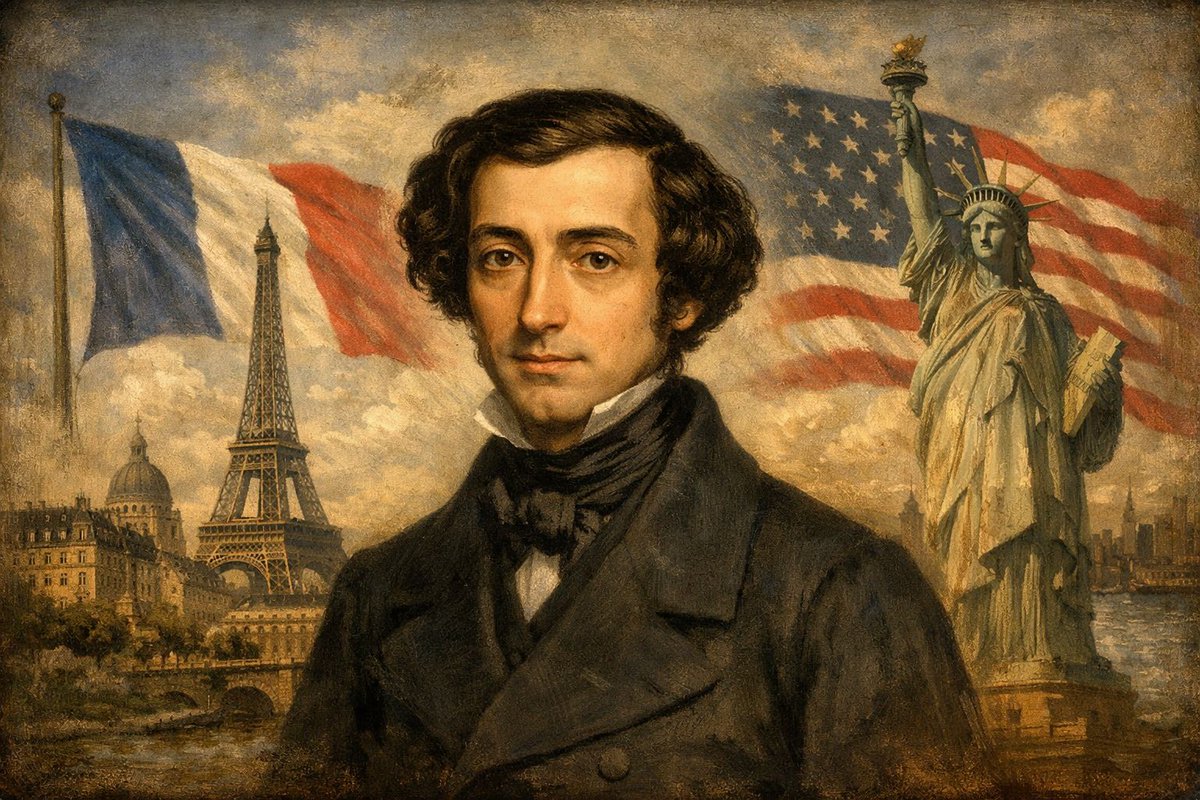
A man who spent less than a year in America understood it better than most people born here.
He wrote down how it could slowly fall apart.
We may be watching it unfold right now. 🧵
Google is so powerful that it "hides" other search systems from us. We just don't know the existence of most of them.
Meanwhile, there are still a huge number of excellent searchers in the world who specialize in books, science, other smart information.
Here's a list of sites you may have never heard of!
https://t.co/hLHSvB1Joo - Academic Resource Search. More than a billion sources: encyclopedia, monographies, magazines.
https://t.co/tzsXqbrCJD - a search for the contents of 20 thousand worldwide libraries. Find out where lies the nearest rare book you need.
https://t.co/Fm78bG5hyH - access to more than 10 million scientific documents: books, articles, research protocols.
https://t.co/JvTczb6j6o is a library of scientific bioscience journals published in developing countries.
https://t.co/ZtsaKUl9Jy - volunteers from 102 countries have collected almost 4 million publications on economics and related science.
https://t.co/aBLUtUW6a8 is an American state search engine on 2200+ scientific sites. More than 200 million articles are indexed.
https://t.co/IAzkF2ErNt is one of the most powerful researches on academic studies texts. More than 100 million scientific documents, 70% of them are free
https://t.co/6ujFPDG4AQ
Ecosia is a not-for-profit tech company that plants and protects trees. By dedicating 100% of its profits to the planet, Ecosia has planted over 214,229,374 million trees since its founding in December 2009
https://t.co/ZrIBFqf207
Yandex is a technology company that builds intelligent products and services powered by machine learning. Our goal is to help consumers and businesses better navigate the online and offline world. Since 1997, we have delivered world-class, locally relevant search and information services.
https://t.co/Duwc39PTkx
Project Gutenberg is a library of over 75,000 free eBooks
https://t.co/hOuRZFcDao
“Protection. Privacy. Peace of mind. Get our browser on all your devices.
Search and browse with the DuckDuckGo browser for more protection. Unlike Chrome and other browsers, we don't track you.”
https://t.co/hIAOHavGYB
Presearch is a community-powered, decentralized search engine that provides better results while protecting your privacy and rewarding you when you search.
https://t.co/BoWNlciH7N
Reliable information for all kinds of research
https://t.co/tPY4FcMJDR
Startpage is a global privacy technology company built around the principle of always putting privacy first. Our suite of easy-to-use privacy products helps anyone around the world to protect their personal data online.
from Christopher Seymore
Emperor Wanli (万历), who ruled China from 1572 to 1620, was the longest-reigning emperor of the Ming Dynasty (1368-1644). His reputation has often been controversial in both Chinese and world historical circles. In his early years, Emperor Wanli worked diligently, lived frugally, and demonstrated the determination and wisdom of a model ruler.
However, after the death of his powerful, paternalistic mentor and chancellor Zhang Juzheng (张居正), he ruthlessly purged Zhang's family and faction. Later, when his ministers advised against making his favored concubine's son the crown prince, Wanli, angered by their opposition, grew estranged from the court, refusing to attend court meetings, and his lifestyle became more lavish, leaving behind an impression of indolence. However, we cannot deny that during his reign, Wanli still managed to maintain some degree of effective governance, particularly in fostering economic and cultural prosperity, and he successfully quelled the Mongolian rebellions in Ningxia, which I have mentioned several times over the past few days.
Queen Elizabeth I of England was also a contemporary of Wanli, and she wrote to him several times in a humble and friendly tone. Unfortunately, due to various reasons, her letters never reached China. It wasn't until the 1980s, during Queen Elizabeth II's visit to Beijing, that a replica of one of these letters was finally presented to China.
More notably, his reign coincided with the rise of Toyotomi Hideyoshi (丰臣秀吉), the powerful and legendary Japanese general who served as Daijō-daijin (equal to the chancellor) from 1587 to 1598. Hideyoshi's grandiose ambitions knew no bounds-he sought to conquer China and India, place the Japanese Emperor in Beijing, and he would reside in the port city of Ningbo in Eastern China. In 1592, he set his plan into motion by invading Korea (poor Korea, harassed by Japan now and then in history). Wanli responded decisively. He ordered troops to assist Korea (very interestingly, at the time, Thailand also offered to join China in fighting Japan, but China declined). This war dragged on intermittently until 1598, when Japan suffered a crushing defeat. After the victory, Wanli, with unbridled confidence, issued an imperial edict that stated:
"I have always kept Korea in mind. The people of Korea are known for their loyalty, but now they are in a difficult situation. How can I stand by and do nothing? If the weak is not supported, who will show compassion? If the oppressive evaded punishment, who will fear authority?
Korea is located to the east and serves as a shield for our country. The Japanese pirates are the enemies who have come to our doorstep, and it is my responsibility to resolve the rebellion...Therefore, I have mobilized the elite troops from the counties, sparing no expense on money and rewards, ensuring they don their armor and sweep the waves at sea. My country embraces benevolence, and we will not allow any loyal nation to face hardship without offering help. With righteous military power, any power-hungry clown will be thoroughly eradicated."
Though he indeed fulfilled his moral duty, the war also consumed vast financial resources. It is generally believed that this weakened the Ming Dynasty (like the Vietnam War did to the US in the 1960s and 1970s, or the Iraq and Afghanistan wars did to the US two decades ago, though these three wars were ALL unjustified), which ultimately fell in 1644 and was replaced by the Manchu regime.
The mausoleum of Emperor Wanli was excavated in the 1950s, and his remains revealed that he had a hunched back and a limp caused by foot ailment. Perhaps his reluctance to meet his ministers was not a matter of confrontation, but a quiet discomfort with his own condition. His remains were found wearing a magnificent crown. This crown was intricately woven from fine bamboo strands, covered with double layers of black gauze, and adorned with two dragons playing with a pearl. The back of the crown also featured two dragons, with the dragon's head supporting the characters "Wan" (万) and "Shou" (寿), symbolizing longevity. The crown was embellished with pearls and various gemstones, making it an exquisite, luxurious piece.
Behind this extravagant crown, perhaps there was a man longing for comfort, a moment of peace beyond the affairs of state.
Historical records state that after the underground palace of Wanli was completed, he visited the site for inspection. He sat alone in the chamber where he would eventually rest, drinking and contemplating. This account deeply moved me, even though I do not drink. He seemed, in that moment, almost like a philosopher.
The exquisite crown, now a national treasure of China, may symbolize a ruler who once had great ambitions, yet spent his life in isolation. As I reflect on Wanli's moment of contemplation, I wonder if he was thinking about whether, one day, his life and legacy would one day be fully understood?
Reuters: Shenzhen team completed a working prototype of a EUV machine in early 2025
Government is targeting 2028 for working chips, but sources say 2030 is more likely.
... The team includes recently retired, Chinese-born former ASML engineers and scientists—prime recruitment targets because they possess sensitive technical knowledge but face fewer professional constraints after leaving the company, the people said.
... Lin Nan, ASML's former head of light source technology, whose team at the Chinese Academy of Sciences' Shanghai Institute of Optics has filed eight patents on EUV light sources in 18 months. [ Note: solid-state pulsed lasers instead of CO2 lasers ]
Take all this with a grain of salt, ofc.
THE WOEBEGONE EFFECT
There’s been some really great comments about why Taiwan’s birthrate has cratered and it confirmed my intuition that the problem is not just structural and material but psychological.
« Everybody knows » kids are super expensive. So if you are not in a position to rear them « properly » it is irresponsible to have them.
But what makes them expensive? Unlike in the US medical care is affordable, public schooling is good quality and food etc is not that high.
But the goal is not to just raise a happy healthy child, it’s always to raise an elite child that is going to be in the top 10-50% relative to their peers. This means expensive after school classes, music classes. The pressure is on. And it’s an arms race since — duh — not every child can be above-average.
Less resourced parents know this so they strategically have fewer children to pool their limited resources into one or two. They delay childrearing until they feel like they can give their kid a good chance at « winning » and in the process, all of society loses.
Instead, a mother here named Cindy encourages having children not as a means of familial upwards mobility but simply for the joy of loving them and seeing them grow. If you take out the pressure of raising elite kids then they are actually not that expensive to have in Taiwan.
In her calculation, the cost of childbirth is almost nothing after subsidies, and the annual basic upkeep perhaps NT100k-200k per year (Around USD $ 3-5k). Of course this is just for food etc and not costing in the time of the parent.
« A lot of people are defeated by their expectations and not the reality. »
@AngelicaOung Dear Angelica there is none!
People commit to promises by way of votes that become obvious betrayals. Like I said now politics has become the new religion, just follow it undeniably or else... And honor is something of the past, becoming a myth, a legend that can only imagined







![hsu_steve's tweet photo. Reuters: Shenzhen team completed a working prototype of a EUV machine in early 2025
Government is targeting 2028 for working chips, but sources say 2030 is more likely.
... The team includes recently retired, Chinese-born former ASML engineers and scientists—prime recruitment targets because they possess sensitive technical knowledge but face fewer professional constraints after leaving the company, the people said.
... Lin Nan, ASML's former head of light source technology, whose team at the Chinese Academy of Sciences' Shanghai Institute of Optics has filed eight patents on EUV light sources in 18 months. [ Note: solid-state pulsed lasers instead of CO2 lasers ]
Take all this with a grain of salt, ofc.](https://pbs.twimg.com/media/G8YX-_zXIAILfbC.jpg)



