The single biggest threat to Nvidia, Amazon and Azure right now is a rocket company: SPACEX
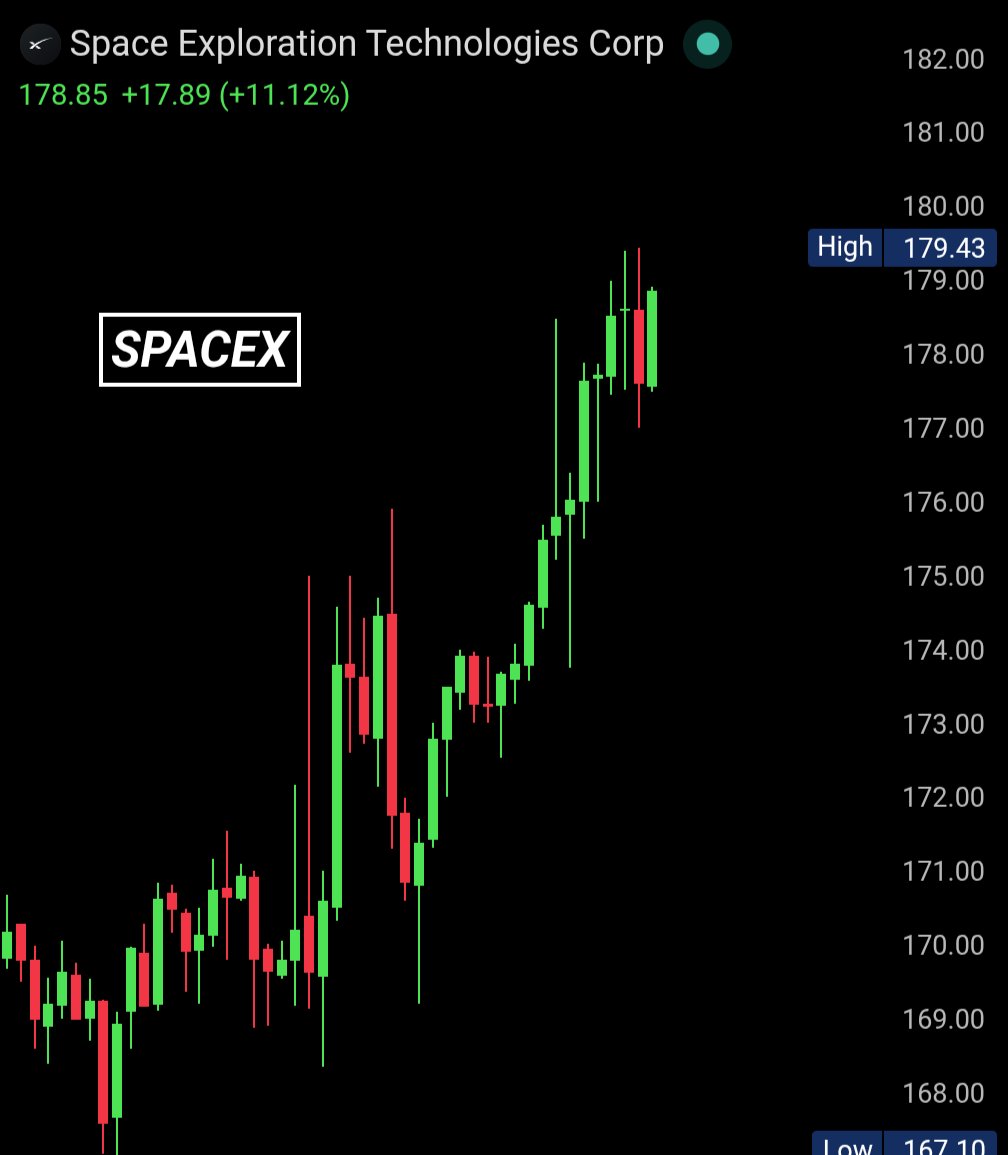
SpaceX generated $18.67 billion in revenue in 2025. At $184 per share today, it is valued at $2.41 Trillion, 129 times trailing revenue.
Nvidia trades at 22 times.
Amazon at 4 times. The valuation only makes sense when you understand what SpaceX is actually building.
SpaceX declared a total addressable market of $28.5 trillion in its IPO filing, equal to the entire annual GDP of the United States.
$26.5 trillion of that is AI alone. At just 1% capture of its own stated market, SpaceX generates $285 billion in annual revenue.
Starlink is the proven starting point.
The constellation has crossed 10,000 satellites, holds 60%+ of the LEO broadband market, and has 10 million monthly active users on Direct-to-Cell. Goldman Sachs projects Starlink reaches $144 billion in revenue by 2030.
At a standard 10x revenue multiple for subscription infrastructure, Starlink as a standalone business is worth $1.4 trillion, more than SpaceX's entire market cap today, before counting anything else.
The bigger bet is orbital AI infrastructure and this is where SpaceX directly threatens Nvidia, AWS, and Azure simultaneously.
AI data centers have a problem that is getting worse. A 1-gigawatt facility now draws more electricity than some mid sized nations. Local governments are rejecting new projects because of grid strain and water use.
AWS and Azure pay $0.05 or more per kilowatt-hour for electricity. That cost is rising as AI demand grows. SpaceX's answer is to move the compute off the grid entirely.
In orbit, solar panels generate more than 5 times the energy of an identical array on Earth because there is no atmosphere blocking sunlight. Capacity factor exceeds 95% versus 24% for terrestrial solar.
No cooling is required, the vacuum of space handles it passively. No land, No grid, No permits, No energy shortages.
An independently verified 10-year cost model for a 40-megawatt cluster: $8.2 million in orbit versus $167 million on the ground.
Effective energy cost in orbit: $0.001 to $0.005 per kilowatt hour, 10 to 50 times cheaper than what AWS and Azure pay today.
SpaceX unveiled the AI1 satellite a few days ago, its first orbital data center prototype with 150-kilowatt peak compute, a 70-meter wingspan, and Nvidia GPUs confirmed by the CFO.
The company has filed with the FCC to deploy up to 1 million AI satellites. Goldman Sachs projects this division alone generates $322 billion in revenue by 2030, a 100-fold increase from $3.2 billion today.
Nvidia generated $115 billion in data center revenue last year at 50 to 80% gross margins. AWS and Azure each generate approximately $120 billion in annualized cloud revenue.
All three are energy buyers locked into grid infrastructure. SpaceX's orbital compute becomes an energy generator with near-zero marginal operating cost. That is not a competitive advantage, it is a different physics regime.
SpaceX is also moving to eliminate Nvidia's chip pricing entirely.
Terafab is a joint semiconductor fabrication venture between SpaceX, Tesla, xAI, and Intel near Austin, Texas.
Total investment: $119 billion.
Target output: 1 terawatt per year of AI compute capacity.
Intel brings its 14A process node, one of only three sub-5nm processes in commercial production globally. The facility will produce D3 chips, radiation hardened and optimized for orbital data centers, alongside AI chips for terrestrial use.
Every dollar Terafab saves on chip costs is a dollar Nvidia loses.
The xAI merger on February 2, 2026 completed the vertical integration. At a combined valuation of $1.25 trillion, SpaceX now owns the AI models (Grok), the training infrastructure (Colossus 1 in Memphis), the orbital deployment system (Starship), the connectivity layer (Starlink), and the chip manufacturing (Terafab).
Anthropic is already paying SpaceX to rent unused Colossus 1 compute, a competitor writing checks to SpaceX for access to its own infrastructure. This is the exact model Amazon used when it built AWS from its own retail logistics and then sold access to the world.
The entire orbital data center thesis depends on Starship. At current launch prices of $900 per kilogram, a 1-gigawatt orbital data center costs $42 billion, three times the ground-based equivalent. At $200 per kilogram, the math inverts completely.
SpaceX has completed two consecutive Super Heavy booster catches. Full ship-side reusability has not yet been demonstrated. Goldman's $474 billion 2030 revenue projection requires growing from $18.7 billion at a rate faster than any company at this scale has ever managed.
SpaceX itself acknowledged in its IPO filing that orbital AI infrastructure "relies on unproven technologies and may not become commercially viable."
But if even half of this works, $2.35 trillion looks cheap before 2030.
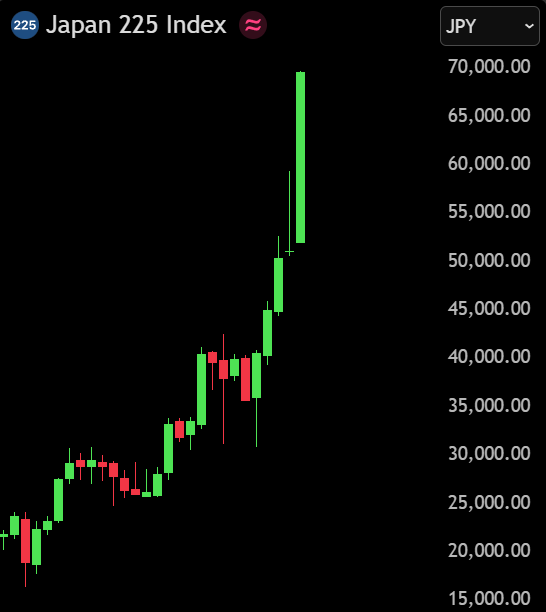
BREAKING: NIKKEI just crossed 69,500 for the first time in history.
Over ¥77,220,000,000,000 ($465 BILLION) added to Japan's stock market as NIKKEI surged +5.4% in just last 2 hours.
Japan's Nikkei is hitting all-time highs despite expectations that the Bank of Japan will raise rates to 1% tomorrow.
WARNING: 🩸 SPACEX IS ABOUT TO REPEAT CISCO 2000.
In 1999, Cisco was the backbone of the internet.
Real company. Real revenue.
The most valuable company on Earth.
Then the bubble burst. Cisco crashed almost 90%.
Now SpaceX went public near $2 trillion.
"The backbone of the Space & AI Age."
The charts are completely different. The idea is identical: overvaluation.
Being right about the future doesn't make you right about the price.
🚨 HUGE SPACEX SHORT
The #1 trader now holds a $14.96 MILLION short on $SPCX. Entry $164.
The stock popped 19% on debut day. Since then, the smart money on Hyperliquid has been fading it.
Liquidation sits all the way up at $305.
This short isn't going anywhere.
🚨The most dangerous 48 hours for risk assets this year starts Monday.
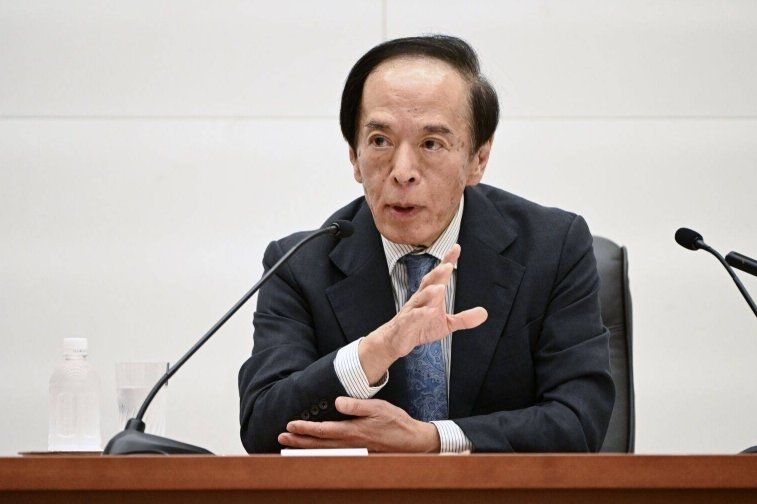
The Bank of Japan is expected to raise rates to 1% on June 16, the highest in 30 years.
The Fed meets the very next day with zero rate cut expectations and inflation still rising.
Every major BOJ hike since 2024 triggered a sharp market selloff.
In previous BOJ-driven selloffs, the Fed was actively cutting rates. Now it is expected to hold with inflation at 4.2% and rising.
INSANE 💥
Japan just added another $130,000,000,000 to its stock market in a single day.
Nikkei 225 surged +2.81%, adding nearly ¥29,000,000,000,000 in market value.
MASSIVE: $14 trillion Blackrock filed an 8-A registration SEC form for its Bitcoin Premium Income ETF, $BITA.
This ETF will hold Bitcoin and sell call options to generate yield, which will be distributed to investors as regular payouts.
🚨 SPACEX IS ABOUT TO REPEAT TESLA 2010
And nobody is ready for what will happen.
2010:
Tesla goes public.
$1.13 → $2.03
Everyone said the same thing:
“This is the future.”
“Elon is changing the world.”
Then came the part nobody talks about:
Tesla collapsed 50%.
$2.03 → $1.00
In days.
Now look at today:
2026:
– SpaceX just went public
– +30% from the IPO price at launch
– Biggest IPO in market history
– Everyone is calling it “the next Tesla”
But there’s one thing…
Tesla 2010:
- Small valuation
- Post-crash market
- Low expectations
- No trillion-dollar exit
SpaceX 2026:
- $1.75T IPO
- Retail access opened at the last second
- The stock market is at the most overvalued level in history
That is not the same opportunity.
Most people think Tesla 2010 means straight up forever:
Yes, Tesla pumped first.
Then it destroyed everyone who chased it.
That is the part they leave out.
Now SpaceX has the same Elon premium.
The same future narrative. But much worse timing.
So now you have two choices:
Chase the most expensive IPO in history after a +30% launch pump…
Or understand what Tesla 2010 already showed you.
Reminder: I’ve called all the market tops and bottoms for the last 15 years, including the Bitcoin bottom at $16,000 and the top at $126,000.
The next call will be even more important.
When I exit the markets completely, I’ll post it here publicly like I always do.
Turn notifications on. If you’re not following yet, you’ll understand why that was a mistake later.
BREAKING: SpaceX, $SPCX, stock officially begins trading, now at $160.83/share, up +19% from the stock's IPO price.
This officially makes SpaceX a $2.1 TRILLION company, the 7th largest public company in the world.