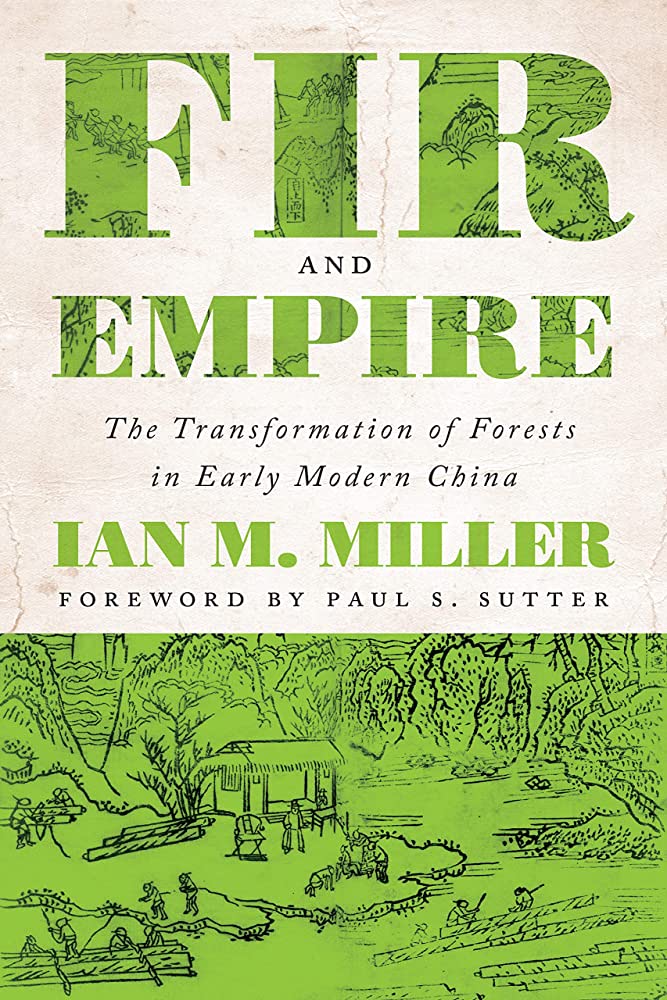
Very happy to share the open access edition of Fir and Empire: https://t.co/GLjPz297ju. It is 1 of 13 open access books @UWAPress funded by the generous support of the Geiss-Hsu Foundation: https://t.co/WTjQVBY5br. Excited to be listed alongside these great titles!
Historian Ian Miller on how for centuries the Chinese harvested, planted, extirpated, cloned, and fought over fir, nanmu, camphor and ironwood to build an empire and a navy. https://t.co/M5G2nXUlWK via @aeonmag
It was an honor and a privilege to be part of this round-table on Fir and Empire. Many thanks to @KDPluymers@RuthMostern and Jonathan Schlesinger for some very thought-provoking comments, and especially to @KaraSchlichting for putting it together!
If you are missing the intellectual dynamism of the recent, great #aseh2023, consider jumping into this new roundtable in Ian Miller's @imiller82's -Fir and Empire' -TY to @KDPluymers@RuthMostern & Jonathan Schlesinger for this smart conversation
It was such a pleasure to be a part of this roundtable and to get to think through a great book. Many thanks to @KaraSchlichting for the invitation and editing.
This multidisciplinary volume puts Asian forests in conversation with global forest histories, collecting case studies from East and Southeast Asia to explore continuities in the history of forest management and forest-human relations. #ReadUP@imiller82
https://t.co/qhy0N3sWa7
Hi Twitter, did you know there is an entire genre of fengshui poems? I did not, until I read several dozen of them. A provisional translation of one: Divining for a happy hill, a poem to remember its majesty卜得樂丘詠以紀其勝 by Wei Ji 魏驥 (1374-1472)
日斜樵弛林邊擔 Daily firewood piled, carried easily from nearby woods
月出漁歸湖上船 Each month fishermen go out, returning to the lakes on boats
不媿誅茅成老計 They take no shame in weeding and planning for old age
教兒耕讀遂餘年 Teaching children to plow and read for many years
Just an announcement that the Mongol Postal Map in my website has been updated. We've corrected the typo of the Koryŏ capital Kaekyŏng 開京: click the map and it'll take you to the interactive map: https://t.co/D9gPLIQdxr
@CarlZha@Salmonellys I think there is a good case for this. Although I also think there were some problems baked into the Ming-Qing military shipyards that surfaced repeatedly, including in the 19th century.
In the 19th century, Europeans loved to ridicule Chinese ships ("junks") as unchangingly bad, an attitude that modern scholars have picked up. I'm sure you'd be astonished to learn that they didn't know what they were talking about. A thread.
Sources. Chinese drawings: 閩省水師各標鎮協營戰哨船隻圖說 @shuge. Taiwan shipyard: 蔣元樞, 鼎建臺郡軍工廠圖, National Palace Museum, Taiwan (https://t.co/tp56O2Fqpo). Western paintings: William Alexander, British Museum (https://t.co/jtZVVWAL9e)