// If you want to scale your ads, then read these quick lessons on advertising //
-> Ads are just one part of the puzzle. Everything else (e.g. your offer, funnel, strategy, etc.) will affect the performance of your ads so optimize them too.
10 years ago, I had a broken laptop, bad internet, and zero capital.
My first 2 years "trying" to be an entrepreneur looked nothing like what people post about.
I was still in college. I had 1 full time job and 2 part time jobs. And I did freelancing on the side after quitting the part time jobs.
My laptop would freeze a few times an hour. I'd restart and keep going.
I had lost my social life. My health deteriorated. Because I was spending all my time and money on books and courses instead.
All that wasn't hard tbh.
What was hard was the part that I didn't know if it was all going to work out.
Most people in that position wait. They want better conditions before they commit. A little more savings. A little more certainty. A cleaner entry point.
But the reality is, the "perfect" condition never comes.
At that moment of my life, the tradeoff was simple: short-term isolation for a shot at not spending 40 years working for jobs I didn't want.
That math wasn't close.
The constraint wasn't capital. It wasn't the laptop. It wasn't even time.
It was the decision.
The actual, irreversible, no-longer-pretending-I-might-not-do-this decision.
So if you're still waiting for the right conditions, what would have to be true for you to stop waiting?
You can't fake what a year of compounding looks like in person.
Walked into the warehouse last week.
Racks stacked with bulk product from floor to ceiling.
Office buildout happening in the back corner.
A team running fulfillment without anyone directing traffic.
A year ago that same space was empty concrete and echo.
No product. No team. No process.
Just a direction we decided to lock in and not second-guess.
That's the part nobody sees when they look at a brand that's working.
Not the ads. Not the offer. Not the creative.
The constraint wasn't the budget or the product - it was clarity.
Who owns what. What we're building toward. What we're not doing.
When those three things stop shifting, the work starts compounding.
Quietly. Without announcement.
Until one day you walk into a room and it's real.
The brands that make it aren't the ones with the best ads.
They're the ones where the direction never moved.
Also, here are some pics July 2025 vs. May 2026 :)
A thought on ownership:
Imagine an ad that went live with the wrong promo. The copywriter didn't own it. The creatives strategist didn't own it. The media buyer didn't own it.
The promo was wrong by $20.
Not a catastrophic number. But it ran for three days before anyone flagged it.
When the complaints came in, you went to the copywriter.
"I wrote what the brief said."
Fair.
Then you went to the creative.
"I pulled the copy straight from the doc. That's my job."
Also fair.
Then you went to the media buyer.
"I check targeting and budget. Copy isn't my lane."
And honestly, he's right too.
Nobody was lying.
Nobody was being defensive for the sake of it.
They were all describing their jobs accurately.
The problem was that their jobs, as they understood them, had gaps in them.
The copywriter's job ended at the doc.
The creative's job started at the doc.
The media buyer's job started at the campaign strategy.
Nobody owned the space between those handoffs.
And in that space, a wrong promo lived for 72 hours.
This is the pattern I keep seeing in ecom operations that look functional on the surface.
The roles exist. The people are competent. The work gets done.
But the edges of each role are fuzzy. And fuzzy edges mean the mistakes belong to no one.
And when a mistake belongs to no one, it happens again.
But the fix is simple: checklists and guidelines.
Specifically, a role-specific checklist for each person at each handoff point.
In the example above:
The copywriter's checklist: does the promo match the approved offer doc?
The creative's checklist: does the copy in the asset match the copy in the doc, word for word?
The media buyer's checklist: does the offer in the ad match the offer currently live on the site?
Three checkpoints. Three owners. Zero ambiguity about who catches what.
The cheap version of this is a Google Doc that takes 45 minutes to build.
The expensive version is finding out the hard way that your team's accountability only goes as far as their job description does.
The ad ran for 72 hours because nobody's job included catching it.
That's a role design problem. And role design is the one thing you can actually fix before it costs you.
The reason you're always "in the trenches" isn't because you're understaffed.
It's that one person is generally doing three or more fundamentally different jobs.
And most operators don't catch it until the business is already stuck.
The first is the general operations. Someone builds the tracking, manages the workflows, keeps everything running.
The second is the analysis. Someone pulls the weekly numbers, finds the real signal, separates what matters from what's just noise.
The third is the strategy. Looking at what the data is saying and deciding where the business goes next.
Those aren't the same job.
Different thinking, different time horizons, different skill sets.
That last one requires you. The first two don't (eventually).
Early on, you carry all three. That's fine. The business is small enough that you can.
But there's a point where the speed of the business outgrows one person holding all the layers.
And most operators miss it.
They keep grinding through all three and wonder why decisions are slow and nothing compounds. Because the layers were never separated to begin with.
The question isn't whether you need help. It's whether the business you're running right now has outgrown the structure you're currently running it with.
You have an open role - and your default move is to look internally...
Someone trusted.
Someone who's been around.
Someone who wants to grow.
But that's already the wrong sequence.
You're starting with the person, when you should be starting with the role.
Before you look at who you have, define exactly what the role requires.
The specific outputs.
The day-to-day decisions.
The skillset it actually demands.
Every role (even the similar ones) has a different set of demands.
Just like how a video editor and a strategist are wired differently. Or how a project manager and an ops manager are not the same job with a different title.
And tenure doesn't change that. Neither does loyalty.
So when you're hiring for a role, find someone whose existing skills actually fit what the role demands. And if that person isn't already on your team, then go find them.
Had a teacher once tell me, “the goal isn’t to get every problem right immediately, it’s to reduce the time you stay confused.”
Getting stuck while learning is normal. What matters is how quickly you recognize what you don’t understand and adjust your thinking.
In the beginning, one concept can take hours or even days to click. With the right feedback loop, that gap shrinks to minutes.
Learning faster doesn’t mean never struggling. It means you’ve trained yourself to notice confusion early, correct it in real time, and move forward without getting stuck.
That’s the real advantage. Not avoiding mistakes, but shortening the time they control your learning.
"Which option is better?" is the wrong question.
It's also hard to answer accurately.
Without data, it becomes a debate about opinions. And opinions don't solve the real problem - they just get louder until someone gives up and agrees.
So stop comparing options and start comparing the "beliefs" each option requires.
For Option A to be right, what would have to be true? About your market. Your customer. Your current capabilities.
And do the same for Option B too.
Now you're not arguing about which option "feels" better or right. You're arguing about which assumptions are more defensible. And assumptions can be tested.
For example example, say you're deciding between launching bundle-first or single-product-first.
Bundle-first assumes your customer already understands the problem and is ready to buy a complete solution. It assumes your AOV math works at current conversion rates. It assumes your creative can carry a more complex offer. etc.
Single-product-first assumes the opposite on most of those.
Now, If you look at data before naming your assumptions, you'll unconsciously cherrypick the numbers that support what you already believed. The assumptions need to come first so the data has something to test against - not something to justify (because the data doesn't lie - but you'll ask it leading questions)
The hard part isn't choosing. It's having the discipline to name what would have to be true - and committing in advance to what would change your mind.
Nobody clicks an ad because it was "well-targeted."
They click because something in it made them feel understood.
The platform gets your ad in front of the right person.
That’s its job.
Your job is to say something worth stopping for.
Yet most brands are outsourcing the hard part to the algorithm and wondering why it’s not enough.
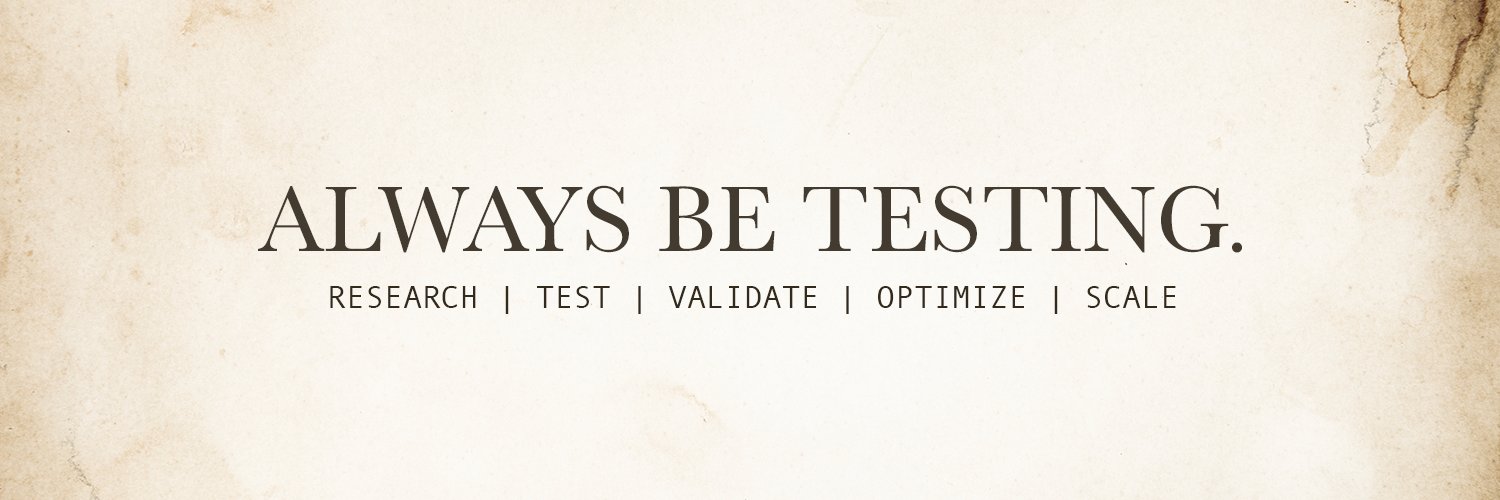
Most people think they're testing. They're just running things and hoping something works.
Real testing has a structure.
Research first. You're looking for the signal before you spend anything. What does your customer actually say about the problem? What language do they use? What do they believe is causing it?
That's your input. Not your gut. Not what worked for someone else's brand.
Then you build a hypothesis. Specifically: if this belief is true about my customer, then this creative angle should outperform. Now you have something falsifiable.
You run the test against that hypothesis. Not 12 variables at once. One thing at a time, isolated enough that the data tells you something clean.
When it works, you validate before you scale. One good week isn't a signal. Consistent performance across enough spend and time - that's a signal.
Then you scale. And you keep the system running because what works now won't work forever.
The pattern I keep seeing is operators who skip straight from "run it" to "scale it" with nothing in between. No hypothesis. No validation threshold. No documented learning.
So when it stops working, they have no idea why. And they start the whole random process over again.
The constraint isn't budget or creative. It's the absence of a repeatable process that compounds learning over time.
Your hiring process isn't broken because you hired the wrong person. It's broken because you never defined the right one.
Most operators treat hiring as a handoff.
Give it to HR, post the role, wait for someone good to show up.
The problem isn't the handoff. It's what gets handed off.
A vague role description. No scoring rubric. No clear picture of what "right" actually looks like in this specific seat.
In the last 17 months, we've hired over 80 people for our business, screened and 1000s of applicants. But very very few made it past the first interview.
And it's not because talent is scarce. But because most processes are built to miss it.
No rubric means every interviewer is scoring against a different standard. No tight role scope means you're filtering for the wrong signals. Stop the search too early and you've sampled nothing. Etc.
The constraint isn't finding great people. It's that operators haven't done the diagnostic work before the search starts.
Some founders fix the process after a bad hire. Don't be like them. The person you hire only reflects the clarity of the thinking done on your hiring process.
Your hiring process isn't broken because you hired the wrong person. It's broken because you never defined the right one.
Most operators treat hiring as a handoff.
Give it to HR, post the role, wait for someone good to show up.
The problem isn't the handoff. It's what gets handed off.
A vague role description. No scoring rubric. No clear picture of what "right" actually looks like in this specific seat.
In the last 17 months, we've hired over 80 people for our business, screened and 1000s of applicants. But very very few made it past the first interview.
And it's not because talent is scarce. But because most processes are built to miss it.
No rubric means every interviewer is scoring against a different standard. No tight role scope means you're filtering for the wrong signals. Stop the search too early and you've sampled nothing. Etc.
The constraint isn't finding great people. It's that operators haven't done the diagnostic work before the search starts.
Some founders fix the process after a bad hire. Don't be like them. The person you hire only reflects the clarity of the thinking done on your hiring process.
Sometimes showing the same creative to the same audience too many times doesn't just stop working, it even starts working against you. Familiarity without freshness breeds indifference. This is why the brands that scale without burning out their audiences put priority in their creative pipelines. Always be testing.
Every time you solve the same problem more than once, you're paying a tax.
Your time.
Your team's time.
The mental overhead of making decisions (especially on things you already had decisions on)
The fix is in how you solve problems.
Make sure you’re solving real problems, not just their symptoms.
What’s the root cause?
Then solve that. Document it. Systemize it.
This ensures the answer already exists the next time the problem shows up again (IF it will show up again).
This is how you keep scaling fast.
There's a version of your creative that's already in your customer's head.
The ad copy that speaks directly to what they feel.
The hook that sounds like something they've said to a friend.
The visual that makes them stop because they see themselves in it.
Your job isn't to come up with something new.
It's to find what's already true - and reflect it back clearly enough that they feel "seen".
That's what makes people buy.
Product is very very important.
But someone's out there selling a product worse than yours.
For a higher price. To a higher value audience. At a higher scale.
Because sometimes the difference isn't the formula or the quality of the product. But how the the product is positioned in the market.
Who it's for
What problem it solves
Why it matters right now
Etc.
You can spend years perfecting a formula and still lose to someone who spent weeks figuring out who it's really for.
There's more to the picture than this of course. Just zooming in on one topic/variable. But it already gives you a lot to think about.
The brands customers are loyal to don't just sell products.
They reflect an identity back at their buyers.
"This is who I am. This is what I stand for."
The purchase is almost secondary because the feeling of belonging comes first.
Build something people want to be part of, not just buy from.
For most brand owners: The ad you're scared to run is usually the one that converts. You know that one - The hook that feels too direct. The creative that's a little too honest. You've been sitting on it. Waiting for it to feel safer. Comfortable ads get scrolled past. Safe creative gets ignored. That's why this industry talks about hooks and attention a lot. The work that converts is the work that made someone feeling weird or nervous before it even went live. The ad that calls out the customer's exact frustration. The one that says the thing your category dances around. The offer that felt too bold. As long as it doesn't hurt the brand, run it and see what happens.