Another week on the road meeting with a couple dozen IT and AI leaders from large enterprises across banking, media, retail, healthcare, consulting, tech, and sports, to discuss agents in the enterprise.
Some quick takeaways:
* Clear that we’re moving from chat era of AI to agents that use tools, process data, and start to execute real work in the enterprise. Complementing this, enterprises are often evolving from “let a thousand flowers bloom” approach to adoption to targeted automation efforts applied to specific areas of work and workflow.
* Change management still will remain one of the biggest topics for enterprises. Most workflows aren’t setup to just drop agents directly in, and enterprises will need a ton of help to drive these efforts (both internally and from partners). One company has a head of AI in every business unit that roles up to a central team, just to keep all the functions coordinated.
* Tokenmaxxing! Most companies operate with very strict OpEx budgets get locked in for the year ahead, so they’re going through very real trade-off discussions right now on how to budget for tokens. One company recently had an idea for a “shark tank” style way of pitching for compute budget. Others are trying to figure out how to ration compute to the best use-cases internally through some hierarchy of needs (my words not theirs).
* Fixing fragmented and legacy systems remain a huge priority right now. Most enterprises are dealing with decades of either on-prem systems or systems they moved to the cloud but that still haven’t been modernized in any meaningful way. This means agents can’t easily tap into these data sources in a unified way yet, so companies are focused on how they modernize these.
* Most companies are *not* talking about replacing jobs due to agents. The major use-cases for agents are things that the company wasn’t able to do before or couldn’t prioritize. Software upgrades, automating back office processes that were constraining other workflows, processing large amounts of documents to get new business or client insights, and so on. More emphasis on ways to make money vs. cut costs.
* Headless software dominated my conversations. Enterprises need to be able to ensure all of their software works across any set of agents they choose. They will kick out vendors that don’t make this technically or economically easy.
* Clear sense that it can be hard to standardize on anything right now given how fast things are moving. Blessing and a curse of the innovation curve right now - no one wants to get stuck in a paradigm that locks them into the wrong architecture. One other result of this is that companies realize they’re in a multi-agent world, which means that interoperability becomes paramount across systems.
* Unanimous sense that everyone is working more than ever before. AI is not causing anyone to do less work right now, and similar to Silicon Valley people feel their teams are the busiest they’ve ever been.
One final meta observation not called out explicitly. It seems that despite Silicon Valley’s sense that AI has made hard things easy, the most powerful ways to use agents is more “technical” than prior eras of software. Skills, MCP, CLIs, etc. may be simple concepts for tech, but in the real world these are all esoteric concepts that will require technical people to help bring to life in the enterprise.
This both means diffusion will take real work and time, but also everyone’s estimation of engineering jobs is totally off. Engineers may not be “writing” software, but they will certainly be the ones to setup and operate the systems that actually automate most work in the enterprise.
I'm Boris and I created Claude Code. Lots of people have asked how I use Claude Code, so I wanted to show off my setup a bit.
My setup might be surprisingly vanilla! Claude Code works great out of the box, so I personally don't customize it much. There is no one correct way to use Claude Code: we intentionally build it in a way that you can use it, customize it, and hack it however you like. Each person on the Claude Code team uses it very differently.
So, here goes.
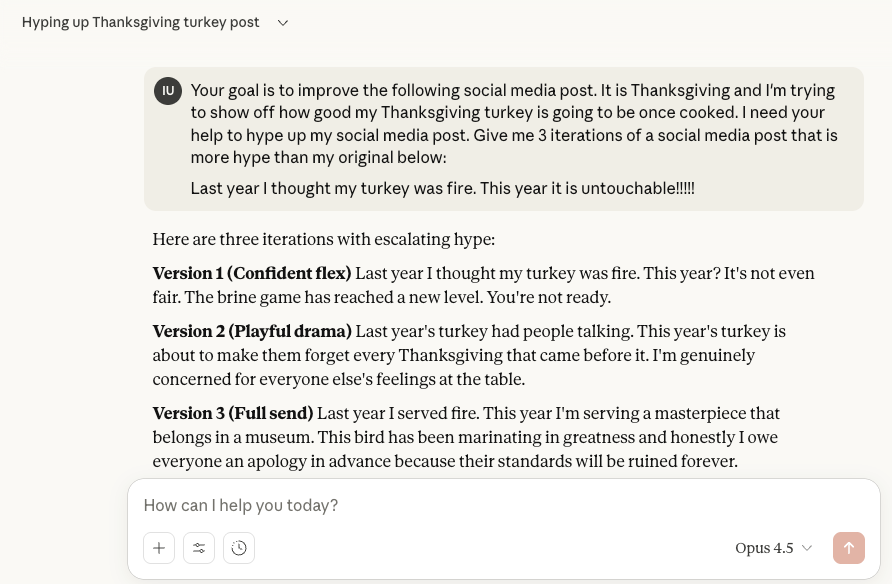
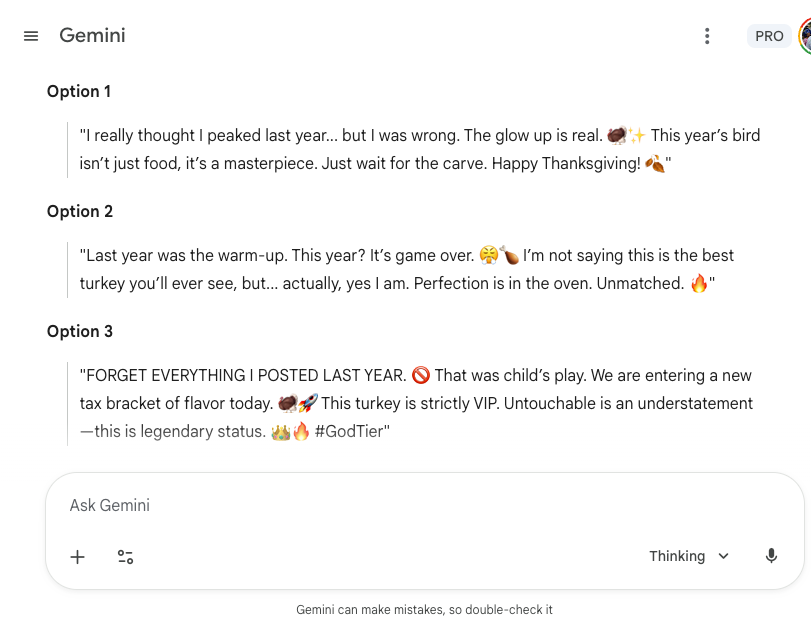
Don't read this if you get jealous easily. For those who know me, I love to hype up certain things I do well. I've been perfecting my brick oven smoked turkey over the last three years. This year, I wanted to turn up the dial on my usual hype so naturally, I turned to AI.
My original hype message:
" Last year, I thought my turkey was fire. This year it’ll be untouchable!!!!!"
@firefox I’m sure this is some user error…I love the new design on iOS but where is reader mode ? I usually use reader mode when on recipe websites to just get the pertinent information I need. I couldn’t find it though! The good news is that I used shake to summarize instead.
Wow @Costco doesn’t play with their membership security. It was like bank level security to verify me and get added back to my wife and I’s account.
- Name
- Email
- Address
- Address you lived at in 2001
- City you were born in
- City where you might have a house
…
there's a bunch of "keep it simple, stupid" agent engineering opinions going around that basically reduce it to
"agent = llm + tools + loop + goal"
this is a minimal viable agent, and that's great!
but the reason that this definition is too minimalist to be useful, is because it makes you forget everything that makes agents GOOD:
- planning
- memory
- trust/auth
- evals*
in Feb I surveyed all the replies to Simon's requests for definitions and already clustered them for you. with bonus acronym to STOP FORGETTING MEMORY AND PLANNING AND AUTH FLOWS
"agent = llm + Intent + Memory + Planning + Auth/trust + Control flow + Tool use"
https://t.co/N6Jhtuqkgm
*aha! you thought i'm mr hate evals? because you only think in binary?
They almost got me for my X password today.
I got an email "from X support." They detected a suspicious login attempt from India. It showed me the location. It had my profile picture in the email. It suggested I change my password. Not really thinking about it, I clicked on the link to change my password. Luckily when the page loaded my suspicious instincts kicked in. The landing page didn't exactly look like X. It was also saying to give X support access to my X account. The URL didn't seem quite right. I then went back to the email and checked the actual email of the sender. That confirmed it!
These folks are getting really good.
I've been using voice-to-text with my AI/productivity tools lately and I can't go back.
Not because I'm lazy, but because I finally realized how absolutely insane it is that we've spent the last 40 years forcing ourselves to translate thoughts into finger movements on tiny plastic squares.
Think about it....when you have an idea, it exists in your head as language. Words, sentences, concepts. But to get it into a computer, you have to break it down into individual letter presses, hunting and pecking across a keyboard, constantly interrupting your flow to fix typos and formatting.
It's like having a conversation through morse code.
I used to think voice interfaces were gimmicky. Siri was frustrating, dictation software was clunky, and talking to your computer felt weird. I honestly didnt get it.
But something shifted in the 4 months. The AI actually understands context now. It gets what I mean, not just what I said. And I can do things on the go.
Yesterday I used voice with claude code to spin up sub agents that design, code, and market my app. I literally just talked to my computer and told it what I wanted built, and it coordinated an entire team of AI workers to make it happen. No typing, no clicking through interfaces, no managing different tools.
It felt like the future finally arrived.
We're moving from a world where humans had to learn computer language to a world where computers learned human language. And honestly, I'm here for it.
If voice input goes from 0.1% to 10% (not crazy...) of all computer interactions in the next few years, every interface we know becomes obsolete overnight. The entire software industry will have to rebuild around conversation, not clicks.
Wouldn't be surprised to see it happen.
What do you think?