کیا سابق وزیر اعلی سندھ قائم علی شاہ کی بیٹی ہونا جرم ھے جناح میڈیکل کالج کی ڈین پروفیسر ڈاکٹر نگہت شاہ کی قابلیت اھلیت اعلی تعلیم تحقیق کا معیار ملاحظہ فرمائیں ۔
پورے ادارے کراچی شہر میں ان جیسی قابلیت کی حامل شائد ھی کوئی خاتون گائنا کالوجسٹ ہو ۔برطانیہ جرمنی سے اعلی تحقیق کی ڈگریاں حاصل کی ۔
پورے پاکستان میں اپنی نوعیت کا پہلا سرکاری بے اولادی کا مرکز قائم کیا جہاں اولاد سے محروم غریب جوڑوں کو اولاد کی نعمت
حاصل ہوئی
۔
The documented fiscal burden already amounted to approximately 5.8 percent of GDP in 2024-25 The additional hidden costs can be conservatively estimated as follows:
Channel Estimated annual burden
Procurement inefficiencies and contracting distortions:
1.0–1.5% of GDP
Land and asset-transfer privileges:
0.5–1.0% of GDP
Restricted competition and market-power distortions:
0.5–1.0% of GDP
Combined with the 5.8 percent of GDP in documented fiscal costs, this suggests that the broader economic burden associated with elite capture could plausibly amount to 8–9.5 percent of GDP — around Rs10–12 trillion annually at current output levels (FY2025–26 GDP: Rs126.87 trillion), or approximately $36–43 billion.
The Chai n Chat group at South Woodford Islamic Centre brings together older members of the community for a free, volunteer-led wellbeing session aimed at reducing loneliness and promoting healthy ageing. The weekly programme includes tea and refreshments, conversation, fun games, arts and crafts, and specially designed exercises for people aged between 50 and 90.
Turkey’s message is clear
Turkey has sent a signal: production deserves privilege. On May 21, Turkey’s parliament passed a law with a clear economic message. First, corporate tax for manufacturing companies has been cut from 25 per cent to 12.5 per cent. Second, money, gold, foreign exchange and securities held abroad can now be brought back into Turkey under a repatriation scheme. Third, the law extends a 100 per cent corporate tax exemption on financial services export income until 2047.
Three moves. One direction. Turkey wants factories. Turkey wants capital. Turkey wants exports. The message is not hidden in policy jargon. It is written in tax rates. Turkey is making production cheaper, capital repatriation easier and export income more attractive. This is industrial policy through the tax code.
Pakistan’s corporate tax rate is not merely 29 per cent. That is only the starting point. For large companies, the super tax can push the burden to 39 per cent. For banks, the standard rate is already 39 per cent, and super tax can take it to 49 per cent. Add the alternate corporate tax, minimum turnover-based taxes, taxes on dividends and taxes on distribution of profit, and the effective cash burden can mathematically approach, and in some cases exceed, 60 per cent.
Red alert: Pakistan is taxing production as if factories are fiscal prey, not engines of growth.Does Pakistan want factories? Does Pakistan want capital? Does Pakistan want exports? Pakistan should read Turkey’s signal carefully. Because countries that reward production create factories. Countries that punish production create deficits.
Turkey is not alone. Around the world, tax policy is being used as industrial policy. Turkey is cutting manufacturing tax from 25 per cent to 12.5 per cent. Germany is moving corporate income tax from 15 per cent to 10 per cent. Portugal is bringing it down from 20 per cent to 17 per cent. Bhutan has cut corporate tax from 30 per cent to 22 per cent.
The pattern goes beyond corporate tax. India has raised the personal income-tax exemption threshold. Canada is cutting its lowest federal income-tax bracket. Greece is reducing personal income-tax rates. Vietnam has brought VAT down from 10 percent to 8 percent on many goods and services. Brazil is expanding income-tax relief for the middle class.
The direction is clear. Countries are lowering taxes where they want investment. Lowering taxes where they want compliance. Lowering taxes where they want consumption. Lowering taxes where they want growth.
Pakistan must now choose: remain a high-tax, low-investment economy or become a competitive, production-led economy. What should Pakistan do? Recommendation: Pakistan must create a 15 per cent corporate tax rate for documented manufacturing.
Pakistan must introduce a special corporate tax rate of 15 per cent for companies that manufacture, document, invest and comply. Not for traders. Not for rent-seekers. Not for paper companies. For factories. For machinery. For value addition. For exports. The concession must be conditional: higher exports, new jobs, import substitution, technology transfer and fully documented supply chains.
Pakistan must stop treating factories as fiscal prey. Pakistan must begin treating them as engines of growth.
What about the IMF? The IMF will ask one question: where is the replacement revenue? Pakistan’s answer must be clear: this is not a tax cut; this is tax redesign. Tax undocumented retail and untaxed income more effectively. Tax documented manufacturing less. Collect more from evasion. Collect less from production.
Yes, one safeguard is essential: this must not become another SRO. No discretion. No lobbying. No permanent privilege. The 15 per cent rate must be automatic, transparent and performance-based.Remember: Pakistan cannot tax factories like enemies and expect them to behave like engines.
https://t.co/ljiwKpeljB
'Pakistan's greatest challenge is no longer security or diplomacy, but transforming fiscal stability into sustainable economic growth through good governance, development, and structural reform'-- Amb. Mushtaq Ali Shah writes https://t.co/NeAMA4rdgA
IT ministry if doesn’t have competent bureaucrats who can red, summarise and cross examine bills, rules against constitution
Maybe they need Google AI to give classes how to use prompts!! It can save embarrassments 😊
Thanks Bhai @KlasraRauf for waking us up to the reality that we still are slaves of multi-nationals. A person exhausts his/her life time savings to build a house and the East India Companies (not one by all Tech companies) are empowered to take him/her out of the house. And the story doesn't end there. The Slave also has to pay 50 million penalty. And our alleged REPRESENTATIVES had passed the law from directly elected National Assembly. Wish you best of luck and energy for telling such stories.
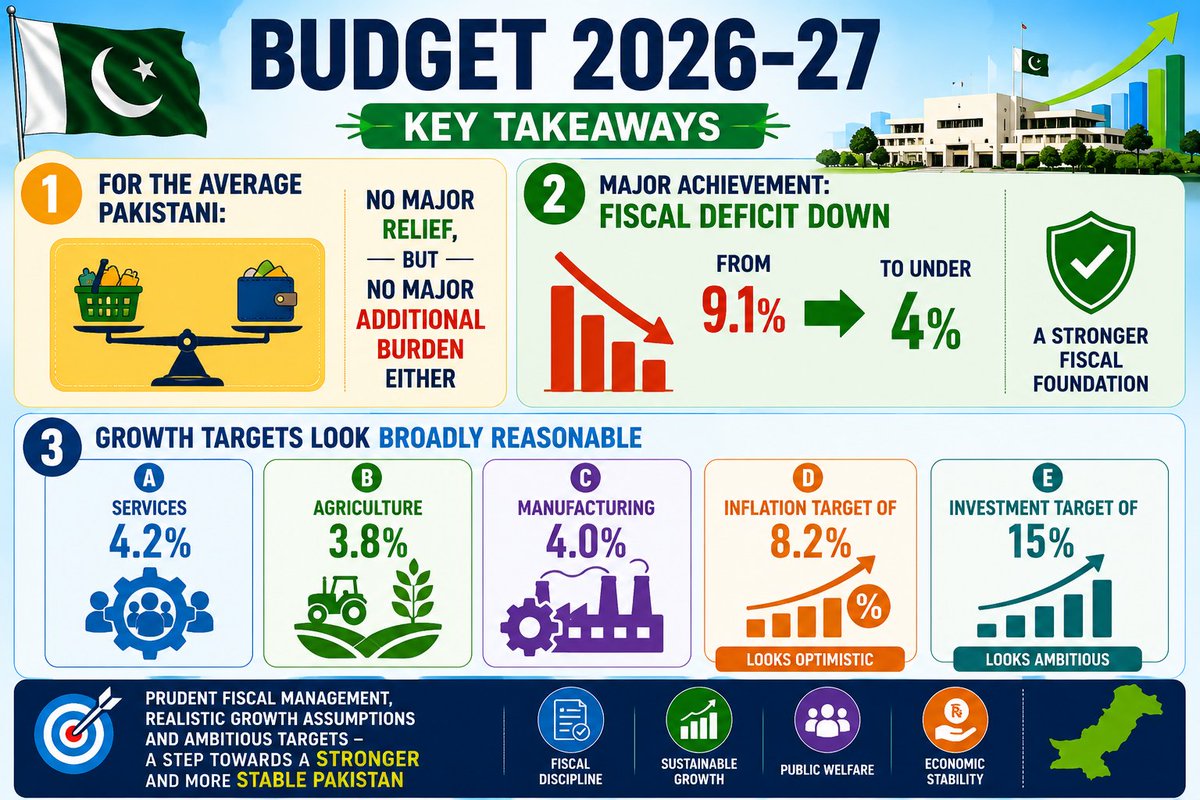
Budget 2026-27:
1. For the average Pakistani: no major relief, but no major additional burden either
2. Major achievement: fiscal deficit down from 9.1% to under 4%
3. Growth targets look broadly reasonable:
A. Services: 4.2%
B. Agriculture: 3.8%
C. Manufacturing: 4.0%
D. Inflation target of 8.2% looks optimistic
E. Investment target of 15% looks ambitious
What impact will this budget have on the business community?
Macroeconomic stability was necessary to restore business confidence.
Exchange-rate stability helps import planning.
Gradual interest-rate reductions may improve investment sentiment.
What are the chances of inflation declining?
In the short term, moderation is possible, but a dramatic decline is unlikely.
The positive developments are:
demand compression has already occurred,
the rupee has become relatively stable,
and imported inflation has eased somewhat
What are the chances of inflation declining?
In the short term, moderation is possible, but a dramatic decline is unlikely.
The positive developments are:
demand compression has already occurred,
the rupee has become relatively stable,
and imported inflation has eased somewhat
Does the government appear capable of expanding the tax net?
The intention is visible, but success will depend entirely on implementation.
Pakistan’s problem is not merely low tax collection; it is:
unequal taxation,
a large undocumented economy,
an extremely narrow tax base.