Urbanist. Geologist. Quote tweeter. Motorsports fan. Bay Stater since '99. Newton hater. Chicago hater. Big fan of walks. Born in MO. Very opinionated (he/him)
This is the saddest outcome of the American suburban car-dependent isolation experiment (enjoy buzzword salad). So many people now genuinely find being part of a community with people they dont know to be the worst thing they could imagine
@himbo_urbanist Adding on to whats already been said: The TOD on the south side of the Fitchburg Line is in the works to be getting a pedestrian/bike bridge over the tracks which would make Alewife much more connected to the area and further the redundancy of a Fitchburg Line station
Been neat seeing the progression of the 85 from day 1 having only a few riders taking it from Longwood during rush hour and nowadays its already got a bunch onboard at Ruggles to bypass ALP and Louis Prang and then gets half off the Binney St crowd filling the seats
Emergency vehicles would get unimpeded access to the heart of the area. Buses would speed up and be more reliable whilst staying out of general traffic. All hospital garages/Fenway can still be accessed as well as emergency entrances by general traffic via Blackfan/Evans/Tetlow
We gotta come to grips with Longwood Medical Area having narrow streets not suited to traffic and if we want to improve emergency vehicle access, safety, and transit travel times for the majority, we need to make Longwood from ALP to Brookline and Louis Prang bus only +deliveries
@OnlyInBOS Is this not the Mobile at the corner of E Berkeley and Albany? No shit its gonna be expensive. Last place to fill before getting on 93. Always been $1-$2/gal more than even the Mass n Cass Sunoco
Beautiful morning on a weekend in Boston for once so I went out for groceries in clear blue skies. Saw people outdoor dining, walking dogs, jogging, biking... and then New England remembered its still the weekend. Moment I get back home it starts pouring. We live in an odd region
@MassJumbo Yeah the plan as of 06 was to build ~1000 apartments with like an actual proper Main St and a bypass street to the highway and station around it but only a couple hundred units were built and the industrial road configuration remained
The complete failure of TOD that is Rt 128 station has me stranded missing my train by 15seconds because I-95 is a literal wall separating here from the nearest crossings (red) by miles. Even if they had built actual masses of apartments theyd be isolated by the worst car infra
People dunking on this but Lowell is actually pretty nice as post industrial Mill towns go. Great architecture and food. Definitely rough but improving. Similar median income to Nashville and Madison WI for reference
@RAILMag@grapeofafeather Yes people colloquially call underground rapid transit stations outside NYC "the subway" in the US because NYC is our well-known one. Which is how it became the sorta de facto American word for rail rapid transit. Obvs locals have diff words but the most general term is "subway"
@RAILMag@grapeofafeather I meant dedicated ROW not grade separated. The issue is grouping MetroLink with Buffalo and Pittsburgh. "Subway" is just the American word for a "metro." A tram =\= a metro. St Louis MetroLink is an odd metro but a metro nonetheless
@RAILMag@grapeofafeather Neither of those are full time high level because they still need to operate as street trams. While grade crossings for platforms and roads for metro systems is strange, Chicago has them both as well.
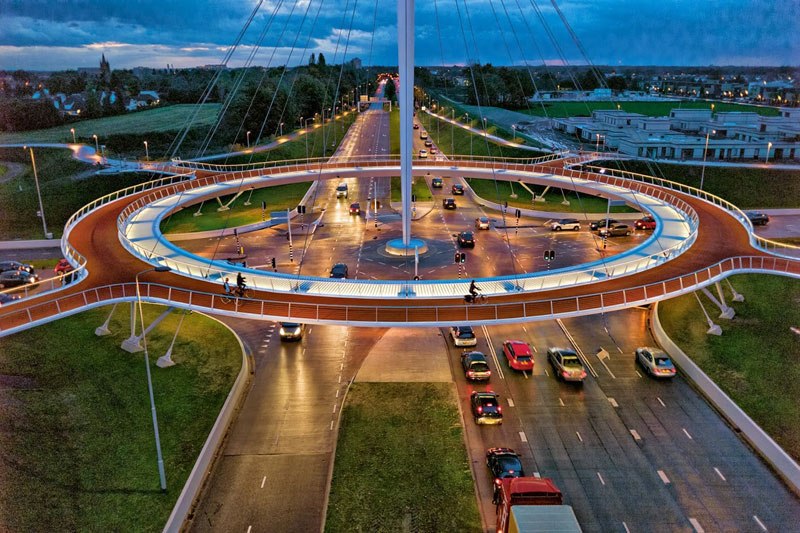
The Netherlands just put another $1.2 billion into its cycling infrastructure.
They aren't being generous, they're actually being cheap. National infrastructure projects of any size are legally required to undergo a cost-benefit analysis before they get built.
They ran the numbers on cycling and every dollar invested came back as roughly $8.90 in benefits: lives saved, healthcare costs avoided, quieter streets, cleaner air, less congestion. 6,500 fewer premature deaths a year, six more months of average life expectancy across the entire country.
A few years ago they were skeptical of a $17 million cycling bridge across the Maas River. They ran the analysis. The bridge was predicted to save $132 million over its lifetime, so they built it.
Most conversations about cycling infrastructure start with "how do we pay for it?" The Dutch conversation starts at "what's the cost-benefit ratio." That's the key difference.
The Netherlands isn't just subsidizing bicycles, it's refusing to waste money on the alternative.
@RAILMag@grapeofafeather St Louis MetroLink isnt trams feeding into a tunnel as is the case with the other systems mentioned here. Fully grade separated and high-floor trains. Same as Cleveland's barely "subway"
@kevinamezaga This is with a singular metro line, a light rail that stops at red lights, and no weekend regional rail service on half the MARC lines. Buses do ALL the heavy lifting and car traffic is abysmal. Imagine Baltimore with a DC transit network.