PAANK expresses grave concern over the continued enforced disappearance of Mehrab Khalid. His whereabouts remain unknown, causing immense distress and uncertainty for his family.
PAANK stands in solidarity with his family and urges all relevant authorities to uphold the rule of law and protect fundamental human rights.
#ReleaseMehrabKhalid
#EndEnforcedDisappearances
The Human Rights Council of Balochistan strongly condemns the enforced disappearance of Mehrab Khalid, a resident of Turbat, district Kech, and a Filmmaking student at the National College of Arts (NCA) Lahore.
He was taken away by Pakistani security forces on the night of 29 May at around 12:30 AM. Eight of his classmates were also detained and later released. Mehrab’s whereabouts remain unknown.
We demand his immediate and safe return, and full accountability for those responsible.
#Balochistan
BNM Holds Awareness Campaigns in London, Manchester, and Cambridge Against Nuclear Tests
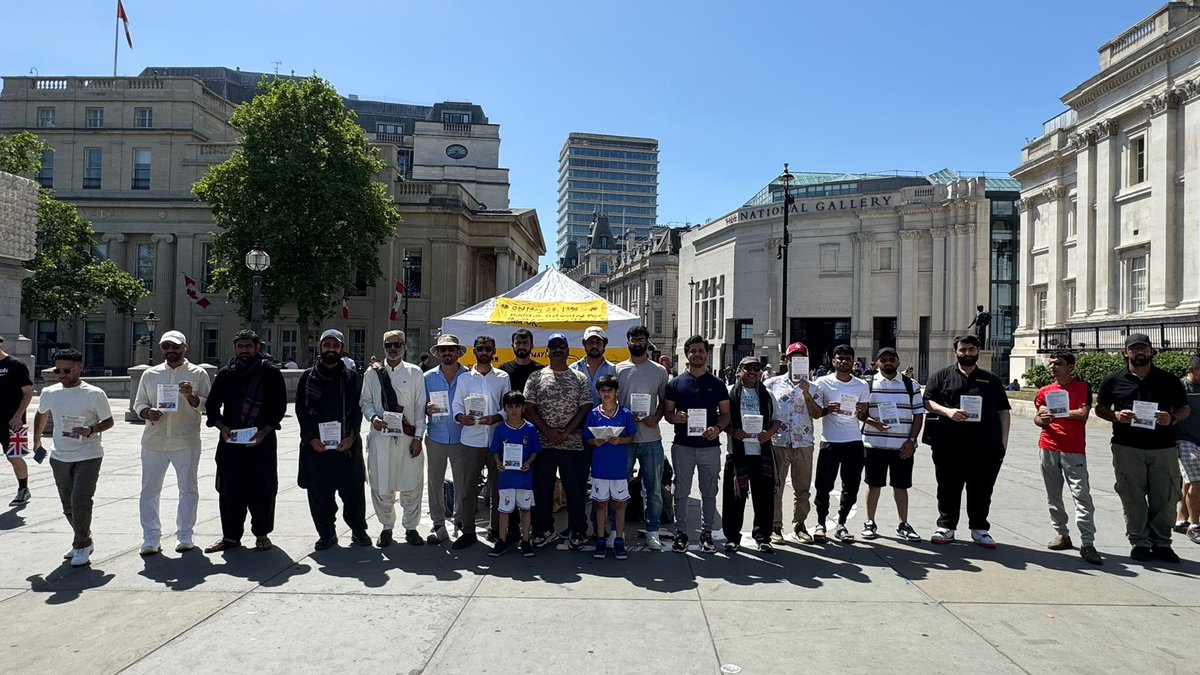
The UK chapter of the Baloch National Movement (BNM) carried out awareness campaigns across several cities in the United Kingdom, including London, Manchester, and Cambridge, to highlight the devastating impact of Pakistan’s nuclear tests conducted in Balochistan in 1998.
Through leaflet distribution and public engagement, BNM raised awareness about how Pakistan used Baloch land for nuclear testing in Chagai without the consent of the Baloch people, leaving behind long-term environmental destruction, radiation-related illnesses, and widespread human suffering.
The campaign aimed to remind the international community that the people of Balochistan continue to face the consequences of these nuclear tests and deserve justice, recognition, environmental rehabilitation, and the protection of their human rights.
https://t.co/C33TXGhX4B
Footages:
https://t.co/6aWypL2J1q
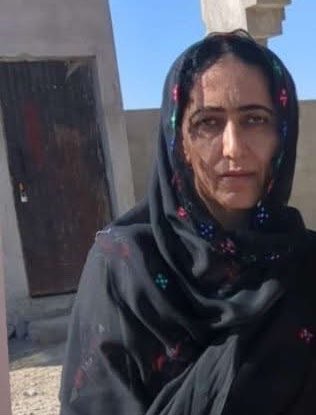
Poet and writer Habiba Peerjan has been forcibly disappeared for the second time.
On 25 May 2026, personnel from CTD and Military Intelligence raided her residence in Baldia Town, Karachi, late at night. Forces harassed the family, seized property, and took her away.
Her son Yasir Baloch was also taken into custody, blindfolded, and subjected to interrogation before being freed several hours later. Habiba Peerjan’s location has remained unknown since the raid.
This is the second time Habiba Peerjan has been subjected to enforced disappearance. She was previously abducted on 19 May 2022 and released on 22 May 2022.
We demand her immediate recovery and end of enforced disappearances under the pretext of national security.
#BALOCHISTAN
The enforced disappearance of Baloch women highlights the dangerous normalization of state repression in Balochistan,a practice that cannot and must not be accepted under any circumstances.
Habiba Peerjan,a resident of Tump Kech currently living in Karachi, has been forcibly disappeared for the second time after security forces raided her house and unlawfully detained her before taking her to an undisclosed location. She was previously abducted on 22 May 2022 and released days later. Today her name is included in the growing list of Baloch women who have been subjected to enforced disappearance, arbitrary detention, custodial abuse and psychological torture by the Pakistani state including Mahjaben, Nasrena and Khadija whose whereabouts and conditions remain deeply concerning.
The targeting of Baloch women represents not only a grave violation of fundamental human rights but also an escalation of collective punishment, political persecution and the systematic criminalization of dissent in Balochistan. Enforced disappearance violates Article 9 of the Universal Declaration of Human Rights UDHR, which states that “no one shall be subjected to arbitrary arrest, detention or exile,” as well as Articles 3 and 5 concerning the rights to liberty, security, dignity and freedom from torture and cruel, inhuman or degrading treatment.
If the state believes that through the Fourth Schedule and other coercive legal instruments it can legitimize unlawful actions suppress political expression and silence dissenting voices, then the responsibility for these ongoing abuses lies entirely with the state itself. Such actions demonstrate institutionalized impunity, structural violence and systematic repression in Balochistan.We will continue to raise our voices on every national and international platform against enforced disappearances, state violence and the ongoing persecution of the Baloch people. Silence in the face of injustice only emboldens oppression and we refuse to normalize the abduction and targeting of Baloch women.
#SaveBalochWomen
Members of @BNM_UK_chapter are holding an awareness campaign across the several cities of UK marking the nuclear tests carried out in Chaghi, #Balochistan, on 28 May 1998.
London | Manchester | Cambridge
Today, the Baloch National Movement (BNM) UK chapter carried out an awareness campaign across several cities in UK, including London, Manchester, and Cambridge, to highlight the devastating impact of Pakistan’s nuclear tests conducted in Balochistan on 1998.
#BNM
#Balochistan
#NukeAftermathInBalochistan
#StopBalochGenocide
#EnforcedDisappearances are a documented reality of #Balochistan. @UN must take notice.
Human rights without enforcement offer no protection to victims.
Once again, authorities raided our family home using drone surveillance and abducted DadShah and Razziq Barkat. We fear for their safety and demand their immediate safe release. #HumanRights#EnforcedDisappearances@paank_bnm
Killing of Farmer Sheerdil Baloch in Drachko
May 21, 2026 -Drachko Dasht, Turbat
PAANK strongly condemns the killing of Sheerdil Baloch, son of Qadir Bakhsh, an elderly farmer who lost his life after FC personnel reportedly opened fire near his farmland in Drachko Dasht district, Kech. According to local reports, Sheerdil was peacefully working on his land.
This tragic incident reflects the continuing climate of violence, fear, and impunity in Balochistan, where families are repeatedly forced to mourn the loss of their loved ones without accountability or justice.
#StopBalochGenocide
The violent raid on the home of Shaheed Zareef Baloch is part of the ongoing repression faced by Baloch families. Security forces entered the house at night, confiscated women’s belongings, damaged household property, and terrorized family members already grieving the loss of their loved one. The targeting of families after custodial killings has become a recurring reality in Balochistan, creating fear and insecurity within entire communities.
Shaheed Zareef Baloch was forcibly disappeared on 26 December 2025. Within a day, his tortured and mutilated body was abandoned near a neighboring house. His body bore signs of severe torture, including burns inflicted on his tongue, constituting torture and cruel, inhuman treatment prohibited under international law. These incidents form part of a broader pattern of enforced disappearances, extrajudicial killings, and abuses repeatedly reported in Balochistan.
The continued harassment of families after the killing of their relatives reflects the absence of accountability and protection for basic human rights. Raids on civilian homes, humiliation of women, confiscation of personal belongings, and intimidation of traumatized families are violations of fundamental human dignity and justice.
@UNHumanRights , @hrw@AndreaBV_SR_HRD , @profbensaul@FrontLineHRD@EUPakistan
#StopBalochGenocide
#EndEnforcedDisappearances
#StopStateTerrorism
#StopCollectivePunishmnet
Dad Shah was forcibly disappeared by Pakistani forces a month ago, yet his whereabouts remain unknown. His sister, is still seeking justice while police refuse to register an FIR. Enforced disappearances in Balochistan are becoming increasingly alarming.
#ReleaseDaadShahBaloch
One month has passed since the enforced disappearance of DaadShah Baloch, yet his family continues to endure fear, pain, and an unending wait for answers. This is his second enforced disappearance, exposing a dangerous pattern of abuse and intimidation. The silence of the authorities deepens the suffering of his loved ones and strengthens the culture of impunity that protects perpetrators from accountability. Enforced disappearance is a grave violation of international law and conventions ratified by the state, including protections against arbitrary detention and torture.
The continued illegal detention of DaadShah Baloch reflects the ongoing human rights crisis in Balochistan, where families are forced to live between hope and despair. No family should suffer the trauma of uncertainty while state institutions deny truth and justice. The international community and human rights organizations must raise urgent concern over this violation and press for his immediate release. Justice demands accountability, transparency, and an end to enforced disappearances.
@AndreaBV_SR_HRD@profbensaul@amnestysasia@hrw
#ReleaseDaadShahBaloch
#ReleaseDadShahBaloch
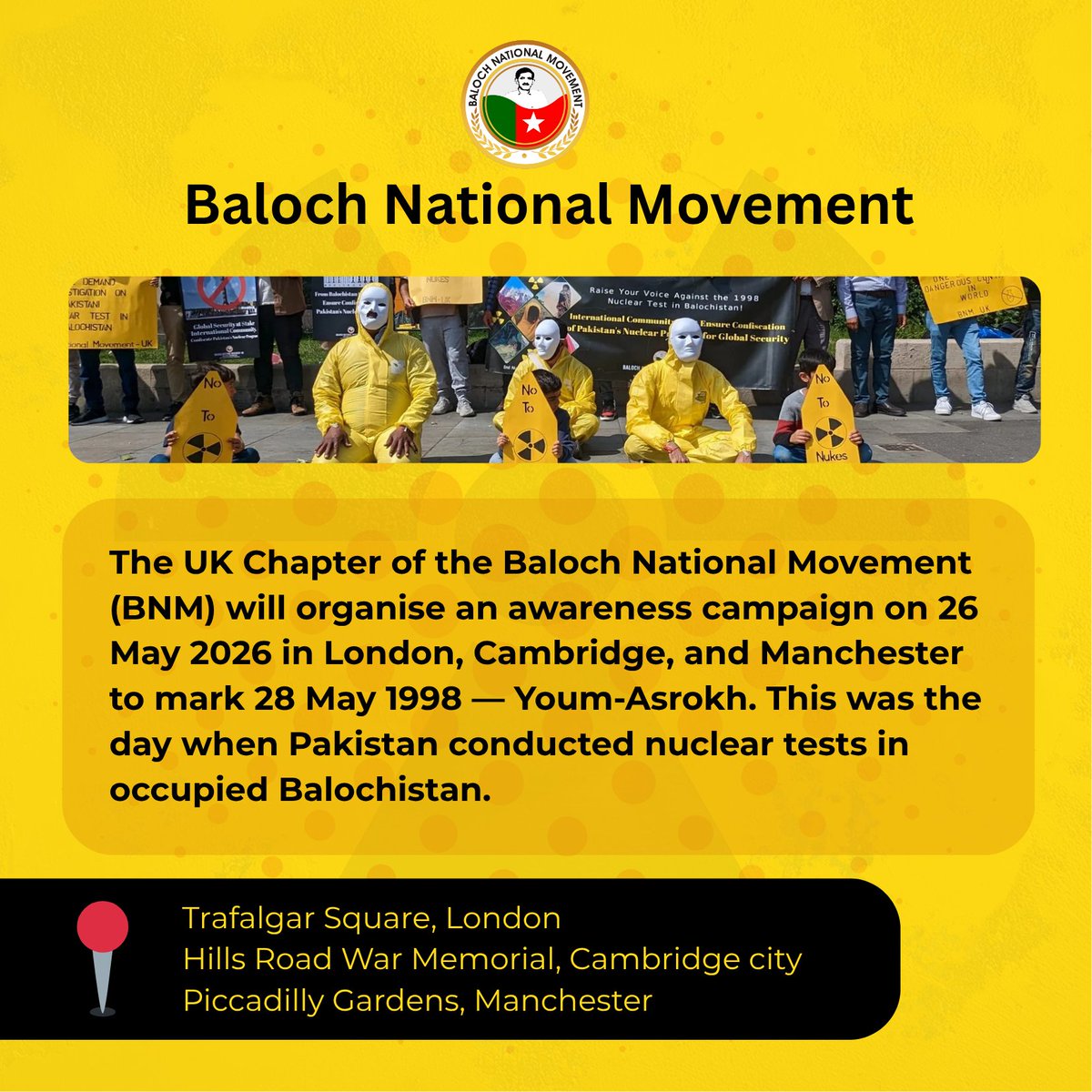
The UK Chapter of the Baloch National Movement (BNM) will organise an awareness campaign on 26 May 2026 in London, Cambridge, and Manchester to mark 28 May 1998 — Youm-Asrokh. This was the day when Pakistan conducted nuclear tests in occupied Balochistan.
BNM UK Chapter to Organise Youm-Asrokh Awareness Campaign in London, Cambridge, and Manchester
The UK Chapter of the Baloch National Movement (BNM) will organise an awareness campaign on 26 May 2026 in London, Cambridge, and Manchester to mark 28 May 1998 — Youm-Asrokh. This was the day when Pakistan conducted nuclear tests in occupied Balochistan.
The campaign aims to raise awareness about the devastating environmental, human, and political consequences of Pakistan’s nuclear tests in Balochistan.
Activists and members of the BNM UK Chapter will engage with the public through leaflet distribution, discussions, and awareness activities across different cities in the United Kingdom.
The body of young man Mohsin Baloch who was forcibly disappeared from the Prom area of Kech has been recovered.
He was taken into custody by the Pakistani army along with other companions on March 16, 2026 Today his body was thrown and found in Prom Kalg. #StopBalochGenocide
پنجگور کے علاقے پروم سے جبری لاپتہ کیے ��ئے نوجوان محسن بلوچ کی لاش برآمد ہوگئی۔
انہیں 16 مارچ 2026 کو پاکستانی فوج نے دیگر ساتھیوں کے ہمراہ حراست میں لیا تھا۔ آج ان کی لاش پروم کلگ میں پھینکی گئی ملی۔
#Balochistan
#StopBalochGenocide
A Baloch student from Balochistan has allegedly been forcibly disappeared in Islamabad.
Will the Pakistani media and rulers also speak about Kambeer Khan, son of Ali Muhammad, who was allegedly forcibly disappeared from Islamabad?
In Balochistan, the military and state authorities present themselves as supporters of education through propaganda, but at the same time, Baloch students and educated people are allegedly being forcibly disappeared not only from Balochistan but also from Punjab.
Meanwhile, thousands of state-sponsored social media pages and accounts remain active to hide the truth about Balochistan.
#ReleaseKambeerKhan #SaveBalochStudents
The Chairman of the Baloch National Movement, Dr. Naseem Baloch, strongly condemned the killing of researcher, poet, writer, and teacher Professor Ghamkhwar Hayat, stating that this tragic incident is part of and a continuation of the ongoing Baloch genocide in Balochistan.
The Killing of Professor Ghamkhwar Hayat Is an Attack on Baloch Intellectualism: Dr. Naseem Baloch
The Chairman of the Baloch National Movement, Dr. Naseem Baloch, strongly condemned the killing of researcher, poet, writer, and teacher Professor Ghamkhwar Hayat, stating that this tragic incident is part of and a continuation of the ongoing Baloch genocide and collective punishment in Balochistan.
He said that fifteen years ago, in a similar attack, the state targeted and assassinated the renowned poet, researcher, and intellectual Professor Saba Dashtyari. “We pay tribute to Ghamkhwar Hayat for his martyrdom, sacrifice, and his immense literary contributions and intellectual efforts. He was the author of nearly eighteen books. Undoubtedly, his loss is irreparable for the Baloch nation and for the Balochi and Brahui languages.”
Dr. Naseem Baloch stated that, as a nation, “we must not forget that the same Pakistan killed more than one thousand poets, writers, intellectuals, and teachers in Bangladesh. On December 14, 1971 alone, the Pakistani military brutally murdered more than 200 prominent intellectuals. Today, the same painful pattern is being repeated in Balochistan. This is the systematic killing of a nation’s intellectual consciousness.”
The BNM Chairman further said that for many years, Baloch intellectuals, students, teachers, poets, and writers have been systematically targeted in order to silence the Baloch national voice and to keep society mentally suppressed and backward. The assassination of Professor Ghamkhwar Hayat is yet another tragic proof of the deteriorating human rights situation and ongoing state violence in Balochistan, where perpetrators continue committing war crimes with complete impunity.
He added that the occupying state is using various tactics to destroy the intellectual, literary, and ideological foundation of the Baloch nation. ��Teachers, intellectuals, and literary figures form the intellectual backbone of any nation, and attacks on them are in fact attacks on Baloch national thought, identity, history, language, and consciousness. However, truth cannot be suppressed through oppression, murder, and fear, nor can a nation struggling for freedom, justice, and dignity be silenced.”
Dr. Naseem Baloch said that Professor Ghamkhwar Hayat played a significant role in promoting awareness, resistance, and national consciousness in Baloch society through his scholarly and literary services. “His killing is not only an irreparable loss for Brahui literature but for the entire Baloch nation.”
The Chairman of Baloch National Movement called on international human rights organizations, the United Nations, literary associations, and media institutions to take notice of the extrajudicial killings, enforced disappearances, and state repression against Baloch intellectuals and civilians in Balochistan, and to hold Pakistan accountable for serious human rights violations.
https://t.co/SnjgHIBWGE
This is the pattern whenever Baloch intellectuals risethe state takes them downProfessor Ghamkhwar Hayat Baloch was targeted precisely because he awakened mind through literature and educationPakistani military wants a subdued ignorant Balochistan no resistance no voice no future
13 مارچ 2026 کو ��رفراز بگٹی نے اسمبلی میں بلوچستان کے تمام پروفیسروں اور دانشوروں کو دھمکی دیتے ہوئے کہا تھا: “ہم اُن کو ہر صورت میں روکیں گے۔گزشتہ ایک ہفتے کے دوران پروفیسروں کی جبری گمشدگیوں اور پروفیسر غمخوار حیات کے قتل نے یہ ظاہر کر دیا ہے کہ اُس منصوبے پر عمل درآمد شروع ہو چکا ہے۔
𝗧𝗮𝗿𝗴𝗲𝘁𝗲𝗱 𝗞𝗶𝗹𝗹𝗶𝗻𝗴 𝗼𝗳 𝗣𝗿𝗼𝗳𝗲𝘀𝘀𝗼𝗿 𝗚𝗵𝗮𝗺𝗸𝗵𝘄𝗮𝗿 𝗛𝗮𝘆𝗮𝘁
𝐃𝐚𝐭𝐞: 𝟏𝟔 𝐌𝐚𝐲 𝟐𝟎𝟐𝟔
PAANK strongly condemns the killing of Professor Ghamkhwar Hayat, a prominent poet, literary scholar, and educator, who was reportedly shot dead by individuals linked to state-backed death squads in the Killi Mengal area of Nushki, Balochistan.
This tragic incident reflects the worsening security and human rights situation in Balochistan, where targeted killings and violence continue to create fear among civilians.
PAANK expresses deep concern over the repeated attacks on intellectuals, educators, poets, and civilians in Balochistan.
Professor Ghamkhwar Hayat was widely respected for his contributions to literature, poetry, and academic life. His loss is not only a tragedy for his family and colleagues, but also for the literary and intellectual community of Balochistan.
We extend our heartfelt condolences to his family, friends, colleagues, students, and admirers during this difficult time.
#StopBalochGenocide
𝟭𝟴-𝘆𝗲𝗮𝗿-𝗼𝗹𝗱 𝗝𝗮𝗻 𝗠𝘂𝗵𝗮𝗺𝗺𝗮𝗱 𝗳𝗿𝗼�� 𝗚𝘂𝗺𝗮𝘇𝗶, 𝗧𝘂𝗺𝗽, 𝘄𝗮𝘀 𝗲𝘅𝘁𝗿𝗮𝗷𝘂𝗱𝗶𝗰𝗶𝗮𝗹𝗹𝘆 𝗸𝗶𝗹𝗹𝗲𝗱 𝗕𝘆 𝗗𝗲𝗮𝘁𝗵 𝗦𝗾𝘂𝗮𝗱 𝗮𝗳𝘁𝗲𝗿 𝟯 𝗺𝗼𝗻𝘁𝗵𝘀 𝗮𝗻𝗱 𝟮𝟭 𝗱𝗮𝘆𝘀 𝗼𝗳 𝗲𝗻𝗳𝗼𝗿𝗰𝗲𝗱 𝗱𝗶𝘀𝗮𝗽𝗽𝗲𝗮𝗿𝗮𝗻𝗰𝗲.
𝙈𝙖𝙮 13, 2026 - 𝘽𝙖𝙣𝙪𝙠-𝙚-𝘾𝙝𝙖𝙙𝙖𝙞, 𝙏𝙪𝙧𝙗𝙖𝙩, 𝙆𝙚𝙘𝙝, 𝘽𝙖𝙡𝙤𝙘𝙝𝙞𝙨𝙩𝙖𝙣
Jan Muhammad was taken from jusak Turbat on 24 January 2026. For more than three months, his family waited in fear and pain, hoping for his safe return. Instead, his tortured body was dumped in the Banuk-e-Chadai area of Kech. His body bore bullet wounds and clear signs of brutal torture. His grieving family identified him through his student ID card.
Jan Muhammad was not a criminal. He was a young student whose books and dreams were taken away before he could even complete his education. No law, no constitution, and no humanity can justify the enforced disappearance and killing of an 8th-class student without trial or court proceedings.
The Baloch Yakjehti Committee strongly condemns this brutal act and calls it a stain on human rights and justice. In a country where many 18-year-olds do not even possess a CNIC card, how can a child be disappeared, tortured, and killed without any legal process?
The silence of the international community is deepening the suffering of Baloch families. Mothers continue to wait for their sons, while families are left with dead bodies instead of justice.
The Baloch Yakjehti Committee urgently appeals to international human rights organizations, the United Nations, and the global community to take immediate action against enforced disappearances and extrajudicial killings in Balochistan. The lives, dignity, and future of the Baloch people cannot continue to be crushed through violence and fear.
#StopBalochGenocide
Today marks 100 days since the enforced disappearance of Mohammad Bakhsh Sajidi (68), the father of Dr. Naseem Baloch, along with his two uncles, Rafeeq Baloch (67) and Naeem Sajidi (66), who were forcibly abducted by Pakistani state agencies from their homes in Hub, Balochistan
𝟭𝟬𝟬 𝗗𝗮𝘆𝘀 𝗼𝗳 𝗘𝗻𝗳𝗼𝗿𝗰𝗲𝗱 𝗗𝗶𝘀𝗮𝗽𝗽𝗲𝗮𝗿𝗮𝗻𝗰𝗲: 𝗣𝗮𝗸𝗶𝘀𝘁𝗮𝗻’𝘀 𝗖𝗼𝗹𝗹𝗲𝗰𝘁𝗶𝘃𝗲 𝗣𝘂𝗻𝗶𝘀𝗵𝗺𝗲𝗻𝘁 𝗔𝗴𝗮𝗶𝗻𝘀𝘁 𝘁𝗵𝗲 𝗙𝗮𝗺𝗶𝗹𝘆 𝗼𝗳 𝗗𝗿. 𝗡𝗮𝘀𝗲𝗲𝗺 𝗕𝗮𝗹𝗼𝗰𝗵
#ReleaseSajidiBrothers
Today marks 100 days since the enforced disappearance of Mohammad Bakhsh Sajidi (68), the father of Dr. Naseem Baloch, along with his two uncles, Rafeeq Baloch (67) and Naeem Sajidi (66), who were forcibly abducted by Pakistani state agencies from their homes in Hub, Balochistan.
For 100 days, their families have lived in uncertainty, fear, and pain, without any information regarding their whereabouts, health, or legal status. The Pakistani state continues to deny accountability while systematically using enforced disappearances as a tool of repression and intimidation in Balochistan.
This is not an isolated incident. It is part of a wider and deeply disturbing policy of collective punishment, where family members of political activists, journalists, and human rights defenders are targeted in retaliation for peaceful political and human rights activities.
Dr. Naseem Baloch is an internationally known political activist and human rights advocate who has consistently raised the issue of enforced disappearances, extrajudicial killings, and state violence in Balochistan at international forums, including the United Nations Human Rights Council in Geneva. Instead of responding to legitimate human rights concerns, Pakistani authorities have chosen to retaliate against his elderly family members.
The abduction of elderly civilians, men in their late sixties, demonstrates the extent to which Pakistani security institutions are willing to violate fundamental human rights norms. Holding senior citizens incommunicado without charge, trial, or legal process is a grave violation of international human rights law, including protections guaranteed under the International Covenant on Civil and Political Rights (ICCPR), to which Pakistan is a state party.
For decades, the people of Balochistan have endured enforced disappearances, torture, extrajudicial killings, arbitrary detention, and harassment. Thousands of Baloch families continue to wait for answers about their loved ones. Yet the international community’s silence has emboldened perpetrators and normalized impunity.
PAANK strongly condemns the enforced disappearance of Mohammad Bakhsh Sajidi (68), Rafeeq Baloch (67) and Naeem Sajidi and demands their immediate and unconditional release.
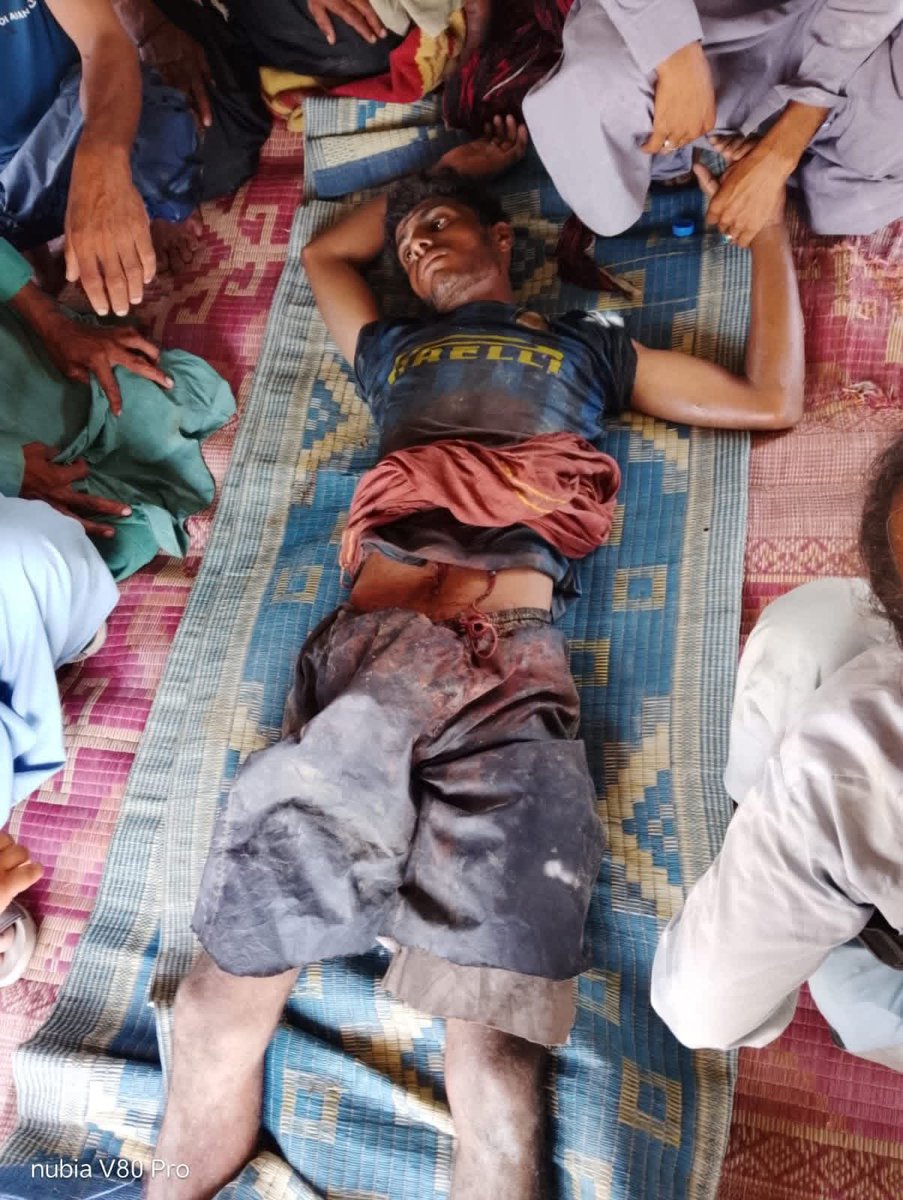
Today’s horrific incident in Kuntani Gwadar once again exposes the brutal reality of life under militarization in Balochistan. Reports indicate that Pakistani security forces particularly the Coast Guards opened fire on Baloch labourers resulting in the martyrdom of dozens and leaving many others severely injured,it is a reflection of the deepening crisis across the entire coastal belt Balochistan where fear, militarization and bloodshed have turned the region into a burning landscape of repression. While the state markets Gwadar to the world as a futuristic economic corridor and a new Singapore for foreign investors and strategic powers, the indigenous Baloch inhabitants remain deprived of the most basic necessities of life even access to a single drop of clean water.
The irony of Gwadar is profoundly violent, a city transformed into a global hub for international projects, trade routes and geopolitical ambitions while its own people are pushed into hunger, displacement, surveillance and death. For the Baloch, Gwadar has effectively become a no go area within their own ancestral homeland. Checkpoints, military presence, enforced disappearances, targeted killings and restrictions on movement have created an atmosphere where the indigenous population is treated as a security threat rather than rightful inhabitants of the land.
This is the logic of colonial extraction where the land is valuable but the native population is seen as expendable. The state securitizes every inch of Gwadar not to protect the people, but to protect strategic and economic interests tied to international investments and regional power politics. Under the shadow of mega projects and militarized development, the Baloch are being systematically excluded from their own coast, their resources and their future.
What is happening in Gwadar today exposes the darker reality behind the language of development. Beneath the promises of prosperity lies a structure of occupation and necropolitics, where the state decides whose lives matter and whose suffering can be ignored for the sake of strategic interests. The burning coast of Balochistan is not only a humanitarian crisis,it is the consequence of turning an indigenous homeland into a militarized zone of extraction and control.
#StopBalochGenocide
Reports from Gwadar Jiwani Kontani area say that indiscriminate firing by the Pakistani Coast Guard has killed 13 Baloch laborers and left many others critically injured. The world must break its silence on the ongoing Baloch genocide and human rights abuses. #StopBalochGenocide