Rubisco is (arguably) the most abundant protein on Earth. (LPP surely comes close, right?) It’s an enzyme that fixes CO₂ into sugars during photosynthesis.
Unfortunately, as most people learn in school, Rubisco is inefficient. Sometimes it confuses O₂ for CO₂ and wastes energy. Plants make up for this in raw concentration; up to half the soluble protein in a leaf is Rubisco.
People have been trying to engineer better Rubiscos for many decades, but it's not easy because the proteins are big, do not fold easily (they need chaperone proteins to help out), are made from 16 subunits in land plants.
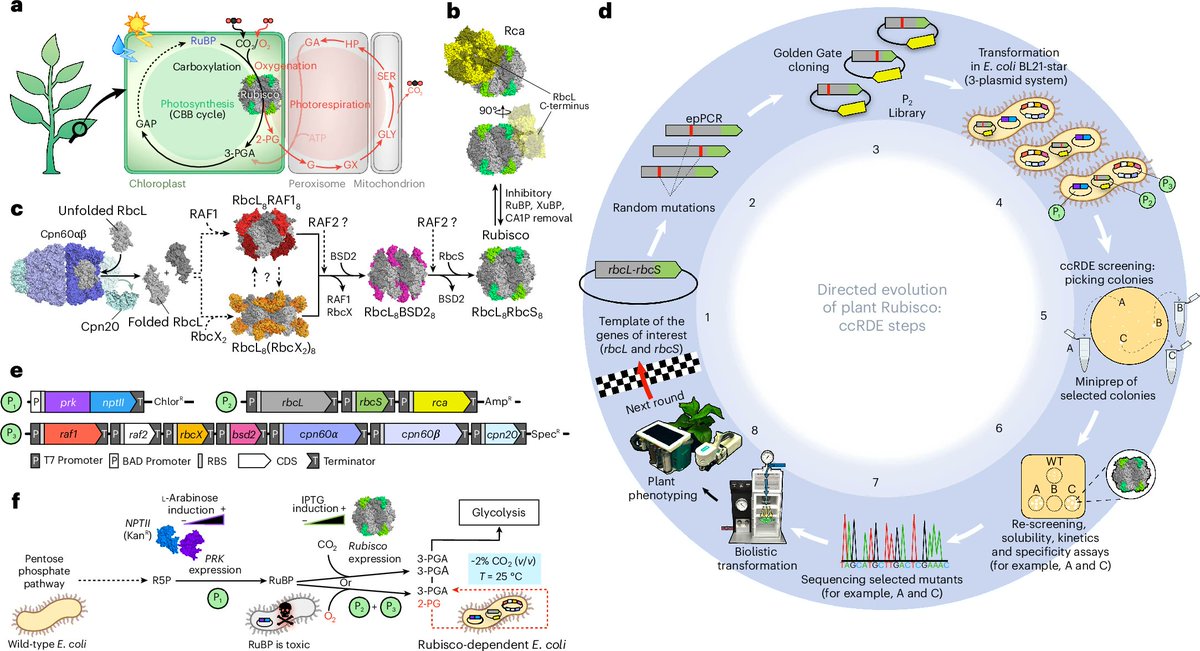
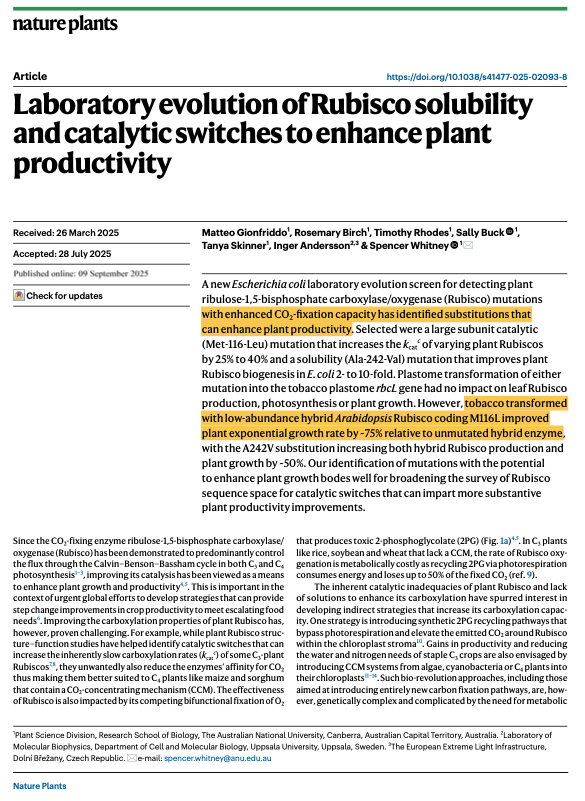
But there's a new paper in Nature Plants that looks really interesting. The TL;DR is that a group in Australia figured out how to express plant Rubiscos (and all SEVEN of their folding chaperones) using a set of 3 plasmids inside of E. coli cells. This enabled them to do "directed evolution" of Rubisco in bacterial cells, and quickly find Rubisco mutants that have higher enzymatic efficiency or that fold better.
In addition to the 3 plasmids, the researchers also coaxed E. coli to make ribulose-1,5-biphosphate, or RuBP, which is the 5-carbon sugar that Rubisco smashes into carbon dioxide to make molecules of 3-PGA for central metabolism.
Now, the clever bit is that you RANDOMLY MUTATE the three plasmids encoding the Rubisco to make millions of variants. Then, you transform those mutated plasmids into E. coli. If the E. coli do NOT make a functional Rubisco, RuBP levels build up and kill the cell; the molecule becomes toxic. But if the E. coli DO make a functional Rubisco, then they keep the RuBP levels in check and live just fine.
Using this "screening assay," the researchers found 46 fast-growing colonies of E. coli. Two of those colonies encoded really useful mutations. One mutation (M116L) makes Rubisco about 25–40% faster. The other (A242V) makes it fold and assemble much more efficiently.
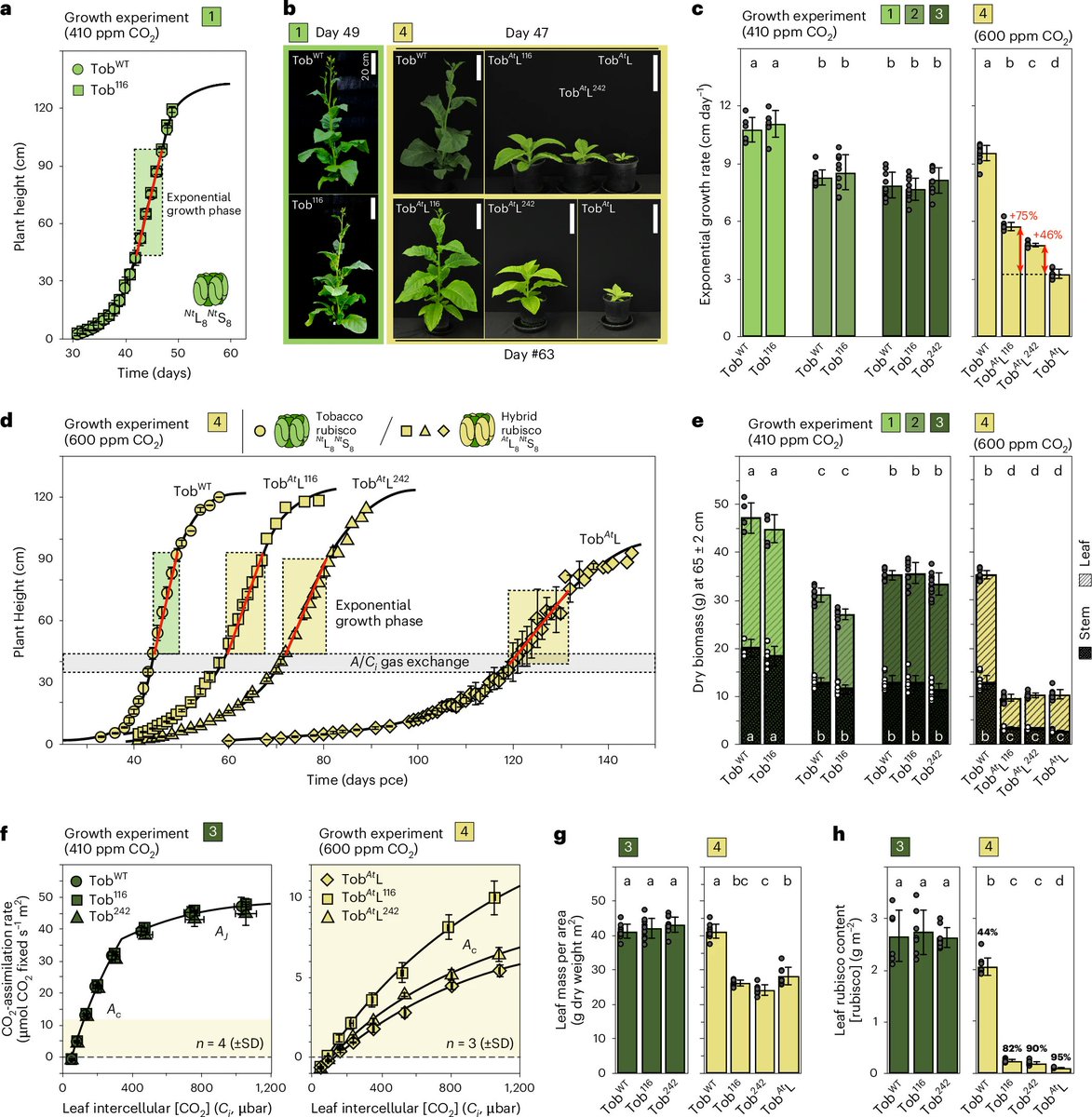
They put this mutation into a "hybrid Arabidopsis–tobacco Rubisco," put that into tobacco plants, and measured growth. The plants with M116L grew 75% faster than wildtype.
No guarantees this will scale to more useful crops, like wheat and corn and soybeans etc. But it seems like a nice in vitro assay for faster prototyping!
Evaluating the true impact of research has always been a challenge. Citations and h-indices tell us something, but they miss the larger picture of how research changes lives, policies, or technologies.
The Indian Council of Medical Research (@ICMRDELHI) has now come up with an interesting idea - the ICMR 𝐈𝐦𝐩𝐚𝐜𝐭 𝐨𝐟 𝐑𝐞𝐬𝐞𝐚𝐫𝐜𝐡 𝐚𝐧𝐝 𝐈𝐧𝐧𝐨𝐯𝐚𝐭𝐢𝐨𝐧 𝐒𝐜𝐚𝐥𝐞 (𝐈𝐂𝐌𝐑-𝐈𝐑𝐈𝐒). At its core is a simple but powerful concept called the 𝐏𝐮𝐛𝐥𝐢𝐜𝐚𝐭𝐢𝐨𝐧-𝐄𝐪𝐮𝐢𝐯𝐚𝐥𝐞𝐧𝐭 (PE). Every peer-reviewed research paper is assigned one PE, and additional impact multipliers are added when that work influences clinical guidelines, public health programmes, or leads to patents and commercial technologies. For example, if a paper changes clinical practice, it counts as 10 PE, while a commercialized health technology is valued at 20 PE.
The positives:
- It provides a single, comparable number to evaluate projects, researchers, and institutions.
- It goes beyond publications and citations, recognizing patents, public health outcomes, and real-world technologies.
- It could encourage more collaborative and impactful research rather than just incremental publications.
The limitations:
- Any single number metric runs the risk of oversimplification. Research is diverse, and its impact cannot always be captured in neat multiples of a paper.
- Documentation requirements (for proving policy or clinical impact) may make the process bureaucratic.
- Indicators like citations and journal impact factors used for the calculation are still subject to biases and delays.
In the end, IRIS is a bold attempt to broaden how we value research in India. It may not be perfect, but it can certainly spark conversations on moving away from “publish or perish” towards “impact and relevance” as the real currency of research.
Also, got an idea of the advancement being made by companies like Cube Biotech or Sino Biological, Inc. in the field of proteins.
My poster explained about the unique mechanical behavior of BiP and Erdj3. https://t.co/hXbXEFN5NH
I am very grateful to @ProteinSociety for selecting my PhD research and awarding me with the travel grant to present my poster at their 39th annual meet, San Francisco. I was lucky enough to learn about so many interesting research going around.
What I will cherish throughout my life was a small conversation I had with Prof. @timothyspringer about my PhD research and a small glimpse of my postdoctoral work. I always imagined meeting with him during PhD and I can't believe that it happened.
Also many thanks to #shivanikrishna@anups_11@AshokaUniv#Biology dept for all your assistance during my PhD whether its during covid or any other critical moment during this journey.