Is euchromatin really “open”? 🧬 Using super-resolution imaging🔬 our new study @NatureGenet reveals: Euchromatin forms condensed domains in live cells. Cohesin constrains them and prevents domain mixing for proper transcriptional insulation🚧 🔗https://t.co/HjjYOjycld (1/2)
Excited to share our collaboration @MahendransGroup in which we showed that peptide based nanopores can detect heterogeneous ensembles of IDPs including toxic oligomers of alpha Synuclein. @ParkinsonRF@ParkinsonDotOrg@CSIR_IND@BricDbt
https://t.co/2ScFHtApAu
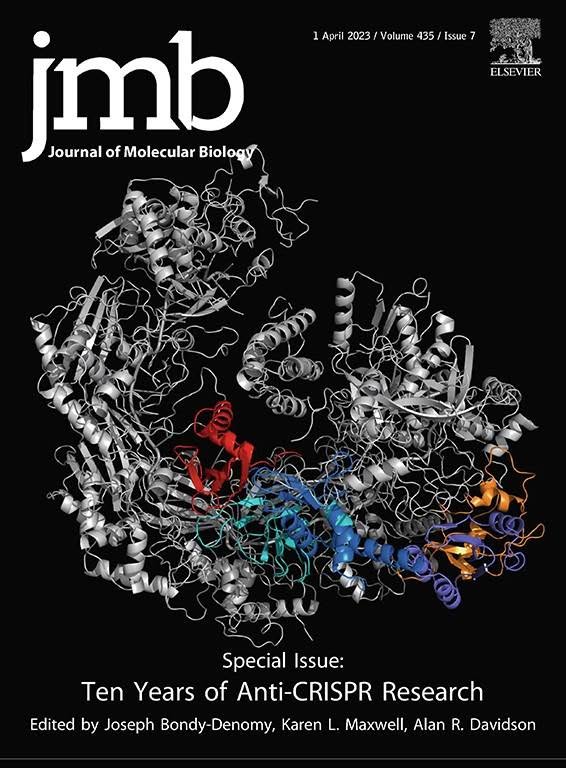
Delighted to share that our second paper accepted this week is in the Journal of Molecular Biology.
Using Covalent Magnetic Tweezers (CMT), we show how molecular chaperones reshape the protein folding landscape at the single-molecule level.
We thank @biopatrika for covering our latest publication @Biomac_ACS
Cellular Crowding Regulates Phase Separation of Yeast Prion Protein Sup35NM https://t.co/DCs9NeJaG3 via @biopatrika@CSIR_IND
(Part 1/2) Excited to share our recent work led by Dr. Shiv Rekhi (@shiv_rekhi), now out in JACS (https://t.co/Hfy15SNb5n). We show that condensates act as distinct solvation environments that reshape amino acid pKₐ values, favoring protonated states within the dense phase.
Excited to share our first story. Preprint: RNA 3D Motif Dynamics Guide Assembly of the Replication Initiation Complex in Flaviviruses. https://t.co/tzUiJdHlce Led by superstar student @LorenaStreit01 supported by @TakaOni61 and also @miroastore@EmilyCioppa et al. Check it out!
(Part 1/2) Excited to share our recent work led by PhD students Qizan Chen and Ryan Soucek, with Prof. Jeffrey D. Rimer (University of Houston), now out in JACS Au (https://t.co/kwTVR8cN1g). We show that molecular modifiers like riboflavin regulate ammonium urate crystallization.
We worked with @janetiwasa to realize our visualization vision with @jclandoni of how mitochondrial pearling redistributes mitochondrial DNA containing nucleoids. Super fun! Couldn’t have done any of this without support from @HFSP and @ERC_Research
In this new paper at JPC Letters @JPhysChem we show that protoporphrin IX can inhibit the phase separation by inducing a protein compaction. @imSouradeep@majuiicb@CSIR_IND
https://t.co/qcncQlNr5c
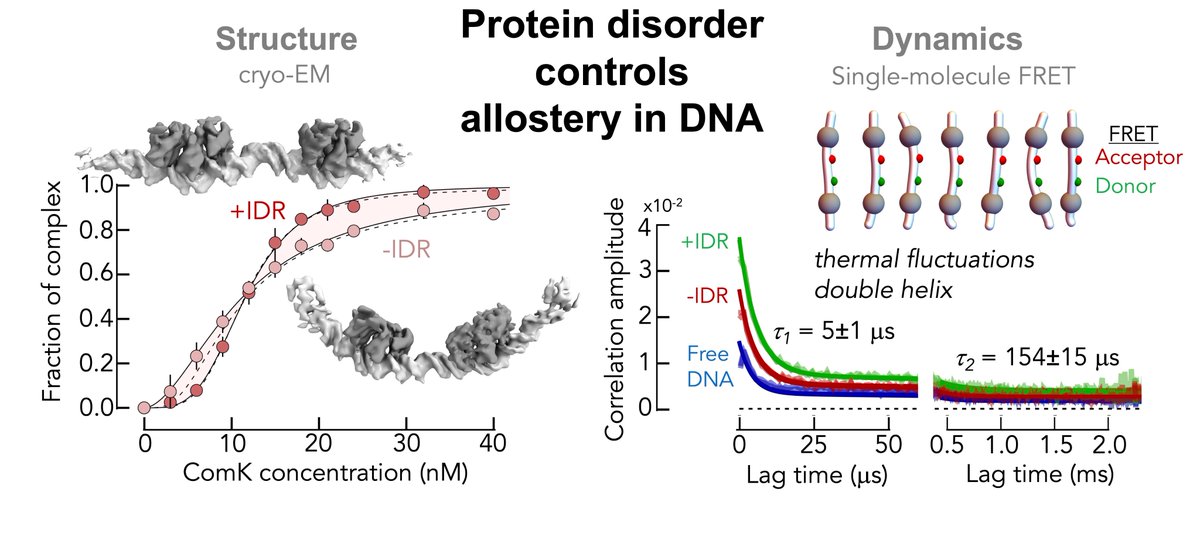
NEW: Dynamic allostery in DNA confirmed! IDR of a transcription factor controls DNA allostery! Single-molecule FRET, cryo-EM, molecular simulations, and elastic network models. Thanks to all co-authors for the amazing team effort!
https://t.co/B8FIJv51J0
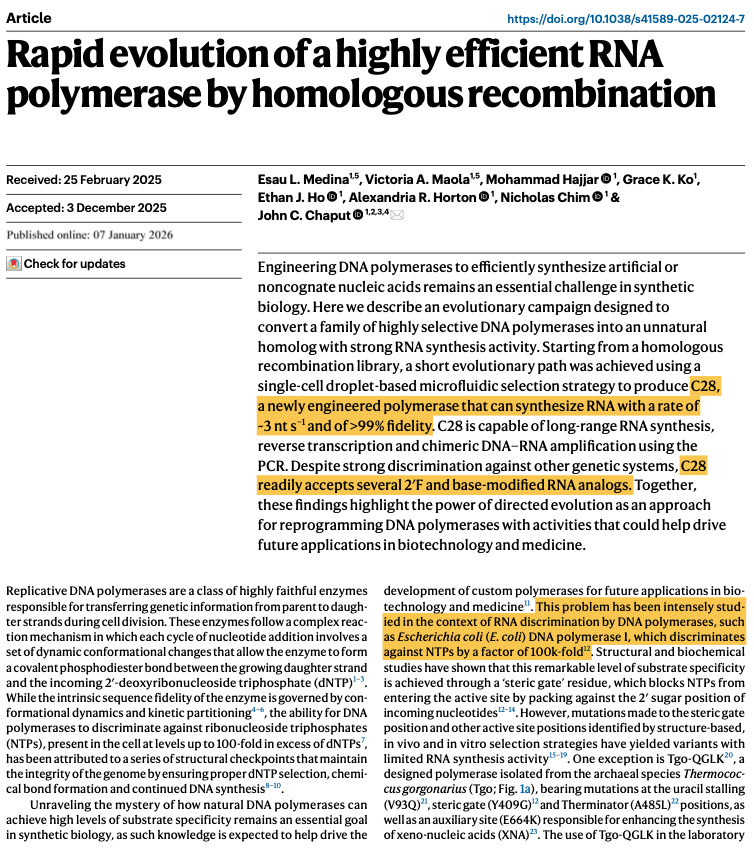
This paper is wild. After 3 rounds of directed evolution, they converted a DNA polymerase into an enzyme that can do:
- RNA synthesis
- Reverse transcription
- Synthesis of "unnatural" nucleotides
- Synthesis of DNA-RNA chimeras
One of the best papers I’ve read recently.
For context: In nature, it is DNA polymerase that takes a DNA sequence as a template and then copies it. These enzymes are crucial in replicating the genome for cell division, and they are EXTREMELY specific for DNA over RNA. This is key because RNA nucleotides are present in the cell at concentrations ~100x higher than DNA nucleotides, so the enzyme has evolved clever strategies to select one over the other.
RNA polymerases, for comparison, are the enzymes that take a DNA sequence as template and then convert it into RNA. They are involved in gene expression, for example.
To convert a DNA polymerase into an RNA polymerase (and all the other functions I mentioned earlier), the authors did a fairly straightforward directed evolution experiment.
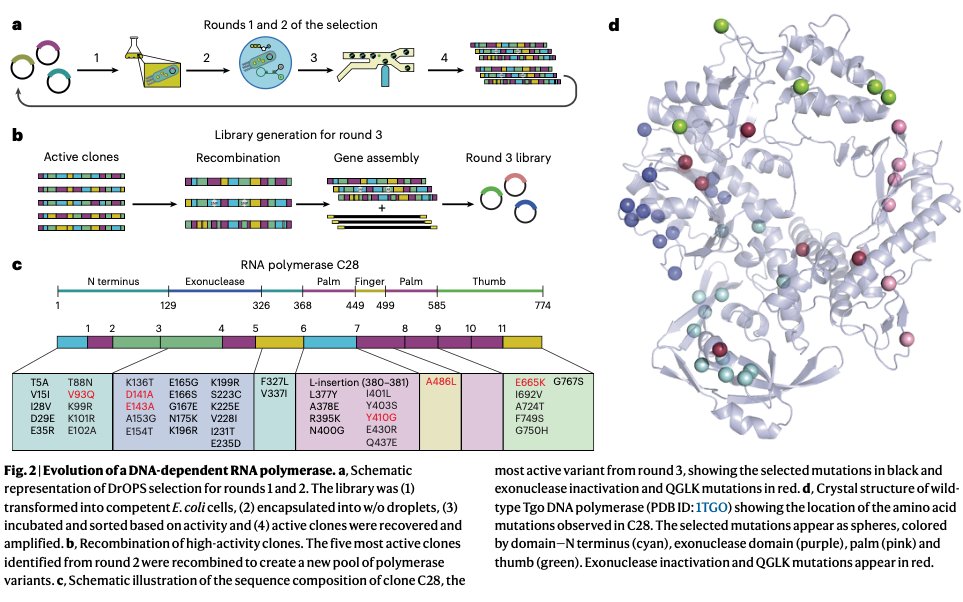
First, they took four DNA polymerase enzymes belonging to various archaea. These DNA polymerases don’t check for DNA vs. RNA as stringently as other types of cells, so they’re a good starting point to evolve RNA polymerases. The authors inserted some targeted mutations into these enzymes, based on known mutations in the literature. For example, they swapped the amino acid at position 409 for a smaller amino acid, thus removing a “gate” that keeps RNA building blocks from entering the enzyme.
Next, they took the four genes encoding these DNA polymerases and cut them up into 12 segments each. They randomly stitched these 12 segments together — from the four different genes — to build millions of unique variants. Each shuffled gene was inserted into an E. coli cell.
Then, they grew up these cells (each carrying a unique polymerase) and put them into microfluidic droplets. A device isolates each droplet, lyses the cell open, and releases the polymerase. The droplet also contains RNA building blocks and a DNA template, encoding a fluorescent reporter. If the polymerase begins synthesizing RNA, it will produce a detectable signal. They screened about 100 million droplets in 10 hours of work, searching for those with a signal.
For each well that yields a fluorescent signal, the researchers isolated the DNA and sequenced it to figure out which polymerase it was. They repeated this 3x times, finally isolating a really excellent RNA polymerase variant which they called "C28."
C28 has 39 mutations compared to the wildtype enzymes. It incorporates about 3.3 nucleotides of RNA per second, with 99.8% fidelity. The crazy thing is that this enzyme can also copy DNA or RNA templates back into DNA (reverse transcription), or use chimeric DNA-RNA molecules as a template and amplify them. It is just a super versatile polymerase that can act on DNA, RNA, or modified nucleotides, to build just about anything.
New paper: Nanoscale domains govern local diffusion and ageing within fused-in-sarcoma condensates
Single-molecule tracking reveals nanoscale domains within #FUS#condensates that migrate to the condensate surface during aging, seeding ALS fibrils.
https://t.co/pxvUdPGDC5