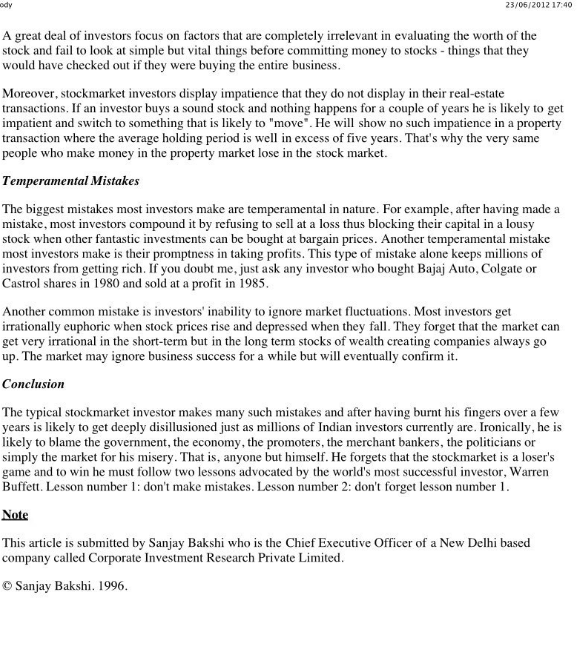
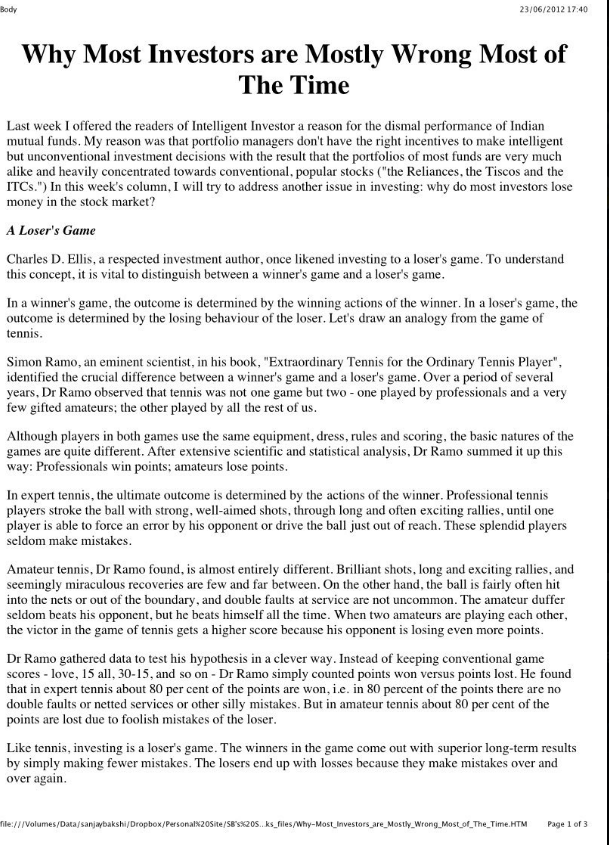
The six signs that can confirm whether I have arrived as an investor: What's your score?
1. The "Silo" Mindset: I can make decisions to buy, sell, add, or reduce positions without waiting for consensus or seeking validation from others’ opinions.
2. Comfort with Uncertainty: I can translate half-baked data into conviction by connecting the dots instead of waiting for 100% clarity. If there were complete certainty, the stock likely wouldn’t offer meaningful upside. In other words, once the entire village knows the story, who is left to buy?
3. Ruthless Capital Allocation: I can ruthlessly cut bad decisions (including high conviction names) via stop-losses to protect capital, while aggressively topping up your winning ideas.
4. First-Principles Thinking: I have the habit of dissecting a business or macro event down to its foundational economic realities (cash flows, unit economics, supply chains), rather than accepting management narratives or broker reports at face value.
5. Ego Zero: I have the humility to instantly flip my thesis from bullish to bearish the moment new, contradictory facts emerge, completely overriding my own biases or past public stances. On a bad news, sell first, think later! In other words, I should be able to say, "Yes, I was wrong," without embarrassment or ego getting in the way.
6. The Hungry Bird: Committing to compounding my knowledge by learning at least one new thing every day, with a relentless focus on playing the long game rather than chasing short-term noise. The art of balancing between "what's now" and "what could be tomorrow".
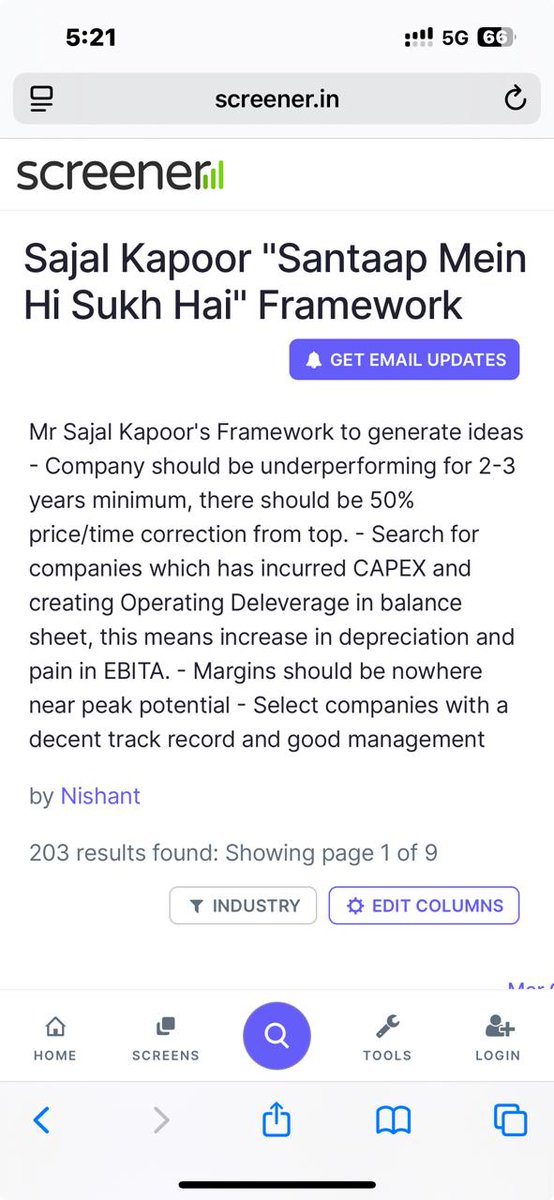
I don't know the person who created this screener, but it's very close to my philosophy of life, not just investing.
Few improvements if I may ...
Time is the single biggest member of the chaos and disorder family, so never knowingly ignore a time-correction. Even 2-3 years time-correction in a sunrise sector is a meaningful correction. Sure, a correction in both time and price is ideal, but a time correction alone is already a powerful force that tests and obliterates fragility.
Second, you need the discipline and independent thinking to disqualify at least nine 9 of 10 ideas that meet this filter. Why? Because of the principle of Via Negativa ... you win by eliminating the relatively fragile options. Think of sperms racing to fertilise the egg; the relatively Antifragile winner takes all; nature works this way. So flow with it and reject 90% or more. Keep refining until you spot the “unseen” today, but the potential gorilla of tomorrow. Probable. Not certain!
Third, accept your ignorance (economics of randomness and probability) and build a basket of 15 to 25 such ideas. This ensures a truly low-downside, unlimited-upside, convex, and therefore sustainable and strategic investment bet. Sure, a “hand of god” is essential, but “पुत्रवती भव” won’t produce a baby without execution!
Finally, partner only with TCE-grade people. The management team must be trustworthy, capable, and energetic enough to exploit the upside of randomness. Learn to ignore the noise. Many will give you free advice, and many "iThought"-type advisors called companies like Neuland and Laurus snake oil sales scams when their stocks got butchered. They disappeared recently. They will change their tone, text and sector but repeat the same pseudo-gyan to gain your attention and probably your capital investment too. They are totally bogus. Ignore them or pay the price by missing out on a great bargain when stock is down and out.
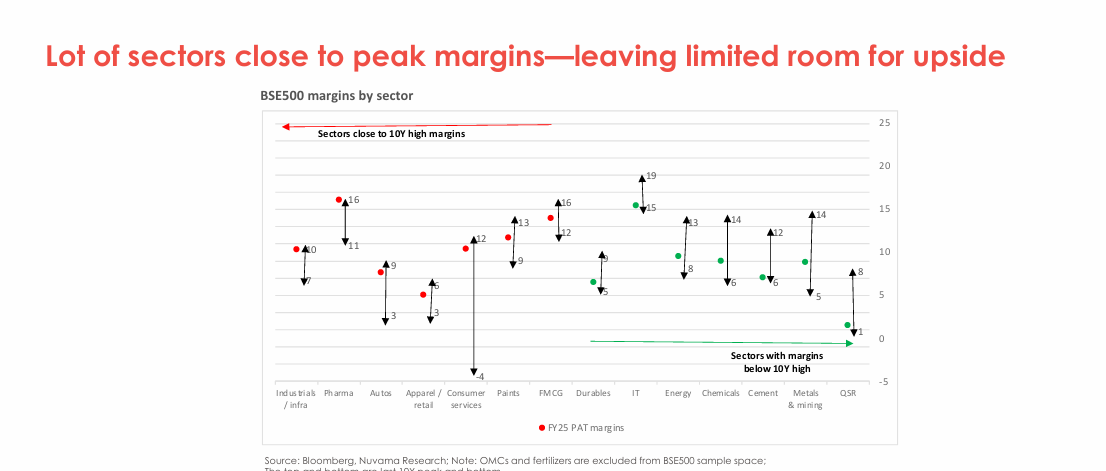
Interesting Perspective Chart , especially for where industry is going through bad times , helps you gain longer term perspective
Cement must focus, in my opinion we are looking at better times ahead for cement industry
Why Silver?
200 million ounces. (Remember this number as you read.)
That's the deficit in the annual Silver demand and supply.
Annually, Silver demand is approx 1200Mn Ounce but the current supply is about a 1000Mn ounce. That a deficit of 200MnOu. 2025 would be the fifth year of running deficit.
This 200Mn ounce number has quite a history.
Back in early 1970s, the Hunt brothers (Nelson Bunker Hunt and William Herbert Hunt) triggered by the Nixon Shock started to accumulate Silver, ostensibly as a hedge against financial repression and debasement of the US Dollar.
As an aside, the Nixon shock has some parallels with what is happening today. Ricard Nixon announced his New Economic Policy in 1971. His key focus areas were three:
1. Stemming the rise in inflation
2. Protecting the US Dollar (abating de-dollarization)
3. Reducing unemployment
(No surprise the above three read as if they were announced in 2025).
By announcing his New Economic Policy Nixon ended the convertibility of US Dollar into Gold. He broke the 'Gold Window' by abandoning the Bretton Woods system.
(The international monetary system after World War II was dubbed the Bretton Woods system after the meeting of forty-four countries in Bretton Woods, New Hampshire, in 1944. The countries agreed to keep their currencies fixed (but adjustable in exceptional situations) to the dollar, and the dollar was fixed to gold. Since 1958, when the Bretton Woods system became operational, countries settled their international balances in dollars, and U.S. dollars were convertible to gold at a fixed exchange rate of $35 an ounce. The United States had the responsibility of keeping the dollar price of gold fixed and had to adjust the supply of dollars to maintain confidence in future gold convertibility.)
Back to Hunt brothers.
Driven by a sound logic of debasement and changing world order, the Hunt Brother went overboard with their desire to corner the Silver market. They started buying Silver in all forms and fashion. By 1974 they had accumulated 50 Mn ounces of Silver. Their physical holdings were so massive that U.S. authorities limited the amount of silver futures contracts any one trader could hold. CFTC formation in 1974 and availability of Silver futures on US exchanges helped the Hunt's to increase their speculative activity manifold.
By 1979, the Hunt Brother, with support from more investors (the Saudi Royal family) had cornered nearly 200 Million Ounces of Silver. About 90 Mn Ounce in Physical Silver and rest in the Futures contract.
Speculators, Silver miners, other commercial hedgers sold Silver to Hunt brothers helping them in accumulating 200 Mn ounces of Silver.
How big was these 200 Mn ounces?
The annual global silver mine production back then was around 400 million ounces, so the Hunt position was massive, nearly half relative to the market size annually.
From early 1979 to Jan 1980, Silver prices rose from $6/troy ounce to $50/troy ounce. In fact, between Jan 7th to Jan 18th, 1980, Silver went from $40 to $50.
COMEX and CFTC feared systemic collapse. They introduced New "liquidation only" rules (you could only sell, not buy Silver futures and there was compulsory delivery). Increased margin requirements (making leveraged silver bets harder).
Silver prices crashed to $11 and Hunt's got a $135 Mn margin call. They filed for bankruptcy in 1985.
Back to 200 Million Ounces
Interestingly the current deficit in Silver market is 200Mn ounces. This is what Hunt brother cornered in 1970s causing an eye watering bubble in prices.
Also, the net physical investment demand for Silver is also ~200 Mn ounces. This means that investment demand for silver could never recover. The shock to the market was so massive that it broke.
Take a look at this table:
Why is this important?
Silver's physical and investment demand hasn't risen for years. Although its industrial uses have only risen and are now sticker than ever. This creates massive price sensitivity for Silver to its investment demand. We have seen this play out recently.
Just two years ago, Gold prices were struggling due to lack of investment demand. The Gold demand and supply situation was also tight (although Silver's D/S is much tighter at present). But Gold's investment demand was missing. Then came the world's central banks buying nearly 2500 tonnes of Gold over just 26 months. That set Gold prices on fire and then the recent trade war added more fuel to fire.
The most important point and the crux of 200 Million Ounce argument is this:
In case of Silver, the sensitivity of price to an increase in investment demand could be much higher. It is hard to put in numbers, but it could be higher than what was for Gold. Where would this investment demand come from is unknown and uncertain. But speculators, hedgers or even institutional looks for adding to non-fiat reserve asset could eye Silver in times to come.
It is also clear that Silver is trading at a level which is not expensive when compared to Gold using the Gold:Silver ratio. Take a look:
Historically,
Gold:Silver ratio has been at around levels of 60 to 65. It is now at ~100.
Here is a snapshot which shows how to value Gold and Silver. It shows that Silver has a large runway ahead.
In conclusion,
Silver appears to be still undervalued relative to Gold. It is a very volatile commodity and often moves wildly. It is not for everyone, especially not for the faint hearted. Most investors are better off having it as part of a Multi-Asset Allocation strategy through an MF.
For others who understand these nuances, having some exposure to this commodity using Silver ETFs and Silver FOFs could make sense.
Silver currently trades at $32.9/troy ounce and Rs. 96,000 per Kg.
Ends.