UNISON's fault lab: anyone can stop a validator, silence a proposer or delay one, and watch how Quantum Cadence's fast path answers.
Each experiment is a short, real run of seven validators with one fault, one at a time; the public network is not touched. A queue shows the position and when the running experiment ends.
In the runs before opening, one validator down still brought every slot to final on the fast path at 200.1 ms (p50), against 138.7 ms with no fault.
https://t.co/G6HvOEBMao
We took away the power to freeze accounts of one of our tokens on UNISON, and no key can get it back.
With our key as freeze authority, we froze our second key's account and thawed it again. Then we set the freeze authority to none. After that, freezing the same account was refused, and so was setting a freeze authority again.
Holders of a token with no freeze authority know that nobody can lock the tokens in their account.
https://t.co/fBk7KK3k26
A token mint of ours on UNISON carries its own name, and that name can never change.
We wrote a name, symbol and link into a Token-2022 mint of ours, renamed it once as update authority, then set the update authority to none.
Read back, the mint holds "UNISON demo 2", "UDEMO" and our docs link with no update authority. A rename after that was refused.
No tokens have been minted from it, and it has no value.
https://t.co/Py9nbebh78
We handed an account of ours on UNISON to a program, and after that our own key could no longer take UNC out of it.
The account held 0.0019 UNC. Before the handover, our key moved some out with an ordinary transfer. After the System Program assigned it to our bench program, the same transfer was refused, and so was handing it back. Sending UNC into it still worked.
Only the program that owns an account can take from its balance, which is what lets a program hold UNC that no key can pull out from under it.
https://t.co/jeGOVRVBnr
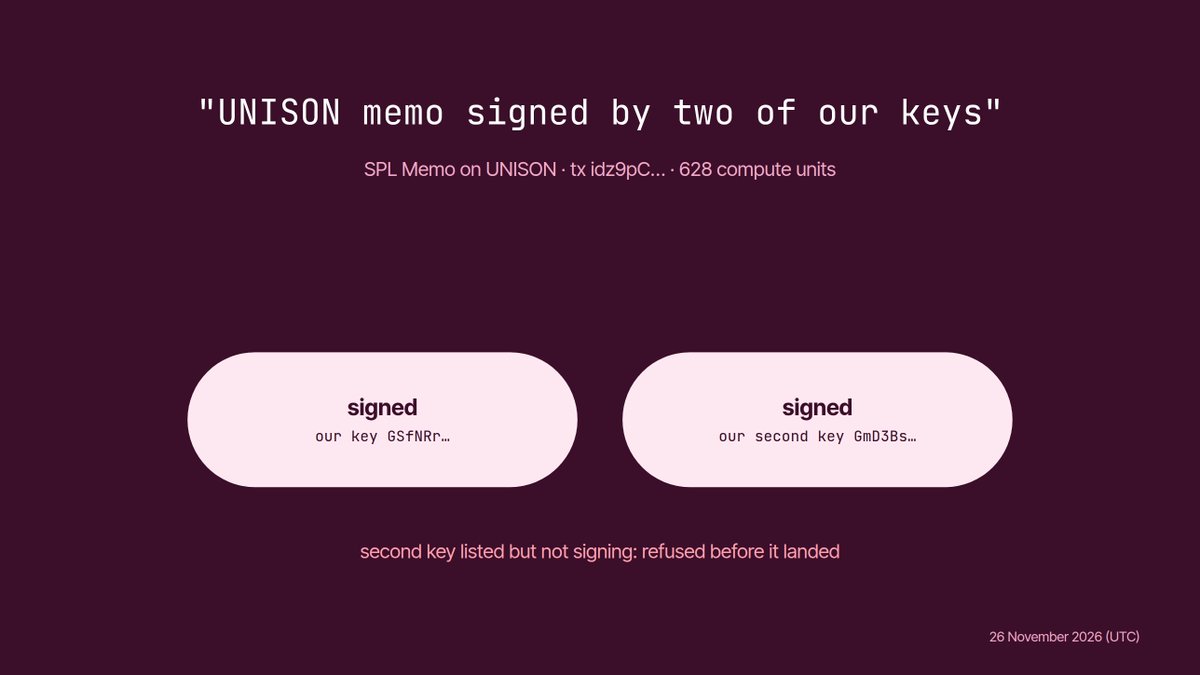
We wrote a note on UNISON that two of our keys signed, using the SPL Memo program.
The memo listed both keys as signers, and both signed the transaction. The same memo with our second key listed but not signing was refused before it landed.
https://t.co/SY4Ym2PHOY
We froze an address lookup table of ours on UNISON, so the two addresses in it can never change.
After the freeze, the table had no authority. Adding an address was refused, and so was deactivating it to close it. A transfer that used the table went through.
A transaction that names an address by its index in a frozen table can count on that index pointing to the same address for as long as the table exists.
https://t.co/n4flO8s2Go
One transaction of ours on UNISON paid 50 addresses at once, and it only fit because it used our address lookup table.
Written out in full, the 50 addresses would have made a 2,113-byte transaction, over the 1,232-byte limit. With the table, each receiver was a one-byte index and the transaction came to 1,102 bytes.
It paid each address 0.00089088 UNC, used 7,500 compute units and was charged one 0.000005 UNC fee.
https://t.co/xReAVDMBck
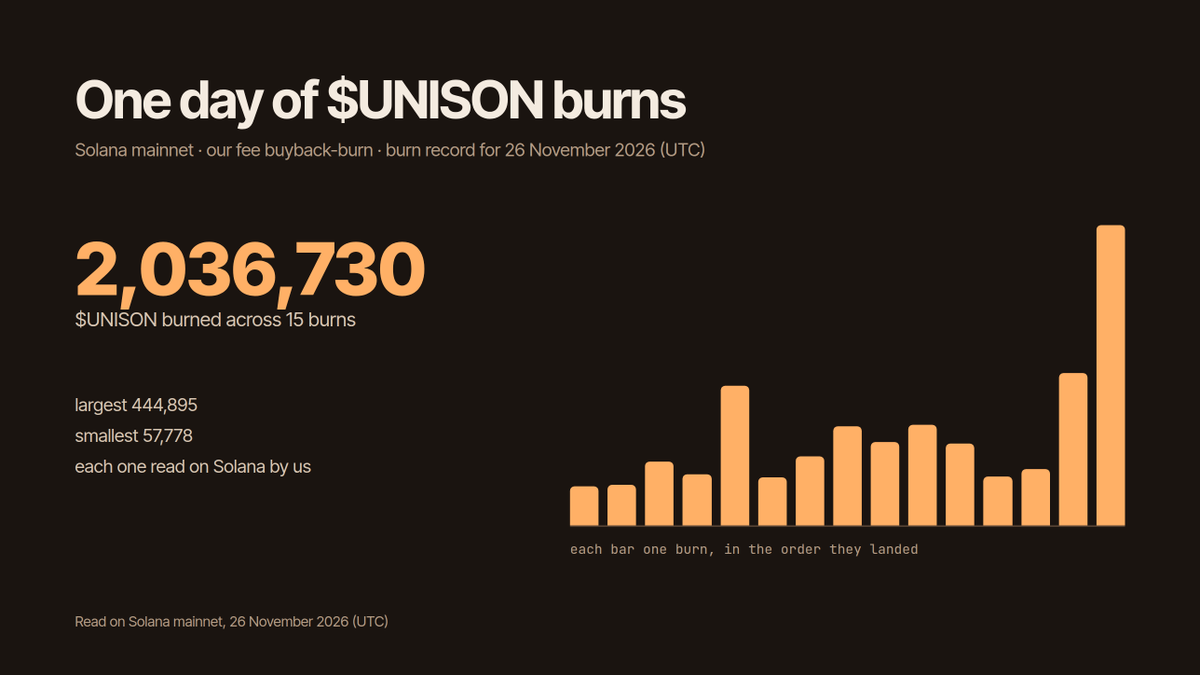
Our fee buyback-burn burned 2,036,730 $UNISON on Solana mainnet on 26 November 2026 (UTC), across 15 burns.
That is the day as our burn record listed it when we read it that evening. We read each of the 15 burn transactions on Solana. The largest burned 444,895 $UNISON and the smallest 57,778.
https://t.co/xKxnCgJr6Q
Our second key paid the fee for a transfer that moved our first key's UNC on UNISON.
The transaction named the second key as its fee payer, and both keys signed it. The first key's balance went down by exactly the 0.001 UNC it sent, and the second key's went down by the 0.00001 UNC fee.
Without the second key's signature, the same transaction was refused.
https://t.co/3gka2EO8w8
A transfer of ours on UNISON that would have opened a new account with too little in it was refused.
We sent 0.0001 UNC to an address that held nothing, and the network turned it away before it landed. Sending 0.00089088 UNC, the minimum for an account with no data, opened the account. After that, the same 0.0001 UNC went through.
An account has to hold enough to pay for the space it takes, as on Solana, so the network keeps no storage that nobody paid for.
https://t.co/8AY5eQrBio
A transaction of ours on UNISON set itself a compute limit of 300 units, used them all, and still paid its fee.
Our bench program needed 2,791 units for the call we gave it, and with a 200,000-unit limit it went through.
With the limit at 300, the program stopped where the units ran out, the transaction failed and its 0.000005 UNC fee was charged.
https://t.co/WY544itboh
We deployed a small program of ours to UNISON and then gave up the right to ever change it.
After it ran once, our key set its upgrade authority to none. An upgrade we then tried from a second buffer, signed by the same key, was refused. The program still runs as deployed.
A program with no upgrade authority keeps the code it has, so anyone calling it knows which code they are calling.
https://t.co/lxxW7OD5p8
We handed a durable nonce of ours on UNISON to our second key, and after that only that key could use it.
Once it was handed over, a transfer that used the nonce and was signed by our first key was refused. The same transfer, signed by the second key as nonce authority, went through.
https://t.co/UItQU1Y0La
We had UNISON check a secp256k1 signature for us, the curve Ethereum keys use.
Our transaction carried one instruction for the network's secp256k1 program: the Ethereum-style address of a key we made, a 32-byte message and its signature. The program recovers the key from the signature and compares its address.
It was finalized for a fee of 0.00001 UNC and used 0 compute units. The same signature with one character of the message changed was refused before it landed.
https://t.co/NHnFJVfUHA
@rugkillazone ha, fair, that one was vague. short version: it's a live network running a new consensus that only existed as a paper. you can send a transfer and watch how fast it goes final. happy to explain any part that doesn't click.
We closed an address lookup table of ours on UNISON, and the network made us wait about 85 seconds first.
A close we sent right after deactivating the table was refused. 534 slots later the close went through, and the table's 0.0015 UNC of rent came back to our key.
Solana's design asks for the wait so that a transaction already in flight cannot lose the table it uses, and so that a table cannot be closed and made again at the same address.
https://t.co/WyxVhfNeoj
@ionut2412000@StanLey32462326 fair question. nobody can honestly promise that, and we won't try. what's there is the network itself, running on faucet test coins for anyone to poke at. judge it by that.
All 217 $UNISON buys on our burn record, as listed on 25 November 2026 (UTC), were burned in full right after each buy.
We read every pair on our burn record from the chain: 217 buys, each with its own burn. In each pair, the burn equals what the buy brought in, to the last base unit.
By block time, each burn landed between 0 and 13 seconds after its buy, 1 second at the median.
https://t.co/xKxnCgJr6Q
$UNISON's supply on Solana mainnet fell by about 816,000 between our two readings, and burning is the only way it falls.
Read from the mint on 26 November 2026 (UTC), the supply is 978,511,888. When we read it on 25 November it was 979,327,778, so about 816,000 more were burned in between.
The mint still has no mint authority and no freeze authority, so no key can add a token.
https://t.co/POOfGggIS0