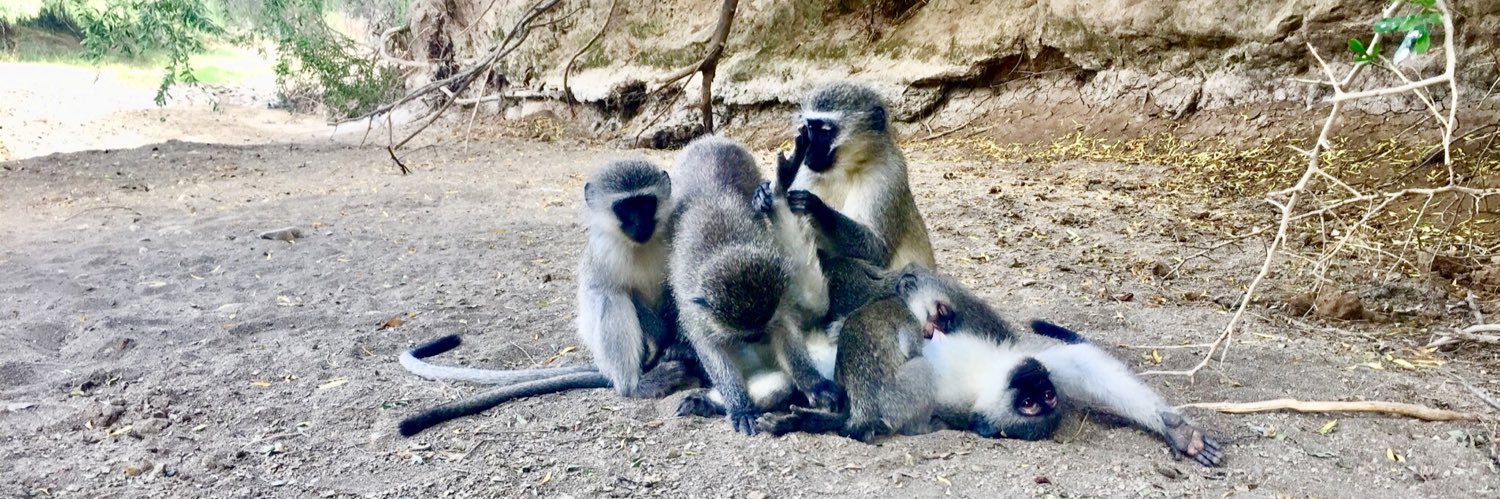
📢 New paper out in Animal Behaviour! We experimentally tested if🪨stone-object play predicts stone-tool use in foraging tasks in 🐒free-ranging long-tailed macaques in Bali. Huge thanks to @ina820, @christie_bess, I Nengah Wandia, Jean-Baptiste Leca!🧵
https://t.co/WScSNs5bbH
Congrats to @maddieclarke15 on her first in-person talk! She found that juveniles are more likely to part. in inter-group conflict as they age, if their mom l participates, and if they have ⬆️ eigenvector centrality in the grooming net (but also ⬇️ EC in the prox net!) #ABS2023
Great to see the hard earned long-term data from the vervet monkeys and the Barrett-Henzi lab leading to some fascinating life history comparisons with @rich_mcfarland@MirjamYoung@Roseblersch@ina820 and many co-authors
Updated the @ESLRSociety jobs board! Highlights include: postdoc on group identity w/@psmaldino and @Adrian_V_Bell, postdoc on orangutan culture w/@carolschuppli, predoc in social minds w/Simon Dedeo, and field assistant job on bird behavior w/@LucyMAplin: https://t.co/g5c3Hv3K6v
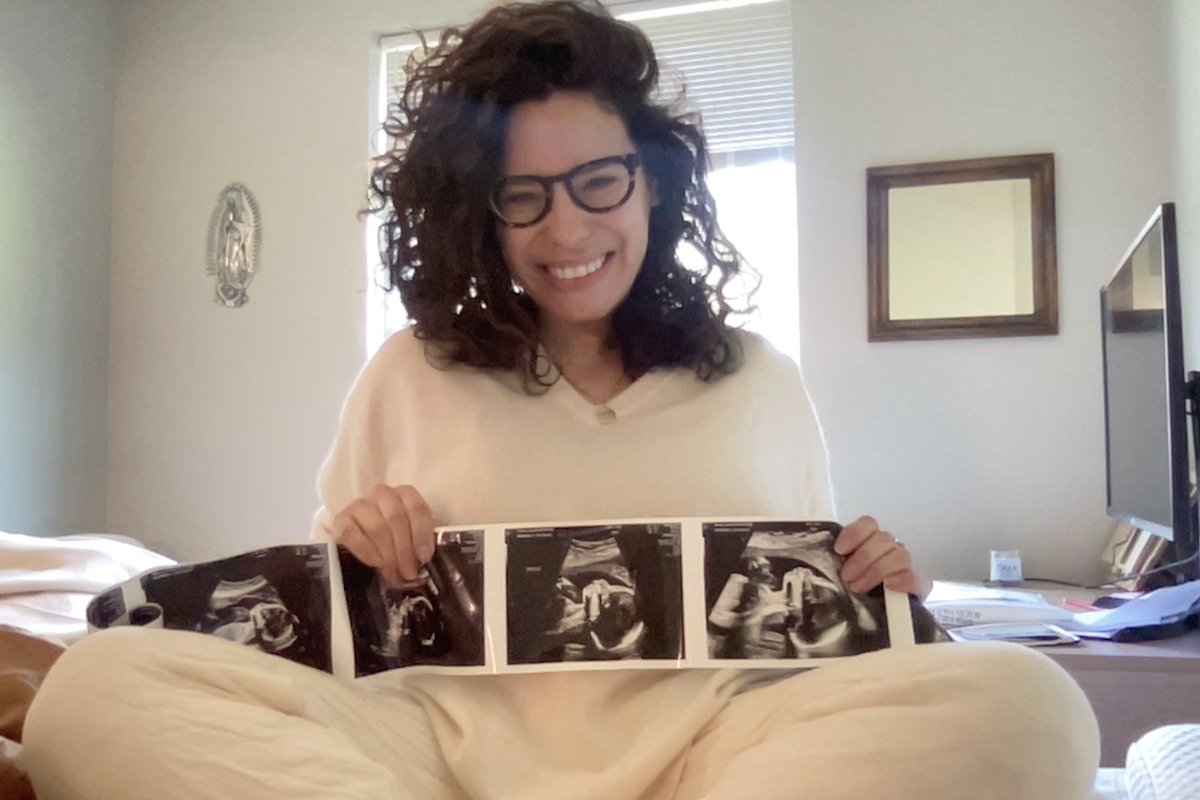
With a 🌈 heart, I want to say that this is my first Mother's Day. With the grace of the 🤱🏽 @err_ring & I will welcome our first child in August. Celebrate baby Mina with us and please consider donating to the Academic Mamas Foundation. https://t.co/ugBYg34BCW
Meet a hero for the planet! @WTHRcom introduces us to one of the six finalists for the Indianapolis Prize, @DrBirute Mary Galdikas, the protector of orangutans in Borneo, Indonesia.
Find out who the winner is on Tuesday, May 16.
@poppy_haze There’s a radio lab episode where a scientist who studied bird patterns applied the same metric to children.
Results were wild - a 10 year old in the 70s had like 2 miles of area he would travel without adults (bikes) and a 10 year old today has like 200 ft of autonomous space.
On a certain type of man who wants not just to mansplain, but to stuff our mouths full of their words and make us echo them. This is a form of silencing. https://t.co/pxnXyvsTxu
608 PhD students were studied during their first year of grad school.
Those from lower SES backgrounds felt less integrated as they struggled to make academic friends, lost non-academic connections, felt misunderstood inside and outside of academia.
https://t.co/dIvx03lFn6
PLEASE RETWEET: If you already submitted an award application for #ABS2023, please make sure to RESUBMIT! Due to a technical error, names and email addresses were not saved.
“Other people are not bundles of inferences or theoretical constructs for our interpretation, but directly perceivable “swarm[s] of participations” (Bruner, 1990, p. 122), bundles of organism–environment relations like ourselves.”