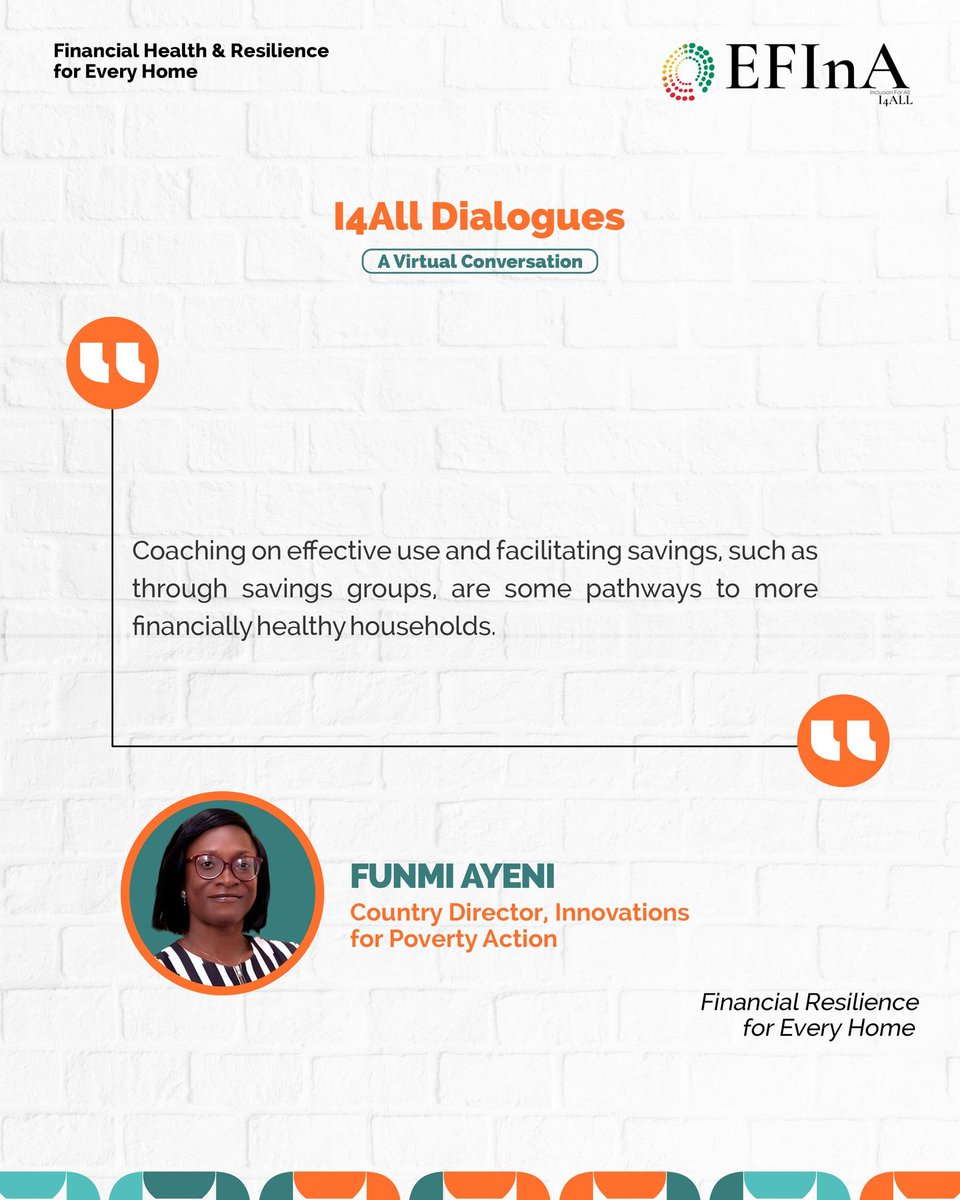
What happens when financial products are designed for people whose realities are completely different?
Not every household faces financial vulnerability in the same way. That's why the same solution won't work for everyone. Millions of Nigerians in the informal economy continue to navigate income volatility, limited financial protection, and products that don't fit the way they earn a living.
In this excerpt from the last I4All Dialogues, Funmi Ayeni breaks down the different realities households face and explains why rethinking financial inclusion begins with understanding people's lived realities in order to design financial systems that truly work for everyone.
Financial inclusion starts with understanding. Technology alone is not enough. People must also be able to understand and confidently use it.
In this I4ALL Radio conversation, @ImadeOsuobeni shares why literacy, local language communication, voice-enabled services, and ethical agent support are essential to true digital financial inclusion.
Click the link below to watch the full episode on YouTube.
https://t.co/trlZy3lvc0
Access has increased, but financial health is telling a different story.
In this clip from the I4All Dialogues, held in May, on Rethinking Inclusion: Financial Health and Resilience as Development Priorities, Dr. Oluwatomi Eromosele, Research Lead at EFInA, shares key data on Nigeria's financial inclusion journey.
While financial inclusion rose from 56% in 2020 to 64% in 2023, financial health has not followed the same trajectory. In fact, fewer than 1 in 5 Nigerian adults were financially healthy in 2023.
She explains that financial health goes beyond having an account, it reflects whether people can manage daily needs, absorb shocks, plan ahead, and achieve their goals. A critical reminder that access alone is not enough; outcomes matter just as much. This is where the real work of inclusion lies.
Every sacrifice made quietly was an investment in a future they may never fully see, but believed in anyway.
Today, we honour the fathers whose work doesn't always make headlines, but holds up entire households and communities.
Happy Father's Day to the men building opportunity, one day at a time.
True resilience is built alongside relief, not outside it.
In this clip, Funmi Ayeni, Country Director at Innovations for Poverty Action, challenges us during the I4All Dialogues on Rethinking Inclusion: Financial Health and Resilience as Development Priorities, held last month, to think differently about support systems for vulnerable communities.
She explains that people cannot build long-term resilience without first meeting immediate needs like food and survival. Effective programmes must therefore do both: provide relief and strengthen resilience at the same time.
A powerful reminder that financial health is not just long-term planning, but also present-day survival.
Digital financial inclusion needs to move beyond building apps to building for the realities people experience everyday. In this episode of I4ALL Radio, Edidiong “Didi” Uwemakpan, Vice President, Corporate Affairs at @moniepoint , shares insights on the realities of designing and building digital financial services for inclusion with accessibility, usability, and customer protection in mind, especially for underserved users navigating the financial system through the last mile.
Crucial factors to consider include low-storage devices, digital literacy gaps, and onboarding friction. The conversation highlights an important truth: digital financial inclusion cannot happen without building for the realities of the people the system is meant to serve.
Discussions on financial inclusion often focus on access, usage, and adoption. However, community engagements continue to reveal another important dimension: consumer protection.
Across many communities, gaps in awareness around complaints mechanisms, escalation pathways, and available protections can influence how people experience and interact with financial services. Understanding these realities is important for stakeholders seeking to build financial systems that are not only accessible, but also responsive to the needs and concerns of users.
Progress in financial inclusion is visible, but it is not yet complete.
Edidiong “Didi” Uwemakpan of @moniepoint explains how trust and proximity are being built into financial service delivery through distribution networks and localised support systems.
The goal is simple: ensure that users are not left alone after gaining access, but can reach real people who understand their language and their context when challenges arise.
What happens when communities are given the information and tools to better understand the financial system around them?
Findings from consumer protection engagements in Malumfashi LGA, Katsina State, suggest that increased awareness can lead to stronger trust, greater confidence in available support systems, and a clearer understanding of the institutions responsible for protecting consumers. The results reinforce an important lesson: meaningful financial inclusion is not only about access, but also about ensuring people can navigate financial services with knowledge and confidence.
Financial inclusion does not end when people gain access to digital services. It also depends on what happens when things go wrong. What happens after a failed transaction can shape whether people continue using digital financial services at all.
In this episode of Banking without Buildings: Can True Digital Financial Inclusion Happen without Digital Enablement? Imade Bibowei Osuobeni, Founder of Tech Herfrica, explores insights from real experiences within underserved communities where failed transactions, unclear resolution pathways, and unresolved complaints trigger confusion and fear and also discourage people from remaining within the formal financial system, ultimately affecting trust in digital finance.
The conversation raises an important question: can financial inclusion truly succeed if people do not feel supported, protected, or confident enough to stay within the system?
Click the link below to watch the full episode on YouTube.
https://t.co/PmIPtK02iw
During our recent grassroots engagements in Mani and Malumfashi LGAs in Katsina State, key insights emerged on what financial consumer protection looks like at community level.
While access to financial services continues to grow, participants across both communities reported increasing use of banking and digital financial services, but also highlighted persistent concerns around fraud, unresolved disputes, and challenges navigating complaint resolution systems.
The engagements also revealed that access alone does not build confidence in the financial system.
Post-engagement assessments, particularly in Malumfashi, showed improved understanding of consumer rights and clearer awareness of the roles of regulators and service providers in addressing financial issues.
These findings underscore that financial inclusion goes beyond access. Trust, responsiveness, and clearly defined consumer protection systems remain critical to how individuals engage with financial services and respond when challenges arise.
During Inclusion for All’s grassroots engagements in Mani and Malumfashi LGAs in Katsina State, a key pattern emerged around financial consumer protection and system navigation.
Many participants across both communities showed varying levels of understanding around complaint resolution, escalation pathways, and how to access support when issues arise. Engagements with regulators and service providers also helped clarify the roles of different actors within the financial system and the channels available for consumer protection.
For many users, access to financial services does not always translate into clarity on what to do when problems occur. To strengthen financial consumer protection: financial service providers and fintechs must improve awareness of complaint-resolution and escalation channels and make support systems more accessible.
Regulators must continue strengthening transparency requirements and enforcement of consumer protection standards. Agent banking networks should expand visible, community-level resolution pathways. Development partners and ecosystem stakeholders should continue supporting financial literacy and system-navigation capacity.
Financial inclusion is not only about access. It is also about ensuring people can confidently navigate financial systems when they need support, resolution, or redress.
Nigeria just made history.
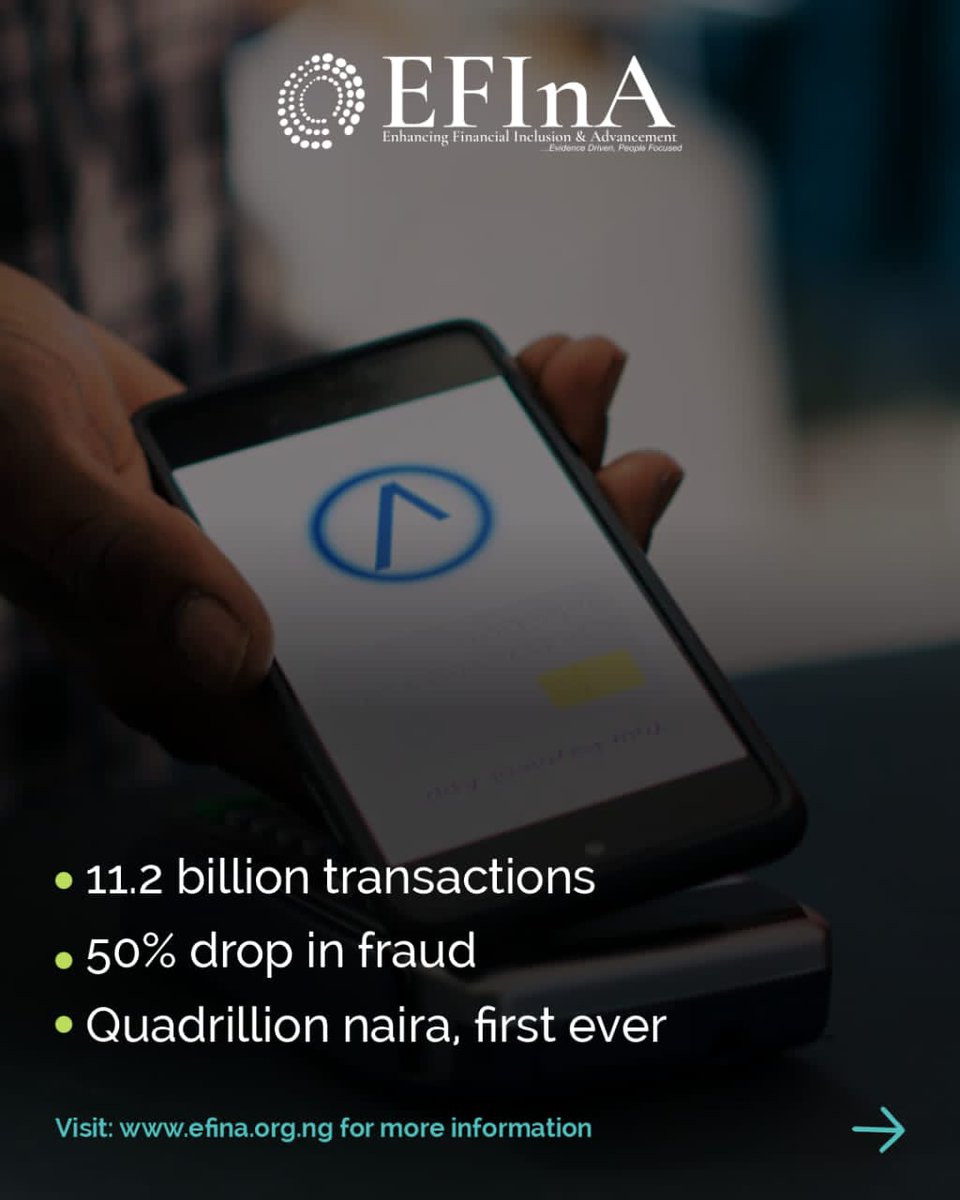
In 2024, Nigeria’s digital payment system processed over 11.2 billion transactions, totalling more than ₦1.07 quadrillion. That’s the first time digital payments in Nigeria have ever crossed the quadrillion-naira mark. And we’re not slowing down.
The @cenbank has now launched the Payment Service Providers Committee, bringing banks, fintechs, mobile money operators and regulators to one table to coordinate, accelerate, and secure the next phase of growth.
From the CBN to the fintechs, the banks to the mobile money operators, this is what happens when Nigeria builds together. The world is taking notes.
Access has improved but has usage?
In this I4ALL Radio episode, Imade Bibowei Osuobeni, Founder of Tech Herfrica, shares insights showing that while access to financial services has expanded, true digital independence is still a work in progress, resulting in assisted, not fully self-driven, digital finance.
Click the link below to watch the full episode on YouTube.
https://t.co/MN4vjBL9Dc
Financial inclusion is not just about access to services. It is about what that access looks like in everyday life, and whether it translates into real financial wellbeing.
Discussions like this help us ground the conversation in data, lived experiences, and the realities shaping financial health and resilience.
Here’s a highlight from Funmi Ayeni’s contribution during the I4ALL Dialogues conversation on financial health and resilience.
.
.
#I4ALLDialogues #I4ALLMainstreamVoices
Happy Africa Day! 🌍
As the continent celebrates “63 Years of Unity, Integration, and Development,” we remain deeply committed to strengthening the inclusive financial foundation our future requires.
True integration and sustainable development begin with financial inclusion. By advancing impact-driven digital financial services and supporting inclusive financial ecosystems, we are helping empower Nigerian communities to thrive and contribute meaningfully to Africa’s collective growth and prosperity.
Let’s celebrate together.
#AfricaDay2026
Inclusion for All, in partnership with @saneflimited and @CARENigeria, recently held I4All Dialogues: Community-Wide sensitization and awareness session on Consumer Protection in Mani and Malumfashi LGAs of Katsina State.
The Mani session, held on 25th April 2026, focused on access to financial services, fraud and available redress channels, transaction disputes and resolution mechanisms, and customer service challenges. The Malumfashi session, held on 26th April 2026, focused on agency banking and consumer protection, fraud and redress, as well as transaction disputes and redress mechanisms. Both sessions were facilitated by the SANEF team, @Sterling_Bankng representatives, traditional leaders, and other key stakeholders committed to advancing financial inclusion within underserved communities.
The dialogues created an important platform for community members to engage directly with financial service providers and regulators, ask questions, share experiences, and gain practical knowledge on safe financial practices. Conversations also highlighted the importance of protecting personal banking information, understanding complaint escalation processes, and building trust in existing financial systems.
Through these engagements, participants gained clearer insights into their rights as financial consumers and the available channels for resolving disputes and reporting fraud. The sessions further reinforced the collective commitment to promoting financial literacy, strengthening consumer protection, and expanding access to inclusive financial services across rural communities.
#I4ALL #I4ALLGRASSROOTVOICES