There’s a lot of writing on what AI means for rich-country economies and far less on what it means for Nairobi, Lagos or Lima.
@asteriskmgzn and @indevmag want to fix that. Essay contest: $10k first prize, deadline Dec 31.
https://t.co/5YCG2mxDQM
In Kenya, the IRC spent $112,000 preparing for a disaster that never came.
Was that a waste of money or a sensible insurance premium?
Justin Labeille and Paige Kirby discuss the nuances of anticipatory action: https://t.co/qAnDJuGij3
Development policy has three dominant paradigms, all devised by economists: neoliberal, neo-Keynesian and neopaternalist. Nobody asks the poor what they want. I make the case for a fourth: reflexive policymaking.
Most development policy tries to change outcomes. What if we changed who gets to decide?
@bijurao makes the case for a different paradigm of development policy: reflexive policymaking.
https://t.co/mD7vW8d20g
Morphine is among the cheapest essential medicines there is. Ten days of oral morphine costs about the same as a loaf of bread.
Yet, in most of the world: the need for severe pain relief still goes unmet.
@morganfairlessb in @indevmag: https://t.co/kUkMvxZC8m
Adding:
How will AI shape local scientific research in LMICs, esp for domains such as agri and health where some research may have to happen in situ? Ideally, pick a specific research problem, identify its binding constraints, and explore how AI could address them (or not). 1/2
🖊️ @indevmag and @asteriskmgzn are running an essay contest on how transformative AI will affect low- and middle-income countries, and how they might respond.
Excited to be a judge for this - $10,000 prize for the best essay!
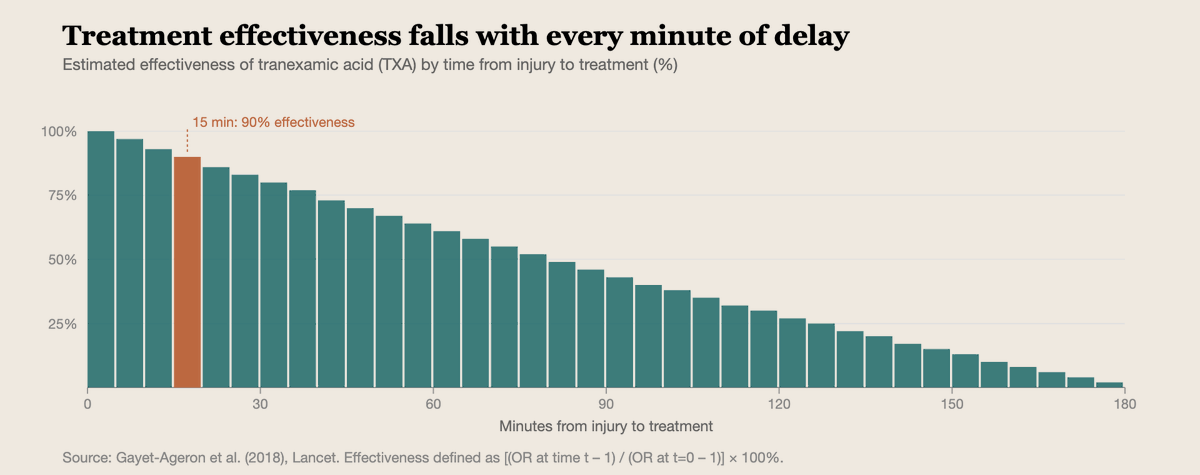
Tranexamic acid is cheap, off-patent, and cuts bleeding deaths by about a third — if it’s given when it's needed. But it requires use of an IV, so it often isn't used.
@AkhilBansalsa and Georgia Bradly write about how autoinjectors could change that: https://t.co/kKtApqyhIE
In 1995, seven in 10 Nepalis lived in extreme poverty. By 2022, fewer than one in 40 did.
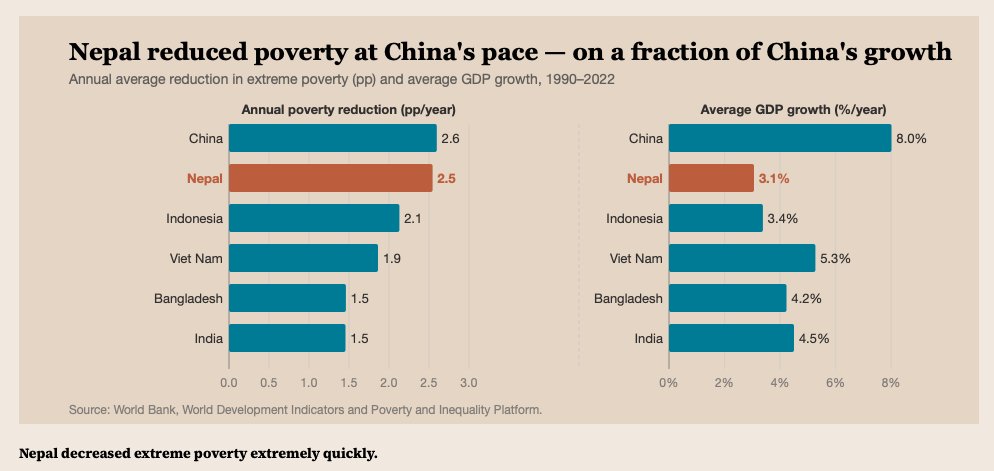
Over that period, Nepal lifted 2.5% of its population from extreme poverty each year.
Today on @indevmag, @MaheshShrestha_ outlines Nepal's remarkable journey.
In 1995, 7 in 10 Nepalis lived in extreme poverty. By 2022, fewer than one in 40 did. Why, how? Migration.
@MaheshShrestha_ for @indevmag:
https://t.co/ediX00SqOF
Nepal reduced extreme poverty almost as fast as China. It did not have much FDI, manufacturing, the agricultural share of the economy remained high, and there was an active civil conflict.
How did Nepal do it? Migration, largely to the Gulf: https://t.co/tUbD2vyRyj