Finally Indian Investors have a single site where you get both technical and fundamental analysis of more than 2800 Indian #stocks...
Scan Based On themes,Sectors, Results, Order Wins, Management Trust ...
Check Whether the company you are investing has any Red Flags, Like promoter pledge, heavy debt.
Use Scopus AI to answer your questions.
See Daily Market Reports-- Pre market and post Market.
Get Technically Strong Trending Charts.
Get VCP Based Breakout Charts.
Compare Stocks.
Learn with https://t.co/gItRZxGsZq
No Recommendations, DYOR.
#investing, #NIFTY, #IndianInvesting, #markets
@vbomkara Hit Job started … Govt is not silly to do this as it has saved a lot of foreign capital which would otherwise been spend on shoring up the rupee
Nifty 50 gained 0.58%, but only 181 Nifty 500 stocks advanced
Nifty 500 breadth recorded 181 advances, 316 declines, and 0 unchanged;
the advance-decline ratio was 0.57. FMCG led at +1.87%;
Pharma lagged at -1.53%.
Bank Nifty outperformed Nifty 50 by 0.31 percentage points.
#nifty #sensex #MarketNews
Detailed close analysis :
https://t.co/tMbcEAG6NT
Here is a complete snapshot of #Indian#auto 2 wheelers industry.
• #Eicher Motors: Best-in-class margins and strong brand moat in the premium 250–450cc segment. Growth is steady rather than explosive. Ideal for investors seeking quality + pricing power.
• #Bajaj Auto: Best balance of scale, margins, exports, and reasonable valuation.
• #TVS Motor: Highest growth momentum (especially EV + exports), but trades at a steep valuation.
• #Hero MotoCorp: Volume king with attractive valuation, but facing margin and growth challenges relative to peers.
Key Takeaway from Q2:
• TVS delivered the highest growth (both revenue & PAT).
• Bajaj showed strong absolute scale + solid margins.
• Eicher maintained the highest margins in the peer set (premium positioning of Royal Enfield).
• Hero lagged on profit growth due to margin compression.
3. Summary View
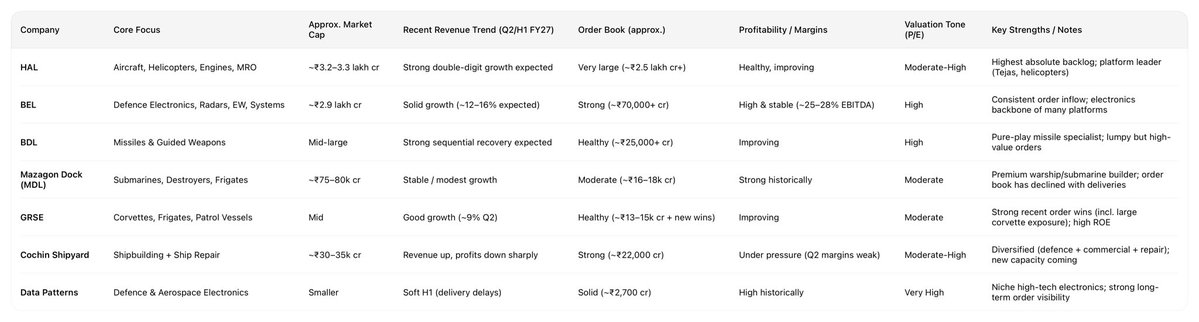
• HAL — Best combination of scale, order visibility and strategic importance. Preferred large-cap anchor for many.
• BEL — Most consistent compounder in the sector with high margins and broad electronics exposure.
• Shipbuilders (MDL, GRSE, Cochin) — Differentiated by vessel type and repair exposure. GRSE currently shows better near-term momentum; Cochin has repair optionality but recent margin compression.
• BDL — High-value missile pure-play; more lumpy results.
• Data Patterns — Smaller, higher-growth, higher-valuation technology play focused on electronics and systems.
Overall Sector Context: The Indian defence sector is in a multi-year execution + order-inflow phase supported by indigenisation, rising capex and large pending programmes. Large PSUs (HAL, BEL) offer relative stability, while mid-sized and pure-play names offer higher growth (and higher volatility/valuation).
Qualitative Comparison
• Growth: TD Power is currently among the fastest growers in the peer set on a percentage basis, driven by export orders linked to global data-centre and distributed power demand. Larger peers (Siemens, ABB, CG, Hitachi Energy) grow from a much bigger base and have more diversified portfolios.
• Margins: TDPS is competitive/high at ~20% EBITDA, comparable to pure-play specialists like Triveni Turbine and better than broader industrial peers in some periods.
• Business Mix: TDPS is more focused/niche (generators) and export-heavy vs the more domestic + diversified profiles of Siemens, ABB, CG Power and Hitachi Energy. This gives higher cyclicality to global industrial/power capex but also strong operating leverage when demand is favourable.
• Balance Sheet & Execution: TDPS is debt-free with rising cash — a clear positive. Larger peers generally have stronger institutional strength and longer project cycles.
• Valuation: TDPS trades at a premium (high P/E reflecting growth expectations), similar to other high-growth electrical equipment names. Larger diversified peers often command premiums for stability and scale.
Summary Positioning
TD Power Systems stands out as a high-growth, export-oriented generator specialist with improving margins and a clean balance sheet. It is smaller and more focused than Siemens, ABB, CG Power or Hitachi Energy, making it higher-beta to global industrial and data-centre related demand. Compared with Triveni Turbine (closest pure-play peer), TDPS currently shows stronger top-line momentum.
TD Power Systems vs Peers – Comparison (as of mid-November 2026)
TD Power Systems (TDPS) is a mid-sized specialist in AC generators and motors, with strong export orientation (gas engine/turbine generators for data centres, industrial & distributed power, hydro generators, etc.). It is currently in a high-growth phase.
TD Power Systems – Latest Snapshot (Q2 & H1 FY27)
Key strengths: High export share, rising margins, debt-free balance sheet with improving cash, strong demand from global gas engine/turbine OEMs (data centres, oil & gas, industrial) and hydro. Management expects sustained 20–25% annual growth potential.
Peer Comparison Overview
Closest and most relevant peers in the electrical equipment / power generation equipment space:
Summary view vs peers:
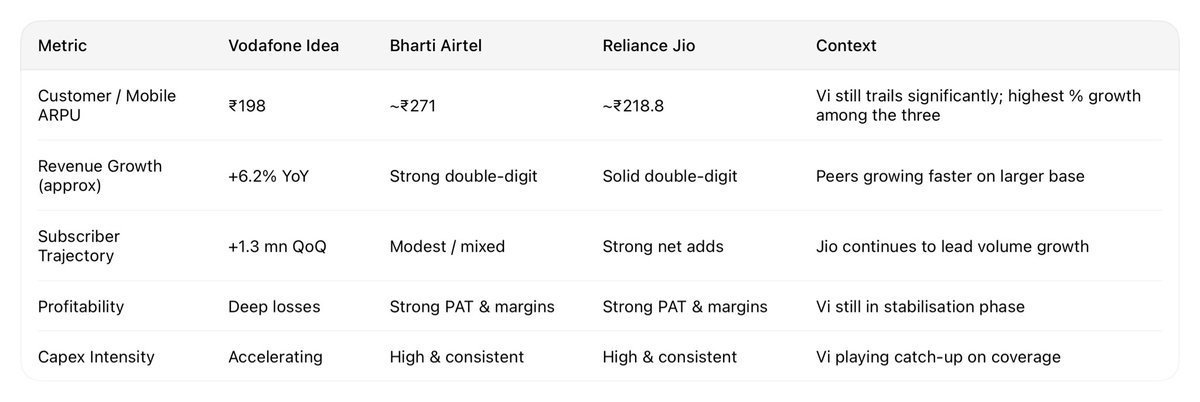
Vi is showing the early signs of stabilisation (positive net adds, industry-leading ARPU growth rate, rising cash EBITDA). However, the absolute gaps in ARPU, scale, profitability, and network quality remain large. Airtel and Jio continue to generate substantial free cash flows and invest aggressively, while Vi’s path depends heavily on closing the remaining funding, executing the large capex plan without major delays, and sustaining the ARPU/subscriber momentum.
Bottom line: Operational metrics are moving in the right direction and management guidance remains focused on network catch-up + cash EBITDA tripling over three years. The stock and equity story remain high-risk/high-reward, centred on successful funding closure and execution rather than near-term profitability.
#Vodafone Concall Highlights & Forward Guidance
Management (CEO Abhijit Kishore and team) described Q2 as steady progress on priorities:
• Network & Capex: Capex orders now exceed ₹13,200 cr (nearly ₹6,000 cr already executed). Part of the three-year ₹45,000 cr investment plan focused on 4G densification (targeting >95% population coverage in priority circles) and 5G expansion. Highest quarterly broadband tower additions in nine quarters.
• Funding: Secured additional ~₹4,000 cr in Q2, taking cumulative funding raised to ~₹10,500 cr (warrants + fund/non-fund facilities). Discussions with banks (SBI-led consortium) for the larger facility continue and are described as progressing.
• Subscribers & ARPU: Net additions positive for the second consecutive quarter. ARPU growth expected to continue via upgrades and better network experience. Focus on postpaid and differentiated propositions (e.g., family plans, international roaming).
• Longer-term outlook (reiterated from prior commentary): Aim to triple cash EBITDA in three years from FY26 base (~₹9,200 cr), supported by revenue CAGR in the mid-to-high teens (~16–17%). FY27 positioned as the “year of execution” on network, funding closure, and operational turnaround.
• Balance sheet: Management expressed confidence in meeting near-term spectrum and AGR instalments from operating cash flows + available liquidity. Deferred spectrum obligations remain very large (~₹1.3 lakh cr range).
Overall tone: Constructive on operational traction and network momentum, but realistic that full competitive parity and profitability still require successful large-scale funding and sustained execution.
Peer Comparison (Q2 FY27)
#idea #telecom #airtel #jio
#Hitachi Energy India (#powerindia ) – Forward Guidance / Outlook (from Q2 FY27 results & concall)
Key Points from Management
Management (CEO N Venu & team) did not provide explicit numerical guidance for H2 FY27 or full-year FY27 revenue, PAT, or margins. This is consistent with their usual approach.
Directional commentary was clearly positive:
• Strong multi-year visibility: Record order backlog of ₹33,335 crore provides revenue visibility for several quarters.
• Demand drivers remain robust: Continued tailwinds from India’s power sector investments, transmission grid expansion, renewable energy integration, data centres, HVDC projects, and industrial electrification.
• Execution focus: Emphasis on disciplined order execution and operational excellence to convert the large backlog efficiently.
• Margins: Operational EBITDA margin printed at 16.5%. Management has previously guided to “sustain and improve” double-digit margins. They highlighted better execution as a key support.
• Capacity expansion: Ongoing investments (Karjan large power transformer facility, Savli HV/GIS, Mysuru, Chennai HVDC/power electronics, etc.). Majority of the current expansion cycle is expected to complete by 2028. Capex deployment remains on track.
Common Themes Across Peers
• Robust demand from transmission grid build-out, renewables integration, and data centres.
• Large order books providing multi-quarter (or multi-year) revenue visibility.
• Capacity expansion ongoing industry-wide.
• Margin outcomes differ: some (GVT&D, CG Power, Hitachi Op.) showing resilience/expansion; Siemens more impacted by commodities/FX.
Hitachi stands out with the highest growth rates this quarter and a very strong backlog, while operating in a similar favourable demand environment as peers.
Every Saturday and Sunday … War handles are fully active … Iran & USA … So many AI generated clips, small incidents are amplified just to get X views. Hey @grok can you tell me the handles which post most fake news about war
@grok@nytimes@WSJ@elonmusk On one hand Pakistan Govt is acting as key mediator and on the other hands
a coordinated fake news war mongering propaganda is being run from Pakistan. What does it imply.. ?