India's First & Most Extensive Data Journalism Initiative. Hard Numbers, Investigations, Insights & News You Won't Find Elsewhere. Quiz with us @indiafactquiz
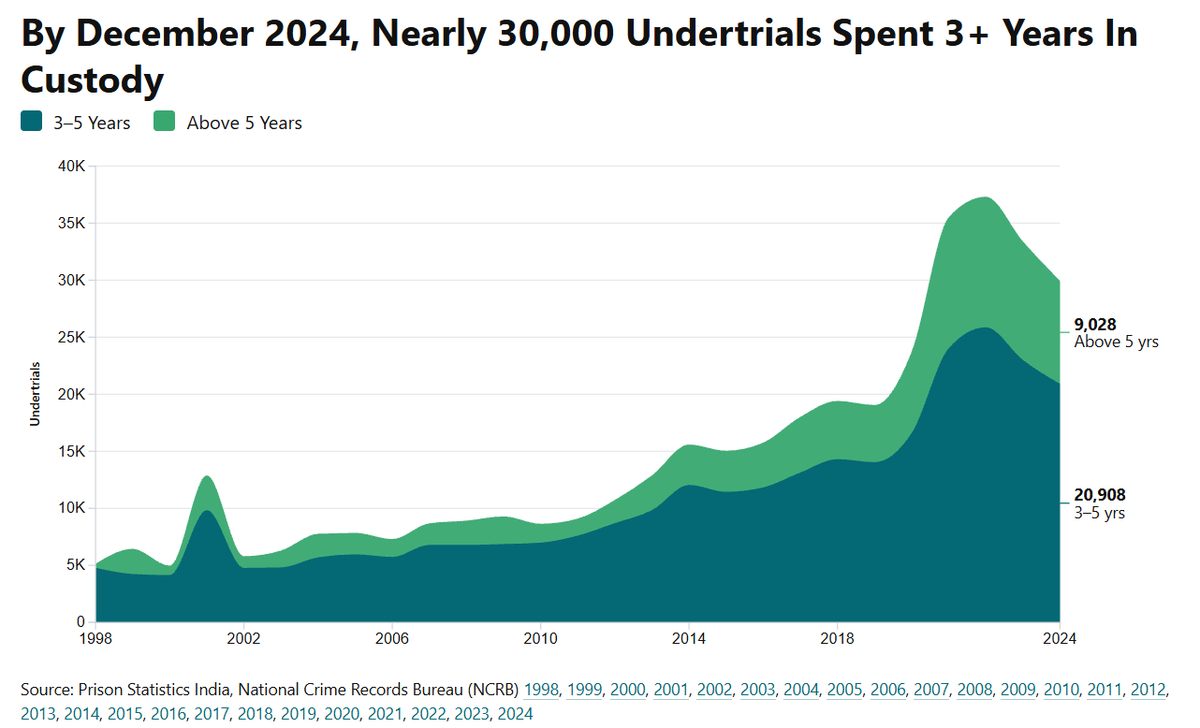
By December 2024, ~30,000 prisoners had spent 3+ years in #prison without a conviction. Of these, more than 9,000 had spent over five years. @Vijay__Jadhav analyses India’s prisons data: https://t.co/vnB4XCP1il
The average Indian prisoner awaiting trial is young and has low levels of education. About 63% of undertrial prisoners did not study beyond grade X. Nearly half of all #undertrial#prisoners are under the age of 30. Our analysis: https://t.co/vnB4XCOtsN
In 2024, 2 in 3 undertrial #prisoners belonged to SC, ST & OBC communities. Another 26% were Muslim, Sikh or Christian. Maharashtra, Delhi, Karnataka, Uttarakhand, Himachal & Arunachal did not provide caste data.@Vijay__Jadhav analyses India’s prisons data https://t.co/vnB4XCOtsN
Undertrials accounted for 72.6% of India's #prison population in 2024, up from 66.2% in 2005. Only 7 countries have a higher share of pre-trial detention than India. Our analysis: https://t.co/vnB4XCOtsN
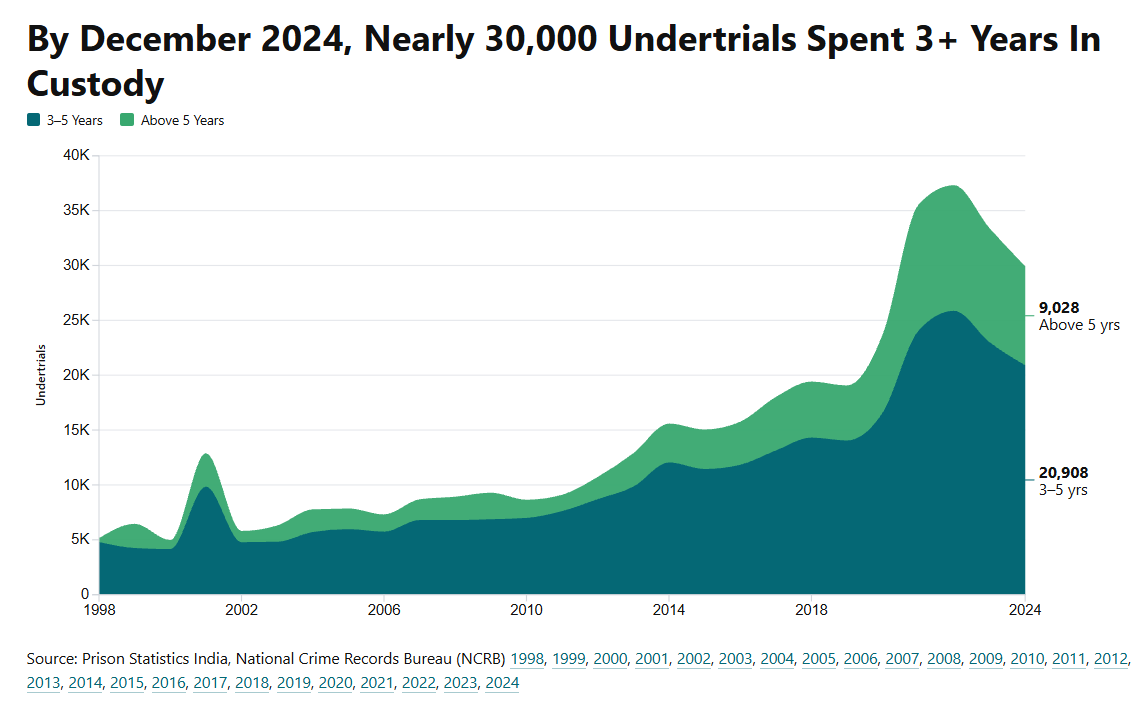
By December 2024, ~30,000 prisoners had spent 3+ years in prison without a conviction. Of these, more than 9,000 had spent over five years. @Vijay__Jadhav analyses India’s prisons data: https://t.co/vnB4XCP1il
Census 2011 shows India's median migrant is a woman moving for marriage. With new census, whether that remains or work-related #migration has taken over would be important to check, says Tamoghna Halder, co-author, @working_india report. Our interview: https://t.co/9R0c9RuPXD
India's informal migrants are more educated than ever—but more educated workers stay closer to home while less-educated ones travel the farthest. @madhavapeddik speaks with Tamoghna Halder of @azimpremjiuniv and co-author, @working_india report https://t.co/9R0c9RuPXD
Caste+village networks shape where India's migrants seek work. "Even though patterns geographically may appear similar to other countries, the underlying structures driving it are different," says Tamoghna Halder, co-author, @working_india report. Interview: https://t.co/ghxrUHEEAU
Eastern zone #migrants with lower #education travel long distances, showing up as dominant source of workers in districts far from their origin states. Northern migrants stay more contained within northern belt. Interview with Tamoghna Halder @azimpremjiuniv https://t.co/ghxrUHEEAU
Migrant workers from Jharkhand move north; from Bengal move south, notably to Kerala. "These routes reflect long-standing social networks that have built the infrastructure of information, contacts & trust," says Tamoghna Halder @azimpremjiuniv. Interview: https://t.co/9R0c9RuPXD
Nearly 2 in 5 informal #migrants are under 30, far younger than the overall unorganised workforce. "Unorganised sector migration is disproportionately a young person's experience," Tamoghna Halder @azimpremjiuniv tells @madhavapeddik. Our interview: https://t.co/9R0c9RuPXD
India's ageing, richer states are absorbing surplus labour from its younger, poorer ones. "The demographic dividend, in part, is being spatially rebalanced through the movement of informal workers," says Tamoghna Halder @azimpremjiuniv. Our interview: https://t.co/9R0c9Rui85
Young informal workers find jobs in education, healthcare, electronics; older ones in construction, agri, domestic work. Tamoghna Halder @azimpremjiuniv ascribes this to higher education levels in this interview with @madhavapeddik: https://t.co/9R0c9Rui85
Census 2011 shows India's median migrant is a woman moving for marriage. With new census, whether that remains or work-related #migration has taken over would be important to check, says Tamoghna Halder, co-author, @working_india report. Our interview: https://t.co/9R0c9Rui85
India's informal #migrants are more educated than ever—but more educated workers stay closer to home while less-educated ones travel the farthest. @madhavapeddik speaks with Tamoghna Halder of @azimpremjiuniv and co-author, @working_india report https://t.co/9R0c9RuPXD
Caste+village networks shape where India's #migrants seek work. "Even though patterns geographically may appear similar to other countries, the underlying structures driving it are different," says Tamoghna Halder, co-author, @working_india report. Interview: https://t.co/ghxrUHEEAU
The poorest 20% of Indian households spend up to Rs 12,000-18,000 per month. If a family member needs hospitalisation, they spend about Rs 25,000 on average out-of-pocket, new data show, forcing families to borrow or sell assets https://t.co/FIcW3Ty63o
Out-of-pocket spending per hospitalisation in Indian cities can range from about Rs 6,000 in govt hospitals to Rs 55,000 in private hospitals. For the poorest families, this could mean debt, asset sales or cutting down on other spending https://t.co/FIcW3Ty63o
Out-of-pocket expenditure (OOPE) accounts for 49.9% of India’s total health spending. Among BRICS members, only Egypt has a higher OOPE. This is even as 60% Indian households report that at least 1 member has health #insurance. @PrachiSalve11 explains why: https://t.co/FIcW3Ty63o