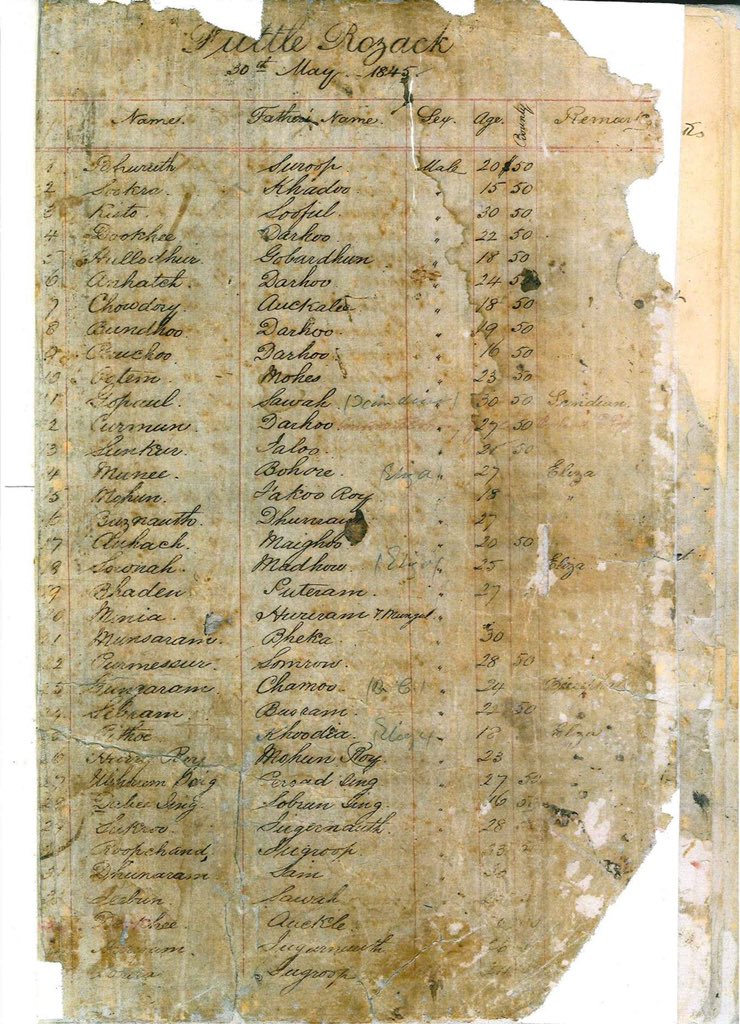
“These records list the 225 adult Indian indentured labourers who, on this very day 176 years ago, were nearing their final destination. Aboard the Fatel Razack (meaning ‘Victory of Allah the Provider’ in Arabic), they would ‘arrive’ in Trinidad and Tobago on May 30th, 1845.”
On May 24, join our first webinar with special guest @cutlasspodcast as we discuss Indo-Caribbean heritage and culture, register here: https://t.co/l9ye7A87mj
“Relatively little is written about Indian indentureship, much of it inaccessible to the general public. Poor record-keeping and colonial documentation have resulted in an unreliable narration of the history and culture.”
“After being transferred to an isolated camp on the island of Yamuna Lailai, the girmityas were finally released from quarantine on August 15th only to be sent to the plantations to fulfill their contracts.”
“Soon after the Leonidas departed the Calcutta Port in West Bengal on January 28th, 1879, the 498 total passengers were exposed to outbreaks of smallpox, cholera, and dysentery, claiming two dozen lives. The Leonidas was barred from docking and quarantined out in the harbour.”
“‘Girmit,’ a corruption of the English word 'agreement,' came to define the name of this day as well as the contracted workers (‘girmitiya’). The three and a half month long maiden voyage foreshadowed the brutality of indentureship.”
“The Protector of Immigrants, a colonial officer, stated in 1915: ‘The tendency of Immigrants who have completed their indenture to leave the country parts and engage in casual work in Kingston, is prejudicial and should be discouraged.’”
“Of the 37,000 who came to Jamaica between 1845 and 1916, from the shipping ports of Calcutta and Madras, nearly 12,000 repatriated home. Close to 62 percent remained on the island due to restrictions placed on return passage and incentives offered to entice them into staying.”
“Every East Indian was expected to live in Jamaica for a minimum of ten years. As the indentureship contract lasted for five years, they had the option to re-indenture for another term or to work as free labourers for five years in order to meet this requirement.”
“What’s her name?” Priyanka! 📣
Priyanka is the Season 1 winner of Canada's Drag Race.
Of Indo-Guyanese descent, Priyanka showcased her heritage through her drag. She is proud to have grown up Hindu and Indo-Caribbean and is proud to be Canadian.
#AsianHeritageMonth
I will be presenting and speaking on a panel at @QPLNYC (Queens Public Library) this Friday, May 7th, at 2pm EST! You can watch via Facebook live from their account or on their YouTube Channel: https://t.co/ktKHWNzzUG
The Caribbean Network is a non-profit focused on expressing innovation, education, and empowerment in the Caribbean community.
Currently they are creating an online directory to better support local Caribbean businesses #CommunityServiceSunday#Toronto
May is South Asian Heritage Month, in which we celebrate the history of Canadians of South Asian descent.
This month serves as an opportunity to learn about the many contributions made by the community in our city.
#IndianArrivalDay#Grenada
Between 1857-1885, 3,200 Indian immigrants arrived in Grenada.
May 1 marks the day that the “Maidstone” arrived in Gouyave Bay with Indian indentured labourers.
Today, the Indo-Grenadian community continues to make important community contributions.
Check out our daily feature posts about Indo-Caribbean Canadian history, culture, and contributions!
We will be featuring Indo-Caribbean Canadian culture and history by highlighting our foods, talent, businesses, fashion, community service, and heritage!
#ShareOurStorySaturday
Many South Asians who arrived in Canada came from communities established in former British colonies throughout the Caribbean.
South Asian Heritage month is an opportunity to showcase Indo-Caribbean contributions, achievements, and culture in Canada.